later12 wrote: » Read the thread.
General scepticism towards the European Union is another issue entirely
trendyvicar wrote: » Why do Irish posters like The Guardian so much? It's practically the only UK paper quoted on Irish forums. It's a figure of ridicule in The UK.
The Corinthian wrote: » I have and I disagree with you. While triggered by current affairs the question for discussion is clearly not tied to those and this was reflected in the responses almost immediately - indeed, read the title of the thread. It's another issue if we redefine the debate according to your definition.
later12 wrote: » In fairness I'm not expecting you to come out of whatever trench you're sitting in so lets leave it there shall we.
Latchy wrote: » The British have never taken kindly to the EU ( Brussels ) telling them how to do things ie, '' your pastries should be 2 metres shorter then they are'' and they sure as hell don't like the Europen court of human rights blocking every move they make with regards to immigrant control and getting shot of the likes of Abu Qatada .
BettyM wrote: » I am not sure what the point of this thread is. Just because the UK, for example, forsaw the problems with the Euro and decided not to join it doesn't mean they are anti-EU. They are anti bad decisions, and it seems they must be rejoicing daily at their correct decision to have nothing to do with the Euro.
McDave wrote: » The UK may as well have decided to stay out of the EEC. Their reasons for joining seem at best to have been ambivalent. But from the POV of the continental EU drivers, at every hand's turn the UK has played an essentially obstructionist role.
McDave wrote: » When the original EEC was being considered the UK was invited to participate. In the event, the UK set up an alternative arrangement with Austria and some Scandinavian countries - EFTA. As the EEC became more successful, enthusiasm for EFTA dwindled. Key members including the UK jumped ship, but not until after finally overcoming French objections. Despite the clause on 'ever closer union' the UK has pretty much objected to most further developments of the EEC-EC-EU. With the fall of the Iron Curtain, Thatcher took the opportunity to push for a rapid widening of membership, with the intention of diluting the EU. France and Germany had to settle for a deal on parallel 'deepening' of competences which resulted in the notoriously half-assed Maastricht criteria. When Bush decided to invade Iraq, Blair lost an opportunity to coordinate foreign policy with the likes of Germany and France, and showed Britain's true leanings by sticking with the 'special relationship' over EU relations. Then we had David Cameron's refusal to back the idea of a fiscal compact within the EU treaties. The UK may as well have decided to stay out of the EEC. Their reasons for joining seem at best to have been ambivalent. But from the POV of the continental EU drivers, at every hand's turn the UK has played an essentially obstructionist role. The outcome has been the Lisbon treaty with its establishment of a framework for common policies which only require a core of participation. I think if you look back over the history of the EU, it's fairly plain to see that the UK is still primarily motivated by its age old policy of divide and conquer the continental powers. The main problem is that this is a primarily negative policy. Whether one accepts or not that the UK is anti-EU/Europe, that's the perception, and the EU has evolved new rules to deal with obstructionism.
BettyM wrote: » To be fair theh UK was missold the EU by Ted Heath who hid from then the objectives of political and economic union. Had this been spelled out by Heath, he thought it likely the UK would not vote to join what was called the "common market". Even the name "Common Market" was intended to deceive.
Certainly the UK are more sceptical than the Irish, although the only intelligent position to take is to be sceptical, to take each issue on its merits, and make a decision.
On the Euro, for example, the UK decided not to join for what have been since proved to have been sound and valid economic arguments. Ireland, by contrast, decided to join the Euro out of a sort of political loyalty and decided to ignroe the economic or other arguments. The price of that decision has all but destroyed Ireland.
In the UK, were it voting on the same issue, the argument would be about giving up soverignty to unelected officials, and the short term financial problems would be seen for what they are - short term.
Certainly the UK takes a more sceptical look at what the EU proposes, and if only Ireland had done the same then it is a virtual certainty that Ireland would not be in the problems it is in today.
Perhaps many of the attitudes in Ireland stem from the attitude that anything "D'Inglish" do must be bad, but the evidence seems to suggest, on the EU, they seem to have outsmarted the irish, who have sold their souls to the EU for a price which has yet to be calculated or realised.
golden lane wrote: » the ordinary person in the street is mostly against it...............they think they have lost control of their everyday life and their future........... and are paying too high a price to be a member.........
The Corinthian wrote: » What price are they paying to be a member exactly that is too high, where "they have lost control of their everyday life"? I don't mean simply some future fear of a United States of Europe, but given you've framed this loss in the present tense, you must be able to point to some fundamental loss of control. Because from what I can see, most if not all of the controls on British "everyday life" (loss of privacy, lack of freedom of information, increased surveillance, etc) are coming from Westminster, not Brussels.
golden lane wrote: » read what i said............ and don't reply with an anti british diatribe........please
The Corinthian wrote: » That is factually completely false. One may argue that membership of the Euro precluded our use of monetary tools, but Ireland's woes do not actually stem from the Euro and it is delusional to suggest they do. Ireland was hit by a double whammy; a property bubble that would have plunged us into recession regardless if we were buying overvalued houses in Euro or Punt and a credit crisis that has affected the whole World. Membership of the Euro in many respects is irrelevant because its going to effect Britain too despite it not being in the Euro. So what you are arguing is completely false. .
The Corinthian wrote: » Unfortunately the debate would be quickly coloured by xenophobic rhetoric, regardless of short or long term considerations. I was having a beer and watching the match with an Englishman yesterday evening and he confessed to me when Bayern-Munich lost to Chelsea that one gets a little bit of of pleasure still from seeing the Germans suffer. And while most nations have their pet dislikes of others, it is far more stark and all encompassing in Britain. Wherever this originated historically in the British psyche, the reality is that it is there, it is engrained and it is likely to determine every policy that Britain will have with the rest of Europe, just as has in the past. Which of course is nonsense, as I've already pointed out. The only possible argument might be that control of monetary policy may have alleviated much of the pain, but in reality this is very, very doubtful. In many other cases, I would likely agree with you, but not here. It is simply that Ireland does not have the same degree of 'little islander' mentality that is prevalent in Britain. Indeed, I find it ironic that you would ignore this part of the British identity and paint her reasoning as some form of objective scepticism, while accusing others of being ruled by their prejudices. Ah sure, we're only drunk little Paddies anyway...
BettyM wrote: » If Ireland had the Punt, the Irish government could, and in the pasts governemnts frequently did, use interest rates to make a correction early on. It was the fact that the interest rates were kept so low for so long ( which was outside irealnds control) coupled with an influx of Euros from French and German banks, which was the catalyst which fuelled the property bubble.
I am not really qualified to judge which country has the greater "little islander" mentality, and even if I was its of little relevance to the argument. As someone who lives in both the UK and Ireland, I judge both countries have a wide spectrum of opinions, and I also recognise there is a thread which runs through Ireland about "D'inglish". Personally, I love both countries and feel privilaged to live in both.
mike65 wrote: » If the British are Anti Europe its because of things like Greece and the Euro, everyone knew and they looked the other way as it didn't suit the politics of the project.
The Corinthian wrote: » If Ireland had the Punt, the Irish government could, and in the pasts governemnts frequently did, use interest rates to make a correction early on - but we wouldn't have. Why? Because we still had fiscal tools to make a correction too and we didn't use them either, so ultimately it made no difference if we were in the Euro or not.
The Corinthian wrote: » I Yet while you can recognise a thread which runs through Ireland about "D'inglish" yet are completely blind to a thread which runs through Britian about "Europeans", despite it being well documented even in popular media: I don't remember ever seeing anything like this with regards to "D'inglish" in the Irish media - do you? Yet somehow for you British attitudes are rationally sceptical and Irish ones are instead tainted by prejudice. Go figure.
BettyM wrote: » If you really believe that it made no difference that Ireland were in the Euro, then we disagree. I don't understand the argument that the irish government in the past had very snesibly used interest rates to head off this problem, but if they had the punt this time they would not have used interest rates.
I prefer to deal in facts and not in speculation, and the fact is that the tool used by governments all over the world to head off this very problem, and used by Irish governments in the past, was not available to be used.
I am not interested in entering some sort of competition to see which of us can come up with more and more examples.
Of course there are elements in the UK who are more extreme than others, just as there are in Ireland.
For me, I am very glad that the UK did not enter the disaster which the Euro has become, as I earn part of my income in sterling. I judge that it's better to be sceptical and judge each issue on its merits, rather than being "pro-european" especially if that means that logic and sense must be cast asid, and the issue ben seen almost as an article or faith as it was in the case of joining the Euro, the results of which can be seen today.
The Corinthian wrote: » So why were they anti-Europe before Greece and the Euro?
BettyM wrote: » If you really believe that it made no difference that Ireland were in the Euro, then we disagree. I don't understand the argument that the irish government in the past had very snesibly used interest rates to head off this problem, but if they had the punt this time they would not have used interest rates. I prefer to deal in facts and not in speculation, and the fact is that the tool used by governments all over the world to head off this very problem, and used by Irish governments in the past, was not available to be used.
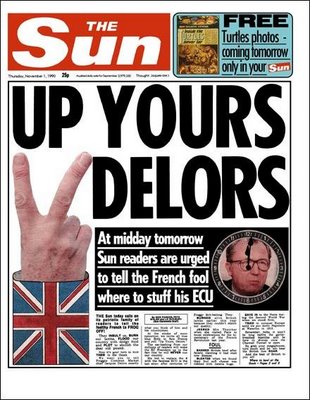
BettyM wrote: » I am not interested in entering some sort of competition to see which of us can come up with more and more examples. Of course there are elements in the UK who are more extreme than others, just as there are in Ireland. If you think the Sun Newspaper is representative of the British people as a whole, then thats a judgment you'll have to make up your own mind on. For me, I am very glad that the UK did not enter the disaster which the Euro has become, as I earn part of my income in sterling. I judge that it's better to be sceptical and judge each issue on its merits, rather than being "pro-european" especially if that means that logic and sense must be cast asid, and the issue ben seen almost as an article or faith as it was in the case of joining the Euro, the results of which can be seen today.
steve9859 wrote: » Why does it bother you so much that the English are, in your view, 'anti Europe'? I don't see why the English not wanting to be part of the party should upset anyone in Ireland....
The Corinthian wrote: » The point is they still had numerous fiscal means to "head off this problem" and didn't - indeed Ahern famously derided those prophets of doom who even suggested there was a problem to head off. As such, even had the government monetary tools to employ, it is clear it would not have done so, just as it did not with the fiscal ones. But you are dealing in speculation - that they would have used this tool. The facts point to the Irish government having no interest at the time in doing so, thus your theory simply does not stand up to examination. Fine then, no one need back up their opinions then for fear that it would become a 'competition'... Are they in the mainstream then? If so, let us know where? Which newspapaer or publication? Yet ironically, that is precisely what you're doing but with the opposite conclusions.
BettyM wrote: » It is not a theory that Ireland gave away its ability to control its own interest rates, and has lost the ability to use this key measure to prevent the enormous building boom and consequent economic destruction.
BettyM wrote: » I'm afraid I have to agree when I observe that political leadership in ireland has been lamentable, and in the past 20 years or so the politicians ceased to care and just became actors, playing out a role but having no ideas or policies other than the policy to get themselves reelected at the next election.
The key policy to stop over lending and over borrowing is control over the interest rate being charged. The fact is that Ireland gave up control over its own interest rates.
It is not a theory that Ireland gave away its ability to control its own interest rates, and has lost the ability to use this key measure to prevent the enormous building boom and consequent economic destruction.