Advertisement
Help Keep Boards Alive. Support us by going ad free today. See here: https://subscriptions.boards.ie/.
https://www.boards.ie/group/1878-subscribers-forum

Private Group for paid up members of Boards.ie. Join the club.
Hi all, please see this major site announcement: https://www.boards.ie/discussion/2058427594/boards-ie-2026

Cutting firewood solo

2

Comments

  • Registered Users, Registered Users 2 Posts: 33 eatmedrinkme


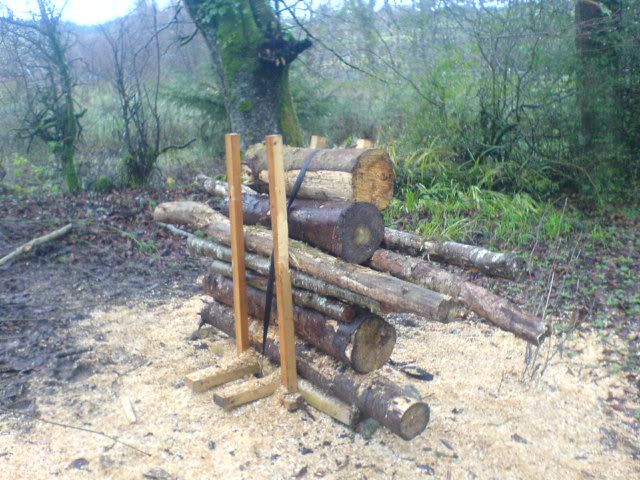
    Finally got it sorted. Built a portable timber horse, capable of being multistacked, and ratheted in the centre. Does 8 to 10 medium logs in minutes, with my 2hp Husqvarna, and a 14 inch bar, and can handle vary length and diameter logs. Small enough to be used in the forest too, which could save a little cleaning.

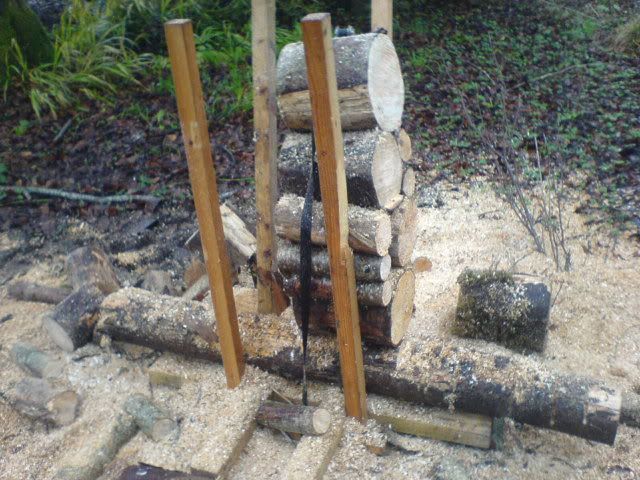
    It's basically a set of four 2x2 uprights, which stick into the ground, with a 2x4 base two plank base, with two 2x4 set horizontally a bit apart. Got all of next years firewood logged to stove size in two half days.

    Will post pictures when I get them hosted.


  • Registered Users, Registered Users 2 Posts: 33 eatmedrinkme


    Fullstack.jpg


    Cutstack.jpg

    Next time, I'd make stronger, taller uprights, with bracing at the top to stop em spreading, I'm make three sets of uprights, with the ratchet strap goiug through a very narrow set, to avoid having to cut close to the strap, and trim the excess strp off the ratchet - it's dodgy to use in wind, even when the excess is tied off. I'll make solid legs, and croiss brace them underneath, probably a tripod, and use it on concrete ( and reserve this one for forest use). The sacrifice log at the bottom works well. The w crosspieces have logs under them to help stability, but the stability on this isn't perfect, because the sharpened legs heel over even though they are buried.


  • Closed Accounts Posts: 521 ✭✭✭Atilathehun


  • Moderators, Science, Health & Environment Moderators Posts: 5,231 Mod ✭✭✭✭slowburner


    Next time, I'd make stronger, taller uprights, with bracing at the top to stop em spreading, I'm make three sets of uprights, with the ratchet strap goiug through a very narrow set, to avoid having to cut close to the strap, and trim the excess strp off the ratchet - it's dodgy to use in wind, even when the excess is tied off. I'll make solid legs, and croiss brace them underneath, probably a tripod, and use it on concrete ( and reserve this one for forest use). The sacrifice log at the bottom works well. The w crosspieces have logs under them to help stability, but the stability on this isn't perfect, because the sharpened legs heel over even though they are buried.
    If you could mortice and tenon the uprights into the bottom rails for sawhorse #2, you'd be on the pig's back.
    It's one of those things you have to make and try out, to see how to develop the concept.


  • Registered Users, Registered Users 2 Posts: 979 ✭✭✭newman10


  • Advertisement
  • Registered Users, Registered Users 2 Posts: 33 eatmedrinkme


    slowburner wrote: »
    If you could mortice and tenon the uprights into the bottom rails for sawhorse #2, you'd be on the pig's back.
    It's one of those things you have to make and try out, to see how to develop the concept.

    That is probably the plan. If I can be unlazy enough to hack out the mortice and tenons. Long term a greenwood versin would be good. Next up, a tyre mounted on a chopping block to minimise bending down, and a car jack homemade log splitter.


  • Registered Users, Registered Users 2 Posts: 307 ✭✭Askim


    nice looking cheap holder, built a 4 leg version, for small diameter sticks, worked really well.

    if you bolt a 4x2 across it, about 1' up should stop it spreading & you won't need a log on the bottom, it will fit less in but it will be off the ground.

    A


  • Registered Users, Registered Users 2 Posts: 33 eatmedrinkme


    Askim wrote: »
    nice looking cheap holder, built a 4 leg version, for small diameter sticks, worked really well.

    if you bolt a 4x2 across it, about 1' up should stop it spreading & you won't need a log on the bottom, it will fit less in but it will be off the ground.

    A

    Thanks Askim. I think I'll build an elevated one to a differenbt design I saw recently. Mightn't do it till the autumn.

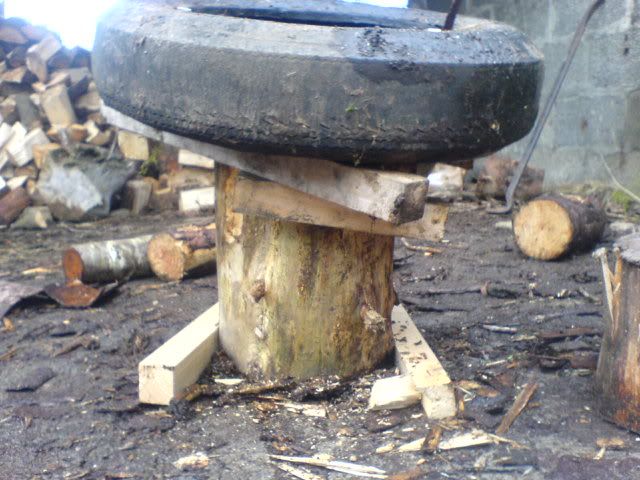
    I built this Tyrestand.jpg

    to make spiltting easire. 3 pieves of three by two screwed to the top of a splitting log, with a tyre srewed in to the top. Legs on the bottom to aid stability - which really help, and 2x2 braces screwed in at eah of the frame angles.

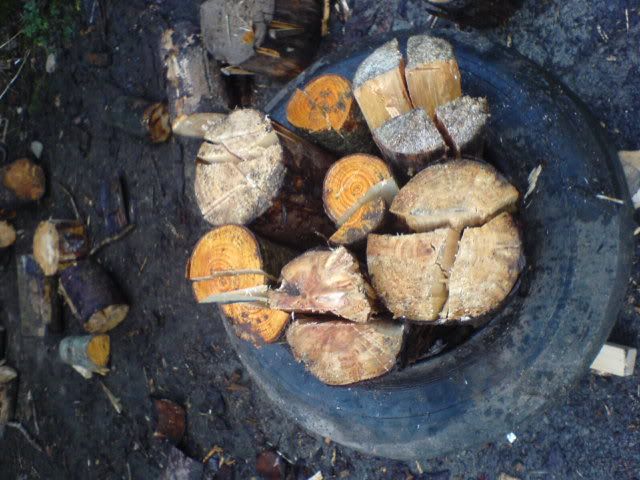
    Here's the topside view

    SplitLogs.jpg

    Mucj less bending, as you can do several splits on one log without needing to bend down at all.

    It's necessary to make sure there's a snug fit, so I keep a couple of small logs on hand to jam in, and reuse. Otherwise the whole shebang can fall apart. It's saving me about 90 per cent of the bending I'd do with a more conventional setup.

    Pros: faster work, easier to split knotty pieces ( no resetting after the first whack), easier to split into smaller pieces, and my back feels a lot better afer four hours of splitting.

    Next time, I'd choose a new or seasoned piece of hardwood - this is a spruce log that's already crumbling. You need to set the trye so that most of it is above the log too, otherwise logs can easily pop ot. And make sure everything is straight.


  • Registered Users, Registered Users 2 Posts: 307 ✭✭Askim


    that looks a simple& handy design, must make one, before you get your patent filed

    my only question is, does the tyre have to be that bald :):)

    was thinking, could you attach the stick holder to a front loader, as your cutting the cut ones start to pile up, just lift up the loader, drive back a few feet & off you go again, standing on level ground,

    or maybe some kind of floor around it, cut 2 goes, lift the whole lot up & tip into a trailer???? maybe 2" weld mesh with angle supports & pin the whole lot to dung forks
    would only work for ones that are not being split

    A


  • Moderators, Science, Health & Environment Moderators Posts: 5,231 Mod ✭✭✭✭slowburner


    Cracking idea ('scuse the pun) eatmedrinkme.
    I can see how it would save your back but is getting the split logs out of the tyre not a slower process then letting them build up to either side of the chopping block?


  • Advertisement
  • Registered Users, Registered Users 2 Posts: 33 eatmedrinkme


    slowburner wrote: »
    Cracking idea ('scuse the pun) eatmedrinkme.
    I can see how it would save your back but is getting the split logs out of the tyre not a slower process then letting them build up to either side of the chopping block?

    Well, I tend to get my feet caught up in odd blocks, so I like a clear splitting space. Getting them out of the tyre, as long as I haven't wedged them in too much to begin with, is really easy. I pick them out with little or no force and chuck em on the pile.

    And I only wedge them in because my block and angles are too wonky. On the next one, that's straight, I won't have to.

    For me, it's my back that gives out and halts the work, after, say, one and a half hours of spruce splitting. With this setup, I can work until I'm tired - say three and a half hours - and my back is ok.


  • Registered Users, Registered Users 2 Posts: 33 eatmedrinkme


    Askim wrote: »
    that looks a simple& handy design, must make one, before you get your patent filed

    my only question is, does the tyre have to be that bald :):)

    was thinking, could you attach the stick holder to a front loader, as your cutting the cut ones start to pile up, just lift up the loader, drive back a few feet & off you go again, standing on level ground,

    or maybe some kind of floor around it, cut 2 goes, lift the whole lot up & tip into a trailer???? maybe 2" weld mesh with angle supports & pin the whole lot to dung forks
    would only work for ones that are not being split

    A
    Askim, if I had a front loader, and knew how to use it, I'd experiment. Longer term, I like your thinking. The quicker and more efficient, the better. But I don't have the machinery, or the need for it yet.

    If I get time this summer, I might build a solar dryer - basically a small woodshed, with tarpp doorway, and clear plastic walls and roof. I'd use it as a cold frame in winter, because of the condensation issue ( cheers slowburner -I think - for warning me of that). In a good summer, it should get wood dry hyper fast. Anyone any ideas for how to effectively measure moisture loss?


  • Closed Accounts Posts: 10,271 ✭✭✭✭johngalway


    Askim, if I had a front loader, and knew how to use it, I'd experiment. Longer term, I like your thinking. The quicker and more efficient, the better. But I don't have the machinery, or the need for it yet.

    If I get time this summer, I might build a solar dryer - basically a small woodshed, with tarpp doorway, and clear plastic walls and roof. I'd use it as a cold frame in winter, because of the condensation issue ( cheers slowburner -I think - for warning me of that). In a good summer, it should get wood dry hyper fast. Anyone any ideas for how to effectively measure moisture loss?

    Seen a photo the last night of someone using a poly tunnel to dry wood. Not such a big job to make your own, fitting the plastic seems to be the toughest bit.


  • Moderators, Science, Health & Environment Moderators Posts: 5,231 Mod ✭✭✭✭slowburner


    Askim, if I had a front loader, and knew how to use it, I'd experiment. Longer term, I like your thinking. The quicker and more efficient, the better. But I don't have the machinery, or the need for it yet.

    If I get time this summer, I might build a solar dryer - basically a small woodshed, with tarpp doorway, and clear plastic walls and roof. I'd use it as a cold frame in winter, because of the condensation issue ( cheers slowburner -I think - for warning me of that). In a good summer, it should get wood dry hyper fast. Anyone any ideas for how to effectively measure moisture loss?
    Only two ways as far as I know.
    Buy a moisture meter - these can range in price from €200 upwards and you need to spend that kind of money for them to be any way effective. Lignomat and Wagner are two well known manufacturers. Moisture meters for under €50 aren't worth a damn. The more reliable ones use pins.
    Weigh a sample piece and record the changes over time. When the wood no longer loses any weight it is at its Equilibrium Moisture Point - that's as dry as it can be relative to its surroundings which is a max of 30% for air dried wood in Ireland.

    I was harvesting firewood the other day. The trees were felled last spring and left out in the open. The wood itself is perfect but the bark is sodden. Apart from being dirty, slimy and a pain to handle, it slows up the whole drying process. I store the wood in a simple, open lean-to for secondary drying. This is fairly effective because by chance, I seemed to have positioned it in a wind tunnel. This is made of corrugated sheet metal fixed to the side of the workshop at a fairly steep pitch. I stuck an underlay of breather membrane between the joists and the roof sheets. No problems with condensation drips.
    But I was thinking.
    All those small branches that we usually leave behind - is there some way these could be burned to dry the main wood, efficiently?


  • Registered Users, Registered Users 2 Posts: 33 eatmedrinkme


    slowburner wrote: »
    Only two ways as far as I know.
    Buy a moisture meter - these can range in price from €200 upwards and you need to spend that kind of money for them to be any way effective. Lignomat and Wagner are two well known manufacturers. Moisture meters for under €50 aren't worth a damn. The more reliable ones use pins.
    Weigh a sample piece and record the changes over time. When the wood no longer loses any weight it is at its Equilibrium Moisture Point - that's as dry as it can be relative to its surroundings which is a max of 30% for air dried wood in Ireland.

    I was harvesting firewood the other day. The trees were felled last spring and left out in the open. The wood itself is perfect but the bark is sodden. Apart from being dirty, slimy and a pain to handle, it slows up the whole drying process. I store the wood in a simple, open lean-to for secondary drying. This is fairly effective because by chance, I seemed to have positioned it in a wind tunnel. This is made of corrugated sheet metal fixed to the side of the workshop at a fairly steep pitch. I stuck an underlay of breather membrane between the joists and the roof sheets. No problems with condensation drips.
    But I was thinking.
    All those small branches that we usually leave behind - is there some way these could be burned to dry the main wood, efficiently?

    Thanks slowburner. Much appreciated.

    Coford's experiments in Ireland gave them circa 20% moisture content after indoor drying, with no kiln aids. Theyt reckon anything belkow 20% would be worthless, as humidity here is often around that, and wood that's untreated will just soak the moisture back up.

    I like your idea of using the smaller stuff. That said, I usually leave it behind to a) heap up around the stumps so they are protected while resprouting, from deer and b) the time taken to bundle and process them seems far more than the time it takes me to fell and strip another ash/alder/spruce pole.

    I like the solar idea because, apart from the initial outlay, it requires zero effort from me. That said, a good method for using the kindling material and brash to give a fast dry could get someone out of a hole if they are behind on their cutting.

    Will research this...


  • Moderators, Science, Health & Environment Moderators Posts: 5,231 Mod ✭✭✭✭slowburner


    ootbitb wrote: »
    That's a sad story and it is always good to have reminder of the devastation a chainsaw can cause.
    I use a single handed saw most of the time but I use it with all due care and I am always mindful of the fact that one lapse in concentration could be fatal.
    I have another big old saw but I actually find the single handed saw is a bit safer to use because of the fact that it is easier to keep your body out of the path of any kickback.
    You can use a single handed saw with two hands if needs be.
    While the small saw lacks the power and cutting capacity of its bigger brothers, it is great for poking into spots where the big saws can't reach - this means you won't need to cut your way in.
    This can make a big saving in fuel, which is an increasingly important consideration these days.


  • Registered Users, Registered Users 2 Posts: 521 ✭✭✭Prowetod


    Any chance of a picture of how you dry the timber, slowburner or anyone else who's having success in drying their wood?


  • Moderators, Science, Health & Environment Moderators Posts: 5,231 Mod ✭✭✭✭slowburner


    Prowetod wrote: »
    Any chance of a picture of how you dry the timber, slowburner or anyone else who's having success in drying their wood?
    I was just throwing out the idea, I haven't tried it myself.


  • Closed Accounts Posts: 1,258 ✭✭✭Tora Bora


    Prowetod wrote: »
    Any chance of a picture of how you dry the timber, slowburner or anyone else who's having success in drying their wood?

    Like this. Gets you in touch with your spiritual side in the process :D
    http://www.motherearthnews.com/multimedia/image-gallery.aspx?id=71972


  • Advertisement
  • Closed Accounts Posts: 631 ✭✭✭ootbitb


    I like this simple one, especially the transporter at the end of the clip.

    http://www.youtube.com/watch?v=dWeQR2Xt7_Q&feature=relmfu


  • Moderators, Science, Health & Environment Moderators Posts: 5,231 Mod ✭✭✭✭slowburner


    ootbitb wrote: »
    I like this simple one, especially the transporter at the end of the clip.

    http://www.youtube.com/watch?v=dWeQR2Xt7_Q&feature=relmfu
    Is it my imagination or does that guy come really close to his feet and legs at the end of each cut?

    He makes a very valid point.
    When you think about the exponential costs of fuel; anything which reduces the amount of time the saw is idling rather than cutting, is worth investing in.


  • Closed Accounts Posts: 10,271 ✭✭✭✭johngalway


    slowburner wrote: »
    Is it my imagination or does that guy come really close to his feet and legs at the end of each cut?

    Yeah, doesn't look the best does it. Perhaps have a sacrifice log under where you put the other logs, just in case.

    Just need a quick and easy way to split the logs now.


  • Registered Users, Registered Users 2 Posts: 125 ✭✭Jack_regan


    My mobile diy solution for moving and cutting logs. It's fairly handy and saves a lot of carrying anyway.


    6783484511_309526323c_z.jpg


    Now ready for stacking in front of the fire!


    6783517967_6c024dc9cc_z.jpg


  • Moderators, Science, Health & Environment Moderators Posts: 5,231 Mod ✭✭✭✭slowburner


    That's a great set up, the sawhorse on wheels/trailer is a brilliant idea.


  • Registered Users, Registered Users 2 Posts: 2,343 ✭✭✭JohnBoy


    So, I finally went and made my sawhorse. Went with a simple X shape for it.

    The Xs are inch box, five foot lengths for the two ends, and four foot in between.


    The whole thing is 45 inches wide I went with 3x15 inch spacing, no real science as to why.


    It folds/lies flat when not in use, this is it just before welding.
    sawhorse1.jpg


    I was trying to figure out how I'd secure/spring the chain as I walked around the co-op shop on saturday morning when I came to the fencing shelf and saw an electric fence gate handle.... A hook, a spring and a handle, all in one simple, cheap package. Perfect!

    This is it with the chain just tied for now, I wanted to use it in prototype mode first before I welded the chain on.
    sawhorse2.jpg

    Takes long lengths:
    sawhorse3.jpg

    Also very handy for awkward ones
    sawhorse6.jpg


    All in all I'm very happy with it. Just needs the chains fixing properly and a lick of paint to call it done.

    around €50 and four hours by the time it's painted.


  • Closed Accounts Posts: 631 ✭✭✭ootbitb


    gl with your horse but keep the file handy:D


  • Closed Accounts Posts: 13,989 ✭✭✭✭recedite


    I'm using one of these;

    http://www.husqvarnachainsaws.co.uk/acatalog/Oregon_easy-cut_saw_horse.html

    Maybe not as heavy duty as the Donegal one mentioned earlier, but very good for the price. Instead of a chain, you press down on the red bar, and it springs the 2 verticals, locking itself against the logs. Grabbing it in the centre, you can can fold it flat and carry it in one hand. Steel is always going to be tough on your chain if you touch it, but the advantage is light weight when moving it around.
    It was also advertised online from a shop in Newry, but I wanted to get a few other bits and pieces from this website.


  • Closed Accounts Posts: 631 ✭✭✭ootbitb


    sorry, another chain wrecker...for me it has to be wood and made for pennies.


  • Advertisement
  • Registered Users, Registered Users 2 Posts: 2,343 ✭✭✭JohnBoy


    I'm curious as to how I'll get on with mine with regard to it being steel. keeping the chain safe was a design consideration alright.

    I think I do better than the oregon design in this regard.

    There's a good 18 inches between the bottom of my timbers and the upper of the two horizontals so I'd want to either drop the saw, or bend down to hit them. I've no need to bend down to cut anything (one of the things I'm happiest about) so I'm safe there.

    That was the one thing that put me off the oregon, you're bending down, and you're working very close to those horizontals.

    The safety chain will be running nice and tight to the second X, it will make it a bit wider, but will be routed better than in the pics, which is basically the prototype stage.


    Vertically I have 14 inches to work in, if I can't keep the saw a safe distance from the steel then I'm not sure I should be using it.

    My only other tweak in this regard is I've currently got dome head bolts, with a nylock nut on them. the dome head fits nice and neat to the box wall but the nylock's a bit big. I'm happy with the design so I'm going to remove the nylocks, clamp the X together and weld a washer on instead, allowing me to create a second dome head basically.

    Other factors for choosing steel were longevity, compactness, and ease of storage.


Advertisement
Advertisement