Advertisement
Help Keep Boards Alive. Support us by going ad free today. See here: https://subscriptions.boards.ie/.
https://www.boards.ie/group/1878-subscribers-forum

Private Group for paid up members of Boards.ie. Join the club.
Hi all, please see this major site announcement: https://www.boards.ie/discussion/2058427594/boards-ie-2026

DVB-I and RTÉ

13

Comments

  • Registered Users, Registered Users 2 Posts: 4,820 ✭✭✭roadmaster


    Is DVB-I just really a fancy EPG?


  • Registered Users, Registered Users 2, Paid Member Posts: 16,493 ✭✭✭✭The Cush


  • Registered Users, Registered Users 2 Posts: 5 DuoLey


    What is a connected epg ?


  • Registered Users, Registered Users 2, Paid Member Posts: 16,493 ✭✭✭✭The Cush


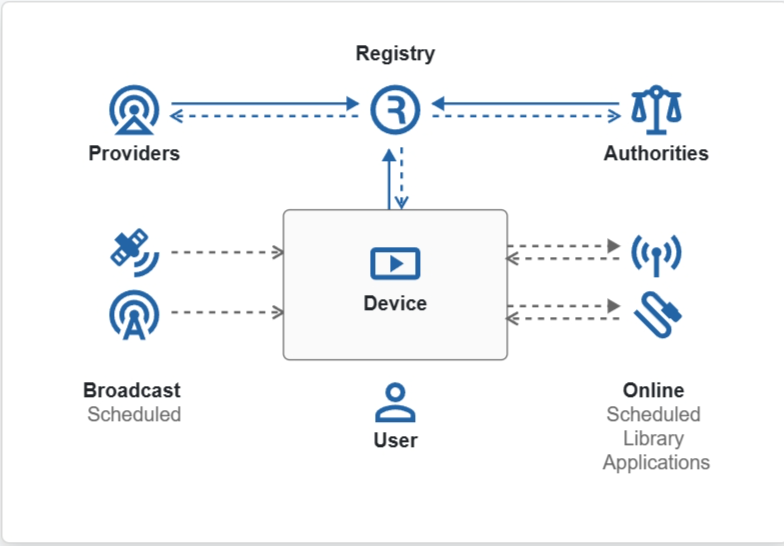
    One of the main components of DVB-I is the Service List Registry (SLR) "a centralized, secure system that allows TV sets and applications to discover and access linear TV services delivered via internet, terrestrial, cable, or satellite. It acts as a "list of lists," providing a standardized way to organize and trust diverse TV service providers' content, ensuring a familiar, consistent user experience across devices".

    The DVB-I EPG, in your TV or connected device, will populate from a national service list registry via the internet.

    The service list data is similar to how the DVB-SI/EIT data is displayed on an existing TV's epg today like LCNs, programme data etc. from your TV aerial, except the SLR goes a step further by linking a linear service/LCN to all available sources - DTT, IP, satellite and cable.

    Priority is given to the DTT feed I believe, followed by whichever other source is prioritised in the SLR for that channel .

    For example RTÉ 1 on the DVB-I SLR is allocated LCN 1 with priority on DTT via the aerial. If there is no DTT signal available the TV will switchover seamlessly to the next prioritised source for that channel.

    I think that's how it works anyway.

    image.png
    Post edited by The Cush on


  • Moderators, Technology & Internet Moderators Posts: 12,871 Mod ✭✭✭✭icdg


    It is the opposite way on Freely I think - priority is given to the IP stream where it exists over the Freeview version. But otherwise similar in concept?


  • Advertisement
  • Registered Users, Registered Users 2, Paid Member Posts: 16,493 ✭✭✭✭The Cush


    My very basic understanding of freely is that it's uses the HbbTV OpAp service delivery application, no interaction with DTT, satellite or cable delivery? It delivers linear channels, interactive services etc via IP.

    DVB-I is a service discovery application, built on existing standards like DVB-T/S to deliver linear channels and other services to your viewing device via prioritised delivery methods.

    Both standards are complementary and HbbTV can be bolted into DVB-I for enhanced services. It's likely the UK will adopt DVB-I in due course together with HbbTV included, combining their IP service with Freeview and Freesat channels.

    DVB-I is taking the lead in Europe and worldwide.

    China for example is moving straight to a verification phase, skipping trials altogether. They are getting ready to use it.

    Germany and Italy are well advanced in Europe, with France and Spain following. Australia and New Zealand are also well advanced. Iran were one of the earliest interested broadcasters.

    Italy's early adoption of DVB-I was based on their need for a backup for their DTT service in remote areas. The ability to switch seamlessly between DTT, their Tivu satellite service and IP.

    Here in Ireland Saorsat is nearing end of life with no replacement available other than a Sky subscription. DVB-I if available by then could be that replacement to your TV.

    Post edited by The Cush on


  • Registered Users, Registered Users 2 Posts: 5 DuoLey


    That sounds really good.


    I've used freely in the north and it's not good at all, very slow to change channels and picture quality poor.


  • Registered Users, Registered Users 2, Paid Member Posts: 16,493 ✭✭✭✭The Cush


    That appears to be the nature of the beast.

    An AI search says -

    DVB-I (Faster Service Discovery): Load Time - Fast (Native/Stream speed), Channel Switching - Instant/Fast, 1-2 sec approx.

    DVB-I is designed for fast, native-like tuning of internet-delivered liner channels. It focuses on service discovery via XML based service lists over HTTPS. Because it operates at a lower, service delivery level, it enables quicker channel changes and "scan-less" startup compared to application-based approaches.

    Primary focus and use, Linear/live service discovery and IP delivery, core EPG and channel switching

    HbbTV OpApp (Slower Application Load): Load Time - Slower (Browser/App speed), Channel Switching - Slower due to app lifecycle, 3-7 sec approx.

    HbbTV is an application-based standard. It usually loads on top of an existing broadcast or IP stream, which introduces a loading delay while the application files are fetched and rendered, resulting in slower initial load times for interactive content compared to the direct stream loading of DVB-I

    Primary focus and use, interactive applications and rich UI, non-linear content where slower loading times are acceptable, catch up

    It comes down to DVB-I versus HbbTV OpApp, right? Wrong! - DVB


  • Registered Users, Registered Users 2 Posts: 4,169 ✭✭✭Digifriendly


    I have Freely via Manhattan Aero Box and changing channels is prompt while picture quality is very good.

    I'm watching on A Sony 43' set.

    Was your experience of Freely through an integrated TV set or an external box?


  • Registered Users, Registered Users 2 Posts: 13,977 ✭✭✭✭Johnboy1951


    @TheCush

    Here in Ireland Saorsat is nearing end of life with no replacement available other than a Sky subscription. DVB-I if available by then could be that replacement to your TV.

    I have never had need of it, just wondering what is the expected remaining lifetime of Saorsat?


  • Advertisement
  • Registered Users, Registered Users 2, Paid Member Posts: 3,528 ✭✭✭Glaceon


    KA Sat was launched in 2010 with a design lifespan of 16 years. So I'd imagine it'll only go on for another couple of years.


  • Registered Users, Registered Users 2, Paid Member Posts: 16,493 ✭✭✭✭The Cush


    I imagine RTÉ will be hoping for a few more years of Saorsat availablity before they can launch DVB-I.

    The early 2025 plan for DVB-I was the small closed trial in 2025 with a larger public trial this year followed by a public launch in 2027. That appears to have slipped by at least a year now.

    Ka-sat might be around for a few more years depending on fuel availability and serviceability. Capacity issues should have lessened now compared to COVID times with Starlink and Eutelsat Konnect increased capacity.


  • Registered Users, Registered Users 2 Posts: 15,040 ✭✭✭✭Red Silurian


    I'm currently in the process of changing broadband providers, the switch was made on the network side a few days ago but I don't have the new providers modem yet as it's still coming in the post. This means I effectively have no broadband in the house. In my man-cave at home I have a saorview/freesat combination and so watched yesterdays match on Saorview

    If DVB-I replaces Saorview, which many on here speculate that it will, would I have lost the ability to watch yesterdays match because I technically had no broadband supplier?


  • Registered Users, Registered Users 2 Posts: 1,590 ✭✭✭galtee boy


    Yes, no broadband, no tv, same applies to eir tv, Virgin Stream, Vodafone TV and Sky Stream, if the broadband goes down, so does the respective tv system. As you say, Saorview and or Freesat is currently a good back up, but in say 10 years time and Saorview and satellite are shut down, there's no back up then.


  • Registered Users, Registered Users 2, Paid Member Posts: 3,528 ✭✭✭Glaceon


    OT for this thread but it's usually possible to reconfigure the old router to work with the new provider temporarily, it's case of changing the username and password on the internet (WAN side) settings.


  • Registered Users, Registered Users 2, Paid Member Posts: 16,493 ✭✭✭✭The Cush


    Saorview remains, delivery methods may change.

    DVB-I is a hybrid application that bridges Saorview terrestrial with Saorview IP.

    WRC-31 will decide the future of UHF terrestrial frequencies. Likely the remaining band will be allocated on a co-primary basis to broadcast and mobile services.

    So what replaces Saorview terrestrial for TVs in homes with no broadband connection or even watching Saorview on the go?

    The answer could be 5G Broadcast via the DVB-I application, with terrestrial frequencies reframed for 5G and reallocated to terrestrial broadcasting.


  • Registered Users, Registered Users 2 Posts: 15,040 ✭✭✭✭Red Silurian


    Fair point, I'm not techy enough to know that was a thing but I'll definitely try that when I get home.

    Regardless, the issue remains that in order to watch Saorview over IP you need an active and fast broadband supply and that's an issue for anybody that doesn't want or have one


  • Registered Users, Registered Users 2, Paid Member Posts: 16,493 ✭✭✭✭The Cush


    Saorview terrestrial will be around for many years to come and no doubt there will be a suitable wireless alternative by then for non connected households


  • Registered Users, Registered Users 2 Posts: 1,040 ✭✭✭decor58


    Not altogether on the subject but figures released by RTE say 1.37million watched on TV and over a million streamed last nights match, in part or whole. Yes its watching one event on a single channel, no switching between channels, but an indicator of the potential of streaming.


  • Registered Users, Registered Users 2 Posts: 15,040 ✭✭✭✭Red Silurian


    Streaming has its place. No doubt. But from a television transmission point of view it's deeply flawed and not a suitable replacement for satellite or terrestrial


  • Advertisement
  • Registered Users, Registered Users 2 Posts: 791 ✭✭✭PixelCrafter


    I think we have to be realistic about where broadcast is going tbh. It is going to get to the stage where we're holding open a huge piece of infrastructure for the sake of a tiny number of users. We're still a decade away from that but it's where it's heading and it is right that they're planning ahead.

    I think DVB-I needs to have an audio-only element though too for streaming radio access. It should be possible to access public audio streams without any fuss on a totally open API that any device can just find.


  • Registered Users, Registered Users 2 Posts: 1,590 ✭✭✭galtee boy


    Just curious, why do you think streaming tv is flawed ? I've had the use of both eir tv and Sky Stream lately and they both worked perfectly. Sky Stream in particular has a huge amount of channels and apps compared to the very limited eir tv , but it works seamlessly and integrates the tv channels with the apps etc. Ok, recording is an issue, but that's the broadcasters restrictions, not a streaming issue. Over the coming years, IT, servers etc etc will only get better and more high tech, which will enhance the capabilites of streaming even more. The cost of maintaining either satellites in the sky and maintaining high powered transmitters stuck on mountain tops is huge compared to a top end server in warehouse/building somewhere, easily accessible etc.


  • Registered Users, Registered Users 2 Posts: 6,151 ✭✭✭JDxtra


    Streaming of live football on RTE Player is not the best as it has a low frame rate. Same content on Eir TV is perfectly fine.

    So streaming does work well if it’s given the bandwidth.

    If you’re doing in game betting, then streaming (from any provider) may be a frustration as it’s behind traditional live TV.


  • Registered Users, Registered Users 2 Posts: 791 ✭✭✭PixelCrafter


    RTE to be fair to them have a tender out to do some kind of significant work the RTE Player. I think it's really suffering from being what was designed as a catch-up tv service, but it now being used as a major viewing platform.

    https://www.rte.ie/news/ireland/2026/0304/1561615-rte-player-tender/


  • Registered Users, Registered Users 2 Posts: 6,151 ✭✭✭JDxtra


    Not quite significant, tender is more of the same but with "incremental modernisation".


  • Registered Users, Registered Users 2 Posts: 791 ✭✭✭PixelCrafter


    They really need to improve the resolution and everything else around it.


  • Registered Users, Registered Users 2 Posts: 15,040 ✭✭✭✭Red Silurian


    Streaming requires broadband capacity. If you live in a city with 500mb+ broadband speeds it works fine but if you're out in the sticks where sometimes you might not even have mobile phone signal that's going to be a huge issue, especially if you have more than one TV in the house. What does the elderly couple without a broadband connection do as well?

    Streaming also requires more capacity on the broadcasting end so if it's not up to scratch and too many TVs connect to watch a particular program it can crash. We saw this in the early days of Now TV

    Another thing we saw back in 2020 was Netflix reducing the quality of their streams back at the start of the covid lockdowns to save bandwidth. So if ever another major incident occurred it's likely the streamers would be doing this also

    No recording, but you've already mentioned that. There's also less channel selection as you can pick up channels such as itv on satellite

    Streaming can be significantly out of sync with what's happening live and even with other devices on the same network. I had premier sports open on my TV the other day via the now app and also watching it on my laptop in the kitchen while making the lunch. There was a 10 to 15 second delay between the laptop and the telly.

    Did you ever try to do a sports watch party over covid with 8-10 people all watching on different devices?

    Streaming is also more expensive as you have to pay for the TV service as well as the broadband service

    So there's 6 reasons


  • Registered Users, Registered Users 2 Posts: 1,590 ✭✭✭galtee boy


    When the national broadband rollout is finished at the end of this year, the fibre cable is supposed to pass every household in the country, no matter how remote, at least that's what they promised. The lag in time for streaming is only an issue if as you say your literally watching the same thing on two different devices at the one time, not many people do that. As I said previously, over the coming years, new technology will improve things like the time lag, bandwidth etc. Anyway, whether we like it or not, it all comes down to money and the broadcasters will go with the cheaper option, which surely has to be streaming. Having said all that, we are probably 10 years away from the total switch over to streaming.


  • Registered Users, Registered Users 2 Posts: 75,482 ✭✭✭✭L1011


    Due to NBI, in the sticks you are more likely to be able to get gigabit than in a city realistically.

    Loads of town/city houses are stuck with ~30mbit VDSL.


  • Advertisement
  • Registered Users, Registered Users 2 Posts: 15,040 ✭✭✭✭Red Silurian


    When the national broadband rollout is finished at the end of this year, the fibre cable is supposed to pass every household in the country, no matter how remote, at least that's what they promised.

    They also promised the childrens hospital by 2023

    The lag in time for streaming is only an issue if as you say your literally watching the same thing on two different devices at the one time, not many people do that.

    I was in a pub on the other day, they had 5 tellys all showing the same match… How would it work for them?

    As I said previously, over the coming years, new technology will improve things like the time lag, bandwidth etc.

    That would definitley help but can you be more specific? Is this technology being used elsewhere around the world at the moment?

    Anyway, whether we like it or not, it all comes down to money and the broadcasters will go with the cheaper option, which surely has to be streaming.

    The cheaper option would surely be DVB-T as all you need is a compatible telly and an antenna, no? With DVB-I you need a broadband connection. DVB-S could even be cheaper as there is no monthly cost to having a satellite dish or box in the house. Terrestrial and Satellite are both far more reliable as well


Advertisement
Advertisement