Advertisement
Please note that it is not permitted to have referral links posted in your signature. Keep these links contained in the appropriate forum. Thank you.

https://www.boards.ie/discussion/2055940817/signature-rules
Help Keep Boards Alive. Support us by going ad free today. See here: https://subscriptions.boards.ie/.
https://www.boards.ie/group/1878-subscribers-forum

Private Group for paid up members of Boards.ie. Join the club.
Hi all, please see this major site announcement: https://www.boards.ie/discussion/2058427594/boards-ie-2026

Peugeot 208e 50kWh

145791017

Comments

  • Moderators, Motoring & Transport Moderators, Regional East Moderators, Paid Member Posts: 6,552 Mod ✭✭✭✭liamog


    I think he will release a charging video in the next day so, he does have clip of it on the Ionity charger, it's taken 15.6kWh in 65 mins. but is at a 98% state of charger, voltage is at 446 and amps at 7.
    Usable battery is 47kWh, so that would be something like a 70% to 98% in 65 mins.

    He's a bit of a madman to be charging that high on Ionity!


  • Posts: 12,708 ✭✭✭✭ [Deleted User]


    47 Kwh usable ? sure that won't help, Kona has 64, that's a pretty big difference to be honest.


  • Moderators, Motoring & Transport Moderators, Regional East Moderators, Paid Member Posts: 6,552 Mod ✭✭✭✭liamog


    Their WLTP range is over 100km less than the Kona (340km vs 450km) and the starting price in Ireland is €12,500 lower.


  • Registered Users, Registered Users 2 Posts: 7,451 ✭✭✭KCross


    liamog wrote: »
    Bjørn is doing some testing of the e-208 right now.

    He achieved 292km @ 90km/h and 187km @ 120km/h

    A german tester did 130km/h indicated and got 200km down to 2% SoC at much the same outside temp.

    187km seems a tad low based on that? Maybe that cell balancing that he didnt allow to finish had an effect.

    https://www.boards.ie/vbulletin/showpost.php?p=112480641&postcount=121


  • Registered Users, Registered Users 2 Posts: 7,451 ✭✭✭KCross


    I looked back at the two videos and the dash readout in Bjorn's fast test was 24.3kWh/100km @ 111km/h (average)
    The German guy did 21.7kWh/100km @ 108km/h

    I guess Bjorn maintained his speed better but even at that Bjorn seemed to get disproportionately higher consumption.


    Either way, realistically its a <200km car at motorway speed as you are not going to be driving it down to 2%!


  • Advertisement
  • Registered Users, Registered Users 2 Posts: 30,525 ✭✭✭✭Lumen


    German roads maybe smoother.


  • Registered Users, Registered Users 2 Posts: 3,995 ✭✭✭McGiver


    KCross wrote: »
    I looked back at the two videos and the dash readout in Bjorn's fast test was 24.3kWh/100km @ 111km/h (average)
    The German guy did 21.7kWh/100km @ 108km/h

    I guess Bjorn maintained his speed better but even at that Bjorn seemed to get disproportionately higher consumption.


    Either way, realistically its a <200km car at motorway speed as you are not going to be driving it down to 2%!

    Wind..


  • Registered Users, Registered Users 2 Posts: 2,349 ✭✭✭Miscreant


    McGiver wrote: »
    Wind..

    Is it just me or was he driving the car in B mode the whole time? Not sure if this would affect anything but I had not noticed that before, usually in D no?


  • Registered Users, Registered Users 2 Posts: 7,451 ✭✭✭KCross


    Miscreant wrote: »
    Is it just me or was he driving the car in B mode the whole time? Not sure if this would affect anything but I had not noticed that before, usually in D no?

    On a motorway with mainly cruise control it wont make any difference what mode it is in unless you use eco which would limit things like heaters and aircon.


  • Registered Users, Registered Users 2 Posts: 60,764 ✭✭✭✭unkel


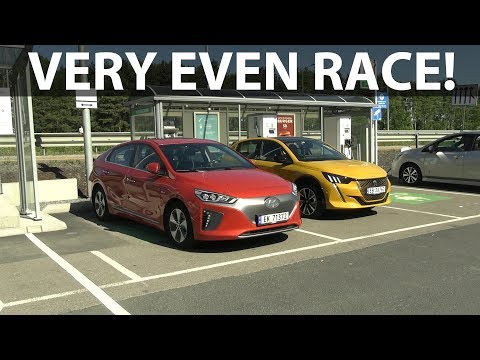
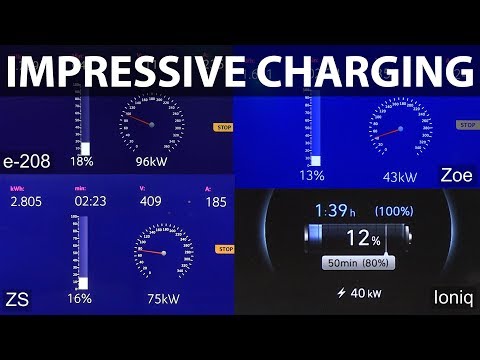
    Race: Peugeot e208 50kWh vs Ioniq 28kWh

    "Make no mistake. The days of the internal combustion engine are definitely numbered" - Quentin Willson, 1997


  • Advertisement
  • Moderators, Motoring & Transport Moderators, Regional East Moderators, Paid Member Posts: 6,552 Mod ✭✭✭✭liamog


    unkel wrote: »
    Race: Peugeot e208 50kWh vs Ioniq 28kWh

    It's a pity the charging issue killed the race, it's amazing to see that the Ioniq 28kWh held it's ground vs the e208. It just show's how far ahead Hyundai were in 2016.


  • Posts: 12,708 ✭✭✭✭ [Deleted User]


    I wonder what point it starts to throttle from 96 Kw 27 kw at what 75% isn’t very impressive.


  • Registered Users, Registered Users 2 Posts: 60,764 ✭✭✭✭unkel


    I wonder what point it starts to throttle from 96 Kw 27 kw at what 75% isn’t very impressive.

    It starts throttling very quickly. You only get the 100kW for a very short while. Still it charges better than any other EV for that sort of money. Which is a bit pathetic (2C for just a very short while) in 2020 while cars like Ioniq could do close to 3C prolonged back in 2016

    Here is a recent video from Nyland that shows the throttling (compared with other EVs in class). Starting at near 100kW but already down to just 76kW at just 20% SOC :rolleyes: it keeps that up for a while but then throttles further down to just 52kW at 48% SOC

    "Make no mistake. The days of the internal combustion engine are definitely numbered" - Quentin Willson, 1997


  • Closed Accounts Posts: 308 ✭✭Mike3287


    liamog wrote: »
    It's a pity the charging issue killed the race, it's amazing to see that the Ioniq 28kWh held it's ground vs the e208. It just show's how far ahead Hyundai were in 2016.

    Or how crap the other efforts are

    Even Hyundai screwed up with Ioniq38

    Interesting vid, e208 like all modern efforts is a dog on the juice

    50% bigger battery than Ioniq 28, 50% more power hungry

    Im fully expecting the same result with base 45kWh ID3

    Wont be any better than 2016 Ioniq 28


  • Registered Users, Registered Users 2, Paid Member Posts: 19,761 ✭✭✭✭ELM327


    At least Ioniq 38 has a few more KM to begin with but , yeah, the ioniq28 is very hard to beat without paying tesla money.


  • Moderators, Motoring & Transport Moderators, Regional East Moderators, Paid Member Posts: 6,552 Mod ✭✭✭✭liamog


    It just goes to show that the Ioniq 28kWh approach of optimise for power density over energy density can come with huge advantages.
    Between the "better" charging curve and the increased efficiency it has an effective charging rate in km's per 30 mins as a car with with a 65% bigger battery.

    The Peugeot is the first affordable car in a while that at least matches it.


  • Posts: 12,708 ✭✭✭✭ [Deleted User]


    And both cars are slow, If the Peugeot has 200+ up and a better charge rate I’d say fair enough but I can’t forgive the poor charge curve in 2020.

    Leaf 60 kWh will probably be the same.


  • Registered Users, Registered Users 2, Paid Member Posts: 19,761 ✭✭✭✭ELM327


    And both cars are slow, If the Peugeot has 200+ up and a better charge rate I’d say fair enough but I can’t forgive the poor charge curve in 2020.

    Leaf 60 kWh will probably be the same.
    Same as leaf 40
    Rapidgate, with 50kW max to begin with (there are no 100KW chargers that support 100kW chademo)


  • Moderators, Motoring & Transport Moderators, Regional East Moderators, Paid Member Posts: 6,552 Mod ✭✭✭✭liamog


    And both cars are slow, If the Peugeot has 200+ up and a better charge rate I’d say fair enough but I can’t forgive the poor charge curve in 2020.

    Leaf 60 kWh will probably be the same.

    I think with the new battery chemistries, the days of increasing charge up to 80% are gone. The only recent car with that kind of profile is the Mini, and that's down to it basically being a 94Ah I3.


  • Moderators, Motoring & Transport Moderators, Regional East Moderators, Paid Member Posts: 6,552 Mod ✭✭✭✭liamog


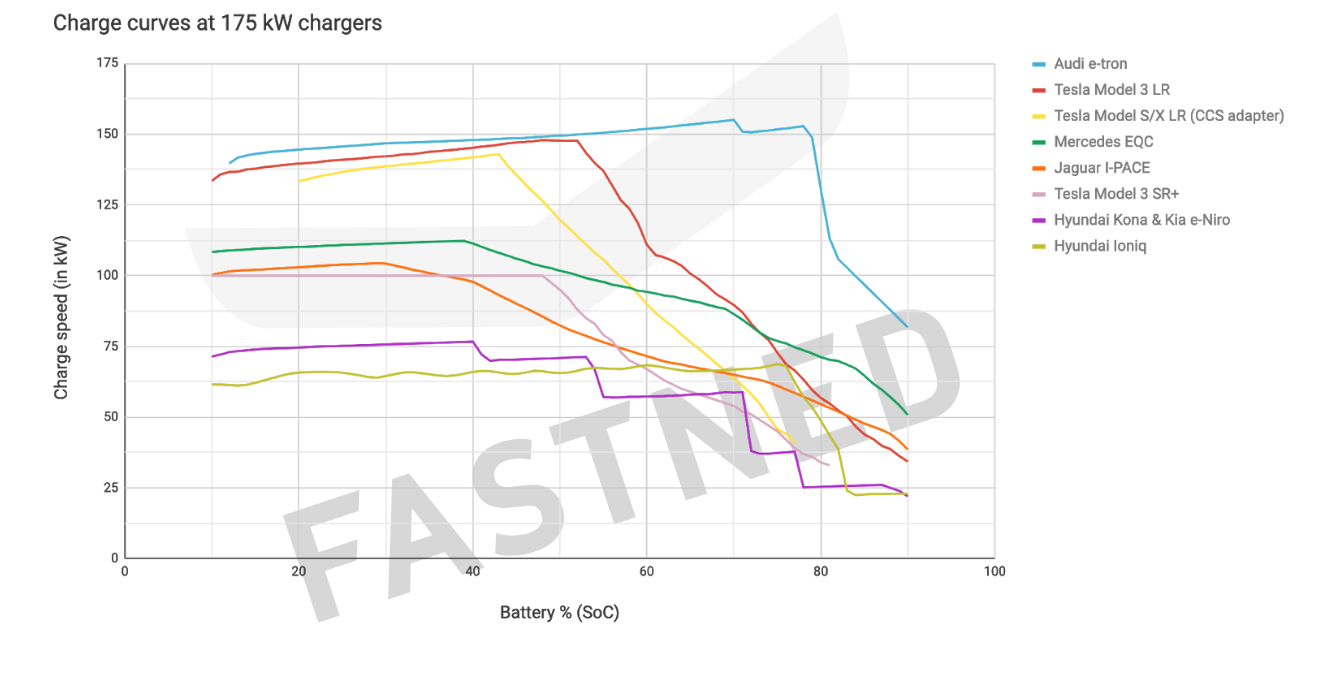
    Here's a graph from Fastned of a few cars.

    175kWcharger_022020.png


  • Advertisement
  • Registered Users, Registered Users 2 Posts: 60,764 ✭✭✭✭unkel


    That curve gives you a hint of what an automotive giant like Volkswagen can do once they spend a little bit of money in a certain area. I'm holding onto my shares :D

    "Make no mistake. The days of the internal combustion engine are definitely numbered" - Quentin Willson, 1997


  • Posts: 12,708 ✭✭✭✭ [Deleted User]


    I'd love to see that graph with cold batteries because charging a cold battery can make a huge difference.

    I am surprised to see the Model S SR so bad but obviously this is down to the smaller battery.

    I can't wait to see how the id.3 performs.

    It's one thing that really makes me appreciate the Rex is seeing the charging profile especially charging a cold battery can be quite irritating.

    It will also be interesting to see what Hyundai come up with 800v tech which they say will be 2021 but Covid could delay this.


  • Registered Users, Registered Users 2 Posts: 60,764 ✭✭✭✭unkel


    I am surprised to see the Model S SR so bad but obviously this is down to the smaller battery.

    Not so. That graph is a bit dated now. Back then the SR+ was software limited to 100kW max (just to give the far more lucrative LR AWD and P models another edge)

    Since then this has been increased to 170kW

    "Make no mistake. The days of the internal combustion engine are definitely numbered" - Quentin Willson, 1997


  • Registered Users, Registered Users 2, Paid Member Posts: 19,761 ✭✭✭✭ELM327


    Worth noting that the graph discriminates against Teslas
    They are amperage limited at a 175kW charger.

    Using an Ionity charger, higher charge curves are possible on all Teslas versus 175kW


  • Registered Users, Registered Users 2 Posts: 7,451 ✭✭✭KCross


    unkel wrote: »
    It starts throttling very quickly. You only get the 100kW for a very short while. Still it charges better than any other EV for that sort of money. Which is a bit pathetic (2C for just a very short while) in 2020 while cars like Ioniq could do close to 3C prolonged back in 2016

    :confused:
    How did you calculate 3C?

    Isnt the Ioniq a ~32kWh battery and averages low 60s during its charge... so about 2C as well?

    It max's at 70kW so still only a tad over 2C at its best rate?


  • Registered Users, Registered Users 2 Posts: 60,764 ✭✭✭✭unkel


    Ioniq can charge at 70kW (proven, on existing real life chargers, not quite the 80kW it was claimed initially, maybe just in theory) and has a 28kWh battery, so I guess about 2.5C

    All these years later, no other car except the Teslas can do that. No small feat. In fact the C ratings for cars seem to get lower and lower for some reason. Very strange as there is no reason why battery manufacturers have suddenly needed to take it easy. No major warranty claims on batteries from any car

    "Make no mistake. The days of the internal combustion engine are definitely numbered" - Quentin Willson, 1997


  • Posts: 12,708 ✭✭✭✭ [Deleted User]


    unkel wrote: »
    Ioniq can charge at 70kW (proven, on existing real life chargers, not quite the 80kW it was claimed initially, maybe just in theory) and has a 28kWh battery, so I guess about 2.5C

    All these years later, no other car except the Teslas can do that. No small feat. In fact the C ratings for cars seem to get lower and lower for some reason. Very strange as there is no reason why battery manufacturers have suddenly needed to take it easy. No major warranty claims on batteries from any car

    Might be due to internal resistance due to the need for more kWh, something has got to give in battery design currently.


  • Registered Users, Registered Users 2 Posts: 60,764 ✭✭✭✭unkel


    Might be due to internal resistance due to the need for more kWh, something has got to give in battery design currently.

    New Teslas can charge at over 3C. The other companies just can't build proper batteries, or are way to conservative with the rate they let the car charge :D

    "Make no mistake. The days of the internal combustion engine are definitely numbered" - Quentin Willson, 1997


  • Registered Users, Registered Users 2 Posts: 7,451 ✭✭✭KCross


    unkel wrote: »
    Ioniq can charge at 70kW (proven, on existing real life chargers, not quite the 80kW it was claimed initially, maybe just in theory) and has a 28kWh battery, so I guess about 2.5C

    It doesnt have a 28kWh battery though.... thats the usable portion. The figure that counts for C-rate is the total capacity and thats 31-32kWh (I think) so closer to 2C.... much the same as the e208 which peaks at 100kW.

    In any case, the only figure that really matters is average charge rate over a charge cycle. Max rate and c-rate are irrelevant really.
    unkel wrote: »
    All these years later, no other car except the Teslas can do that. No small feat. In fact the C ratings for cars seem to get lower and lower for some reason. Very strange as there is no reason why battery manufacturers have suddenly needed to take it easy. No major warranty claims on batteries from any car

    Must be the energy density and the ability to get that heat away. Tesla can do it because they have a comprehensive cooling system at every cell.


  • Advertisement
  • Registered Users, Registered Users 2, Paid Member Posts: 19,761 ✭✭✭✭ELM327


    KCross wrote: »
    It doesnt have a 28kWh battery though.... thats the usable portion. The figure that counts for C-rate is the total capacity and thats 31-32kWh (I think) so closer to 2C.... much the same as the e208 which peaks at 100kW.

    In any case, the only figure that really matters is average charge rate over a charge cycle. Max rate and c-rate are irrelevant really.


    Must be the energy density and the ability to get that heat away. Tesla can do it because they have a comprehensive cooling system at every cell.
    Yes but the Ioniq maintains 70kW up to 77% SOC


Advertisement
Advertisement