Advertisement
Help Keep Boards Alive. Support us by going ad free today. See here: https://subscriptions.boards.ie/.
https://www.boards.ie/group/1878-subscribers-forum

Private Group for paid up members of Boards.ie. Join the club.
Hi all, please see this major site announcement: https://www.boards.ie/discussion/2058427594/boards-ie-2026

Wind farms - ugly truths

1363739414247

Comments

  • Registered Users, Registered Users 2 Posts: 10,051 ✭✭✭✭Birdnuts


    djpbarry wrote: »

    You keep recycling that flawed SEI dispatch model on which your link is based


    http://irishenergyblog.blogspot.ie/2014/12/seais-quantifying-savings-from.html

    You have constantly failed to address any of the points in the above link on the matter. And I'll ask again for the nth time - Where did these fossil fuel savings go when the retail price of power in this country continued to rise despite falling oil/gas prices during that period???????


  • Registered Users, Registered Users 2 Posts: 10,051 ✭✭✭✭Birdnuts


    The clue is in the word future.


    I think you need to look a little closer at that article, and the implications of it.
    Grants, subsidies and incentives are still being given to construct, fuel, decommission and clean-up conventional thermal fossil fuel plants.
    A tax break is an incentive, "subsidy" may be an inaccurate choice of words, but the effect is the same.
    As long as this incentive exists, whether it is tax-break based, or direct subsidy based is irrelevant. Once it exists, it acts as a disincentive for renewable energy development. That is the point of the article. Have a read of "This Changes Everything" by Naomi Klein if you want a few really good chapters on how screwed up US Federal spending/funding/tax is in relation to the notional policy of renewable energy.


    Sure Ireland has more pressing humanitarian issues like poverty, health & education, but as long as our energy supply is subject to the whims of Sheiks and Texan Oil barons, the best laid plans and budgets have the potential to end up on the scrap-heap. Spend the time and money to put a comprehensive 20 year plan in place, safeguard it from administration change and every future budget will benefit from the investment.

    However as FClauson has already pointed out, a large part of the problem is our out-dated housing stock, which is dire need of upgrade, why not include this as part of the 20 year strategy ?

    The electoral cycle has done a massive dis-service to the people of Ireland in this regard, with the continual changes in administrations completely failing to address the looming problems in favor of securing enough votes to keep leather under there arses. But I suppose that is far enough off topic for now.


    It is not all about current energy costs.
    Every time you bring this point up you fail to acknowledge that there have been savings in inputs and correspondingly in CO2 outputs.
    Fossil Fuels are a finite resource, by definition as supply diminishes, cost is going to go up:
    Has that happened yet- occasionally.
    Will this happen in the future - Definitely
    Will this drive up costs - Definitely

    You seem to be basing all of your points on the status quo being sustainable.
    It most definitely isn't.

    Also - Polite request for the sake of sanity, can you please use Multi-quote and post one response at a time ? It just seems like you are trying to carpet-bomb the thread with one-line responses that blithely ignore the true complexities of the points you are trying to respond to.
    It makes for very hard work as the thread goes on.

    Ah yes - sometime in the future. Convenient waffle from an industry that's squeals like a pig at any suggestion in cuts in subsidies etc. No doubt much of these same predictions are coming from the geniuses that predicted we would be paying $200 per barrell for oil by now. I suggest you do a bit of reading on the current projections for gas,oil prices globally and energy demand in many developed economies in the coming years. The Economist had a piece recently highlighting how modern economies are more about "peak demand" and not about "peak oil". Highlighting how per capita energy demand in many economies is now falling due to energy saving technology etc. while gas/oil recovery technologies open up vast new supplies as already discussed and highlighted in this thread. Its says a lot about the wind developer fan boys that all they have to offer is unsubstantiated hysteria on the matter

    Also you lecture on tax breaks doesn't hold much water either in that you seem to be unaware that all businesses can right off the costs of R and A and other legitimate business expenses against tax. That goes for whether your an oil company, farmer, crèche operator etc. So lets not pretend otherwise

    PS: I don't appreciate being lectured too about my posting style. Obviously you have a problem with posters that don't share your view of the world. I also suggest your read the rules on here regarding back-seat modding


  • Registered Users, Registered Users 2 Posts: 10,051 ✭✭✭✭Birdnuts


    The fact still remains that they survived without them for years. And even now out of 50+ reactors only two are back on line.

    Japan’s nuclear generating capacity factor in October was 2.7 percent, up from 2.2 percent in September. http://www.world-nuclear.org/info/Country-Profiles/Countries-G-N/Japan/

    Japan had to massively up its import of fossil fuels during that time as solar/wind typically failed to provide a cost effective or reliable energy source for their massive industrial base. No wonder their keen to get conventional power plants up and running again.


  • Registered Users, Registered Users 2 Posts: 10,051 ✭✭✭✭Birdnuts


    I see Fintan Slye of Eirgrid wind waffle fame let slip yesterday in a puff piece on green energy in the Indo that they are now considering paying domestic consumers up to 100 euro a year to switch off appliances during low wind conditions etc.. This has 2 frightening implications 1) the price per unit of energy will go through the roof to pay for this on top of all the other wind related costs heaped on consumers in recent years and 2) suggests that the system will start suffering power crunches of the type seen in the UK only last month that prompted the minister there to announce a massive investment in conventional power generation and an end to wind/solar supports.


  • Registered Users, Registered Users 2 Posts: 2,625 ✭✭✭AngryHippie


    Birdnuts wrote: »
    Ah yes - sometime in the future.

    Yes the future, as in we have already made a pigs ear of the present, and doing nothing about it will only serve to lock us into a similarly haphazard future
    Birdnuts wrote: »
    while gas/oil recovery technologies open up vast new supplies

    I suppose you would support tar sands, permafrost drilling, LNG fracking a nd continuing to blast methane and CO2 into the atmosphere then......I think this is the fundamental point where our arguments will stem from.....

    Birdnuts wrote: »
    PS: I don't appreciate being lectured too about my posting style. Obviously you have a problem with posters that don't share your view of the world. I also suggest your read the rules on here regarding back-seat modding

    I wasn't modding, I had no comment about your content or tone, nor would I presume to lecture. I was merely pointing out that the thread was starting to resemble a Cambodian hillside where every time you graced us with your input you did so over a half a page of posts. I apologize if you don't appreciate it, I don't believe it reflects on my world views (aside from my admiration of efficient communication) nor was it a criticism of you or your posts. Hence it was posed as a polite request. Feel free to ignore the request, it wasn't meant to be taken personally.


  • Advertisement
  • Moderators, Science, Health & Environment Moderators Posts: 6,391 Mod ✭✭✭✭Macha


    [mod] Oi, get back on topic. No more talk of back seat modding. Criticism of posts (not posters) perfectly valid but please keep it focused on content rather than style [/mod]


  • Registered Users, Registered Users 2 Posts: 1,691 ✭✭✭fclauson


    Birdnuts wrote: »
    I see Fintan Slye of Eirgrid wind waffle fame let slip yesterday in a puff piece on green energy in the Indo that they are now considering paying domestic consumers up to 100 euro a year to switch off appliances during low wind conditions etc.. This has 2 frightening implications 1) the price per unit of energy will go through the roof to pay for this on top of all the other wind related costs heaped on consumers in recent years and 2) suggests that the system will start suffering power crunches of the type seen in the UK only last month that prompted the minister there to announce a massive investment in conventional power generation and an end to wind/solar supports.

    This is actually a really good idea - if implemented correctly - there is a tender on http://www.etenders.gov.ie under ENQEIR506 - Residential Consumer Demand Response.

    What is forgotten in this mad rush to build generation plant to reach some nebulous x% of energy from renewables is that if you drop demand you can reach that target a different way.

    With my own home when I was getting it BER assessed I struggled to reach 4kw/sqm/year renewables requirement for a new build because the building demand is so low that this 4kw equates to some 25% of the building demand. When the requirement was written it was assumed it would amount to 5%. By dropping demand your percentages go up

    Now the building is up and running I am actually creating some 35% to 40% from renewables with a combination of a HP (420% efficiency), PV (25% of demand) and being Passive Certified less than 9Kwh/sqm/annum heat demand

    So in summary one facet of the 2020 target is not to build more plant but to drop demand


  • Registered Users, Registered Users 2 Posts: 651 ✭✭✭L


    As fclauson said. Also, during most daily peaks, it'd be a net saving if you can shift enough demand around to avoid having to start up those peakers. Flattening out the daily demand makes a lot of sense.


  • Registered Users, Registered Users 2 Posts: 9,015 ✭✭✭Markcheese


    Isnt that supposed to be the main reason for heading to smart meters ???

    Slava ukraini 🇺🇦


  • Moderators, Recreation & Hobbies Moderators, Science, Health & Environment Moderators, Technology & Internet Moderators Posts: 96,590 Mod ✭✭✭✭Capt'n Midnight


    Birdnuts wrote: »
    Japan had to massively up its import of fossil fuels during that time as solar/wind typically failed to provide a cost effective or reliable energy source for their massive industrial base. No wonder their keen to get conventional power plants up and running again.

    As I posted earlier
    Capacity (IEA figures) at end of 2012 was 295 GWe, this being 46 GWe nuclear, 45 GWe hydro, 36 GWe coal, 47 GWe gas, 41 GWe oil, 16 GWe oil or coal, 50.6 GWe autoproducers’ ‘combustible fuels’, 6.6 GWe solar, 2.5 GWe wind and 0.5 GWe geothermal.

    So perhaps you like to explain to everyone here how exactly anyone could expect to replace 46GWe with 6.6 GWe of solar and 2.5 GWe of wind , especially when claiming that Solar and Wind have very low capacity factors ?


    The thing is that gas generators are cheap to buy and quick to install. Handy if you need to cover for a few years. Less problems with NIMBY's too.

    Wind and solar , like nuclear have high upfront costs. So it's difficult to invest in both. This is one reason I'm anti-nuclear as it soaks up capital for decades in an era where renewables are getting cheaper year upon year.


  • Advertisement
  • Registered Users, Registered Users 2 Posts: 10,051 ✭✭✭✭Birdnuts


    Yes the future, as in we have already made a pigs ear of the present, and doing nothing about it will only serve to lock us into a similarly haphazard future


    .

    I'm all for practical solutions that are sustainable economically and environmentally. But I'm getting tired of the hysteria and misinformation put out by vested interests in relation to energy matters. At the end of the day we will all die and the Sun will eventually consume the Earth and the rest of the Solar system. You would swear by some of the coverge on these matters by the Pollyanna self serving elements that are behind the likes of the wind/solar industry that next week we should all be looking at jacking in the job, leaving the wife and going out on a high of hookers and coke:rolleyes:. What annoys me the most about this is that other much more pressing matters like plastic contamination of soils/water, overfishing, food waste, unsustaineable population growth etc. don't get a fraction of the coverge compared to the media circus around this issue.


  • Registered Users, Registered Users 2 Posts: 10,051 ✭✭✭✭Birdnuts


    fclauson wrote: »
    This is actually a really good idea - if implemented correctly - there is a tender on http://www.etenders.gov.ie under ENQEIR506 - Residential Consumer Demand Response.

    What is forgotten in this mad rush to build generation plant to reach some nebulous x% of energy from renewables is that if you drop demand you can reach that target a different way.

    With my own home when I was getting it BER assessed I struggled to reach 4kw/sqm/year renewables requirement for a new build because the building demand is so low that this 4kw equates to some 25% of the building demand. When the requirement was written it was assumed it would amount to 5%. By dropping demand your percentages go up

    Now the building is up and running I am actually creating some 35% to 40% from renewables with a combination of a HP (420% efficiency), PV (25% of demand) and being Passive Certified less than 9Kwh/sqm/annum heat demand

    So in summary one facet of the 2020 target is not to build more plant but to drop demand

    I've no problem with folks spending their own money like that on micro/domestic renewables and energy efficiency technologies and I would like to see energy levies going into the latter particularly, instead of being handed to wind farm developers and the like. Especially if it allows folks to achieve near independence from the big power companies and energy developers that have ruthlessly exploited Irish energy consumers over the last 20 years while the likes of government quangos such as the CER consistently fails to protect the interests of ordinary energy users. Indeed Colm McCarthy had another excellent piece in this weeks Farmers journal about the crazy expansion in energy generation in recent years at national grid level, especially wind, costing consumers dearly and making no economic sense whatsoever given current and predicted demand profiles

    But getting back to what the chief blowhard at Eirgrid said, sadly his actual suggestion was far from such commonsense. For example - given what we already know about the output profile of wind farms across the country, it is totally impractical to expect people to use basic appliances vital for everyday life, only when the wind regime across the country provides the required output. Take most of this October and early Nov for example. For days on end wind was contributing a tiny % of daily energy demand to the system. Expecting families, the elderly etc. not to use appliances for basic everyday needs over such long time periods is simply not practical and given that such a regime will enormously jack up the price of power over these prolonged periods, then it is a certain recipe for increased energy poverty and other problems.


  • Registered Users, Registered Users 2 Posts: 10,051 ✭✭✭✭Birdnuts


    As I posted earlier

    So perhaps you like to explain to everyone here how exactly anyone could expect to replace 46GWe with 6.6 GWe of solar and 2.5 GWe of wind , especially when claiming that Solar and Wind have very low capacity factors ?


    .

    I suggest you address your concerns to the heads of Japans biggest industries. They are the ones that have been pushing the government to get its act together on the subject and this is what they are responding too. Clearly they don't have much faith wind/solar to do the job so are looking to the government to get their act together when it comes to restoring conventional plant outputs


  • Registered Users, Registered Users 2 Posts: 64 ✭✭signinlate


  • Registered Users, Registered Users 2 Posts: 13,104 ✭✭✭✭djpbarry


    Birdnuts wrote: »
    You keep recycling that flawed SEI dispatch model on which your link is based


    http://irishenergyblog.blogspot.ie/2014/12/seais-quantifying-savings-from.html

    You have constantly failed to address any of the points in the above link on the matter.
    I have addressed that blog post several times, as have other posters. You keep throwing up the same links over and over again without paying the slightest bit of attention to what anyone says in response. Maybe instead of repeatedly throwing up links, you could actually make specific points with reference to said links and formulate a coherent argument?
    Birdnuts wrote: »
    Ah yes - sometime in the future. Convenient waffle from an industry that's squeals like a pig at any suggestion in cuts in subsidies etc. No doubt much of these same predictions are coming from the geniuses that predicted we would be paying $200 per barrell for oil by now.
    It’s relatively easy to calculate the return on investment of wind and solar, as has been demonstrated several times on this thread.
    Birdnuts wrote: »
    The Economist had a piece recently highlighting how modern economies are more about "peak demand" and not about "peak oil". Highlighting how per capita energy demand in many economies is now falling due to energy saving technology etc.
    Energy demand fell over the last few years mainly due to a global recession.
    Birdnuts wrote: »
    But getting back to what the chief blowhard at Eirgrid said, sadly his actual suggestion was far from such commonsense. For example - given what we already know about the output profile of wind farms across the country, it is totally impractical to expect people to use basic appliances vital for everyday life, only when the wind regime across the country provides the required output.
    It is not “vital for everyday life” that dishwashers, washing machines and the like be run at specific times.
    Birdnuts wrote: »
    Take most of this October and early Nov for example. For days on end wind was contributing a tiny % of daily energy demand to the system. Expecting families, the elderly etc. not to use appliances for basic everyday needs over such long time periods is simply not practical…
    Well of course it isn’t, which is probably why nobody has suggested that anyone has to go without using appliances for days on end.

    I don’t see why demand-side management is such a ridiculous idea anyway? In Texas, some utilities companies are offering essentially free electricity at night:
    http://www.nytimes.com/2015/11/09/business/energy-environment/a-texas-utility-offers-a-nighttime-special-free-electricity.html?_r=0


  • Closed Accounts Posts: 264 ✭✭OssianSmyth


    signinlate wrote: »
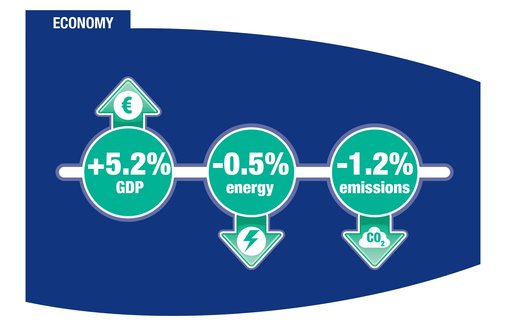
    A new report published on Thursday shows that fossil fuel use is also falling. Energy emissions are falling while GDP is rising.

    CUvpwKtUsAEHUjr.jpg:large

    http://www.seai.ie/Publications/Statistics_Publications/Energy_in_Ireland/Energy-in-Ireland-1990-2014.pdf


  • Registered Users, Registered Users 2 Posts: 10,051 ✭✭✭✭Birdnuts


    signinlate wrote: »

    Wow - a whole 2%!! Over the past 2-3 years oil/gas prices have fallen 30% +. As I stated earlier the likes of the CER and SEI have failed the energy consumer in this country badly. And that quote from Alex White is beyond laughable given this governments failing energy policies


  • Registered Users, Registered Users 2 Posts: 10,051 ✭✭✭✭Birdnuts


    djpbarry wrote: »
    I have addressed that blog post several times, as have other posters. You keep
    throwing up the same links over and over again without paying the slightest bit
    of attention to what anyone says in response. Maybe instead of repeatedly
    throwing up links, you could actually make specific points with reference to
    said links and formulate a coherent argument?

    You certainly have not!!! And that accusation is a bit rich coming from someone who's main contribution to this thread is repeating the same tired "wind is cheap" line

    It is not “vital for everyday life” that dishwashers, washing machines and the
    like be run at specific times.
    .

    I see - so you can go without using cookers, heaters, toasters,TV's and fridges etc. for days on end:rolleyes:

    Energy demand fell over the last few years mainly due to a global recession


    Again your statements on such matters do not reflect the reality of declining per capita energy demand in many Western countries

    http://www.bbc.com/news/business-30518649.


  • Registered Users, Registered Users 2 Posts: 10,051 ✭✭✭✭Birdnuts


    A new report published on Thursday shows that fossil fuel use is also falling. Energy emissions are falling while GDP is rising.

    CUvpwKtUsAEHUjr.jpg:large

    http://www.seai.ie/Publications/Statistics_Publications/Energy_in_Ireland/Energy-in-Ireland-1990-2014.pdf

    What your point?? Energy efficiency technology has reduced per capita energy consumption in many countries - even those with strongly growing economies. Claiming that the likes of wind energy is behind such things is simplistic and inaccurate

    http://www.bbc.com/news/business-30518649


    .


  • Moderators, Recreation & Hobbies Moderators, Science, Health & Environment Moderators, Technology & Internet Moderators Posts: 96,590 Mod ✭✭✭✭Capt'n Midnight


    Wind does increase the capital cost of power generation but it reduces the future running costs by cutting fossil fuel imports.
    Birdnuts wrote: »
    Can you give an example of where this has actually happened in a modern industrialized country??
    Please learn to verb.

    A reasonable person might think it's a bit rich asking for examples of where something has happened in the future.


  • Advertisement
  • Moderators, Recreation & Hobbies Moderators, Science, Health & Environment Moderators, Technology & Internet Moderators Posts: 96,590 Mod ✭✭✭✭Capt'n Midnight


    Birdnuts wrote: »
    I suggest you address your concerns to the heads of Japans biggest industries. They are the ones that have been pushing the government to get its act together on the subject and this is what they are responding too. Clearly they don't have much faith wind/solar to do the job so are looking to the government to get their act together when it comes to restoring conventional plant outputs
    Japanese industrialists are the guys who are happy to kill off whales in at unsustainable rate. They are the ones who built nuclear reactors on fault lines and with sea walls below historical flooding levels. These are the guys who spent $20Bn on a breed reactor program that was only connected to the grid for an hour. Look at the conditions of the workers on the Fukushima cleanup.

    Again I'll try to explain that 6.6GWe of wind can't replace 46GWe of nuclear.

    Forget it there's no point. You are trying to set up a strawman argument that wind sucks because a watt of wind didn't replace seven watts of nuclear, and expect to be taken seriously ??


    I'll try saying this a different way. Both nuclear and wind are capital intensive. (Though of course wind is getting cheaper and has a shorter payback time and fewer hidden capital costs.)

    Both Nuclear and Wind rely on gas to load balance. Nuclear relies on it for daily and yearly peak demand. Wind relies on gas to take up the slack predicted days in advance.

    So it's more difficult to invest in wind when you have all your capital tied up in nuclear. And as nuclear can't load balance worth a damn it doesn't mix as well with wind as gas or even coal.

    Really it's just a case of gas being cheap and quick. And adage of not trusting old people "because they don't have to worry about the future". Business leaders close to their pensions aren't necessarily the best people to trust to protect the future.


  • Banned (with Prison Access) Posts: 1,933 ✭✭✭robp


    Japanese industrialists are the guys who are happy to kill off whales in at unsustainable rate. They are the ones who built nuclear reactors on fault lines and with sea walls below historical flooding levels. These are the guys who spent $20Bn on a breed reactor oprogram that was only connected to the grid for an hour. Look at the conditions of the workers on the Fukushima cleanup.

    It is more than a little ridiculous to try discredit Japanese energy policy by pointing to the Japanese marine harvest and whaling.


  • Moderators, Recreation & Hobbies Moderators, Science, Health & Environment Moderators, Technology & Internet Moderators Posts: 96,590 Mod ✭✭✭✭Capt'n Midnight


    robp wrote: »
    It is more than a little ridiculous to try discredit Japanese energy policy by pointing to the Japanese marine harvest and whaling.
    And what exactly do you think would happen if you left Japanese energy policy to the self interests of the Keiretsu ?


  • Banned (with Prison Access) Posts: 1,933 ✭✭✭robp


    And what exactly do you think would happen if you left Japanese energy policy to the self interests of the Keiretsu ?
    What might or might not happen has little to do with their marine harvest.
    Markets work. In fact they don't just work they are the only show in town. All means of energy generation are dependent on private capital, from large corporations to small co-operatives but I am digressing.


  • Moderators, Science, Health & Environment Moderators Posts: 6,391 Mod ✭✭✭✭Macha


    Not really, because for you to concede any point would be against your religion despite the facts.
    Birdnuts wrote: »
    You certainly have not!!! And that accusation is a bit rich coming from someone who's main contribution to this thread is repeating the same tired "wind is cheap" line

    [mod] Once again, let's try to keep our attacks on posts, not posters. [/mod]


  • Registered Users, Registered Users 2 Posts: 13,104 ✭✭✭✭djpbarry


    Birdnuts wrote: »
    You certainly have not!!!
    Yes, I have. I have also asked you several times now what specific point you are trying to make by continuously referencing this blog post? Have you even read it? It states that an SEAI report contains flaws. What report doesn’t contain flaws? Is that a good reason to dismiss the report out of hand? Of course not.
    Birdnuts wrote: »
    And that accusation is a bit rich coming from someone who's main contribution to this thread is repeating the same tired "wind is cheap" line
    Not so long ago, I was being accused of arguing that “wind is free”.
    Birdnuts wrote: »
    I see - so you can go without using cookers, heaters, toasters,TV's and fridges etc. for days on end:rolleyes:
    No.

    Which is precisely what I said in my last post.
    Birdnuts wrote: »
    Again your statements on such matters do not reflect the reality of declining per capita energy demand in many Western countries

    http://www.bbc.com/news/business-30518649.
    There’s plenty of evidence that the recession played a role in reducing energy consumption – for example:
    Fossil fuel CO2 emissions in the United States decreased by ~11% between 2007 and 2013, from 6,023 to 5,377 Mt. This decline has been widely attributed to a shift from the use of coal to natural gas in US electricity production. However, the factors driving the decline have not been quantitatively evaluated; the role of natural gas in the decline therefore remains speculative. Here we analyse the factors affecting US emissions from 1997 to 2013. Before 2007, rising emissions were primarily driven by economic growth. After 2007, decreasing emissions were largely a result of economic recession with changes in fuel mix (for example, substitution of natural gas for coal) playing a comparatively minor role.
    http://www.nature.com/ncomms/2015/150721/ncomms8714/full/ncomms8714.html


  • Registered Users, Registered Users 2 Posts: 651 ✭✭✭L


    Birdnuts wrote: »
    Wow - a whole 2%!! Over the past 2-3 years oil/gas prices have fallen 30% +. As I stated earlier the likes of the CER and SEI have failed the energy consumer in this country badly. And that quote from Alex White is beyond laughable given this governments failing energy policies

    Wholesale energy prices actually have fallen more in line with the gas price. It just hasn't been passed on to consumers by suppliers - which makes the minister's comment pretty much on the ball.


  • Registered Users, Registered Users 2 Posts: 23,759 ✭✭✭✭ted1


    L wrote: »
    Wholesale energy prices actually have fallen more in line with the gas price. It just hasn't been passed on to consumers by suppliers - which makes the minister's comment pretty much on the ball.

    Any savings are bring wiped out by a poor performing euro


  • Moderators, Recreation & Hobbies Moderators, Science, Health & Environment Moderators, Technology & Internet Moderators Posts: 96,590 Mod ✭✭✭✭Capt'n Midnight


    robp wrote: »
    What might or might not happen has little to do with their marine harvest.
    Of course not. But it's the same mentality. Focusing on short term returns doesn't always bode well for the future.
    Markets work. In fact they don't just work they are the only show in town. All means of energy generation are dependent on private capital, from large corporations to small co-operatives but I am digressing.
    We haven't had a fully open market here all that long. Before April 2011 Electric Ireland weren't allowed to set their own prices for all customers.

    We've seen examples of what happens when a market is abused such as Enron. And of course the hidden subsides and guarantees for nuclear distort the market.


  • Advertisement
  • Registered Users, Registered Users 2 Posts: 10,051 ✭✭✭✭Birdnuts


    L wrote: »
    Wholesale energy prices actually have fallen more in line with the gas price. It just hasn't been passed on to consumers by suppliers - which makes the minister's comment pretty much on the ball.

    ?? So the minster and his quangos like the SEI and CER have failed to protect the consumer. Kinda the point I was making in relation to our energy policies.


Advertisement