Advertisement
Help Keep Boards Alive. Support us by going ad free today. See here: https://subscriptions.boards.ie/.
https://www.boards.ie/group/1878-subscribers-forum

Private Group for paid up members of Boards.ie. Join the club.
Hi all, please see this major site announcement: https://www.boards.ie/discussion/2058427594/boards-ie-2026

Why are the British so anti Europe?

1353638404158

Comments

  • Registered Users, Registered Users 2 Posts: 721 ✭✭✭MarkK


    Boroso wrote: »
    The I suggest you don't look at the "trade" figures as they give a misleading picture of the overall position.

    14% of the Uk's business is done with countries within the EU

    15% of the UK's business is done with countries outside the EU

    71% of the UK's business is done within the UK.

    It's impossible to get any sense of proportion if you say that 48% of the UK's trade is done with countries within the EU, as it's a meaningless figure which does not tell the proportion of british business which is dependant on other countries within the EU.
    You still haven't given a source for your figures or the other stuff you have been challenged on.

    You are mixing international trade figures (trade between countries) with trade between individual business. So what you are saying does not make sense.


  • Banned (with Prison Access) Posts: 79 ✭✭Boroso


    Scofflaw wrote: »
    External trade is very widely used as an indicator, and is generally regarded as more than slightly relevant to relations with other countries. To be honest, it's pretty obvious that the only reason you want to concentrate on the figures you're giving is because they can be used to make the EU figure look small.

    Out of the 71% of business done within the UK, do you have any idea what proportion in turn relates to companies that do external trade? Or what proportion of national GDP relates to external trade as opposed to internal? The UK's trade as a proportion of GDP looks to be about 68%, which isn't exactly a trivial figure, and the UK prides itself on being a trading nation - but perhaps that's all irrelevant?

    cordially,
    Scofflaw

    If you think the figure of 48% of external trade gives a better picture of the amount of british business which is dependant on other countries in the EU, then we differ, rather the the figure of 14% of total british trade. Lets agree to differ and move on.

    The figure of 14% if the figure, whether you think it looks small or not. It seems to many that 14% is a huge figure, and not at all small.

    The UK does pride itself on being a trading natino ( which nation doesn't) and one of the restricting factors which membership of the EU has brought about is that the UK has been restricted in trading with it's commonwealth, where it has good connections.

    Of the 71% of trade done within the UK, you want to know how much of that internal trade "relates" to companies who are also involved in the 29% which is internal trade? I am certain companies like, for example, Nissan are included in the 71% and the 29%, but I don't know the answer to your question.

    In any case, even if the UK were to leave the EU (unlikely) all trade would no cease with other countries of the EU, so in many ways its an academic question as the 14% would not become 0%.


  • Closed Accounts Posts: 9,085 ✭✭✭SpaceTime


    Internal trade is actually not so that relevant.
    The key thing is getting in foreign money. Otherwise you're just recycling you're own money and could be analysing credit bubbles...


  • Registered Users, Registered Users 2 Posts: 23,283 ✭✭✭✭Scofflaw


    SpaceTime wrote: »
    Internal trade is actually not so that relevant.
    The key thing is getting in foreign money. Otherwise you're just recycling you're own money and could be analysing credit bubbles...

    Which is why the figure Boroso is using is not one you'll find in use in any economic analysis. I'm not sure how it has even been derived in the first place?

    cordially,
    Scofflaw


  • Registered Users, Registered Users 2 Posts: 23,283 ✭✭✭✭Scofflaw


    Boroso wrote: »
    If you think the figure of 48% of external trade gives a better picture of the amount of british business which is dependant on other countries in the EU, then we differ, rather the the figure of 14% of total british trade. Lets agree to differ and move on.

    Well, no, I don't think we can do that. You're using a figure which appears in no economic literature, and which you haven't yet sourced. We know nothing about its meaning or reliability, nor is there any explanation of why this figure is supposed to be important in this debate, yet nobody otherwise uses it, and no government department or economic analyst appears to care about it.

    It looks like a "political" figure - that is, one drawn up on the back of an envelope by someone who said "cool, that makes it look like EU trade isn't important", and who then farmed it out to EU-exit supporters as a talking point. I can't help but note that you introduce the point that the UK is 'restricted' in trade with Commonwealth countries as somehow important, even though the figure for these is very much smaller than the trade with the EU (most of the non-EU trade is with the US).

    Further, we still don't have an answer to the question of who exactly "threatened the UK" over euro membership, and there's really a limit to how many completely unsupported claims one should throw into an argument and then refuse to defend.

    cordially,
    Scofflaw


  • Advertisement
  • Closed Accounts Posts: 9,085 ✭✭✭SpaceTime


    To be honest, any journalist writing and quoting that figure 14%and expecting to be taken seriously really needs to be handed a book on macroeconomics for dummies!


  • Banned (with Prison Access) Posts: 79 ✭✭Boroso


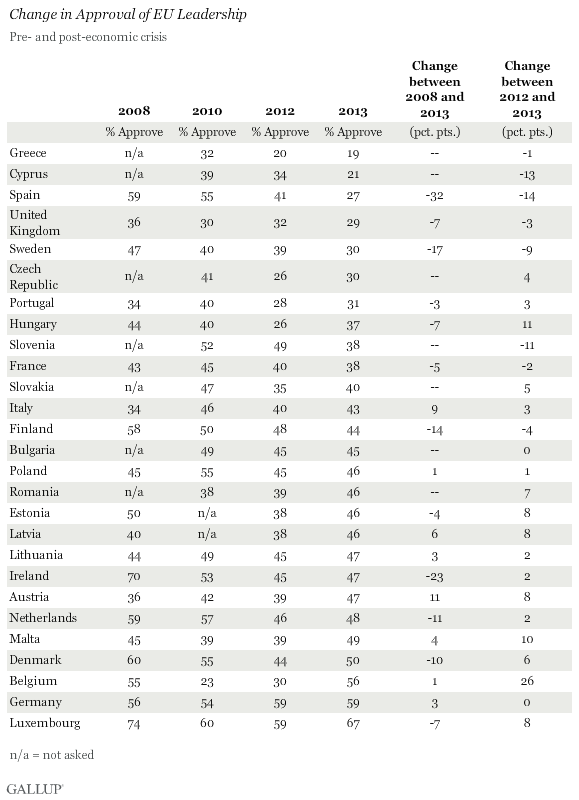
    I see the latest gallup poll here http://www.gallup.com/poll/166757/leadership-approval-record-low-spain-greece.aspx?utm_source=sitemap&utm_medium=rss&utm_campaign=syndication&utm_term=leadership-approval-record-low-spain-greece shows record low levels of support for the EU. As can be seen, the UK is not out not step with other countries, and is not noticeably more "anti-Europe" than other countries.

    r-mi01w6i0-ruqttjtsygw.png


  • Registered Users, Registered Users 2 Posts: 23,283 ✭✭✭✭Scofflaw


    Boroso wrote: »
    I see the latest gallup poll here http://www.gallup.com/poll/166757/leadership-approval-record-low-spain-greece.aspx?utm_source=sitemap&utm_medium=rss&utm_campaign=syndication&utm_term=leadership-approval-record-low-spain-greece shows record low levels of support for the EU. As can be seen, the UK is not out not step with other countries, and is not noticeably more "anti-Europe" than other countries.

    r-mi01w6i0-ruqttjtsygw.png

    Er, first, that appears to be EU leadership rather than the idea of the EU - the question asked was "do you approve or disapprove of the job performance of the leadership of the EU" and frankly I would be answering 'disapprove' to that, although it should be rather obvious I'm not exactly eurosceptical. Second, the EU is suffering from the same scepticism as national governments and parliaments and any other part of the political establishment:

    29zoklw.png

    Third, you appear to have moved seamlessly on to a new talking point without justifying the last couple.

    cordially,
    Scofflaw


  • Banned (with Prison Access) Posts: 79 ✭✭Boroso


    Scofflaw wrote: »
    Er, first, that appears to be EU leadership rather than the idea of the EU, and frankly I would be answering 'disapprove' to that, although it should be rather obvious I'm not exactly eurosceptical. Second, you appear to have moved seamlessly on to a new talking point without justifying the last couple.

    cordially,
    Scofflaw

    Yes, the Gallup poll is new and shiny and fresh. And of course, if anyone wants to imagine that the people in Europe "love the EU , but hate the leadership", then that's entirely a matter for each of us.

    Perhaps what's most interesting is the trend, as one poll in isolation doesnt' really tell us as much as the trend.

    Sure I could repeat what I said about why I think the 14% figure gives a more balanced view of what the UK stands to lose overall. But if you disagree with that view, then we'll have to agree to disagree. Was that the point to which you refer, or was it something else?


  • Registered Users, Registered Users 2 Posts: 640 ✭✭✭PLUG71


    JoeGil wrote: »
    The reasons that strike me are are

    1. Lack of understanding of what Europe is all about. The concept of peaceful respectful cohabitation and as fair as possible distribution of wealth among it's people is difficult to to understand for the british bulldog mentality.

    2. Colonial past means that Britain became accustomed to telling everybody else what to do and can not work easily in a club where everybody else has a say.

    3. The loss of Britain's economic power is made more transparent through European integration and this does not sit well with British pride.

    4. Bigotry towards cultures which deviate from the British norm.

    More anti-brit ****e!:(


  • Advertisement
  • Closed Accounts Posts: 5,361 ✭✭✭Boskowski


    I think the EU suffers from the same problem practically all western democracies suffer from.
    The electorate has stopped trusting and believing in their elected representatives and ultimately stopped trusting that the system actually works as they think it should. They feel democracy has effectively been suspended for quite some time now.
    Political decisions are not beneficial to the majority of people in a lot of cases which surely was the whole idea in the first place. Political decisions are beneficial to lobbying groups who have learned over the years how to work democracy and it's players.
    IWhen the electorate points that out we're being told 'you don't understand, you don't have all the facts, trust us. It's for your own good you just don't know it yet. And in any case what's the alternative - if you don't want hitler or Stalin then better stick with it and shut up'.
    The EU suffers even more from that because their bodies are more remote.
    The local charlatans are still charlatans but at least they're our charlatans. And of course the local ones often justify their actions pointing at the remote ones thus not helping EU popularity either.

    But I think ultimately it's a crisis of the western democracy in general. The EU phobia is just a symptom.


  • Closed Accounts Posts: 9,085 ✭✭✭SpaceTime


    The EU has the added issue of being perceived as quite remote too and the commission isn't directly accountable which doesn't help people trust it.

    There's a well-documented democratic deficit in how the EU operates. It's not anything malevolent, it's just because there's a strong political opposition to a federal system yet it's being expected to take on tasks that are increasingly like a federal government when it isn't designed to function like that.


  • Banned (with Prison Access) Posts: 79 ✭✭Boroso


    SpaceTime wrote: »
    The EU has the added issue of being perceived as quite remote too and the commission isn't directly accountable which doesn't help people trust it.

    No one should be expected to "trust" politicians. The systems should be in place to have checks and balances and leaving things to "trust" is, obviously, asking for trouble.

    The Euro is a good case in point. It was rammed through as a political goal and the economics of the Euro (an economic project) were simply ignored. The effects on countries like Ireland were simply brushed aside for the good of the "grand project", and the people of Europe are put into second place, in second place behind the glory of the project.

    The hubris of that is telling about the way the EU works, and about the mindset of those running the EU.

    As we can see in poll after poll (and even in the Euro barometer polls), the people in the EU as dissatisfied with the way the EU works, there is a growing realisation that the EU is incompetent and damaging to the people of Europe, and the people seem to be coming to a point where they want change, and no longer want to give more and more powers to the EU, and in many cases want to take powers given to the EU back.


  • Closed Accounts Posts: 9,085 ✭✭✭SpaceTime


    I think there's a major problem with how the EU functions but I don't think it's all a bad idea.
    It needs reform and more accountability to the citizens.

    The biggest issue I see is the commission. Each commissioner should be elected rather than just appointed by member state governments.

    The issues that I see are ones created by just constantly coming up with messy workarounds that avoid using anything that might be seen as 'federal' and instead sticking with this super national organisation that is kind of morphing out of an intergovernmental organisation.

    It's either a federal system with accountability or it's an intergovernmental organisation. What it's trying to be at the moment is something between the two.

    Couple that with lousy communications and a perception that it's quite aloof and add in the current economic crisis and you will see why the support rates are so poor.

    I just think we need to be very careful that, like the Seanad, we don't just have a situation where a bunch of people decide well that didn't work let's just abolish it instead of reforming it.


  • Registered Users, Registered Users 2 Posts: 23,283 ✭✭✭✭Scofflaw


    Boroso wrote: »
    Yes, the Gallup poll is new and shiny and fresh. And of course, if anyone wants to imagine that the people in Europe "love the EU , but hate the leadership", then that's entirely a matter for each of us.

    Perhaps what's most interesting is the trend, as one poll in isolation doesnt' really tell us as much as the trend.

    Sure I could repeat what I said about why I think the 14% figure gives a more balanced view of what the UK stands to lose overall. But if you disagree with that view, then we'll have to agree to disagree. Was that the point to which you refer, or was it something else?

    What I was asking for was for you to give a source for the 14% figure. You seem unable to do so?

    If you continue being unable to do so, I'll ask you to stop using it, on the basis that it is presumably made up. It's a little thing we have round these parts, where you don't get to keep using your preferred "facts" unless you can show them to be facts. Your misinterpretation of the Gallup poll does not give much cause for confidence in your reliability on the statistical front.

    cordially,
    Scofflaw


  • Registered Users, Registered Users 2 Posts: 23,283 ✭✭✭✭Scofflaw


    SpaceTime wrote: »
    I think there's a major problem with how the EU functions but I don't think it's all a bad idea.
    It needs reform and more accountability to the citizens.

    The biggest issue I see is the commission. Each commissioner should be elected rather than just appointed by member state governments.

    The issues that I see are ones created by just constantly coming up with messy workarounds that avoid using anything that might be seen as 'federal' and instead sticking with this super national organisation that is kind of morphing out of an intergovernmental organisation.

    It's either a federal system with accountability or it's an intergovernmental organisation. What it's trying to be at the moment is something between the two.

    Couple that with lousy communications and a perception that it's quite aloof and add in the current economic crisis and you will see why the support rates are so poor.

    I just think we need to be very careful that, like the Seanad, we don't just have a situation where a bunch of people decide well that didn't work let's just abolish it instead of reforming it.

    That last just won't happen. I appreciate people will think I simply think it's unthinkable that it should, but I mean that there are too many issues that need to be handled at the European level for there not to be some kind of EU. Even the eurosceptics these days are nominally in favour of an EC, because that has worked well even by their lights, so if the EU in its current form were abolished it would simply be replaced with another version.

    That's part of what makes the whole UK debate unintentionally entertaining, because the things the EU-exit side like to emphasis as being the problems with "the EU" are primarily three - niggling regulations, interference in social issues, and immigration as a drain on the UK economy.

    Of those, the first is largely single market legislation (source of 'straight bananas' rules), the second is almost entirely the non-EU ECHR, and the last has been shown repeatedly to be of benefit to the UK economy as regards EU immigration.

    cordially,
    Scofflaw


  • Closed Accounts Posts: 9,085 ✭✭✭SpaceTime


    It's also quite baffling that the same people who would rant and rave about the EU dictating to them also tend to blame the EU on non-EU immigration too which is entirely a matter for the UK Government as it's not part of any visa union.

    The other thing I come across a lot in the UK though (having lived there) is that the EU is used as a scapegoat for a lot of badly or very harshly implemented regulation too. You find a lot of "Elf and Safety" and trading standards type laws in the UK can be implemented with an iron fist by various quangos who will often refer you to European Union requirements if you make any complaint or query about it.

    It's a handy excuse for local bureaucracies sometimes when they're implementing some new policy that they don't really want to take responsibility for themselves.

    You get a bit of that in the US too where they blame "Washington" for some daft regulation that is being implemented by some state-level board in the most annoying way possible.

    In a lot of cases the issue actually turns out to be a locally generated one.


  • Banned (with Prison Access) Posts: 79 ✭✭Boroso


    SpaceTime wrote: »
    It's also quite baffling that the same people who would rant and rave about the EU dictating to them also tend to blame the EU on non-EU immigration too which is entirely a matter for the UK Government as it's not part of any visa union.

    The other thing I come across a lot in the UK though (having lived there) is that the EU is used as a scapegoat for a lot of badly or very harshly implemented regulation too. You find a lot of "Elf and Safety" and trading standards type laws in the UK can be implemented with an iron fist by various quangos who will often refer you to European Union requirements if you make any complaint or query about it.

    It's a handy excuse for local bureaucracies sometimes.

    And yet that doesn't explain why there is growing and substantial opposition to the EU across the other countries in the EU.


  • Registered Users, Registered Users 2 Posts: 23,283 ✭✭✭✭Scofflaw


    SpaceTime wrote: »
    It's also quite baffling that they tend to blame the EU on non-EU immigration too which is entirely a matter for the UK Government as it's not part of any visa union.

    The one thing I come across a lot in the UK though (having lived there) is that the EU is used as a scapegoat for a lot of badly or very harshly implemented regulation too. You find a lot of "Elf and Safety" and trading standards type laws in the UK can be implemented with an iron fist by various quangos who will often refer you to European Union requirements if you make any complaint or query about it.

    It's a handy excuse for local bureaucracies sometimes.

    The UK has, I think, one of the most egregious records for 'gold-plating' EU legislation, or for interpreting it in a very rigid way.

    There's rather a good report by the UK's Institute of Directors called "The Midas Touch", which finds that, contrary to government claims, UK governments regularly gold-plate EU law:
    European legislation is frequently blamed for the adverse effects that it has on UK competitiveness and often rightly so. By way of example, as I write, a General Regulation on Data Protection continues to progress through the European institutions. If implemented this EU imposition could spell immeasurable damage to UK businesses.

    Despite these very real concerns regarding legislation originating in the EU, far too many UK Governments have hidden their own regulatory zeal behind a ‘fig leaf’ of enforced European requirements.

    Successive Governments have reached the conclusion that gold-plating of EU rules is not as bad as claimed by industry; and some administrations have even professed to having eradicated the practice altogether. However, this report’s comparison between EU Directives and their corresponding UK employment legislation shows that over-compliance is significant, common and in cases, still being added to.

    http://www.iod.com/~/media/Documents/PDFs/Influencing/Regulation%20employment/2013/The_Midas_Touch

    As you can see from the overall tone, it's rather hard to characterise the IoD as a bunch of simpering europhiles, although that won't necessarily prevent someone doing so, of course.

    cordially,
    Scofflaw


  • Closed Accounts Posts: 9,085 ✭✭✭SpaceTime


    Boroso wrote: »
    And yet that doesn't explain why there is growing and substantial opposition to the EU across the other countries in the EU.

    Many of the same reasons apply elsewhere too.

    The biggest reason for growing annoyance at the moment is the economic situation which is being blamed on the EU by a lot of commentators.

    The EU didn't really handle it as well as it should and the Euro integration project certainly created a few bubbles of its own and accelerated some of the problems. However, the main problem was lack of banking regulation both within and outside the EU.

    Banks got rather crazy with new ways of raising money on the markets and the whole thing was running way ahead of regulation.

    I think to be perfectly honest the Greeks in particular are being quite unfair in their criticism of the EU and Germany who have bailed them out over and over. If they want to point a finger at anyone, it's their own corrupt and incompetent governments that they elected over the last 30+ years.

    Nobody forced Greece to borrow billions and billions that they couldn't pay back and when they couldn't pay, they were propped up substantially.

    If they'd wanted to leave the EU or the Eurozone nobody was really going to stop them. In fact, many people would have been delighted I suspect.

    You can see how the Germans are getting annoyed because they're seeing lots of their money going to Greece to pay off debts and the Greeks are going around burning German flags and accusing them of being a big bunch of Nazis. From a German perspective, they see themselves as showing huge solidarity towards Greece and getting slapped in the face for it.

    I think in Ireland we are a hell of a lot more realistic about what actually happened. The blame's firmly and squarely on the administration at the time the lack of regulation and the speculators and bankers.

    I just think in typical European fashion, we've a financial crisis and everyone's blaming all the wrong things. Europeans have a along history of being whipped into hysterical reactions to situations like this and causing wars over them. I would be very concerned with the rise of extreme right wing politics in several countries that is coming about due to this crisis.

    It wasn't caused by the EU, it wasn't caused by immigration - it was caused by lack of regulation and crazy financial speculation gone mad in quite a few countries.


  • Advertisement
  • Registered Users, Registered Users 2 Posts: 23,283 ✭✭✭✭Scofflaw


    Boroso wrote: »
    And yet that doesn't explain why there is growing and substantial opposition to the EU across the other countries in the EU.

    The existence of a crisis invariably produces opposition to the establishment. As I already pointed out, the growth in opposition to the EU (more dislike or distrust, really) over the crisis period has been matched or exceeded by growth in dislike or distrust of national governments and parliaments over the same period.

    I know you'd like the rise to be meaningful, and based on principled opposition to the idea of the EU, but it almost certainly isn't, and the apparent strength of the anti-EU cause in Europe is likely to fade away as the crisis recedes.

    This is your moment - use it wisely!

    cordially,
    Scofflaw


  • Banned (with Prison Access) Posts: 79 ✭✭Boroso


    SpaceTime wrote: »
    Many of the same reasons apply elsewhere too.

    The biggest reason for growing annoyance at the moment is the economic situation which is being blamed on the EU by a lot of commentators.

    The EU didn't really handle it as well as it should and the Euro integration project certainly created a few bubbles of its own and accelerated some of the problems. However, the main problem was lack of banking regulation both within and outside the EU.

    Banks got rather crazy with new ways of raising money on the markets and the whole thing was running way ahead of regulation.

    I think to be perfectly honest the Greeks in particular are being quite unfair in their criticism of the EU and Germany who have bailed them out over and over. If they want to point a finger at anyone, it's their own corrupt and incompetent governments that they elected over the last 30+ years.

    Nobody forced Greece to borrow billions and billions that they couldn't pay back and when they couldn't pay, they were propped up substantially.

    If they'd wanted to leave the EU or the Eurozone nobody was really going to stop them.

    I think in Ireland we are a hell of a lot more realistic about what actually happened. The blame's firmly and squarely on the administration at the time the lack of regulation and the speculators and bankers.

    It's not just about Greece or any individual country. We can see from the Euro Barometer polls or the Gallup poll above that it's large proportions of the populations in almost every country, and a majority in many counties who are increasingly dissatisfied with the EU.

    I have no idea if the Greeks are being unfair, or not. And even if they are being unfair, they are allowed to be unfair in a democracy. We all have to make up our own minds on whatever criteria we wish to use to make up our own minds, and even if someone uses criteria we think is "unfair" their vote has rthe same value as someone who we think makes up their mind on "fair" criteria.


  • Closed Accounts Posts: 9,085 ✭✭✭SpaceTime


    I would actually also add with regard to the UK. It had possibly the biggest incident of social unrest in modern history - the London Riots and from what I've seen there is absolutely no analysis of why that happened going on.
    It's just being put down to 'oh a bunch of roughians of some sort'.

    There's something very, very disconnected about an aspect of British society at the moment and it's down to lack of economic opportunity and social exclusion largely. If you're somewhere like London you're also finding that accommodation is becoming totally inaccessible to most people on normal incomes.

    All that stuff is causing huge strife in British society and it's not being addressed in a reasonable way and instead outrage is being focused on immigration, the EU and general xenophobia from what I can see.


  • Closed Accounts Posts: 9,085 ✭✭✭SpaceTime


    Boroso wrote: »
    It's not just about Greece or any individual country. We can see from the Euro Barometer polls or the Gallup poll above that it's large proportions of the populations in almost every country, and a majority in many counties who are increasingly dissatisfied with the EU.

    Yeah, but a large amount of that is being driven by a perception that the Greek, Spanish, Portuguese etc situations are being directly caused by the EU or the Euro.

    In the countries with economic crisis situations, the EU's being seen as some kind of malevolent power that's causing the problem because certain countries aren't willing to admit that they drove their economies off a cliff through excessive borrowing (either through property - Ireland, Spain etc or state : Greece and Italy)

    While in the countries with well-run economies, you're seeing a very strong degree of "why are we paying for this??" and an increasing lack of solidarity towards those countries, particularly Greece due to the reaction that has been seen on the streets e.g. burning flags, effigies of Merkel etc.


  • Banned (with Prison Access) Posts: 79 ✭✭Boroso


    SpaceTime wrote: »
    Yeah, but a large amount of that is being driven by a perception that the Greek, Spanish, Portuguese etc situations are being directly caused by the EU or the Euro.

    I think its very brave to claim you know why motivates millions of others in many countries. For me I am less interested in guessing what might drive others perceptions, and more interested in the trends and what they tell us.


  • Closed Accounts Posts: 9,085 ✭✭✭SpaceTime


    Boroso wrote: »
    I think its very brave to claim you know why motivates millions of others in many countries. For me I am less interested in guessing what might drive others perceptions, and more interested in the trends and what they tell us.

    Well, the only things that have changed in the past few years are regarding the economic crash and public opinion shifted rapidly after that.

    So, I think it's not really 'brave' to make a conclusion that the two are quite likely strongly connected.

    If you read any public opinion polling from the 'wealthier' countries (non crisis hit ones) you'll find it's mostly upset about having to foot a bill.

    If you read any similar polls from Spain, Greece, Ireland etc.. it's all about external interference.


  • Registered Users, Registered Users 2 Posts: 23,283 ✭✭✭✭Scofflaw


    SpaceTime wrote: »
    Well, the only things that have changed in the past few years are regarding the economic crash and public opinion shifted rapidly after that.

    So, I think it's not really 'brave' to make a conclusion that the two are quite likely strongly connected.

    If you read any public opinion polling from the 'wealthier' countries (non crisis hit ones) you'll find it's mostly upset about having to foot a bill.

    If you read any similar polls from Spain, Greece, Ireland etc.. it's all about external interference.

    Also the effect of recessions on trust in the political establishment is really rather well known.

    cordially,
    Scofflaw


  • Registered Users, Registered Users 2 Posts: 2,398 ✭✭✭McDave


    sin_city wrote: »
    They have good reason to be anti EU.

    Just look at how Norway and Switzerland do without being in the EU.

    It was great for Ireland. We got so much free money.

    Only problem for us was when the EU didnt respect our right to vote no in treaties and made us return with the correct vote
    If Norway didn't have North Sea oil, they'd very likely be in the EU.

    Switzerland is a different matter. It has ploughed a particular furrow throughout its existence, but one not many others would be able to do without ultimately beggaring each other and their neighbours. Indeed, Switzerland's special status may be coming to an end.

    As for Nice 2 and Lisbon 2, those were initiatives taken by Irish governments after appallingly complacent initial campaigns. The electorates endorsed both referenda both times, and resoundingly so in Lisbon 2. No Sir, the EU didn't made us done it!


  • Closed Accounts Posts: 9,085 ✭✭✭SpaceTime


    Iceland's the only really odd one in that regard. Although they're so small, it's hard to compare to anything else really.
    Co. Cork's got a bigger population and economy


  • Advertisement
  • Registered Users, Registered Users 2 Posts: 23,283 ✭✭✭✭Scofflaw


    SpaceTime wrote: »
    Iceland's the only really odd one in that regard. Although they're so small, it's hard to compare to anything else really.
    Co. Cork's got a bigger population and economy

    They have a very large and fertile sea area in comparison to population. Mind you, Greenland also opted out of the EU, so perhaps there's something else at work there too.

    cordially,
    Scofflaw


Advertisement
Advertisement