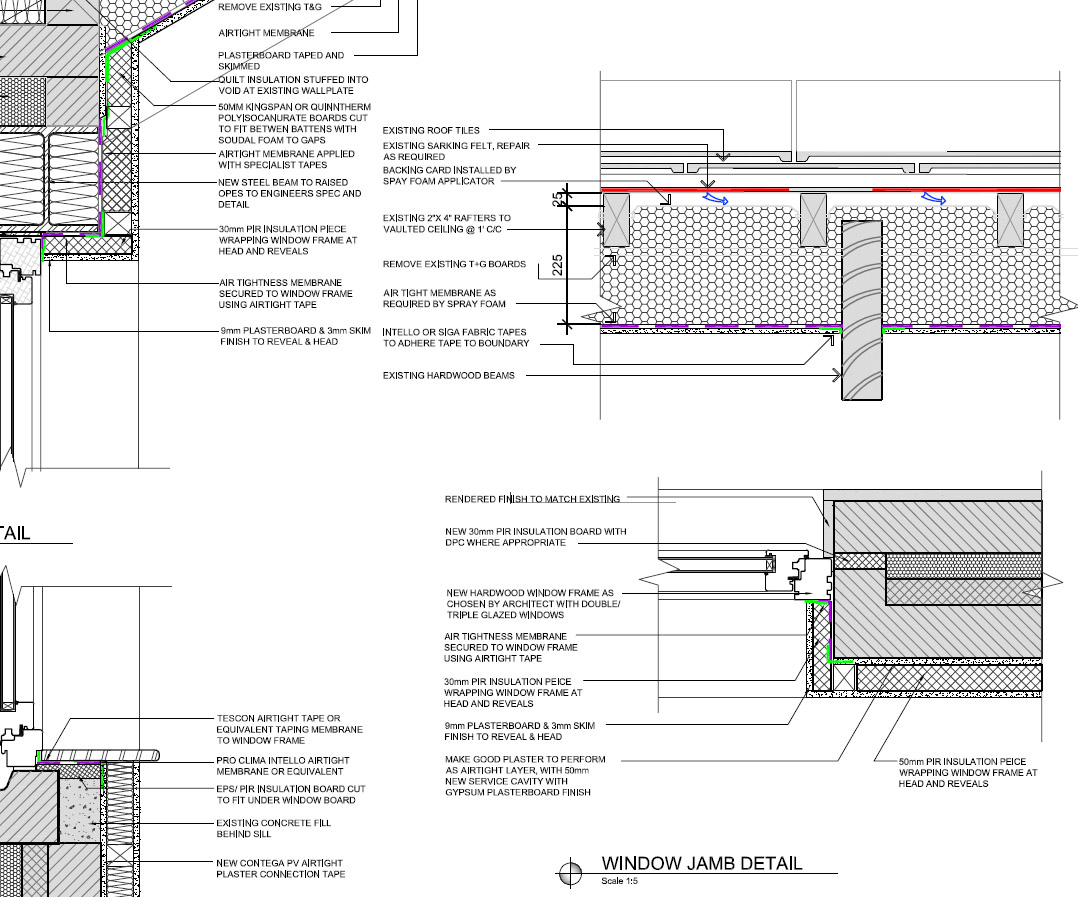
Advertisement
Help Keep Boards Alive. Support us by going ad free today. See here: https://subscriptions.boards.ie/.
https://www.boards.ie/group/1878-subscribers-forum

Private Group for paid up members of Boards.ie. Join the club.
Hi all, please see this major site announcement: https://www.boards.ie/discussion/2058427594/boards-ie-2026

Icynene spray foam between roof joists

2»

Comments

  • Registered Users, Registered Users 2 Posts: 630 ✭✭✭ceekay74


    sinnerboy wrote: »
    Our building regulations require that roofs are ventilated to remove this condensation. Condensation which is 100% gaurenteed to happen.

    This image is reasonable summary of what our regs require

    Swish-Building-Regs-Images-.jpg


    The second diagram shows her attic type and it seems to me (as she doesn't want any more insulation rolled out over her floor) that the best and safest option for her is to get breathable vent cards fitted with the icynene sprayed on then.


  • Registered Users, Registered Users 2 Posts: 619 ✭✭✭batman1


    The second diagram shows her attic type and it seems to me (as she doesn't want any more insulation rolled out over her floor) that the best and safest option for her is to get breathable vent cards fitted with the icynene sprayed on then.

    If you read through sinnerboy's posts, it makes sense not to use the foam. As he said condensation will occur on the rafter vents instead of the felt.

    If my house was not a dormer, but a 'normal' roof over the whole house which your mother's seems to be, then I would look to insulate the attic floor, or upgrade the attic floor insulation. If storage is a problem then the floor can be raised above the insulation. WHat about blown in cellulose or rockwool

    My problem is draughts in the crawlspaces but hopefully I will find a reasonable solution to at least reduce them. For the price of the foam for me (€18/sqm+VAT) I can hopefully do a job that won't have the risk of condensation down the line and will make the house more comfortable.


  • Subscribers, Paid Member Posts: 44,924 ✭✭✭✭sydthebeat


    an issue i have with spray foam is one that hasnt been mentioned here yet.

    Felt sags between rafters, and in doing so creates a natural drainage channel to allow water flow down to the eaves. Wind driven rain WILL be blown back under slates or tiles, its a given.

    When you spray foam on the underside of this felt, you invert this channel. What you actually create is a 'bowing' of the felt where the drainage channel is formed directly over the rafter. This is exactly where you DO NOT want the water to flow. Remember that this is also the area where the felt is fixed to the rafter by nailing. So you have a perfect storm of issues here:
    1. the foam will direct vapour to the easiest exhaust point, the rafter.
    2. the felt no longer drains what away from the rafter, but actually directs it on top.
    3. This water is allowed to drain over the most vulnerable part of the felt, the nail points.

    so in each of these three issues the rafter becomes vulnerable to moisture damage, and as its now surrounded on 80% by water resistant material its eve more prone to damage.


  • Registered Users, Registered Users 2 Posts: 630 ✭✭✭ceekay74


    sydthebeat wrote: »
    When you spray foam on the underside of this felt, you invert this channel.

    But the foam will be sprayed onto vent cards in this case.


  • Registered Users, Registered Users 2 Posts: 558 ✭✭✭beyondpassive


    I've used sprayfoam insulation on a recent renovation and would only specify it with a plastic card backing and a vapour control layer. By using the card, the timber gets enough exposed surface to breath.

    Renovation.jpg
    Sprayfoam roof.jpg
    Sprayfoam roof-2.jpg


  • Advertisement
  • Subscribers, Paid Member Posts: 44,924 ✭✭✭✭sydthebeat


    ceekay74 wrote: »
    But the foam will be sprayed onto vent cards in this case.

    ever seen them applied?


  • Registered Users, Registered Users 2 Posts: 619 ✭✭✭batman1


    With all these issues taken on board, in my case it doesn't seem to be the way to go, or indeed for the op.

    As an alternative can an open cell foam be used on the attic floor, or in my case the floor of the crawlspace and dwarf walls provided the ventilation is maintained from eaves as it is at the moment?

    Would cellulose be suitable for reducing draughts or another blown in type such as rockprime?


  • Registered Users, Registered Users 2 Posts: 1,282 ✭✭✭sas


    batman1 wrote: »
    Would cellulose be suitable for reducing draughts or another blown in type such as rockprime?

    If you've ready done this then feel free to ignore me.

    Any chance you could put a sketch together (in section) of your specific build up and the issue you have? It would help people advise.


  • Registered Users, Registered Users 2 Posts: 619 ✭✭✭batman1


    sas wrote: »

    If you've ready done this then feel free to ignore me.

    Any chance you could put a sketch together (in section) of your specific build up and the issue you have? It would help people advise.

    I'll give it a go. What's the easiest way to upload it as I am not a computer whizz?


  • Subscribers, Paid Member Posts: 44,924 ✭✭✭✭sydthebeat


    hand sketch and scan would probably be the easiest.

    then when you "post reply" pull the screen down a tad and you will see "manage attachments" tool. Just attached the scanned jpeg using this.


  • Advertisement
  • Registered Users, Registered Users 2 Posts: 630 ✭✭✭ceekay74


    sydthebeat wrote: »
    ever seen them applied?

    nope. have you?


  • Subscribers, Paid Member Posts: 44,924 ✭✭✭✭sydthebeat


    if left to the spray foam supplier, the cards are held in place by a bead of spray foam along the rafter... so the same issue exists re creating the channel over the rafter.


  • Registered Users, Registered Users 2 Posts: 630 ✭✭✭ceekay74


    sydthebeat wrote: »
    if left to the spray foam supplier, the cards are held in place by a bead of spray foam along the rafter... so the same issue exists re creating the channel over the rafter.

    oh, thanks! will have to keep an eye out for that.


  • Subscribers, Paid Member Posts: 44,924 ✭✭✭✭sydthebeat


    you should make sure that the vent card is of a type that is fixed directly to the rafter.


  • Closed Accounts Posts: 5,433 ✭✭✭sinnerboy


    @ ceekay74
    Sounds like after all that has been posted that you are going to proceed with this foam spray . If so why ?


  • Registered Users, Registered Users 2 Posts: 630 ✭✭✭ceekay74


    sinnerboy wrote: »
    @ ceekay74
    Sounds like after all that has been posted that you are going to proceed with this foam spray . If so why ?

    My main concern was some cowboy spraying foam willy-nilly all over my mothers attic, taking her money, and causing problems for the timber in her attic. I know for sure that ventilation is needed in an attic space so suspected the sales rep was talking out his ar$e about spraying directly onto the felt.

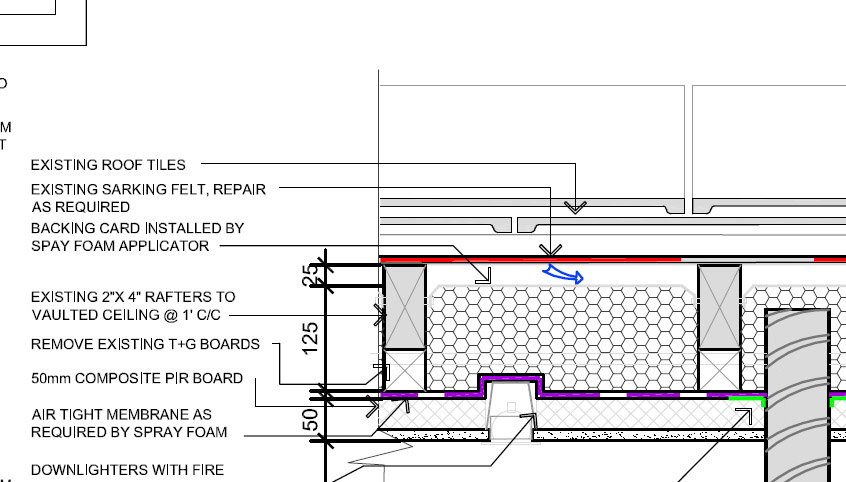
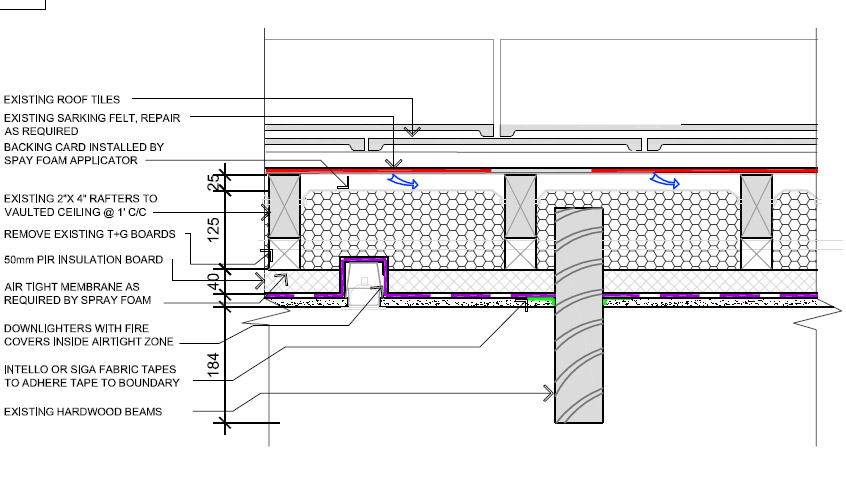
    The concept of tiles, felt, 50mm gap, vent cards, foam, and a VCL makes sense to me and after talking to another company (a reputable one!) my concerns are gone.

    If it was my house, I would have gone with increased insulation on the floor (mainly because its alot cheaper). But it's not my decision, and as mother spent a bit of cash getting a proper floor installed in the attic only 2 years ago, she wants to keep the floor as it is.

    Thanks everyone for your input.


  • Registered Users, Registered Users 2 Posts: 619 ✭✭✭batman1


    Good luck with your mother's house. Hope it does the trick.

    In relation to the foam, if applied at ceiling level I'm assuming the condensation problem would be overcome once the attic ventilation is maintained, as water vapour will travel up through the foam, if it's open cell and breathable, and removed by the natural ventilation the same as any other ceiling level insulation.


  • Closed Accounts Posts: 5,433 ✭✭✭sinnerboy


    I've used sprayfoam insulation on a recent renovation and would only specify it with a plastic card backing and a vapour control layer. By using the card, the timber gets enough exposed surface to breath.

    Any reliable data (BS/EN) to quantity and verify this bp?


  • Closed Accounts Posts: 5,433 ✭✭✭sinnerboy


    ceekay74 wrote: »
    My main concern was some cowboy spraying foam willy-nilly all over my mothers attic, taking her money, and causing problems for the timber in her attic. I know for sure that ventilation is needed in an attic space so suspected the sales rep was talking out his ar$e about spraying directly onto the felt.

    The concept of tiles, felt, 50mm gap, vent cards, foam, and a VCL makes sense to me and after talking to another company (a reputable one!) my concerns are gone.

    If it was my house, I would have gone with increased insulation on the floor (mainly because its alot cheaper). But it's not my decision, and as mother spent a bit of cash getting a proper floor installed in the attic only 2 years ago, she wants to keep the floor as it is.

    Thanks everyone for your input.

    Lets suppose your mothers rafters are 125mm deep. This leaves 75mm for insulation. The stiff PIR boards have ( a lot ) better thermal conductivity values but more importantly if they dislodge upwards to close the 50mm vent gap this will be obvious to see and rectify. Unless you actively supervise the installation of the cards and spray foam you cannot have the same confidence.


  • Registered Users, Registered Users 2 Posts: 630 ✭✭✭ceekay74


    sinnerboy wrote: »
    Lets suppose your mothers rafters are 125mm deep. This leaves 75mm for insulation. The stiff PIR boards have ( a lot ) better thermal conductivity values but more importantly if they dislodge upwards to close the 50mm vent gap this will be obvious to see and rectify. Unless you actively supervise the installation of the cards and spray foam you cannot have the same confidence.

    A.B.S.F. :pac::pac:

    I'll be there at the installation so will get to see all stages.

    Thanks again!


  • Advertisement
  • Registered Users, Registered Users 2 Posts: 21 Dully


    Interesting threat.
    My 5cent worth:
    If you insulate an attic at rafter level, you do turn the "cold" attic into a warm roof. It is the last line of insulation that counts as your thermal envelope.
    Side effects are:
    your former insulation layer (if there was any) on ceiling / joist level turns into an intermediate floor.
    You heat your attic in addition to your living space, you actually heat more volume than you did before and you get an increased area of external envelope.
    This might effect your BER as well as your heating bill.
    It is by far easier to insulate on joist level than it is at rafter level.

    Regarding the spray foam:
    I`ve read through a lot of certs, all of them stating that a VCL is required on the warm side, unless exception like stated by Sinnerboy. This is actually in line with building physics and makes sense regarding risk of condensation. You wouldn´t install any other breathable insulation without a VCL, so why spray foam?
    Another thing to ask you / to think about:
    If breathable foam is not supposed to be sprayed onto diffusiontight bitumen felt, how do PVC trays improve this situation ;) ?
    Well, not at all... the gap created for ventilation will never kick in as moisture will not get that far being stopped by PVC trays instead of bitumen felt.


  • Registered Users, Registered Users 2 Posts: 14,547 ✭✭✭✭Poor Uncle Tom


    Dully wrote: »
    Another thing to ask you / to think about:
    If breathable foam is not supposed to be sprayed onto diffusiontight bitumen felt, how do PVC trays improve this situation ;) ?
    Well, not at all... the gap created for ventilation will never kick in as moisture will not get that far being stopped by PVC trays instead of bitumen felt.
    the 50mm air gap is meant to provide ventilation to the roofing timbers, not the roof space.


  • Registered Users, Registered Users 2 Posts: 21 Dully


    the 50mm air gap is meant to provide ventilation to the roofing timbers, not the roof space.

    It still does not deal with the condensation issue you get where the foam touches the trays and thereby I do not fully understand why one would go that route.
    Given there is no VCL installed on the warm side of the foam (like it is the case in 99.9%) moisture gets into the foam, cools down, condensates on the outside of the foam, is blocked by the trays, finds it way into the rafters, bypasses the trays through the rafters and is then ventilated away using a 50mm air gap which has no ridge vent and thereby no stack / chimney effect??? Would you really rely on that?
    It also does not solves condenstaion issues that might arise underneath the old bitumen felt as it might happen in certain circumstances.


  • Registered Users, Registered Users 2 Posts: 619 ✭✭✭batman1


    Having posted here and taken on board comments and opinions, I opted for cellulose instead of foam and it seems to be a good job.


  • Registered Users Posts: 64 ✭✭shianto


    Firstly thank you to everyone for running this thread. It is very timely as I am about to convert my attic space and need to make a call on the insulation.

    I looked at the traditional methods - fibreglass and kingspan etc, but over the last two days I had two different companies who offer icynene solutions. Going back to what I can see is one of the biggest points of contention of this thread is whether you can spray it directly onto the roof felt... never be content to listen to contractors I did some digging and if I am reading correctly http://www.icynene.com/sites/default/files/downloads/Moisture-Design-Strategies_0.pdf the LD-C 50 product (which is what would be used in an attic space) can be sprayed directly onto the felt.

    I take the point that sydthebeat made about gullying, but surely a small amount of pooling would occur normally in any case, no?

    Thanks for your responses.


  • Registered Users Posts: 64 ✭✭shianto


    Sorry to everyone, I have since found this thread: http://www.boards.ie/vbulletin/showthread.php?p=74653909 which I think addresses my question (any then a lot more).. Feel free to responded further though if you believe there is some updated thinking given the age of the thread...


  • Registered Users, Registered Users 2 Posts: 4,027 ✭✭✭horse7


    What thickness is required (foam) have been quoted 150mm plus 50mm for vent card.


Advertisement
Advertisement