Advertisement
Help Keep Boards Alive. Support us by going ad free today. See here: https://subscriptions.boards.ie/.
https://www.boards.ie/group/1878-subscribers-forum

Private Group for paid up members of Boards.ie. Join the club.
Hi all, please see this major site announcement: https://www.boards.ie/discussion/2058427594/boards-ie-2026

Icynene spray foam between roof joists

  • 15-11-2012 01:55PM
    #1
    Registered Users, Registered Users 2 Posts: 630 ✭✭✭


    Just looking for an informed opinion as I'm no expert.

    Basically, an insulation company called to my mothers house at her request to look at her attic. The attic is floored with some insulation beneath the floor and she wants to keep it that way.

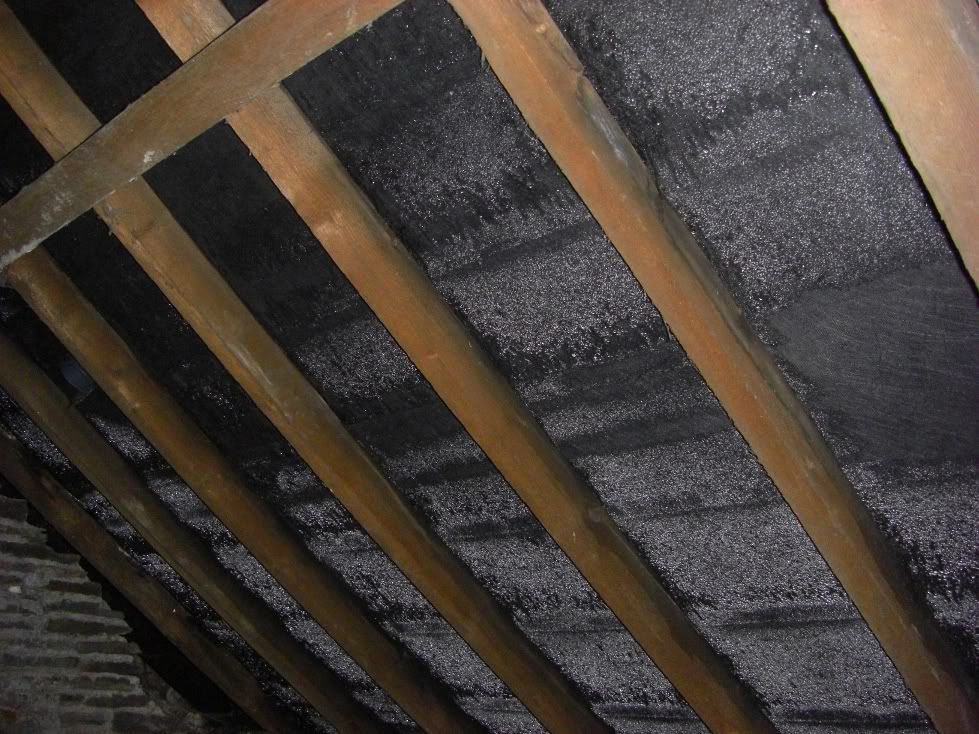
    So Icynene is being recommended to be sprayed between the roof joists and will be then cut back to be level with the joists. There will be no plaster board put over the job.

    The company rep has said the felt they would be spraying onto is breathable, but I wouldn't be sure about that, as far as I know, it is the original felt from when the house was built in the 1970's.

    My main worry is with condensation rotting the joists though. The rep said the attic space would be completely sealed. Surely this causes ventilation issues??

    Any help will be appreciated.


«1

Comments

  • Registered Users, Registered Users 2 Posts: 1,282 ✭✭✭sas


    ceekay74 wrote: »
    Just looking for an informed opinion as I'm no expert.

    Basically, an insulation company called to my mothers house at her request to look at her attic. The attic is floored with some insulation beneath the floor and she wants to keep it that way.

    So Icynene is being recommended to be sprayed between the roof joists and will be then cut back to be level with the joists. There will be no plaster board put over the job.

    The company rep has said the felt they would be spraying onto is breathable, but I wouldn't be sure about that, as far as I know, it is the original felt from when the house was built in the 1970's.

    My main worry is with condensation rotting the joists though. The rep said the attic space would be completely sealed. Surely this causes ventilation issues??

    Any help will be appreciated.

    My parents had a company out to quote to insulate their attic recently. That company was going to blow glass wool on the flat. The price for 76m2 for 200mm was €575 inc vat.

    They didn't mention anything to my parents about the need to not bury certain power cables (the one serving the shower etc.). I rang them as I wasn't happy. They weren't going to install vent trays at the eaves, just leave the insulation out "every so often". I raised the power cable issue with them and then they admitted that you needed to be careful of any cable carrying more than 2 bar. I wasn't aware of any measure of electrical load measured in pressure units....

    I had them use a company I recommended. They paid more than twice as much but got a top class job. They admitted afterwards that they could see why I recomended the alternative company.

    At 575 euro for 2 people and material, they would literally have f***ed the insulation in over anything and everything and disappeared over the horizon.

    My point being that the average person knows nothing insulation, ventilation. They assume that if something is available, it's reputable and suitable and all due diligence will be done. Companies prey on this.

    In my opinion your concerns are very well founded and your mother is lucky to have you watching out for her.


  • Registered Users, Registered Users 2 Posts: 619 ✭✭✭batman1


    Just looking for an informed opinion as I'm no expert.

    Basically, an insulation company called to my mothers house at her request to look at her attic. The attic is floored with some insulation beneath the floor and she wants to keep it that way.

    So Icynene is being recommended to be sprayed between the roof joists and will be then cut back to be level with the joists. There will be no plaster board put over the job.

    The company rep has said the felt they would be spraying onto is breathable, but I wouldn't be sure about that, as far as I know, it is the original felt from when the house was built in the 1970's.

    My main worry is with condensation rotting the joists though. The rep said the attic space would be completely sealed. Surely this causes ventilation issues??

    Any help will be appreciated.

    I was looking at this option also. Had an engineer friend look into it as I also have non-breathable felt.

    The product you refer to is the ONLY sprayfoam certified for spraying directly onto felts. Just recently it has gained certification from the BBA (uk) and Ireland's IAB for just this type of applicaton. I had the very same concerns about rot etc and, having done loads (and I mean loads) of research into it I have no doubt that it is suitable for me.

    With any product like that which is relatively new on the Irish market, there will be scaremongering among th professionals. Don't forget that the professionals built the wprst quality houses i Europe for years in this country, hence the need for everyone to be retrofitting insulation.

    Sprayfoam has been in use for decades in Europe and America with no issues.

    However, during my research I concluded that the Icynene was the best (and dearest!).

    Have a look at their certs and ring the technical guy and he will fill you in. If you still have queries then contact the IAB and BBA in th Uk. They are most helpful.


  • Registered Users, Registered Users 2 Posts: 630 ✭✭✭ceekay74


    The price quoted was not far off €1,500 for the job, don't know the m2 but its an average size 3 bedroom semi-d in dublin 24.

    Can you pm me the company you got them to use in the end? Might be worth asking them to call out too.


  • Registered Users, Registered Users 2 Posts: 630 ✭✭✭ceekay74


    batman1 wrote: »
    Just looking for an informed opinion as I'm no expert.

    Basically, an insulation company called to my mothers house at her request to

    I was looking at this option also. Had an engineer friend look into it as I also have non-breathable felt.

    The product you refer to is the ONLY sprayfoam certified for spraying directly onto felts. Just recently it has gained certification from the BBA (uk) and Ireland's IAB for just this type of applicaton. I had the very same concerns about rot etc and, having done loads (and I mean loads) of research into it I have no doubt that it is suitable for me.

    With any product like that which is relatively new on the Irish market, there will be scaremongering among th professionals. Don't forget that the professionals built the wprst quality houses i Europe for years in this country, hence the need for everyone to be retrofitting insulation.

    Sprayfoam has been in use for decades in Europe and America with no issues.

    However, during my research I concluded that the Icynene was the best (and dearest!).

    Have a look at their certs and ring the technical guy and he will fill you in. If you still have queries then contact the IAB and BBA in th Uk. They are most helpful.

    Thanks for that, how were your concerns about the rot/ventilation put to rest?


  • Registered Users, Registered Users 2 Posts: 88 ✭✭duffman21


    Hi ceekay,

    i had to make the same decision last year. I too had some concerns with regards spraying directly onto the felt along with what sprayfoam to choose see this thread
    http://www.boards.ie/vbulletin/showthread.php?p=74653909

    in the end i went with the icynene spray and used the vent cards.

    Have to say delighted with the job!


  • Advertisement
  • Registered Users, Registered Users 2 Posts: 1,282 ✭✭✭sas


    ceekay74 wrote: »
    Thanks for that, how were your concerns about the rot/ventilation put to rest?

    WHile it will appear that I am on a mission here, I'm not.

    My concern is the entire sealing up of the attic with the foam, not the specifics of the product. If it's sealed, moisture will get trapped.


  • Registered Users, Registered Users 2 Posts: 619 ✭✭✭batman1


    What will happen is that your cold roof structure will be turned into a warm roof structure. It must be noted that the habitable area of a house must have adequate ventilation in any case. This natural ventilation (in your new warm roof ) will not cause damp or rot. I have seen 2 houses that had Icynene foam retrofitted in this way and although the attiic was nice and warm, it certainly was no more damp than the rest of the house. Does moisture get trapped in the house anywhere else?

    Although breathable, the foam does not allow moisture laden air pass through it naturally, due to low permeability. (Complicated to explain here but simple really!!)

    If you can, go to a really old building. In many of those older buildings the space between the rafters was filled with render. This made them airtight. Those roofs are hundreds of years old.

    I was not convinced about the foam until I looked further into it. I am now planning on getting it done in the new year.
    My advice is to go onto their website and study their certs and information. Ring the technical department.


    full BBA Certification for direct application to breathable and non breathable felts and membranes”. Icynene is the only product on the market safe for this application


  • Registered Users, Registered Users 2 Posts: 1,282 ✭✭✭sas


    batman1 wrote: »
    What will happen is that your cold roof structure will be turned into a warm roof structure. It must be noted that the habitable area of a house must have adequate ventilation in any case. This natural ventilation (in your new warm roof ) will not cause damp or rot. I have seen 2 houses that had Icynene foam retrofitted in this way and although the attiic was nice and warm, it certainly was no more damp than the rest of the house. Does moisture get trapped in the house anywhere else?

    I'm no expert but I don't see any expert here so far so I'll keep going...

    A warm roof typically has a vapour control layer on the inside to protect the structure. If the foam has low permeability, then the timber joists themselves become the moisture path to outside.

    Most houses are very poorly ventlilated, there's a constant trickle of threads here with people describing moisture issues.

    As I understand it, the concern here isn't based on catastrophic failure within a year or 2, it's based on the roof potentially slowly rotting over the longer term.
    batman1 wrote: »
    If you can, go to a really old building. In many of those older buildings the space between the rafters was filled with render. This made them airtight. Those roofs are hundreds of years old.

    This keeps getting thrown up to support arguments here and it fundamentally misses a point. Old buildings were reallly really drafty, they have fabulously efficient levels of ventlilation.
    batman1 wrote: »
    I was not convinced about the foam until I looked further into it. I am now planning on getting it done in the new year.
    My advice is to go onto their website and study their certs and information. Ring the technical department.

    Both the BBA and IAB certs linked off their website state that a vapour control layer is recommended unless an assessment determines it's not. Getting an independent assessment is just not something I can see many people doing.

    Very best of luck with this.


  • Registered Users, Registered Users 2 Posts: 630 ✭✭✭ceekay74


    sas wrote: »
    I'm no expert but I don't see any expert here so far so I'll keep going...

    A warm roof typically has a vapour control layer on the inside to protect the structure. If the foam has low permeability, then the timber joists themselves become the moisture path to outside.

    Most houses are very poorly ventlilated, there's a constant trickle of threads here with people describing moisture issues.

    As I understand it, the concern here isn't based on catastrophic failure within a year or 2, it's based on the roof potentially slowly rotting over the longer term.


    This keeps getting thrown up to support arguments here and it fundamentally misses a point. Old buildings were reallly really drafty, they have fabulously efficient levels of ventlilation.


    Both the BBA and IAB certs linked off their website state that a vapour control layer is recommended unless an assessment determines it's not. Getting an independent assessment is just not something I can see many people doing.

    Very best of luck with this.


    Thanks for your input sas, do you know if vent cards are a vapour control layer??


  • Closed Accounts Posts: 5,433 ✭✭✭sinnerboy


    sas, you do a fine impersonation :)
    Condensation risk — the product will contribute to minimising the risk of surface condensation and interstitial condensation driven by convection, but has a low µ value (between 2 and 5) and should be used with a vapour control layer (VCL)
    7.1 The product is combustible and must be protected from naked flames and other ignition sources during and
    after installation.

    From here

    Vent cards are NOT a VCL

    Placing (any sort of ) insulation between any roof joists ( flat or pitched ) does not make the roof a warm roof. You only create a warm roof by placing insulation over the roof timbers.

    warm-roof_000.gif


  • Advertisement
  • Registered Users, Registered Users 2 Posts: 619 ✭✭✭batman1


    7.1 The product is combustible and must be protected from naked flames and other ignition sources during and
    after installation.

    The product will be in the loft space. Timber is also combustible.

    If in the loft space, the ceiling below is deemed adequate for fire protection.
    7.3 Once installed, except for the unoccupied loft application and the suspended timber floor application, the product
    must be contained by a suitable lining board, eg 12.5 mm plasterboard, with joints fully sealed and supported by
    rafters, battens or studs. Therefore, the product will not contribute to the development stages of a fire

    In relation to the OP
    3.11 The product can be applied directly to bitumen felt, breathable roof tile underlays or timber sarking boards

    If in doubt, either fit rafter vent boards or afterwards fit a VCL on the inside.


  • Registered Users, Registered Users 2 Posts: 45 rodzer


    Im assuming your mothers attic is a cold attic and not used for habitable space. Why didn't the company suggest lifting the flooring in your mothers attic, (they are usually screwed down) increase the quilt depth and return the flooring onto secondary joists? It's done all the time.
    They are pushing a product that isn't required in a cold attic.
    BTW the sloping timbers are called rafters, not joists.
    "...rep said the felt they would be spraying onto is breathable, .......house built in the '70s."
    Good God. You shouldn't even let these guys inside your front gate.
    I agree with SAS.
    "...... the average person knows nothing about insulation, ventilation."
    My comment, IF YOU INSULATE, YOU MUST VENTILATE.
    I don't agree with batman1.
    "...... there will be scaremongering among the professionals. .....the professionals built the worst quality houses ......... in this country, hence the need for everyone to be retrofitting insulation."
    The professionals built to whatever Building Regulations were in force at the time. 4" insulation was the requirement up to recently.
    "Sprayfoam has been in use for decades in Europe and America with no issues."
    How can you make such a generalised statement, I find it hard to believe.
    ceekay74, €1,500 is twice what you would pay for properly installed quilt incl. lagging of tanks, pipes, etc. in an average size 3 bedroom semi-d.
    batman1
    ....your cold roof will be turned into a warm roof."
    This simply is not true as pointed out by sinnerboy.
    "7.1 The product is combustible."
    Good God again.
    Do your self a favour, if you have a cold attic get a reputable company to increase the quilt at ceiling level to 12" deep and spent the €750 saved on a weekend away ;).


  • Closed Accounts Posts: 5,433 ✭✭✭sinnerboy


    batman1 wrote: »
    If in doubt, either fit rafter vent boards or afterwards fit a VCL on the inside.

    Can you expand on this please?


  • Closed Accounts Posts: 5,433 ✭✭✭sinnerboy


    batman1 wrote: »
    The product will be in the loft space. Timber is also combustible.

    Foam is very much so. We all know how to start fire don't we. Wrap timber in paper and light the paper first which heats up to ignite the timber. OP before wrapping all your mothers roof timbers in the stuff ask for a sample of it and do a simple cigarette lighter test.
    batman1 wrote: »
    If in the loft space, the ceiling below is deemed adequate for fire protection.

    This is the limitation - in my opinion - of taking a legalistic , minimalist approach to building regulation compliance. "What can I get away with ?"

    According to the BBA Cert the material must not be left exposed in habitable areas but may be in un coverted attics and may be to the underside of timber ground floors. I do think more of my own mother than to increase the fire risk of her roof structure like this.


  • Closed Accounts Posts: 5,433 ✭✭✭sinnerboy


    3.11 The product can be applied directly to bitumen felt, breathable roof tile underlays or timber sarking boards

    Is qualified by the detailed requirement of BS 5250 : 2002 cited in the BBA Cert.

    That Code requires that where insulation ( of any sort) is placed directly below a non breathing felt that one must have a "well sealed ceiling" - as defined by the code. A house built in the 1970's will not comply , believe me .


  • Registered Users, Registered Users 2 Posts: 619 ✭✭✭batman1


    So, in the OPs case of a non breathable felt and he wants to get the foam what are his options?

    Will fitting the rafter vent cards do the job, thus leaving a 50mm air gap between the insulation and felt?


  • Registered Users, Registered Users 2 Posts: 630 ✭✭✭ceekay74


    batman1 wrote: »
    So, in the OPs case of a non breathable felt and he wants to get the foam what are his options?

    Will fitting the rafter vent cards do the job, thus leaving a 50mm air gap between the insulation and felt?

    I was just about to ask this very question.


  • Registered Users, Registered Users 2 Posts: 619 ✭✭✭batman1


    ceekay74 wrote: »

    I was just about to ask this very question.
    I have just now come from a house that had the icynene done in 2008. The house is a bog standard dormer built in 2000 with normal bitumen felt and tiled roof. They have had no issues with moisture and had the rafters looked at in February by an engineer. No abnormal moisture was found and they are quite happy with it. And it hasn't burned down either.


  • Closed Accounts Posts: 5,433 ✭✭✭sinnerboy


    And seeing is beleiving . Right ?


  • Registered Users, Registered Users 2 Posts: 45 rodzer


    batman1, could you post a rough sectional sketch of the roof showing exactly where the material was used?
    It will give us a better idea of what you saw.


  • Advertisement
  • Registered Users, Registered Users 2 Posts: 619 ✭✭✭batman1


    rodzer wrote: »
    batman1, could you post a rough sectional sketch of the roof showing exactly where the material was used?
    It will give us a better idea of what you saw.
    It was sprayed from the wall plate to the ridge, including behind the sloping ceilings upstairs. About 4 inches deep so in fact the rafters were not completely covered.


  • Registered Users, Registered Users 2 Posts: 619 ✭✭✭batman1


    The professionals built to whatever Building Regulations were in force at the time. 4" insulation was the requirement up to recently.

    The building regulations weren't written by nurses...;)

    Building regulations mean very little in this country as they are simply not enforced. I know a young couple who bought a semi D house off the plans in the last few years. You could put your head over the wall into the next door attic. When the 'building surveyor' checked it out he said it was unacceptable for fire risks etc. So the bulder stuffed the holes with fibreglass insulation from the attic floor. Building inspector comes back and signs off on it. I kid you not!
    This is the limitation - in my opinion - of taking a legalistic , minimalist approach to building regulation compliance. "What can I get away with ?"

    Haven't the professionals (not all of course) been doing that for years?
    I do think more of my own mother than to increase the fire risk of her roof structure like this.

    Mothers aside, the foam will not increase the fire risk anywhere. It's not subject to spontaneous combustion. If some dodgy wiring or appliance was placed there then that would increase the risk of fire. If a fire, sufficient in strength to cause the foam to ignite, was in my roofspace then the foam would be the last thing on my mind! (One should always have a fire detector in the attic anyway BTW)

    What the OP is asking is if Icynene foam is suitable for his situation. If the foam is fitted as set out in it's certification then I cannot see where the problem lies. The foam has obviously been through testing in order to achieve BBA and IAB certification. These indicate that the foam complies with the relevant building regulations. Are the people who certify these products wrong or misinformed in some way? I doubt it. Is it not this line of professionals who write or consult on building regulations? All products used in construction must be certified (correct me if I'm wrong). Advice given in this forum time and time again is for people to only use certified products etc.

    I cannot find any evidence of where this open cell foam product was applied in the manner described by the OP caused condensation problems or rot in roof timbers. If anyone else has this evidence then please give the details.

    Fitting insulation to a new build is one thing. Trying to make an old, draughty house more comfortable by retrofitting insulation is another. It's extremely difficult to get right.

    From what I can gather about the Icynene open cell foam is that it is as breathable, if not more breathable than the timber rafters. I cannot see why fitting an approved product in accordance with it's certificate, by a trained and reputable installer, is such an issue when clearly any other method of insulation is not as effective.
    In my house, there is 300mm of insulation fitted in the crawlspaces. Now, I would invite you to stick your head in there on a stormy January morning. It's not pleasant.


  • Closed Accounts Posts: 5,433 ✭✭✭sinnerboy


    Heated internal air in our homes can physically carry more moisture than the colder external air. The underside of roofing felt / membranes in an attic will be almost a cold as the external air temperature. Warm air penetrates our ceilings carrying with it moisture which condenses on that cold surface.

    Condensation_on_membrane3.gif

    This is true for breathing felt / membranes .....

    loftcondensation.jpg

    and non breathing felts


  • Closed Accounts Posts: 5,433 ✭✭✭sinnerboy


    Our building regulations require that roofs are ventilated to remove this condensation. Condensation which is 100% gaurenteed to happen.

    This image is reasonable summary of what our regs require

    Swish-Building-Regs-Images-.jpg


  • Closed Accounts Posts: 5,433 ✭✭✭sinnerboy


    Applying any insulation directly onto non breathing felt will only conceal the inevitable condensation.

    @ batman1 .
    I am glad the "2008" house you saw is presenting well. But that is not to say all is well at the topsides of the rafters which were obscured from view. Condensation has happened there and will happen there again. The affect will be cumulative. Sincerely for the sake of those in that house - I hope I am wrong. But I believe they will experience rot in those roof timbers one day.


  • Registered Users, Registered Users 2 Posts: 619 ✭✭✭batman1


    sinnerboy wrote: »
    Applying any insulation directly onto non breathing felt will only conceal the inevitable condensation.

    @ batman1 .
    I am glad the "2008" house you saw is presenting well. But that is not to say all is well at the topsides of the rafters which were obscured from view. Condensation has happened there and will happen there again. The affect will be cumulative. Sincerely for the sake of those in that house - I hope I am wrong. But I believe they will experience rot in those roof timbers one day.

    So what you are saying is that the BBA and IAB certs for the icynene foam are worthless, or at best inaccurate.

    Don't get me wrong I'm not disputing your obvious knowledge in this area. I am in a position where I find that my dormer is near impossible to heat and retain heat. That is not down to lack of insulation as I have heaps of fibreglass both in the floor of the attic and floor of the crawlspaces. The problem lies in the cold air flowing through the soffit vents, going between the ceiling downstairs and floor upstairs and robbing any heat generated. Also behind the dwarf walls there is fibreglass which is loosely fitted and falling down in many places. I would imagine the walls in the rooms upstairs are leaking cold air into the house too.

    I have been wrecking my head trying to figure out how I can make the house more comfortable. I looked at the sprayfoam option and it seemed to be a good job. However, I don't want to have the condensation issues down the road either.

    I am open to suggestions, as the fibreglass doesn'tseem to be doing the job. Is there a way I can block off the spaces between the joists, replace the fibreglass behind the sloping ceilings ( they are only about 2 metres long and the fibreglass comes out easy enough), and improve the draughty that way. Then perhaps upgrade attic floor?

    I am due to get the walls pumped with bead soon. They currently contain 50 mm white aeroboard. I'm hoping this might improve things a bit.

    Perhaps the op would be interested too.

    If I had the opportunity I would build a new house and get it all done properly, but that's long term....


  • Closed Accounts Posts: 5,433 ✭✭✭sinnerboy


    batman1 wrote: »
    So what you are saying is that the BBA and IAB certs for the icynene foam are worthless, or at best inaccurate.

    No. It takes a trained eye to read them.
    batman1 wrote: »
    Don't get me wrong I'm not disputing your obvious knowledge in this area. I am in a position where I find that my dormer is near impossible to heat and retain heat. That is not down to lack of insulation as I have heaps of fibreglass both in the floor of the attic and floor of the crawlspaces. The problem lies in the cold air flowing through the soffit vents, going between the ceiling downstairs and floor upstairs and robbing any heat generated. Also behind the dwarf walls there is fibreglass which is loosely fitted and falling down in many places. I would imagine the walls in the rooms upstairs are leaking cold air into the house too.

    I have been wrecking my head trying to figure out how I can make the house more comfortable. I looked at the sprayfoam option and it seemed to be a good job. However, I don't want to have the condensation issues down the road either.

    I am open to suggestions, as the fibreglass doesn'tseem to be doing the job. Is there a way I can block off the spaces between the joists, replace the fibreglass behind the sloping ceilings ( they are only about 2 metres long and the fibreglass comes out easy enough), and improve the draughty that way. Then perhaps upgrade attic floor?

    I am due to get the walls pumped with bead soon. They currently contain 50 mm white aeroboard. I'm hoping this might improve things a bit.

    Perhaps the op would be interested too.

    If I had the opportunity I would build a new house and get it all done properly, but that's long term....

    You need to hire an clever experienced Architectural Technician to take a look. I expect given your expressed contempt for such professionals you don't want to hear that.


  • Closed Accounts Posts: 5,433 ✭✭✭sinnerboy


    batman1 wrote: »
    So, in the OPs case of a non breathable felt and he wants to get the foam what are his options?

    Will fitting the rafter vent cards do the job, thus leaving a 50mm air gap between the insulation and felt?

    Oh , the OP - lest we forget him .

    Rafter vent cards will simply transfer the condensation plane from the underside of the felt to the underside of the rafter vent cards. If the ventilation airflow cannot directly impact the condensation it will not remove it.

    Did you ever see condensation form withing the cavity of a double glazed unit where the seal was broken ? Nothing shifts the condensation in this case - save for the smashing of the glass.


  • Closed Accounts Posts: 5,433 ✭✭✭sinnerboy


    OP - rodzer gave you the same advice I would give @ post no 13.


  • Advertisement
  • Registered Users, Registered Users 2 Posts: 619 ✭✭✭batman1


    You need to hire an clever experienced Architectural Technician to take a look.

    If my budget went as far as being able to do that, I would without hesitation.
    Unfortunately it doesn't at this time, unless you can make me an offer ;)
    I expect given your expressed contempt for such professionals you don't want to hear that.

    I have great respect for that profession. As an obvious professional, you must see the 'cowboys' during your working life who unfortunately tend to give some reputable and competent persons a bad name. It happens in every profession.

    Due to the comments posted here, I have now conceded that spraying foam onto my felt is not a good idea long term, despite what I have 'seen'. This is something that many homeowners would not be able to find out.
    I still have my problem of draughts though. What do you think of the following idea.

    Use sprayfoam from the wall plate across the floor of the crawlspace between the joists and up the back of the dwarf walls to meet the rafters, keeping ventilation free from the eaves through to the sloping ceiling. This will stop the draughts into the rooms upstairs while maintaining the ventilation from the soffit vents right through to the attic, as it is at the moment.

    Then either leave the fibreglass in place behind the sloping ceiling or pull it out and replace it with rigid insulation(or another insulation that is better than fibreglass)

    Upgrade the attic floor insulation to a better type/density.

    Fill the oil tank and light a good fire ;)


Advertisement
Advertisement