Advertisement
Help Keep Boards Alive. Support us by going ad free today. See here: https://subscriptions.boards.ie/.
https://www.boards.ie/group/1878-subscribers-forum
Private Group for paid up members of Boards.ie. Join the club.
Private Group for paid up members of Boards.ie. Join the club.
Hi all, please see this major site announcement: https://www.boards.ie/discussion/2058427594/boards-ie-2026
Rum Sodomy & the Lash - Irish Maritime Times & Lore
-
07-01-2011 01:14AM#1

Comments
-
-
-
-
-
-
Advertisement
-
-
-
-
-
-
Advertisement
-
-
-
-
-
-
-
-
-
-
-
Advertisement
-
-
-
-
-
-
-
-
-
-
Advertisement
-


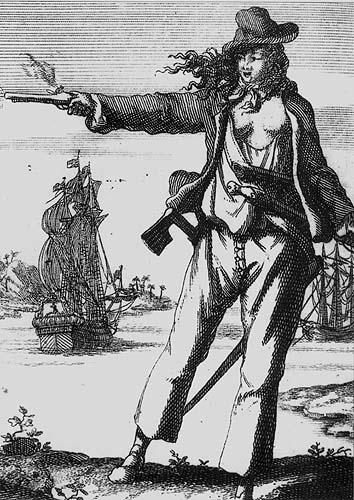


 In the summer of 1631 Baltimore fell victim to the most spectacular raid by pirates in Irish history. At that time the population consisted chiefly of settlers from England who had arrived some years earlier to work in the lucrative pilchard fishery under lease from the O'Driscoll chieftain, Sir Fineen O'Driscoll. Piracy was rife along the shores of West Cork, much of it of a home-grown variety. However, the danger in this case was from farther afield.
 Her family had become wealthy mainly through fishing and trade, but in her later life, Grace took up piracy by taking on Turkish and Spanish pirate ships and even the English fleets. She grew her estate to include a fleet of ships as well as several islands and castles on the west coast of Ireland.
  The O'Flahertys were a seafaring people, much like the O'Malleys, so Grace was right at home with their clan. Over the course of their marriage, Grace learned more about seafaring from Donal and his clan and added to her knowledge of sailing and trading at sea. Grace was soon in charge of the O'Flaherty fleet of ships and ruled the waters surrounding their lands. Although it was unusual for a woman to lead men, Grace earned the respect of all who followed her through her shrewdness as well as her knowledge of sailing and bravery at sea. Her husband, Donal, had a reputation for being quite a "hot head" and his temper eventually cost him his life in battle against a rival clan. They were married for a total of nineteen years.
  Ship's Rigging - Flickr
 Ship at Sea - Author Unknown
 Captain Luke Ryan (Hibernian Magazine, May 1782)

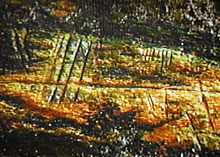 Irish petroglyph detail. Compare to the West Virginia petroglyph detail at the top left of this page. For the first time it is possible to say with some degree of certainty that there is real evidence of pre-Columbian visitors to the North American continent. In fact, you could say it is carved in stone. Twenty years of research leads to the conclusion that the same disciplines and tools were employed to create Ogam glyphs and Christian symbols (Chi-Rho) on rock faces in both southern West Virginia and southern Ireland.
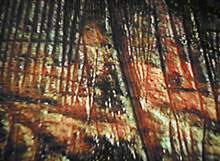 Another view of the recently discovered Irish petroglyph. Note the vertical Ogam markings. Dr. William Grant, Edinburgh University, Scotland, and Dr. John Grant, Oakland, Maryland, both Celtic linguists/scholars, participated in Pyle's Ogam research in southern West Virginia and endorsed the West Virginia petroglyphs as authentic archaic Ogam. The Grants were former students at the Catholic University in Washington, DC, under the direction of Dr. Robert Meyer, Celtic professor and linguist for 33 years.
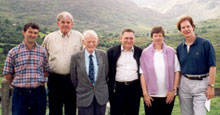 Stephen O'Shea, Earl E. Hill, Dr. William Grant, Robert L. Pyle, Breda O'Shea, and Mike Baker. Photo taken in southern Ireland. The expedition was mounted by Dr. William Grant and led by Stephen O'Shea. Michael Baker, a film producer, and crew documented the entire expedition. Five hours of strenuous climbing led to the petroglyph location in a "wedge tomb" where Pyle immediately recognized the similarities between Irish and American petroglyphs. The panel is 8 feet high and 20 feet long, and the markings are textbook examples of the alphabet known as Ogam. Significant features include: (1) the Irish Ogam is identical in form to that found in West Virginia and Manchester, Kentucky; (2) it is identical in form to that found in the Book of Balleymote, which is located in the Royal Irish Academy in Dublin; (3) the same types of symbol are identified on artifacts and cliff carvings.


Advertisement