Advertisement
Help Keep Boards Alive. Support us by going ad free today. See here: https://subscriptions.boards.ie/.
https://www.boards.ie/group/1878-subscribers-forum

Private Group for paid up members of Boards.ie. Join the club.
Hi all, please see this major site announcement: https://www.boards.ie/discussion/2058427594/boards-ie-2026

Is Irelands neutrality stance in WW2 unfairly criticized? (see Mod note 217)

199100102104105109

Answers

  • Registered Users, Registered Users 2 Posts: 8,897 ✭✭✭jmcc


    Just in case anyone is wondering what about counterfactuals, they are explorations of how history could have turned out differently if a few key decisions or events were different. They can form the basis for fictional Alternative History books and articles. There are actually quite a few good Alt History books on Amazon and I think that there was even an article a few years ago that had Aiken leading the Irish government and joining the Allies circa 1943.

    Regards…jmcc


  • Registered Users, Registered Users 2 Posts: 6,544 ✭✭✭Francis McM


    More copy and paste from you, and debunked already. As regards the distance between Cobh / Berehaven and the U-boat bases in France - please do not expect us to believe that U—boats from France would have been on the prowl for spotter sea planes from Cobh? It was the other way around : the U-boats were afraid of planes. As pointed out to you already and it was in some books but you did not read them, the Treaty ports were suitable for seaplanes as well as sea going vessels. German U-boats were extremely afraid of Allied airplanes, and rightfully so. While Allied aircraft crews respected the danger of a U-boat's anti-aircraft guns, the overall dynamic was highly in favour of the aircraft and what it could do in more ways than one. The Allies also developed ways and means of defending their ports.

    As regards the Germans reaching the northern convoy routes, yes the s.w. corner of Ireland would have been of great value as a base from which aircraft could locate those u-boats going to and fro. No wonder the British Admiralty, together with the dominions office in London which was involved in war-time planning, came up with a figure of 5070 British sailors lives lost as a result of Irish neutrality.


  • Registered Users, Registered Users 2 Posts: 6,544 ✭✭✭Francis McM


    The Azores was in "no fit state to get involved in any war" either as much as Ireland was in "no fit state to get involved in any war", but that did not stop it being used as a base for the Allies in WW2, to save lives and shipping in the Atlantic.

    You are right we were in no fit state, we had to even import oil and coal from the UK during the war, but hundreds of thousands of brave people volunteered to help the Allies either directly in their forces or indirectly in hospitals, factories etc.

    As regards morality, Germany in WW2 was a mortal threat to Western civilization, and nobody can defend being neutral against Nazism / Dev being the only prime minister in the world to commiserate on the death of Hitler. As regards WW1, we can be proud someone at least stood up to the German invasion of neutral Belgium, a relatively small Catholic country, in 1914. The German invasion of it was widely considered a severe breach of international law and a defining moral failure of the early 20th century, just as the invasion by Germany of other countries a generation later was also a moral failure.


  • Registered Users, Registered Users 2 Posts: 81,061 ✭✭✭✭FrancieBrady


    Their declaration of war had absolutely nothing to do with morals. Britain declared war because her hegemony was under threat from an emergent Germany.

    Not emphasised enough IMO.

    The colonists and imperialists hid behind the 'freedom of small nations' nonsense. Britain and the US did the same as Germany - acted in their own selfish interests and only acted/responded when those interests were threatened as you say.
    We acted in our own interests too and we were able to survive as a country as a result of a brave and resolute 'national' government decision.


  • Registered Users, Registered Users 2 Posts: 6,544 ✭✭✭Francis McM


    Doing nothing while captured Irish seamen were known to be in, any dying in, slave labour Nazi Concentration camps was not in our own best interests. In the event of a German victory in Ireland, many more Irish would have been in Nazi camps.

    As noted already, you just have not got over the fact your fellow Republican Sean Russell did not fully succeed in collaborating with the Nazis and died on a U-boat. You defended him on another thread.


  • Advertisement
  • Registered Users, Registered Users 2 Posts: 146 ✭✭casey jones


    You debunked nothing though, a lower Lough Erne site was identified in Dec 1940 by air survey and permission to fly out via Donegal Corridor granted Jan 1941. If you have any sources to the contrary please share them, lols and omfgs dont count.

    As for your questions about the sinkings indicated by the blue dots west of Donegal the map shows they were well inside the existing air cover range so imaginary bases in the west of Ireland wouldnt have prevented those losses.


  • Registered Users, Registered Users 2 Posts: 81,061 ✭✭✭✭FrancieBrady


    Hiding behind bogus claims about abandonment when it has been debunked multiple times has gotten old.

    Ignoring you now @Francis McM

    You failed to convince anyone here that your unhinged nonsense has any basis in fact.


  • Registered Users, Registered Users 2 Posts: 22,960 ✭✭✭✭Tony EH


    There was very little that the UK or France could have done about the German invasion of Poland.

    Indeed, but Britain and France's declaration of war had nothing to do with Poland. It was all about Germany. They had no intention of doing anything with regards to Polish sovereignty and their guarantee only came about in the first place because Hitler made fools of the British with Czechoslovakia. Chamberlain's "Peace for our time" proved not to be the case. The fact of the matter is that both Britain and France had had abysmal relations with Poland in the interwar years as they had repeatedly snubbed (sometimes with legitimate reasons) British and French approaches with regards to an entente because of western fears about German power. Unfortunately for both Britain and France, their declaration didn't have the desired effect of halting Hitler and was instrumental in kicking off another European wide war.

    The speed at which Germany took over most of mainland Europe and even
    removed the British Expeditionary Force from mainland Europe may have
    been a major influence on the policy of Irish neutrality because by
    early 1940, Germany had successfully invaded most of mainland Europe
    within a matter of months.

    Bewegungskrieg caught everyone by surprise at how effective it was, including the Germans ironically, and it certainly put the fear of god into their enemies and potential enemies. For us and others, it did look for a time that Germany couldn't be stopped. But crossing a large mass of water was an entirely different matter to warfare on the continent. Even in 1940, it became obvious that the Wehrmacht was land army and Churchill etc had known that crossing the channel was out of the question. He even said "I'm not saying that they won't come. But they won't come by sea lion". He was entirely correct, of course, as the Germans had no equipment to support a seaborne invasion of anywhere. The Rhine river barges they had lined up on the French coast for deceptive purposes would have floundered mid channel. The reality was that Britain's greatest defence wasn't the RAF, the Royal Navy, or chain home. It was simply a body of water. Once that light had been shone on Germany, Ireland breathed a sigh of relief.

    There was also a pro-armistice element in British politics that thought
    that the UK should seek an armistice with Germany and Halifax had
    approached the Italians to see if there were possible terms.It could all
    have turned out very differently.

    There were many within the British establishment that had genuine sympathies with Germany and they feared more a Soviet influenced Europe than a Nazi influenced one. Previous to the Czech crisis in 1938, many within the corridors of power in White Hall thought that if there was going to be war in Europe, it was better that it was contained in the east and the west kept out of it. Few establishment Britons would have cared too much if Germany and Russia spent the next half decade knocking ten shades out of one another. But Hitler's full take over of Czechoslovakia changed that and that insult was hard to take for the British, hence a pretty reckless "guarantee" to Poland which, according to Liddel-Hart, practically guaranteed nothing but war.


  • Registered Users, Registered Users 2 Posts: 22,960 ✭✭✭✭Tony EH


    I'm not interested in your trolling.

    The Azores…

    🤣


  • Registered Users, Registered Users 2 Posts: 22,960 ✭✭✭✭Tony EH


    We acted in our own interests too

    The difference is that we acted in the only way that was open to us. Neutrality really was the only option as far as the nation was concerned, but we didn't stop anyone from going over to Britain and joining up, even if they were doing so more for mercenary reasons than moral ones.

    My father was one of those who hopped on the boat to Liverpool in 1943 at the tender age of 16.


  • Advertisement
  • Registered Users, Registered Users 2 Posts: 6,544 ✭✭✭Francis McM


    It was me that said permission was only granted to use the Donegail corridor in Jan 1941. This was after 1000 Allied ships were sunk in the Atlantic in 1940 and German Condor four-engined aircraft had regularly crossed over Irish airspace before that….with only a few complaints from the Irish government to the Germans which they of course ignored.


  • Registered Users, Registered Users 2 Posts: 6,544 ✭✭✭Francis McM


    You may not have heard of the Azores in the war but it was part of neutral Portugal but became an important Allied base during the war. Unlike Ireland which the Germans dropped about 50 bombs on, Portugal was not bombed.


  • Registered Users, Registered Users 2 Posts: 22,960 ✭✭✭✭Tony EH


    Don't presume that you could tell me anything about the Second World War.


  • Registered Users, Registered Users 2 Posts: 6,544 ✭✭✭Francis McM


    You left the thread earlier but you came back. It is a fact you defended your fellow Republican Sean Russell on another thread. It is also a fact he died on a German U-boat, having tried to collaborate (on behalf of the IRA), with the Germans. You refused to condemn that of course, shure Sean was doing the right thing.


  • Registered Users, Registered Users 2 Posts: 6,544 ✭✭✭Francis McM


    Rest assured I know some things about it that you do not. However, unlike you, I would never be as presumptuous to say to someone else that they could not tell me anything about WW2.


  • Registered Users, Registered Users 2 Posts: 81,061 ✭✭✭✭FrancieBrady


    Absolutely agree.
    The unfair criticism and refusal to emphatise with leaders making decisions under duress and without the benefit of hindsight has completely failed here as it did before on several occasions.
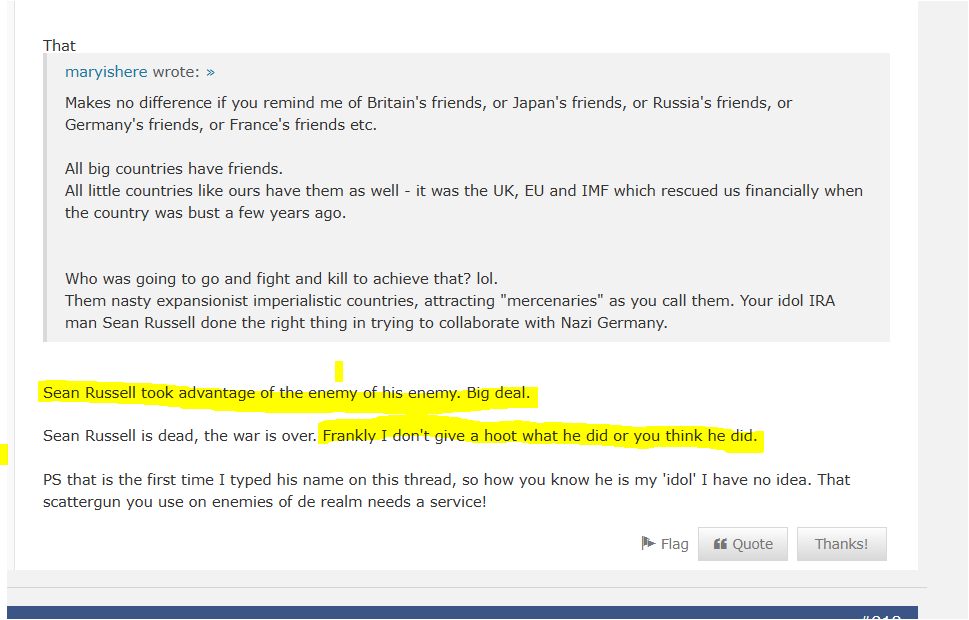
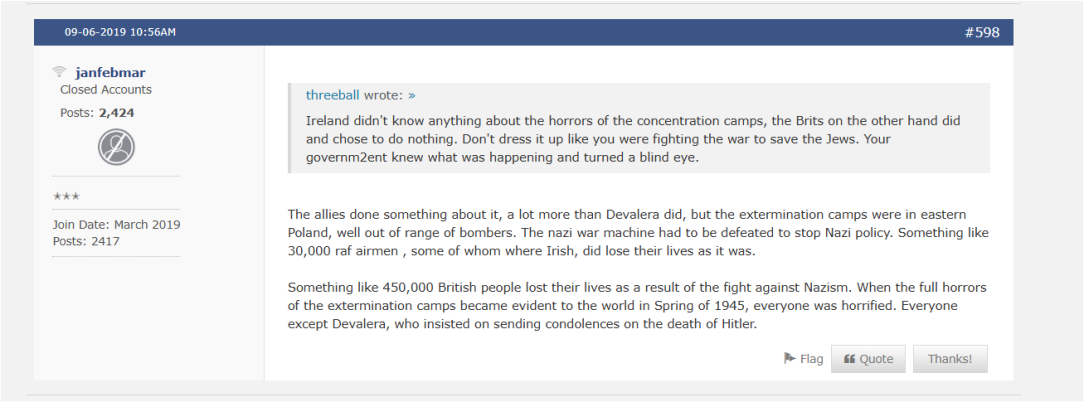
    It is a pity Francis didn't have Maryishere and Janfebmar here anymore to support them. They both had the exact same opinions on Dev as Francis.
    I even told Maryishere what I thought of Russell, as she liked to badger about him when stuck.

    image.png

    Janfebmar was also very upset about Dev:

    image.png


  • Registered Users, Registered Users 2 Posts: 8,897 ✭✭✭jmcc


    In 1940, a lot of the technology and tactics for massed seaborne landings (D-Day style) against a defended coast didn't exist on either side. The Channel was a major problem for the Germans and there was a suggestion from Milch (a Luftwaffe general), I think) that there should be a paratroop landing around the time of Dunkirk to take advantage of the retreat. The problem, of course, is that they would have had a resupply problem, an air problem and the RN problem. Ireland would have been a much tougher problem geographically for the Germans as the Irish Sea is quite changeable. There was a plan to invade using the Waterford/Wexford coastal area. That has been the traditional route for invasions. The plan itself, not to be confused with the Plan Kathleen, was very well researched.

    The Germans would not have been able to attempt something of the complexity of D-Day in 1940 because of the lack of dedicated ship types and landing craft. Since WW2, there were some books on how an invasion could have been mounted using alternatives and not targeting the Channel facing coast.The failure to destroy RAF airfields in the Battle Of Britain made any invasion from the Channel coast a very tricky prospect. Missing the 1940 window of opportunity also gave the UK the chance to rebuild and replace a lot of the weapons and supplies that it had left on the beaches at Dunkirk.

    On the diplomatic side of things, the UK was trading on past glories and a lot of its military supplies were from WW1 or shortly after that. Germany had effectively rebuilt its armed forces and had modernised some of it. The flaw was that it still relied heavily on horses and mules for military supplies. This apparently led to some advances in early WW2 outrunning their supply lines. Chamberlain was in a no-win situation. He may well have been playing for time before the outbreak of war. Once the wrong decisions are made, there is a terrible inevitability about how they lead to war.

    Regards…jmcc


  • Registered Users, Registered Users 2 Posts: 6,544 ✭✭✭Francis McM


    Do not know what you are talking about there, but it is known and revealed by a mod you had other accounts like Happyman42 and Alf. You even admitted it too. Not sure how many other accounts you may or may not have had on this thread: certainly earlier in this thread I caught you and another poster on at exactly the same times, always thanking each other and writing in the same style with the same opinions. When I pointed it out the other poster suddenly stopped for a while!


  • Registered Users, Registered Users 2 Posts: 146 ✭✭casey jones


    More of this attempt to pin the 1940 losses on neutral Ireland. The Donegal corridor request was first made in Jan 1941 at a meeting between Dev and Mahaffey the British rep in Ireland and was granted straight away. The site was only surveyed Dec 1940 when moorings etc were identified. What more could we have done in relation to this?


  • Registered Users, Registered Users 2 Posts: 6,544 ✭✭✭Francis McM


    Not all of the losses can be "pinned" as you say on neutral Ireland. Only 5070 British lives and that was throughout the entire war. The British would ideally have flown over Ireland in 1939 when war broke out, but our neutrality was our neutrality. The agreement for the Donegal Corridor was finally agreed in Jan 1941 but the British had to fly around the top of Donegal in order to get to the Atlantic before that, which used more fuel but more importantly mean they could not reach as far out in to the Atlantic and had much less time to spend there. The reason they could not "take the short cut" and fly over Donegal before that was because of our strict neutrality. Permitting foreign military aircraft to openly cross sovereign territory directly violated our neutrality policy. When it was finally agreed in early 1941, it was supposed to be for air-sea rescue missions only, planes were supposed to fly "at good height" over the short stretch of neutral Co. Donegal, planes were supposed not to fly over Finner camp, planes were required to keep to the narrow corridor, pilots were not supposed to talk about it etc.

    Even though it was supposed to be secretive, Germany knew about it almost immediately, through its espionage and intelligence network in Ireland. Lord Haw-Haw, even taunted the Allies on his Germany Calling radio broadcasts by referring to the lumbering Allied flying boats as "swans on Lough Erne".

    Germany could not say much though, as it had violated our airspace hundreds of times with their Condor aircraft on their reconnaissance flights trying to locate the convoys, especially early in the war. Some even crashed in Cork, Kerry etc.

    Post edited by Francis McM on


  • Advertisement
  • Registered Users, Registered Users 2 Posts: 81,061 ✭✭✭✭FrancieBrady


    Sensational figures will be plucked out of the air, to try and escuse and blame others. Wouldn't be the first time nor will it be the last.


  • Registered Users, Registered Users 2 Posts: 6,544 ✭✭✭Francis McM


    One thing the Admiralty (and other government departments it co-operates with) did not do is pluck anything out of the air. It was highly respected around the world for its professionalism and attention to detail.


  • Registered Users, Registered Users 2, Paid Member Posts: 4,304 ✭✭✭Cyclingtourist


    Why stop at 5,070?

    Surely some genius could push that guesstimate up round 10k.


  • Registered Users, Registered Users 2 Posts: 1,960 ✭✭✭rock22


    I think the German focus, and especially Hitler, was always eastward. He probably had a delusion of Britain agreeing an armistice, Had Britain and France not given Poland a commitment to come to their aid in the event of an invasion by Germany it is possible that the war might have been restricted to the east.

    Incidentally, Chamberlain made it cleat to the Poles that regarding conflict with the Soviets, that the UK was , and would remain, "neutral', i.e. that the commitment for military aid only applied to an attack by Germany and not USSR. It is also worth remembering that Poland was no innocent party to conflict in all this. In 1938, along with Germany, it invaded territories in Czechoslovakia.

    Once the major powers made it clear that they were not interested in the enforcement of the rule of law in international affairs vis a vis the Italian invasion of Ethiopia , De Valera considered that the League of Nations was effectively dead and that no reliance could be placed of the major powers. In those circumstances the only rational policy a small nation could pursue was one of neutrality.


  • Registered Users, Registered Users 2 Posts: 22,960 ✭✭✭✭Tony EH


    I've seen enough of your nonsense on here to give me more than a presumption.

    I've been familiar with the likes of your petty Irish hating drivel for more than a quarter of a century and it's been roundly dismissed before just as it's being roundly dismissed now.

    😉


  • Registered Users, Registered Users 2 Posts: 6,544 ✭✭✭Francis McM


    And after Pearl Harbour very few neutral countries left in the world. ( grey on map below)

    And by the time of Hitler's death, only one Prime Minister in the world expressed condolences on it. Ours.


  • Registered Users, Registered Users 2 Posts: 146 ✭✭casey jones


    What planes would have flown via Donegal in 1939 ?

    The Donegal Corridor was used by the boat planes based in Lough Erne from Feb 41 when the base became operational. As far as I know it was used by some heavy bombers much later in the war when they finally became available to coastal command.


  • Registered Users, Registered Users 2 Posts: 81,061 ✭✭✭✭FrancieBrady


    That's all it was essentially, a sensationalist guess to deflect from their own failings and incompetence. They made many blunders in WW2 that cost many lives.


  • Registered Users, Registered Users 2 Posts: 8,897 ✭✭✭jmcc


    There was also the territory that was removed under the Treaty of Versailles. That was always going to be a flashpoint.There was also a very strong union movement in the UK and there had been unrest a in the 1930s and 1920s. The USSR also had active intelligence operations in the UK. The German-USSR deal to carve up Poland probably created a delay for both sides.

    One of the problems with the League of Nations was that the major powers were not exactly able to enforce things because many of them were still recovering from the effects of the Great Depression and WW1. The Spanish Civil War also provided a testing ground for some of the tactics and strategies used in WW2. Both Germany and the USSR were very active. The reluctance of the UK to get involved in a war with the USSR is understandable given that it tried to fight against the Bolsheviks in the Russian Revolution. Neutrality was the least worst option.

    Regards…jmcc


  • Advertisement
  • Registered Users, Registered Users 2 Posts: 8,897 ✭✭✭jmcc


    The debunked number is still being repeated.The lives and shipping lost because the Germans were reading the BAMS messages and using it to target convoys. That was more significant than any argument the poster can offer about Irish neutrality.

    The BAMS messages were being read by the Germans until at least late late 1942 with the ciphers only being replaced by mid 1943. During all that time from the start of the war until then, the Germans had the details of the convoys, their routes, and the diversions. It could not use all of the decrypts but the British were unaware of the compromise for years. Without that information, Allied shipping losses might have been less. That is very different from the poster's wibbling about the Irish Treaty Ports.

    In simple terms, it cost Allied lives.

    Regards…jmcc


Advertisement
Advertisement