Advertisement
Help Keep Boards Alive. Support us by going ad free today. See here: https://subscriptions.boards.ie/.
https://www.boards.ie/group/1878-subscribers-forum

Private Group for paid up members of Boards.ie. Join the club.
Hi all, please see this major site announcement: https://www.boards.ie/discussion/2058427594/boards-ie-2026

Is Irelands neutrality stance in WW2 unfairly criticized? (see Mod note 217)

13031333536109

Answers

  • Registered Users, Registered Users 2 Posts: 81,058 ✭✭✭✭FrancieBrady


    It's an easy 'accusation' to back up. It's not hard to check if a Wiki page was edited, what the edit was, who edited it and when. I have edited pages more times than I can count on various pages detailing local events and heritage.

    One of the more transparent sites in that regard. There was zero evidence in the history of the page in question that it was 'edited' to include what was claimed.


  • Registered Users, Registered Users 2 Posts: 5,124 ✭✭✭adaminho


    And yet them continue to use quotes out of context, in the wrong order and omit stuff that doesn't suit their narrative despite being called on it several times.


  • Registered Users, Registered Users 2 Posts: 6,540 ✭✭✭Francis McM


    Nobody is denying there was majority support for neutrality, for most of the war anyway, in the 26 counties, during the war. It was different in N.I. of course.

    The U.S. President, according to our own records even as early as 1941 said, and I quote "

     The President said that the Irish did not seem to realise what a German victory would mean. At present they could buy and sell where they liked, but the Germans, even if they did not ravage and destroy the country, would take the Irish produce and say you will take in exchange children's toys. The Irish would reply 'We do not want children's toys', but the Germans would say, whether you want them or not, you are going to take them in exchange for your produce."

    Even the German bombing of the Synagogue or our clearly identifiable ships, with the loss of Irish lives, did not wake Dev up. to tell the Irish people.

    If there was a free bar, paid by overseas Allies, there would be majority support for that as well.

    Welcome back to the debate by the way, I thought you said you had left.


  • Registered Users, Registered Users 2 Posts: 5,124 ✭✭✭adaminho


    If there was a free bar, paid by overseas Allies, there would be majority support for that as well.


  • Registered Users, Registered Users 2 Posts: 6,540 ✭✭✭Francis McM


    On the question of neutrality during the war, it would have been interesting to have had a Referendum then. We know than Dev had offered Irish neutrality in return for the use of our treaty ports, which Britain gave to us in 1938. The Americans wanted the use of the treaty ports too during the war.

    If the question during a referendum had been " Do you want a United Ireland if the cost of same is allowing the Allies the use of the treaty ports, and all guaranteed by America", what would the result have been?

    Not sure would there have been much support for neutrality then? Portugal, a neutral country, gave the Allies the use of the Azores to help them the Allies defend themselves in that part of the Atlantic.

    Worth noting that hundreds of thousands of Irish helped the Allied war effort without any carrot of a U.I.


  • Advertisement
  • Registered Users, Registered Users 2 Posts: 5,124 ✭✭✭adaminho


    You were already told, Dev was re-elected twice during the war.


  • Registered Users, Registered Users 2 Posts: 81,058 ✭✭✭✭FrancieBrady


    Neutrality was established as official policy before the outbreak of war. 1937-38
    None of the main parties in the 3 General Elections from 1938 to 45 campaigned to end it.


  • Registered Users, Registered Users 2 Posts: 6,540 ✭✭✭Francis McM


    Were the Irish people told what a Nazi victory in the war would mean?

    Of course people will vote for a free bar if there is one, as long as others are paying.


  • Registered Users, Registered Users 2 Posts: 6,540 ✭✭✭Francis McM


    But hundreds of thousands still joined the Allied war effort, with many people paying the ultimate price for freedom of the west.

    If the question during a referendum had been " Do you want a United Ireland if the cost of same is allowing the Allies the use of the treaty ports, and all guaranteed by America", what do you think would have been the result?


  • Registered Users, Registered Users 2, Paid Member Posts: 4,303 ✭✭✭Cyclingtourist


    "Eire, ruled by Eamon De Valera (1882-1975), was the only British Dominion to refuse to support Britain. To Britons like Churchill,who did not take Irish Independence seriously, it was little better than a traitor. Indeed, in1939-40 the extreme republicans of the IRA conducted a bombing campaign in Britain. In consequence, Ireland lived in constant fear of a British invasion, and De Valera was obliged to declare a permanent state of emergency. Churchill, in particular, hoped to recover Ireland's Atlantic ports for Royal Navy use. Yet De Valera resisted temptations to draw closer to Germany, made no issue of British violations of Irish airspace and Irish territorial waters, and in the end was left alone."

    Quote from 'Europe at War 1939-1945' by Norman Davies (McMillan 2006)

    One of a number of short pen-pictures of European neutral states in WW2 in the book.


  • Advertisement
  • Registered Users, Registered Users 2 Posts: 81,058 ✭✭✭✭FrancieBrady


    Any fair appraisal, without the aid of hindsight, would have to accept it was an incredibly tricky time to negotiate for the government of a newly independent country.

    That the entire Executive supported Neutrality (Bar Dillon, who may or may not have been playing to the high formerly Unionist numbers in his constituency) has to be key to this.
    DeValera led a parliament, not just a political party, that supported Neutrality yet is the subject of bitter and unfair criticism. The most strident critics of it have all moved on, as early as 1946 too.


  • Registered Users, Registered Users 2 Posts: 23,006 ✭✭✭✭Strazdas


    People knew full well that invasion by the Nazis would be very bad. They saw what happened to Poland for example, another Catholic country and one that was heavily brutalised by the Germans - there's no way they would have viewed a Nazi occupation as a potential positive.


  • Registered Users, Registered Users 2 Posts: 81,058 ✭✭✭✭FrancieBrady


    Must have been extraordinary for people to have listened to or read about this.

    First Amendment of the Constitution Bill, 1939—First Stage. – Dáil Éireann (10th Dáil) – Saturday, 2 Sep 1939 – Houses of the Oireachtas

    They were well aware of what invasion might mean and had very recent experience of how brutal a 'larger power' could be.


  • Registered Users, Registered Users 2 Posts: 6,540 ✭✭✭Francis McM


    Why did Roosevelt say to Aiken, having had the FBI listen to his talks and speeches for a few weeks in America, say,

    you are reported as having said that the Irish had nothing to fear from a German victory'.

    Why did some Republicans try to co-operate with the Nazis so, eg Sean Russell, who died or was killed aboard a German submarine? The Nazis only killed 3 million Jews in Poland alone.

    Did Dev tell the Irish public that the first public building the Germans bombed in Dublin was a Synagogue?

    Did Dev go and meet the people from the Synagogue and sympathise on this, like he did by going to the Nazi part member and Nazi diplomat on the death of Hitler?


  • Registered Users, Registered Users 2 Posts: 5,124 ✭✭✭adaminho


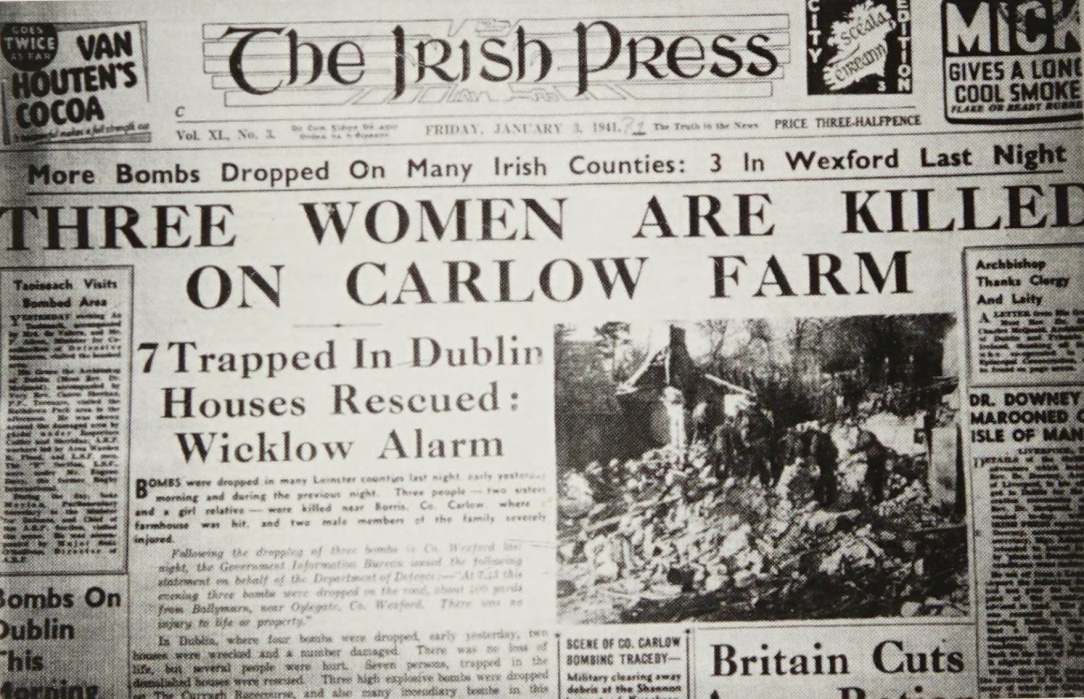
    10 times you've posted that link trying to make out it was some big thing. No mention of the Three people that were killed in Carlow the day before or the 3 in Wexford 4 months previously! You didn't mention that the school or the Presbyterian church suffered more damage in the same attack!

    That was the papers.

    irish press.jpg


    1–2 January 1941: bombs fell in Counties Meath, Carlow, Kildare, Wicklow, Wexford and Dublin.[15] In Meath, five bombs fell at Duleek and three at Julianstown, without casualties;[16][17] In Carlow, a house in Knockroe was destroyed, killing three people and injuring two others;[15][18] In Kildare three high explosive, as well as many incendiary, bombs fell in the Curragh area; two sea mines were dropped by parachute near Enniskerry in Wicklow; Ballymurrin in Wexford saw three German bombs fall without casualties;[15] and in Dublin, German bombs hit Terenure, two falling at Rathdown Park, with another two at Fortfield Road and Lavarna Grove,[1] with injuries but no loss of life.

    I gave you all this information yesterday but you keep on spamming that one link trying to make out that it was targeted or that it wasn't reported!


  • Registered Users, Registered Users 2 Posts: 81,058 ✭✭✭✭FrancieBrady


    The Germans didn't have the ability to target specific buildings in a city, and the aftermath photos show how indiscriminate the effect of the dropped bombs were.

    DeValera sympathised in the Dáil and on visits to the affected areas. Protested to the Germans via Hempel and re-iterated that Ireland would not be intimidated, enticed or taunted into a war. That I am sure meant by Britain, the US and Germany


  • Registered Users, Registered Users 2 Posts: 5,124 ✭✭✭adaminho


    After the war Winston Churchill said that "the bombing of Dublin on the night of 30 May 1941, may well have been an unforeseen and unintended result of our interference with 'Y'". He was speaking of the Battle of the Beams, wherein "Y" referred to the direction finding radio signals that the Luftwaffe used to guide their bombers to their targets.[28] The technology was not sufficiently developed by mid-1941 to have deflected planes from one target to another and could only limit the ability of bombers to receive the signals.

    Even Churchill knew this. And the only Synagogue in the whole of Europe that compensation was paid for was Dublin.


  • Registered Users, Registered Users 2, Paid Member Posts: 4,303 ✭✭✭Cyclingtourist


    The Holocaust (not a term used much in the decade after 1945) or news of German brutality didn't play any part in countries abandoning neutrality. Prime example was the U.S. where isolationist sentiment was still strong up to the events of early December1941, despite the presence of American journalists in Germany and occupied Europe.

    The British Labour Party promised large numbers of Jewish survivors would be allowed emigrate to British Mandatory Palestine but once elected renaged on it. The resultant violence and drain on resources caused them to announce their withdrawal for 1948.


  • Registered Users, Registered Users 2 Posts: 81,058 ✭✭✭✭FrancieBrady


    With two CoI churches badly damaged it would have been wrong for DeV or anyone else to say one religion was targeted when it simply couldn't be sustained as a German objective.
    It's just wise after the event desperate taunting really.


  • Registered Users, Registered Users 2 Posts: 6,540 ✭✭✭Francis McM


    Yes, we know some Nazi bombs fell elsewhere in Ireland, but why did Dev or the media not tell people that the first public building the Germans bombed in Dublin was a Synagogue? As noted before, most Irish people could not find a Jew, never mind a Synagogue, but a circling low flying German aircraft did. Dublin was lit up, unlike all UK cities, so I suppose that made their navigation easier. Why did'nt Dev meet the Jews affected, whose building was destroyed? He was well able to go to his Nazi friend to express condolences on Hitler's death.

    Yes, I know the West German government paid some compensation 13 years after the war, out of American Marshall aid money they received. So indirectly the American government paid, the same people who we refused to join or help in the war.


  • Advertisement
  • Registered Users, Registered Users 2 Posts: 6,540 ✭✭✭Francis McM


    Did'nt have the ability? Never hear of the German "Baedeker" Raids (1942) - Hitler explicitly ordered attacks on historically and culturally significant British cities (e.g., Exeter, Bath, Norwich, and York). The goal was to bomb buildings marked with three stars in Baedeker tourist guidebooks.

    That despite British cities were protected with proper anti-aircraft defences so airplanes could not fly low, certainly in comfort, and the raf's job was to stop the Luftwaffe bombing precise buildings, in fact bombing at all. The British also had blackouts. Our cities were lit up, with no airforce, and none of our very few little guns ever hit a German aircraft.

    That said, it was still difficult to bomb precise buildings, because of the speed of the aircraft, crosswinds affecting the bombs etc. Even the 4 bombs meant for Amiens station ( now Connolly station) missed by 400 to 800 meters, and killed about 28 people.


  • Registered Users, Registered Users 2 Posts: 5,124 ✭✭✭adaminho


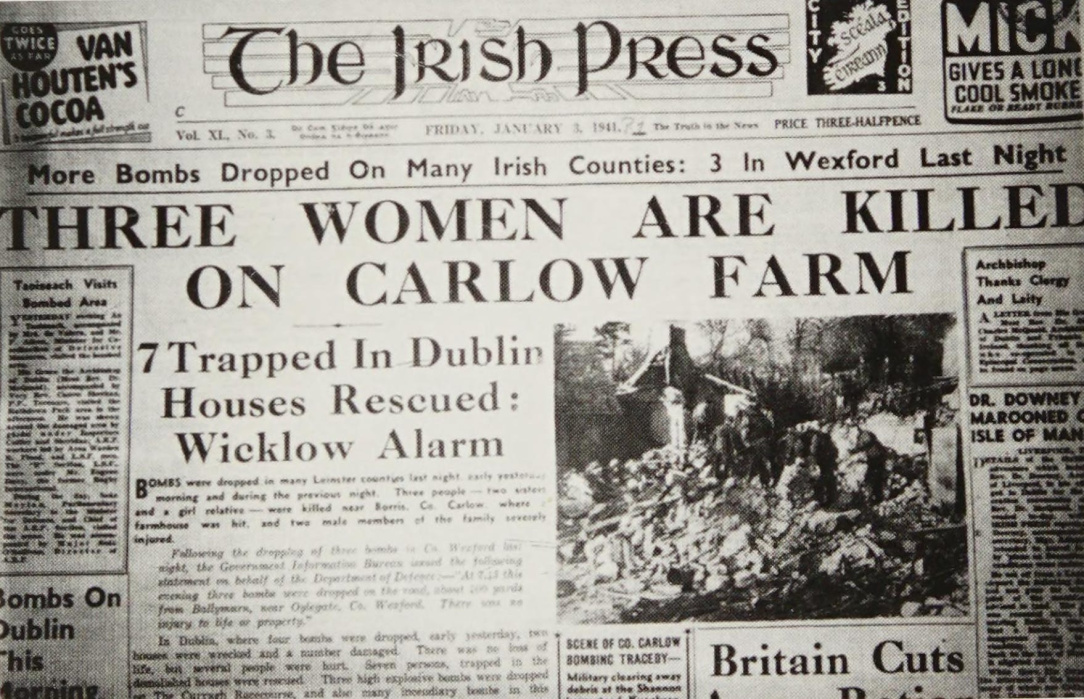
    What are you on about? Do you want a Synagogue being damaged to headline over 3 dead? It's the next paragraph down. You are trying to find a story where there is none. Even the link you keep spamming mentions the Government protesting it! If you are going to spam a link READ IT FIRST!

    irish press.jpg


  • Registered Users, Registered Users 2 Posts: 9,184 ✭✭✭saabsaab


    Can you name the 50 countries and when they declared declared war on the Axis before they were attacked?


  • Registered Users, Registered Users 2 Posts: 81,058 ✭✭✭✭FrancieBrady


    why did Dev or the media not tell people that the first public building the Germans bombed in Dublin was a Synagogue?

    Because it wasn't.

    Other public buildings were hit before and on the night of the bombing the Synagogue and the Church were hit at the same time most likely damaged by the same bomb.

    Maybe stop relying on Jewish sources for your info here?

    Read the actual facts and look at the indiscrimate damage caused etc.

    Again, the best they could do was bomb a general area, they did not have the tech to accurately hit a single building in a built up area. Hence they hit a number of religious buildings in Dublin.

    And please try and accept that NONE of it whether deliberate or accidental brought us into the war.

    We are still a neutral country.


  • Registered Users, Registered Users 2 Posts: 6,540 ✭✭✭Francis McM


    Are you referring to the post where I wrote "Some took a moral position. If you saw prisoners mis-treated by the Japanese or Germans you would understand why. Some countries even switched from the axis Powers to the Allies eg Italy.

    According to wiki "Almost every country in the world participated in World War II. Most were neutral at the beginning, but relatively few nations remained neutral to the end."

    The blue on the map are Axis, the light grey are neutral. Says it all."


  • Registered Users, Registered Users 2 Posts: 6,540 ✭✭✭Francis McM


    The Synagogue was in the Jewish quarter and suffered much worse damage than the Presbyterian church building, which only suffered a few broken windows from the blast. The Synagogue was the first public building hit in Dublin.

    Being neutral did not stop people being killed by the Nazis in Ireland. Neither did it stop people being killed in the 6 neutral countries Germany invaded, albeit on a much larger scale there of course.

    If the Nazis did invade, do you think Hempel would have assisted in rounding up the Jews, or was he a different Nazi official to the Nazi officials in the 6 neutral countries Germany invaded?


  • Registered Users, Registered Users 2 Posts: 6,540 ✭✭✭Francis McM


    Did Hempel ( Dev's Nazi friend and diplomat) ever express codolences for any of our ships sunk? For example, a German submarine sunk the Irish Pine, a ship we leased from the States but painted in the Irish colours, with the loss of 33 crew, mostly Irish?


  • Registered Users, Registered Users 2 Posts: 81,058 ✭✭✭✭FrancieBrady


    BOTH suffered blast damage and were not directly hit.
    Go compare the photos and you will see buildings obliterated by actually being directly hit.


  • Registered Users, Registered Users 2 Posts: 6,540 ✭✭✭Francis McM


    The Synagogue got structurally damaged. The Presbyterian church did not.


  • Advertisement
  • Registered Users, Registered Users 2 Posts: 81,058 ✭✭✭✭FrancieBrady


    By BLAST damage same as the Church and every building in the area. Other building including Pubs and factories and residences got actually directly hit.
    Do you even know what ‘blast’ damage is?


Advertisement
Advertisement