Advertisement
Help Keep Boards Alive. Support us by going ad free today. See here: https://subscriptions.boards.ie/.
https://www.boards.ie/group/1878-subscribers-forum

Private Group for paid up members of Boards.ie. Join the club.
Hi all, please see this major site announcement: https://www.boards.ie/discussion/2058427594/boards-ie-2026

Is Irelands neutrality stance in WW2 unfairly criticized? (see Mod note 217)

12930323435109

Answers

  • Registered Users, Registered Users 2 Posts: 6,540 ✭✭✭Francis McM


    Your Irish Independent link though did not say the Synagogue was hit, the first public building hit in Dublin by the Luftwaffe, the German air force. in the First 24 hours of bombings of Dublin. Lord Haw Haw said Dublin would be targetted, and it was. It is laughable but not surprising that the newspaper said " the prevailing opinion in Ireland was that pilots wanted to offload bombs ensuring planes were light enough to survive the flight back to base". It forgot to say that there was no blackout in Dublin during "the emergency", unlike in N. Ireland and Britain. If the German pilots "wanted to offload bombs ensuring planes were light enough to survive the flight back to base", they would have dropped them in the sea 5 or 10 km away, rather than on a Synagogue. Who would have thought the first public building the Germans would hit in Dublin would be the Synagogue? They should have bought a lottery ticket, those Germans.

    The west German government in the late fifties, not the Nazi government, paid money to Ireland, a paltry amount, under £400,000, to compensate for many Irish people killed in their bombing in Ireland. This came out of Marshall aid money from the Americans.

    N.B. I see wiki has been edited to include the bombing of the Synagogue now. It was not in your copy and pasted list of German bombings in Ireland , your post no. 920?

    Post edited by Francis McM on


  • Registered Users, Registered Users 2 Posts: 5,125 ✭✭✭adaminho


    No edit of the wikipedia page. I quoted from the section Timeline of German bombings of the Irish state. The Synagogue is mention in detail further down.

    Several buildings were bombed before the synagogue the Creamery in Wexford was August 20th 1940.

    I never said anything abojut the Nazi's paying compensation. I said the Germans.

    The Irish Independent didn't mention the Synagogue bombing because it was published BEFORE the bombing which I stated! I merely used that to prove that there was no Censorship or blackout of the bombings in the Irish press.

    You seem to have a problem reading through links provided and my posts as you seem to gloss over anything that doesn't suit your narrative. You have willfully omitted sections of the links you provided that disprove your argument.

    AGAIN, How did the meeting end between FDR and Aiken?


  • Registered Users, Registered Users 2 Posts: 5,125 ✭✭✭adaminho


    Btw It's okay to admit when you're wrong, I did it yesterday.


  • Registered Users, Registered Users 2 Posts: 6,540 ✭✭✭Francis McM


    I said in Dublin, "the Creamery in Wexford" is not in Dublin.

    I never said that you said the Nazis paid compensation, you said the Germans. I made the point it was "The west German government in the late fifties, not the Nazi government, paid money to Ireland, a paltry amount, under £400,000, to compensate for many Irish people killed in their bombing in Ireland. This came out of Marshall aid money from the Americans."

    I never said there was a blackout of the Bombings in general in the press : I said it was the bombing of the Synagogue which was not widely reported. Did you know the first public building the Germans would hit in Dublin would be the Synagogue?

    Post edited by Francis McM on


  • Registered Users, Registered Users 2 Posts: 5,125 ✭✭✭adaminho


    Your Irish Independent link though did not say the Synagogue was hit, the first public building hit in Ireland by the Luftwaffe, the German air force. in the First 24 hours of bombings of Dublin.

    This is what I was replying to, the Creamery was a public building. You later pivoted to Dublin.

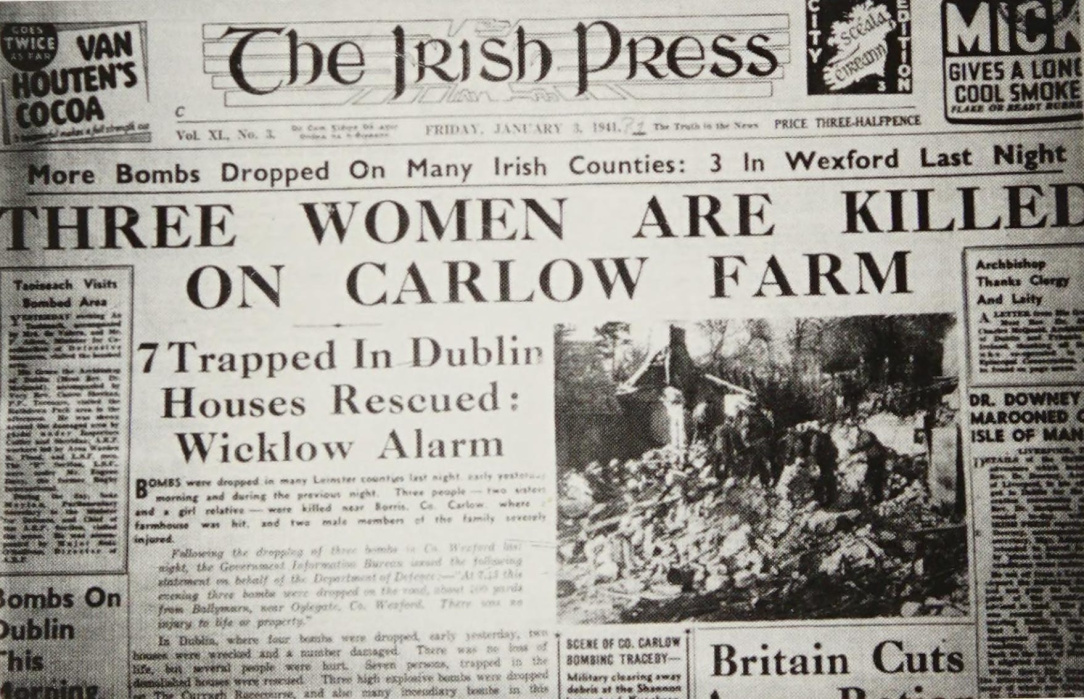
    Why do you think it wasn't widely reported? Maybe because it was only one of several attacks some fatal!

    irish press.jpg

    You keep on implying that the Germans targeted the Synagogue. They didn't it was a coincidence, just as it was a coincidence that they hit the Presbyterian church as well.

    A German bomb fell at the rear of the houses located at 91 and 93 Donore Terrace in the South Circular Road area of Dublin in January 1941. Three houses were destroyed and approximately fifty others damaged. Donore Presbyterian Church, the attached school and the Jewish Synagogue in Donore were also damaged. 20 people were injured, but there was no loss of life.

    This fragment of bomb shrapnel was recovered from Donore Terrace.

    https://www.museum.ie/collections/collection/object-180375/?return=%2Fcollections%2Fcollection%2F%3Fterm%3D%252A%26media%3Dyes%26subject%255B%255D%3DThe%2BEmergency%252C%2B1939-1946

    Still no answer to the question I keep asking as you know the answer proves you wrong

    How did the meeting between FDR and Aiken end!


  • Advertisement
  • Registered Users, Registered Users 2 Posts: 6,540 ✭✭✭Francis McM


    Fair enough, in one post I said the Synagogue was the first public building hit in Dublin by German bombing : in another post I said it was the first public building hit in Ireland by German bombing. May I clarify and say it was just the first public building hit in Dublin by German bombing. There was a Presbyterian Church also in the Jewish quarter then, that was also damaged by the German bombing. They were both damaged in the first 24 hours of German bombing of Dublin.

    It was not widely reported that the Synagogue bombing - accidental or not - was the first public building bombed by the Germans in Dublin. You linked to the Irish Independent but it did not say the Synagogue was bombed and structurally damages.

    The newspaper did say in relation to German bombing in general " the prevailing opinion in Ireland was that pilots wanted to offload bombs ensuring planes were light enough to survive the flight back to base". It forgot to say that there was no blackout in Dublin during "the emergency", unlike in N. Ireland and Britain. If the German pilots "wanted to offload bombs ensuring planes were light enough to survive the flight back to base", they would have dropped them in the sea 5 or 10 km away, rather than on a Synagogue.

    Now maybe it was a coincidence that Lord Haw Haw, the Nazi propoganda minister, warned us shortly before that Dublin was going to be bombed. Maybe it was a coincidence the planes circled around low and maybe it was a coincidence the bombs fell on the Synagogue.

    As regards Roosevelts meeting with Aiken, many pages were spent telling you exactly how it ended, and backed it up with quotes from a link, and links. See posts no. 888, 892, 896. You did not answer my questions at the time. Now stop badgering.

    A few questions for you: the Germans sunk a number of Irish ships / vessels in the Atlantic, even though they were clearly identifiable as Irish. For example the Irish Pine ship, a ship we leased from the Americans, with the loss of about 3 dozen crew, most of them Irish if I remember correctly. Are you going to tell us that was accidental as well, or maybe the German submarines were getting rid of their torpedoes before heading home to France?

    Did Hempel express his condolences to Dev or to the families to those lost at sea ( all crew of the ship died )? Did Dev indeed go to the ordinary Irish families and express his condolences, seeing as he had form on April 2nd 1945 for going and expressing condolences for the most evil man in history?

    God bless the poor men in Irish ships lost at sea, because of German attacks in WW2. Huge respect to them.


  • Registered Users, Registered Users 2 Posts: 5,125 ✭✭✭adaminho


    There are the three posts you claim you answered the question in.

    None of that is how the meeting ended. There is more after that. It's in the link YOU posted but you seem to not want to say it!

    You also claim to have a paywalled link for the US version that I've asked for several times with no reply.


  • Registered Users, Registered Users 2 Posts: 6,540 ✭✭✭Francis McM


    As regards the meeting betwen Aiken and Roosevelt, you were given lots of links and quotes already. Obviously you did not like them. Here is a another account of the meeting, from our own Examiner Newspaper:

    "Aiken arrived in Washington on Mar 18, 1941, but was kept waiting for almost three full weeks before he got to meet the president, who treated him dismissively. He accused Aiken of being anti-British.

    Shortly after the meeting began an aide entered the Oval Office and put a tablecloth and arranged cutlery on the president’s desk, but Aiken refused to take the none-too-subtle hint to leave. He had come too far and waited too long to be brushed off that easily. Aiken denied he was pro-Nazi, and the president suddenly jerked the tablecloth from the desk, sending the cutlery flying, and ending the meeting."

    A few questions for you: the Germans sunk a number of Irish ships / vessels in the Atlantic, even though they were clearly identifiable as Irish. For example the Irish Pine ship, a ship we leased from the Americans, with the loss of about 3 dozen crew, most of them Irish if I remember correctly. Are you going to tell us that was accidental as well, or maybe the German submarines were getting rid of their torpedoes before heading home to France?

    Did Hempel express his condolences to Dev or to the families to those lost at sea ( all crew of the ship died )? Did Dev indeed go to the ordinary Irish families and express his condolences, seeing as he had form on April 2nd 1945 for going and expressing condolences for the most evil man in history?


  • Registered Users, Registered Users 2 Posts: 5,125 ✭✭✭adaminho


    No, I asked you to answer from the link YOU posted. This one

    You don't get to ask questions without answering the ones posed to you. I'll answer yours if you answer mine.


  • Registered Users, Registered Users 2 Posts: 6,540 ✭✭✭Francis McM


    I asked you questions first, you refused to answer and despite that your questions on the Aiken-Roosevelt meeting were answered in full. A good summary of it was from the Examiner link I showed you, as you did not read the other, more detailed links I gave you.

    "Aiken arrived in Washington on Mar 18, 1941, but was kept waiting for almost three full weeks before he got to meet the president, who treated him dismissively. He accused Aiken of being anti-British.

    Shortly after the meeting began an aide entered the Oval Office and put a tablecloth and arranged cutlery on the president’s desk, but Aiken refused to take the none-too-subtle hint to leave. He had come too far and waited too long to be brushed off that easily. Aiken denied he was pro-Nazi, and the president suddenly jerked the tablecloth from the desk, sending the cutlery flying, and ending the meeting."

    Aiken then toured the US and associated openly with some of Roosevelt’s bitterest political opponents. As a result Gray was instructed to tell Éamon de Valera that while the US would negotiate the transfer of a couple of ships, it would not deal with Aiken. Insulted by Gray’s attitude, the taoiseach was unwilling to negotiate with him for the ship.

    "Roosevelt was only trying to placate his Irish-American supporters. He publicly announced that the US would send $500,000 worth of medical supplies to Ireland.

    “I’d hate like hell to think our nuisance value was only half a million dollars,” Aiken remarked to legendary pilot Charles Lindbergh, who was leading the opposition to the White House’s pro-British policies.

    The Americans approached Robert Brennan, the Irish minister in Washington, with an offer of two impounded Italian vessels, but Dublin balked at this. Next, two American ships — the West Hematite and West Neris, which had lain idle in New Orleans for several years — were chartered to Irish Shipping Ltd. The two ships sailed from New Orleans en route to Ireland in Sep 1941.

    The West Hematite, which was renamed the Irish Pine, made it to Ireland expeditiously and promptly began trading between the US and Ireland, until it was torpedoed by a U-boat on Nov 16, 1942, foundering within three minutes with the loss of all 33 of the crew."

    "The West Neris, which was renamed the Irish Oak, was in such poor condition it had to return for repairs several times before it could cross the Atlantic. It took it nine months to complete the journey from New Orleans to Dublin. The ship seemed plagued with bad luck.

    On Oct 19, 1942, its captain Matthew Moran, 51, from Rosslare, fell from the gangway while boarding the ship in Dublin and received injuries from which he died four days later. While returning from Florida with a cargo of phosphates on May 14, 1943, the Irish Oak noticed that it was being shadowed a U-boat. Next morning at 8.40am it was torpedoed without warning about 800 miles (1,300km) from Cobh."

    "James Everett, the Labour deputy, brought up the sinking of the Irish Oak in the Dáil. He asked the taoiseach if the ship had warned a nearby British convoy of the presence of the submarine.

    “It is not the business of our ships to give information to anybody,” de Valera replied.

    The failure to inform the convoy led to questions in the British parliament. Douglas Savory, the Ulster Unionist member, called for all coal supplies to be cut off to the 26 counties in retaliation."

    The quotes above are from the article in the link below:


  • Advertisement
  • Registered Users, Registered Users 2, Paid Member Posts: 4,303 ✭✭✭Cyclingtourist


    Reading contemporary commentary often just passing remarks it's clear our neutrality was viewed as a 'De Valera policy' first and foremost. As with Churchill's speech people were also keenly aware of the many from Eire who had joined up.

    There was little appreciation of the wide public and political support for Dev's position, a level of knowledge/interest that hasn't changed much in eighty years.


  • Registered Users, Registered Users 2 Posts: 5,125 ✭✭✭adaminho


    I've been asking you for the last two days to answer from the original link you posted. You answered with what you said was the end but it wasn't was it?

    You've now come out today with a new article with what you yourself describe as a summary. This report doesn't contain some of the quotes you used in your "answer" to my question.

    So let's try this again.

    Using the original link you posted and quoted from

    How did the meeting end?

    Edit: Grammar

    Post edited by adaminho on


  • Registered Users, Registered Users 2 Posts: 6,540 ✭✭✭Francis McM


    I told you about the meeting between Aiken ( Dev's rep.) and Roosevelt, we spent many pages discussing it. As you did not bother reading the links about the meeting between Roosevelt and Aiken, today I gave you a summarised version from another source, the examiner. Nice attempt at diverting from the other questions you were asked though.

    "Aiken arrived in Washington on Mar 18, 1941, but was kept waiting for almost three full weeks before he got to meet the president, who treated him dismissively. He accused Aiken of being anti-British.

    Shortly after the meeting began an aide entered the Oval Office and put a tablecloth and arranged cutlery on the president’s desk, but Aiken refused to take the none-too-subtle hint to leave. He had come too far and waited too long to be brushed off that easily. Aiken denied he was pro-Nazi, and the president suddenly jerked the tablecloth from the desk, sending the cutlery flying, and ending the meeting."

    Do not take my word for it: you can read that here:

    The Germans sunk a number of Irish ships / vessels in the Atlantic, even though they were clearly identifiable as Irish. For example the Irish Pine ship, a ship we leased from the Americans, with the loss of about 3 dozen crew, most of them Irish if I remember correctly. Are you going to tell us that was accidental as well, or maybe the German submarines were getting rid of their torpedoes before heading home to France?

    Did Hempel express his condolences to Dev or to the families to those lost at sea ( all crew of the ship died )? Did Dev indeed go to the ordinary Irish families and express his condolences, seeing as he had form on April 2nd 1945 for going and expressing condolences for the most evil man in history?

    N.B. seeing as you are so interested in Aiken, did you know that , the deputy leader of the Fine Gael was reported at the time to have described Aiken as having “a mind, halfway between that of a child and an ape”. Interesting times. No wonder President Roosevelt lost him temper and had knives and cutlery go flying.


  • Registered Users, Registered Users 2 Posts: 5,125 ✭✭✭adaminho


    You are not listening to me are you? You posted a link yesterday and quoted select parts of it. I challenged you on it and asked you to tell me USING YOUR OWN LINK how the meeting ended. You have refused to answer instead coming back today with a different link, which literally said it it's a summary of the meeting, that even omitsout the parts that you yourself were using in your argument!

    I already know the answer to the question because I read the original link you used, one which I may add I posted last week to counter another one of your tangents, what I'm trying to do is establish your credibility! By not answering the question and trying to pivot to something else it just shows that you are admitting to selective quoting and omitting facts you don't like and thus rendering ever argument you've made null and void!

    Answer that and I'll talk to you. And stop with the spamming the same link over and over when I gave you better links for the point you're trying to make!


  • Registered Users, Registered Users 2 Posts: 6,540 ✭✭✭Francis McM


    I already told you numerous times how the meeting ended. It was in the link. It did not end well, there were knives and cutlery flying and Aiken was throw out, having been asked to leave more than once. Unless you are related to Aiken I cannot see how you are defending him in that meeting.

    The conversation long since moved on to other matter, for example

    I answered your questions, not it is time you made at least some attempt at answering mine.

    The Germans sunk a number of Irish ships / vessels in the Atlantic, even though they were clearly identifiable as Irish. For example the Irish Pine ship, a ship we leased from the Americans, with the loss of about 3 dozen crew, most of them Irish if I remember correctly. Are you going to tell us that was accidental as well, or maybe the German submarines were getting rid of their torpedoes before heading home to France?

    Did Hempel express his condolences to Dev or to the families to those lost at sea ( all crew of the ship died )? Did Dev indeed go to the ordinary Irish families and express his condolences, seeing as he had form on April 2nd 1945 for going and expressing condolences for the most evil man in history?


  • Registered Users, Registered Users 2, Paid Member Posts: 4,303 ✭✭✭Cyclingtourist


    Think we've got ww3 going here.


  • Registered Users, Registered Users 2 Posts: 5,125 ✭✭✭adaminho


    By refusing to read out the answer to the question from your original link you've shown you either don't know what you're talking about or are purposely lying! Thus everything you say from is moot because you've destroyed any credibility you had!

    The reason the conversation moved on is because you tried to deflect from answering!

    I'll ask you one last time how did the meeting end? Not how you think it ended, how it actually did because, I'll give you a hint here, it forms part of the answer to some of your questions.


  • Registered Users, Registered Users 2 Posts: 5,125 ✭✭✭adaminho


    I'll make it easy for you!

    During the interview, General Watson4 had come in a couple of times to signify that the interview was at an end, but, as Mr. Aiken had not said all he wanted to say, he kept on. At this stage, however, the President showed that the interview was at an end, and a couple of other Secretaries had come in as well as a half a dozen negro waiters who prepared to serve the President's lunch.

    Mr. Aiken, standing, asked the President whether we could say that he (the President) sympathised with Ireland's stand against aggression. The President replied 'against German aggression'. Mr. Aiken said 'or British aggression'. The President said 'Nonsense, you don't fear an attack from England. England is not going to attack you. It's a preposterous suggestion.' Mr. Aiken said why did the British refuse to give us a specific undertaking on this point when they were asked to. The President said 'It is absurd nonsense, ridiculous nonsense. Why, Churchill would never do anything of that kind. I wouldn't mind saying it to him myself.' Mr. Aiken said 'Will you do this, Mr. President'. He said 'I certainly will. I'll ask Churchill myself.' Mr. Aiken then said 'Would you give an instruction, Mr. President, that we get a definite yes or no on the matter of supplies within a few days'. He said 'I will do that.' We then withdrew, the interview having lasted from 12.30 to 1.45.

    Do you think the meeting ended before or after the bit in bold!


  • Registered Users, Registered Users 2 Posts: 6,540 ✭✭✭Francis McM


    There was support for Dev's position, there is no doubt about that. There would also be support from many people if they were some place and there was a free bar.

    Remaining on the sidelines while the horrors of the Holocaust and Nazi atrocities were fully exposed, and espressing condolences on the death of Hitler, is viewed by many historians and people around the world as a failure of moral duty.


  • Registered Users, Registered Users 2 Posts: 6,540 ✭✭✭Francis McM


    There were only 14 countries in the whole world that remained neutral during WW2.

    Not saying that was good or bad, just saying that is how it was.


  • Advertisement
  • Registered Users, Registered Users 2 Posts: 145 ✭✭casey jones


    What it says is that some countries switched sides when they saw what way the wind was blowing in terms of the likely outcome, some neutral countries sold important resources such as iron ore and tungsten to the Nazis. Ireland did neither.

    At least give Ireland credit for being consistent in its position even when the war's outcome was obvious and for providing assistance to the allies throughout the war.

    In one of your posts you downplay the importance of the Belmullet weather forecast for D Day. Its like you just want to rubbish the actual contribution we made while pretenting Belmullet could have had an airfield built and moved 1000km NW into the Atlantic to bring it closer to the NW approaches than Derry.


  • Registered Users, Registered Users 2, Paid Member Posts: 4,303 ✭✭✭Cyclingtourist


    A lot of countries were neutral till they were invaded, it's not as if they chose to abandon neutrality. Some were neutral then became 'non-belligerent'.

    British India was not neutral but Goa (Portuguese) was. Iceland was invaded by Britain and handed over to still neutral America. Argentina was neutral for the vast majority of the war and then joined at the last minute as did Turkey, neither actually fought against Nazi Germany.

    It's just a box ticking exercise.


  • Registered Users, Registered Users 2 Posts: 6,540 ✭✭✭Francis McM


    More than a box ticking exercise. Some took a moral position. If you saw prisoners mis-treated by the Japanese or Germans you would understand why. Some countries even switched from the axis Powers to the Allies eg Italy.

    According to wiki "Almost every country in the world participated in World War II. Most were neutral at the beginning, but relatively few nations remained neutral to the end."

    The blue on the map are Axis, the light grey are neutral. Says it all.


  • Registered Users, Registered Users 2 Posts: 6,540 ✭✭✭Francis McM


    All of the Allies were convinced that having bases in Ireland during WW2 would have critically shortened the Battle of the Atlantic, saved thousands of Allied lives, and significantly reduced shipping losses. That is why Churchill offered a United Ireland if the Allies could have the use of the treaty ports back ( Britain gave them to Ireland in 1938 in a spirit of goodwill). The absence of these bases created what they considered a devastating geographical disadvantage for the Allies known as the "Western Approaches Gap".

    An interesting analogy would be Portugal. It was neutral officially but it gave the use of its territory the Azores for use by some of the Allies. It was not attacked by any of the Axis powers. Portugal done its bit to help the Allies in the Atlantic.

    Even if we did not stand up to Hitler ourselves, we could have done more to help those who did, especially in the closing year or two of the war when it was increasingly likely the Allies would win.


  • Registered Users, Registered Users 2 Posts: 23,006 ✭✭✭✭Strazdas


    The Holocaust and various war crimes weren't really revealed until practically at the war's end. The first major inkling of how depraved the Nazi regime was with the liberation of Belsen concentration camp in mid-April 1945.

    Up until then, Nazi Germany had been viewed as a very aggressive and militarised authoritarian dictatorship which had invaded many countries - but knowledge of the genocide was not at all common (which is why news of Belsen, Dachau, Buchenwald and Auschwitz came as a terrible shock to the western public, as they had not been prepared for how bad it was).


  • Registered Users, Registered Users 2 Posts: 6,540 ✭✭✭Francis McM


    To a certain extent, yes, the world discovered that the Axis powers were even more evil than ever imagined as the war came to an end and exterminations camps were liberated in Europe, Japanese prisoner of war camps were liberated in the far east, which were just as horrific etc.

    However, others were telling our government of the realities of Nazism in the early forties, but our government was too evil to listen and pass the information on. It kept our population in the dark as regards the evils of Nazism. Even after Kristelnacht, other neutral countries invaded, the Blitz which killed tens of thousands of civilians in our neighbours etc. Nearly 1000 civilians were killed in the Blitz in Belfast in Spring 1941. Lord Haw Haw told us Dublin would be bombed and then it was bombed etc. The writing was on the wall.

    At the meeting between Roosevelt and Aiken in America in 1941, Roosevelt told Aiken " The President went on to talk of the dire consequences that would come to Ireland in the event of a German victory. "

    Aiken was too anti-British to take that on board. If many of the Irish public were ignorant of the dangers of a German victory, that was because of the failure of the leadership of our country.

    "The President (Roosevelt) interrupted to say that he believed in being perfectly frank. He said 'you are reported as having said that the Irish had nothing to fear from a German victory'. " Of course Aiken disagreed he had said that, even though the FBI had listened to his speeches and talks for the previous few weeks.

    " The President said that the Irish did not seem to realise what a German victory would mean. At present they could buy and sell where they liked, but the Germans, even if they did not ravage and destroy the country, would take the Irish produce and say you will take in exchange children's toys. The Irish would reply 'We do not want children's toys', but the Germans would say, whether you want them or not, you are going to take them in exchange for your produce."

    Aiken still did not learn what Roosevelt said, or educate his boss Dev with that information.

    Lets face it, we let others do the heavy lifting in the defence of the free world, and to add insult to injury, our 2 leaders Dev and President Hyde commiserated on the death of Hitler. To our credit though, not all of us were as bad, hundreds of thousands of people did help directly or indirectly in the Allied war effort. Glad someone did.


  • Registered Users, Registered Users 2 Posts: 5,125 ✭✭✭adaminho


    I see you are selectively quoting that meeting again and omitting important things. How did the meeting end? Your credibility is on the line here, either answer truthfully or expose yourself as a bulllsh*tter!


  • Registered Users, Registered Users 2 Posts: 81,059 ✭✭✭✭FrancieBrady


    Gonna ignore the SS behaviour - spin + selectivity, because there is an interesting discussion here.
    I didn't know that my local TD James Dillon resigned as vice president of FG over neutrality. More or less shown the door by W.T. Cosgrave over a speech he made.

    Nonetheless, when Dillon met with Cosgrave and other senior members of Fine Gael – Richard Mulcahy, Patrick McGilligan and Thomas F. O'Higgins – at party headquarters after the ard fheis, it was made clear that his speech was a resigning matter. He stood down as vice president of Fine Gael less than ten days after he had been elected. Cosgrave responded by saying, “A sense of duty has compelled you to pursue a particular course in relation to external policy in the emergency of which we could not, in the interests of the country, approve.”


    Neutrality had overwhelming cross party support of a majority in the Dáil. Was there any other outspoken voices among TD's?

    February 10th 1942 – James Dillon criticises Irish neutrality at Fine Gael ard fheis


  • Registered Users, Registered Users 2, Paid Member Posts: 4,303 ✭✭✭Cyclingtourist


    "4th February 1944

    Pug* wasted a great deal of our time at COS. He has been having a row with the PM in defending a document we had produced yesterday. Winston had asked us to consider the advisability of pressing De Valera to sack the German Ambassador in Dublin for security's sake. We had discovered that as we had broken the German cipher we could control all cable messages, and as wireless sets had been removed, it was perhaps better to remain with the devil we knew as opposed to the devil we did not know. Winston apparently wished for another answer and was very angry because he did not get it."

    *Hastings 'Pug' Ismay

    COS Chief(s) of Staff

    Above quote from 'War Diaries 1939-1945 Field Marshall Lord Alan Brooke' (PB edition 2002 Phoenix Press)

    In fact De Valera and our neutrality gets very few mentions from the Chief of the Imperial General Staff (CIGS) 1941-46.

    Alan Brooke, 1st Viscount Alanbrooke - Wikipedia


  • Advertisement
  • Registered Users, Registered Users 2 Posts: 5,125 ✭✭✭adaminho


    Careful now, they'll accuse you of editing wikipedia!


Advertisement
Advertisement