Advertisement
Help Keep Boards Alive. Support us by going ad free today. See here: https://subscriptions.boards.ie/.
https://www.boards.ie/group/1878-subscribers-forum

Private Group for paid up members of Boards.ie. Join the club.
Hi all, please see this major site announcement: https://www.boards.ie/discussion/2058427594/boards-ie-2026

Irish rail fleet and infrastructure plans

1565759616264

Comments

  • Registered Users, Registered Users 2 Posts: 2,159 ✭✭✭Caquas


    You're right but let's be clear - Paris to Lyon is 465km and the TGV takes just under 2 hours.

    Almost three times the distance in the same time as now promised for Dublin-Belfast. It's been doing that for the past 40 years.


  • Registered Users, Registered Users 2 Posts: 2,159 ✭✭✭Caquas


    The trains are mainly competing with buses, not cars. 3 hours on the bus between O'Connell Bridge and Patrick's Bridge is equivalent to Heuston-Kent in 2hrs. 35 minutes for most passengers.

    The train is more comfortable and relaxing but the €18 bus fare is hard to resist when the train's "low fare" is sold out. A one-hour journey time for Dublin-Cork would be transformative, especially for business. Dream on!


  • Registered Users, Registered Users 2 Posts: 11,041 ✭✭✭✭Jamie2k9


    DD was 447 but was reduced to 376 (76 1st, 16 Dinning, 284) when generator vans started.

    The ICR is 376 (36 1st 340) and NIR 402.

    With 407. I think you might see somthing like 70 1st and 337 std which is decent increase in standard.


  • Registered Users, Registered Users 2 Posts: 951 ✭✭✭EarWig


    But won't we be sitting in the back of cars soon enough.


  • Moderators, Motoring & Transport Moderators, Technology & Internet Moderators Posts: 24,360 Mod ✭✭✭✭bk


    Keep in mind the Belfast service increased frequency to an hourly service last year, so that was a doubling in capacity. I’ve seen some docs from Irish Rail talk about future increase to a 30 minute service to Belfast, so that would be another doubling in capacity in the future.

    I’m a Corkonian who lives in Dublin, I use to regularly take the train, but now I’ve switched to the Citylink coach and actually find it vastly more comfortable then the train!

    Much quieter and smoother ride, dimmed lighting, no stupid noisy announcements, people tend not to talk and obviously not walking around, reclining seats. I can actually sleep on the coach, I could never sleep on the train. I much prefer it.

    Obviously the train has some advantages like larger tables and wider seats and the ability to walk around and maybe get food.

    I feel like IR has gotten their intercity service all wrong, it feels more like a commuter service than a comfortable intercity service. Far too bright lighting, like what you expect from an office, very noisy and annoying announcements at every stop, seats don’t recline, noisy and bumpy rides, etc.

    Far inferior to the intercity services I’ve experienced in the likes of Italy and Portugal, speed aside. There they tend to use low lighting, minimum announcements, comfy leather reclining seats, etc.

    I’m hoping IR correct this mistake with these new trains, but we will see.


  • Advertisement
  • Moderators, Motoring & Transport Moderators, Technology & Internet Moderators Posts: 24,360 Mod ✭✭✭✭bk


    The conversation about TGV is a complex one, TGV doesn’t actually suit all routes and services.

    The issue with TGV and other high speed trains is that they are much heavier then 200km/h trains so they tend to have slower acceleration speed. Now this isn’t a problem if you have very long distances between stops, it takes longer to get up to top speed, but once there you are doing 300km/h for long periods.

    The problem is with shorter lines and in particular lines with multiple intermediate stops, it means the TGV is slower to accelerate and might not spend all that much time at 300km/h.

    There are examples of routes in Europe operated by both TGV and 200km/h trains and the 200 ones have a journey time only 10 minutes slower then TGV due to multiple intermediate stops!

    Paris to Lyon is an example of where TGV works very well, a long distance at 465km, but also no intermediate stops, a direct non stop service allows them to get up to 300km/h and stay there for a long time.

    By comparison Cork to Dublin is relatively short at just 266km, but worse, it has a bunch of intermediate stops, Mallow, Limerick Junction, Thurber, Portlaoise, etc. that means even if we had TGV, it would barely get up to 300km/h for any significant length of time and would end up with a journey time not much different from a 200km/h train with better acceleration speed.

    We aren’t the only ones, a bunch of small, rich European countries have made the same decision, Netherlands, Switzerland, Norway have all opted not to invest in TGV and instead invest in 200km/h service.

    TGV is more suited to very large countries or long distance international services. 200 km/h is better suited to smaller countries looking to give an overall better service to all towns and cities, rather then one off premium services.


  • Moderators, Motoring & Transport Moderators, Technology & Internet Moderators Posts: 24,360 Mod ✭✭✭✭bk


    BTW another point on this, no the purpose of improving train journey times is not to compete with coaches, it is to attract motorists out of cars.

    While Irish Rail may consider coaches competitors, from a government policy perspective it would be a complete failure if they invested hundreds of millions or even billions in rail only for it to take passengers from coaches rather then cars.

    From a government perspective, they are both public transport and have a vastly lower environmental impact then cars, so it is a much of a muchness which one people use. If anything the government would prefer people on coaches as it doesn’t cost them any money to run them as they are privately operated.

    If we spend billions on rail, it has to be to get people out of cars. Otherwise we have other things we can spend the money on.


  • Registered Users, Registered Users 2 Posts: 30,004 ✭✭✭✭end of the road


    the road infrastructure the coaches run on cost the government money however and that is generally more then rail, though it can take multiple types of vehicles.

    i think if the government preferred people to use coaches they would have shut the lot down in the 70s but the reality is you were and are never going to get a situation where everyone would use any specific method of PT.

    so i don't think the government specifically care about either methods being available now whereas perhapse in the past maybe they would have prefered that everyone just take the bus but i think that is now being eroded like it was in the grown up countries decades ago.

    I'm very highly educated. I know words, i have the best words, nobody has better words then me.


  • Moderators, Motoring & Transport Moderators, Technology & Internet Moderators Posts: 24,360 Mod ✭✭✭✭bk


    The money has already been spent on the roads, they exist and are being used. It costs the government nothing to have coaches operate on those existing roads.

    It costs the government large amounts of money to invest in rail. €700 million for just 8 new trains to Belfast, while it costs the government zero for the coaches operating the Dublin Express service to Belfast.

    Don’t get me wrong, I’m very much in favour in investing in rail, but it needs to attract people out of cars, if all it achieves for billions of investment is attracting existing public transport users out of coaches, then that is deeply stupid and an utter failure.


  • Registered Users, Registered Users 2 Posts: 2,159 ✭✭✭Caquas


    No doubt the Government wants to shift inter-city travel away from private cars for environmental reasons and to reduce congestion but it would take a radical improvement in the current service to shift large numbers of drivers from their cars to the the Dublin-Cork train. IR CEO is now talking about 90 minute journeys and half-hour frequency, which would attract a lot of car drivers - but she gave no timeframe. Don't hold your breath.

    https://www.irishexaminer.com/business/economy/arid-41799359.html?utm_source=chatgpt.com


  • Advertisement
  • Moderators, Motoring & Transport Moderators, Technology & Internet Moderators Posts: 24,360 Mod ✭✭✭✭bk


    I’d say that is just poor reporting by the journalist mixing up the Cork line with Belfast


    The goal for Belfast is 90 minutes. The goal for Cork is 2 hours per the All Ireland Rail Review.

    I don’t think 90 minutes to Cork would be possible. Perhaps a single non stop service per day, but not for the regular trains that have multiple stops.

    30 minutes frequency has long been a goal for Cork, I’ve seen mention of 30 minutes frequency for Belfast too, but I’m not sure if that is national policy yet.


  • Registered Users, Registered Users 2 Posts: 453 ✭✭legend99


  • Registered Users, Registered Users 2 Posts: 34,833 ✭✭✭✭breezy1985


    I find standard intercity services in Europe either the same or worse than here it really depends on what train shows up. On the same route you could have a new train or something that looks like it's from the 70s. Only Britain seems to have a generic standard across the fleets.

    High speed is a whole different thing of course. Those trains are top notch.


  • Registered Users, Registered Users 2 Posts: 3,640 ✭✭✭Citizen  Six


    I’ve been on a lot of high speed TGV in France, and they are often quite worn and grotty.


  • Registered Users, Registered Users 2 Posts: 34,833 ✭✭✭✭breezy1985


    Our intercity fleet is showing its age but it's still a pretty decent experience.

    As someone was saying about lighting I do wish they would at least dim the lights at night on the designated quiet carriage.


  • Registered Users, Registered Users 2 Posts: 11,041 ✭✭✭✭Jamie2k9


    Most ICR coaches now have 4-5 different shades of lighting now. They managed consistently for 18 years yet over the last year any old bulb will do.

    I suspect depots in Cork/Limerick have started replacing bulbs that they use on other fleets or not supplied with the correct lights.

    Its not possible to dim.


  • Moderators, Motoring & Transport Moderators, Technology & Internet Moderators Posts: 24,360 Mod ✭✭✭✭bk


    Yes, I’ve been very lucky and impressed with the trains I took in Italy and Portugal.

    The reason I express this opinion is in the hope that IR take it on board when they buy new trains.

    Some of the differences wouldn’t even cost anything extra. It is just as easy to do low dim lighting as it is to do very bright white ugly office type lighting. Or to reduce the volume and length of the constant stupid announcements.

    It more about the “atmosphere” they are going for then anything else.

    Things like leather seats and reclining cost more, but if a coach can have a reclining seat, I don’t see why expensive new trains can’t.

    Hopefully the new trains will be specified to be less bumpy and perhaps better sound isolation. I’m hopeful on this the Swiss tend to be good with that sort of thing.

    I’m not hating on rail here, I’m expressing these opinions in the hope they can do better. If they can create a nicer experience with the new trains, keep prices competitive and reduce journey times, then perhaps they can win lots of people out of cars.


  • Registered Users, Registered Users 2 Posts: 34,833 ✭✭✭✭breezy1985


    Nowhere should have reclining seats. Absolute menace of a thing.

    I've never noticed anything particularly loud or bumpy on the intercity trains but I'm not really paying attention either.

    Speed and price are certainly the big ones but the biggest driver for getting people in trains that I have seen is the convenience of not having to deal with your car in the destination city.


  • Registered Users, Registered Users 2 Posts: 453 ✭✭legend99


    Would have to agree about the bumpiness. The Cork-Dublin train lurches around like mad for a lot of the route. Very bumpy ride.


  • Moderators, Motoring & Transport Moderators, Technology & Internet Moderators Posts: 24,360 Mod ✭✭✭✭bk


    You can have reclining seats that recline forward and don’t impact the person behind you.

    One of the trains I was on had seats like that. Best of both worlds.


  • Advertisement
  • Registered Users, Registered Users 2 Posts: 758 ✭✭✭PlatformNine


    By comparison Cork to Dublin is relatively short at just 266km, but worse, it has a bunch of intermediate stops, Mallow, Limerick Junction, Thurber, Portlaoise, etc.

    Related to this and your point about IÉ getting IC services wrong, I think there is a lot to be said about the stopping patterns our IC services have.

    It feels very random when an IC service will stop at most intermediate stations, especially for Cork and Galway services. As much as a quicker time with less stops would be great, having an intuitive and consistent service I would argue is more important. I think consistent stopping patterns is something IÉ should really work towards.

    Not every service needs to be the same, but at the very least limiting it to 2 maybe 3 variations would go a long way. For example, Cork could have the peak time express, a limited stop service calling at Mallow and LJ, and a regular "all-stops" service calling at everything from Mallow to Portlaoise (or Portarlington if it becomes a major interchange as implied by AISRR).


  • Registered Users, Registered Users 2 Posts: 8,087 ✭✭✭GerardKeating


    An idea would be a Cork-Mallow-Limerick Junction/Port Laoise/Kildare/Huestion Express Service and intermediate Stations (a few more could be opened) handled by a stopping service.

    For example

    • Cork-Limerick Service (with more stations reopened)
    • Limerick-Neagh/Ballybrophy/Thurlas/Limerick Junction/Limerick loop
    • Port Laoise - Hueston


  • Moderators, Motoring & Transport Moderators, Technology & Internet Moderators Posts: 24,360 Mod ✭✭✭✭bk


    If Cork to Dublin goes to a 30 minute frequency, then that would be a great opportunity to implement some of the ideas above.

    Perhaps the train on the hour could be limited stop, with the one on the half hour a stopping service. Or it might be easier in terms of scheduling to split up the intermediate stops between the service on the hour, versus half hour.


  • Registered Users, Registered Users 2 Posts: 76,149 ✭✭✭✭L1011


    They take up a lot of space normally, as the recline pushes you forward so you need to be further from the seat in front / table to begin with.


  • Moderators, Motoring & Transport Moderators, Technology & Internet Moderators Posts: 24,360 Mod ✭✭✭✭bk


    Yes, but trains tend to have more space then coaches (or airplanes). The train I was on it basically pushed your feet out under the table. It didn't look like it took more space then the Mark 4.


  • Registered Users, Registered Users 2 Posts: 758 ✭✭✭PlatformNine


    That could also work well. I wasn't thinking too much about what stations should be called at more just giving an example. However, thinking about it, it would make sense for the limited stop service to call at Portlaoise given its size. One note about Kildare though, if all goes well with the HH-Portalington fast line, it would only be a feasible stop in the medium term.


  • Registered Users, Registered Users 2 Posts: 758 ✭✭✭PlatformNine


    I would think from a passenger perspective alternating limited stop and regular stopping would work best, as it gives users travelling between Cork and Dublin better journey times, while maintaining the regular stopping service maintains connectivity. I also don't think the journey times would really be too different, which should help with scheduling. Even post AISRR I would be surprised if the stopping service were more than 20 minutes longer. But with further service increases it would start to create some problems.


  • Moderators, Motoring & Transport Moderators, Technology & Internet Moderators Posts: 24,360 Mod ✭✭✭✭bk


    Yes, some sort of express service would certainly be preferred by passengers, but I wasn't so sure how well it would work from an operations/scheduling perspective. Express train being slowed down by a stopping train ahead of it and complexity around turn around time. Maybe it would work fine.

    Belfast going 30 minutes would also be interesting. At the moment I think every departure has 4 intermediate stops. Even if you were to divided them up two and two, that could still be a nice time saving.

    For me this is where the real benefit of 30 minute service comes from. Outside of peak time Cork doesn't really seem to need a 30 minute frequency at the moment, but being able to serve different intermediate stops and possibly faster journey times is where the real benefit kicks in (in addition to some peak time services).


  • Registered Users, Registered Users 2 Posts: 463 ✭✭Ireland trains


    https://www.railjournal.com/in_depth/developing-city-to-city-connections/

    Interesting in relation to an electric intercity fleet, IE ‘expects a tender for a framework contract to supply the new fleet to be launched within the next 12 months, with the first trains operational in the early 2030s’.


  • Advertisement
  • Registered Users, Registered Users 2 Posts: 117 ✭✭thosewhoknow


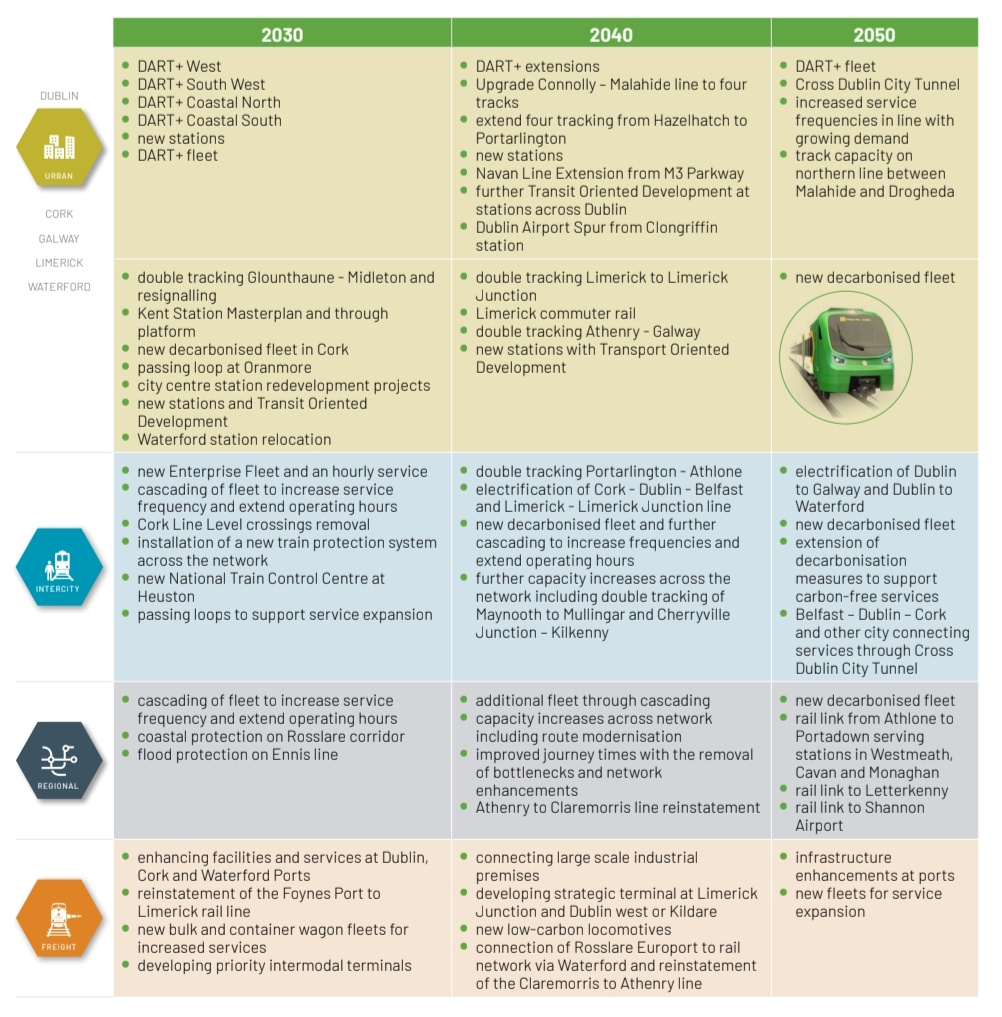
    Irish Rail's new 'Rail2050' corporate strategy. It's quite similar to the AISRR but a little more in-depth. Here's the timeline provided:

    1000011771.jpg


Advertisement
Advertisement