Advertisement
Help Keep Boards Alive. Support us by going ad free today. See here: https://subscriptions.boards.ie/.
https://www.boards.ie/group/1878-subscribers-forum

Private Group for paid up members of Boards.ie. Join the club.
Hi all, please see this major site announcement: https://www.boards.ie/discussion/2058427594/boards-ie-2026

Nuclear - future for Ireland?

1868789919299

Comments

  • Moderators, Recreation & Hobbies Moderators, Science, Health & Environment Moderators, Technology & Internet Moderators Posts: 98,144 Mod ✭✭✭✭Capt'n Midnight


    Please post the link to my post.

    And then where in in my post it referred to £10Bn (hint it didn't)

    And you'll have to post another link to where you got the £10Bn from.

    And then explain why it's really £10Bn and not £38Bn.

    And then you have to prove that there isn't

    • A) a contingency for over €50n and
    • B) where nuclear didn't increase in cost once construction actually started ie prove a contingency wasn't needed
    • C) show where the contingency wasn't then exceeded

    The capital costs have to be paid for. Unless massively subsidised with a "must buy" enforced on the grid they can only be paid for by sales of electricity when nuclear can meet the wholesale rate. Hint : in 20 years time most of today's wind and solar will will have been paid for so the marginal costs will be close to zero.

    Storage, demand shedding, interconnectors, hydro, biomass, bio-gas, waste to energy, CHP etc. will play their part when wind and solar are forecast to be low. (unlike nuclear they don't tend to fall off the grid without warning, and while the need the same amount of backup plant they don't require anywhere as much spinning reserve which would depend on fossil fuel )


  • Moderators, Recreation & Hobbies Moderators, Science, Health & Environment Moderators, Technology & Internet Moderators Posts: 98,144 Mod ✭✭✭✭Capt'n Midnight


    For nuclear to be even considered you would need to demonstrate low risk ways to get to low/zero carbon for ALL of these

    • keep the lights on for the next 20 years
    • provide spinning reserve
    • meet peak demands
    • backup during long planned outages for refuelling or maintenance
    • backup for unplanned outages or when planned outages extend way beyond the initial forecasts
    • etc.

    If you can't meet every single one of these conditions then nuclear can't even be considered for use on the Irish grid. Do not pass Go. Do not collect $200 (There's also other requirements for local voltage/frequency control too … )

    At this point we aren't even arguing if nuclear could be economic. As that's academic unless it could provide benefits instead of being a burden that needs more support that it's worth)

    Upgrading the Irish grid to the point where it could support nuclear would mean that renewables would do the job earlier.


  • Registered Users, Registered Users 2 Posts: 16,599 ✭✭✭✭charlie14


    Lets take a look at offshore wind.

    Ireland. Corio Generation walk away from 450MW Sceirde Rocks contrac. Reason. Unviable.

    U.K. Orsted walk away from 2.4 GW Honsea even after cfd price adjusted to reflect the 60% rise in offshore wind. Reason. Unviable.

    Australia. Equinor walk away from 2.0 GW Novocastrian. Reason Reason. Unviable.

    Australia. Equinor walkaway from 4.0 GW Eden and Illawarra. Reason. Unviable.

    Australia. Equinor walkaway from 1.5 GW Bass Tasmania. Reason. Unviable.

    Australia. Blue Energy walk away from 2.1 GW Gippsland Dawn. Reason. Unviable.

    Australia. RWE walk away from 2.0 GW Kent offshore. Reason. Unviable.

    Germany. Twice now for 2.5 GW offering. No bids.

    France. 1.0 GW offering. No bids.

    Netherlands. 2.0 GW offering reduced to 1.0 GW. No bids.

    Denmark. Largest ever offering of a potential 10.0 GW. No bids.

    Taiwan. The country that looks even more insane than Germany`s last government on nuclear after agreeing terms on a 1.0 GW offshore wind farm for $6.5 Bn. (€5.65 Bn.) which with their average offshore wind factor of 28% is €20.20 Bn per GW delivered, have now cancelled two other agreed contracts for two other offshore wind farm of 900 MW. They are seriously making the effort to outdo Ireland for the tin hat award on offshore.

    None of the above includes all the Offshore Wind Farm operators that have pulled out of a host of countries in Europe and worldwide because of it being financially unviable.

    Neither is that the full extent as to the trouble offshore is in. Especially in Denmark, the high profile wind generator in Europe. Along with receiving no bids for a potential 10 GW offering, they have been hit with the double whammy of losing the Norway teat that supplied them when renewables were doing little to nothing. The response to that from wind operators, similar to your Galloway wind farm example, has not been a lick of paint and a bit of sticking plaster to keep turbines at the end of their lifespan going. Nor has it been even the re-powering that is nothing other than dismantling and seeking new contracts for a completely new wind farm, It`s seeking extensions to their present contracts until those turbines literally fall apart.

    In fairness to the Danes they did eventually recognise a renewables grid was not possible in their words, "without something else" and changed their law on nuclear in a parliamentary vote by a large majority.


  • Moderators, Recreation & Hobbies Moderators, Science, Health & Environment Moderators, Technology & Internet Moderators Posts: 98,144 Mod ✭✭✭✭Capt'n Midnight


    And yet we already get 40% from renewables out a maximum possible 75%.

    And since you aren't providing links you may as well be hand waving.

    Nuclear doesn't solve any problems now, or in the next 20 years. After that it causes problems unless you can find a zero-carbon way to provide spinning reserve and backup.

    Compared to the existing road map using 100% nuclear might result in a maximum possible saving of a total of 15% of emissions spread the last 5 years before we reach net-zero.

    However, since nuclear could only provide half the demand half the time during times solar isn't handing it it's arse we won't be using 100% nuclear so it's more like 2-3% of one years emissions savings. Which is not a great return for money pits that will eat money for 20 years before startup and another 30 years after that to cover the costs which will mostly be interest.

    You don't buy nuclear. You covert the tax payer into a revenue source for 50 years in a financing scheme that has a sideline in power production.


  • Moderators, Recreation & Hobbies Moderators, Science, Health & Environment Moderators, Technology & Internet Moderators Posts: 98,144 Mod ✭✭✭✭Capt'n Midnight


    In recent news Apollo Funds Commit $6.5 Billion to Ørsted’s Hornsea 3 in the UK

    The average price for wind and solar projects in the fifth RESS auction of €98.81 per MWh was up slightly on last year’s figure of €96.85 but under the peak in the 2023 auction of €100.47. …. Contracts were also awarded to 18 solar energy projects with a combined capacity of 860 MW. 

    https://www.ucl.ac.uk/news/2025/oct/analysis-wind-power-has-saved-uk-consumers-over-ps100-billion-2010-new-study From 2010 to 2023, wind power delivered a benefit of £147.5 billion — £14.2 billion from lower electricity prices and £133.3 billion from reduced natural gas prices. If we offset the £43.2 billion in wind energy subsidies, UK consumers saved £104.3 billion compared with what their energy bills would have been without investment in wind generation.

    Since about 1978 construction was abandoned on half of the nuclear power plants that actually started construction in the US. Nuclear projects are high risk so you need a Plan-B if they aren't built. You don't even have a Plan-A to cater for what's needed if they are actually built.


  • Advertisement
  • Registered Users, Registered Users 2 Posts: 29,922 ✭✭✭✭end of the road


    the more i look at it, the more and more horific nuclear actually is.
    ireland is right to stay away from it on an indigenous level, we can't afford it and what we can afford can do an even better job at a millifraction of the cost + what we will be able to afford and will use will be dependable.
    import nuclear generated from france if we need it as while it costs it will be less then generating it ourselves but on an indigenous level forget about it.

    I'm very highly educated. I know words, i have the best words, nobody has better words then me.


  • Registered Users, Registered Users 2 Posts: 16,599 ✭✭✭✭charlie14


    Orsted ran away from a cfd for Horsea 4 of £58.87 per MWh because it was financially unviable. Their cfd for Hornsea 3 is £54.23 per MW/h so how is it financially viable to go ahead with Hornsea 3 for less per MW/h.

    They would I presume have had to pay fines and penalties, plus the loss of whatever they had already invested in Hornsea 4. Their Hornsea 3 cfd was awarded years prior to Hornsea 4, so fines, penalties and the loss of what they had already invested would have been much greater. That left them financially between the devil and the deep blue sea for Hornsea 3.

    Now I don`t know about you, but if I was ran Apollo Funds I would be asking serious questions if somebody invested in a project where a cfd of £58.87 per MWh was unviable as too why are we investing for a lesser cfd of £54.23 per MW/h. unless we are getting one hell of a write-down from a company that is in serious financial difficulties, looking to raise billions from shareholders and cutting its workforce by 25%.

    219 MW of onshore wind with a capacity factor of 28% will deliver 61MW. In terms of our projected requirements and reaching the 2030 emissions targets describing it as the nearest thing to nothing would be overly generous. €100.63 per MW/h for solar that has a capacity factor of 11%, that would be supplying nothing for 17.5 hours of the days during mid-winter when our demand is at its highest is insane to look on as any kind of serious investment for our grid.

    I have seen so many poof pieces from renewable companies as to how much they are saving us on electricity charges where I have only had to look at my own electricity bill to recognise them for what they are. One thing I have always found curious about them is how George Lee repeats them gushingly verbatim. George has a Master Degree from The London School of Economics, yet I have yet to hear him question them or make financial comparisons to any other source. But then when it comes to being well fed and watered when someone else is picking up the bill, you would be hard pressed to find many that would turn it down I imagine.


  • Registered Users, Registered Users 2 Posts: 16,599 ✭✭✭✭charlie14


    Your posts get more like a child stuffing it`s fingers in it`s ears and screaming so as not to hear what it knows to be true but does not want to hear by the day.

    The information I posted on companies walking away from offshore wind contracts due to them being financially unviable, not bidding on offerings, and companies in Denmark now looking for extensions to run offshore wind farms until the fall apart is all easily and widely accessible.

    If it was incorrect, you would be all over it like a rash. The only reason you are not is because - similar to your total and absolute refusal to give a single costing for your proposals - you know in both instances it shows how financially irresponsible and financially ruinous what you are proposing is.

    40% renewables, third most expensive electricity in the E.U. - Denmark being second and Germany first emphasis why - and highly unlikely to reach even 23% of the 51% emissions target for 2030 resulting in fines well past 2050. Yeah that really is a great argument to continue with more of the same failed strategy to bankrupt the country.

    Still trying to peddle the lie on nuclear that consumers pay " all day every day whether they need it or not" rather than withdrawing it. Very poor posting form. Especially from a Mod.


  • Registered Users, Registered Users 2 Posts: 16,599 ✭✭✭✭charlie14


    By definition intermittent is as far removed from dependable as you could get.

    There is no guarantee that we would get nuclear from France when we would need it. There is a long line of countries that have been importing nuclear from France for years now so we would be at the end of that queue.

    I would be interested to see your figures though on how much these renewables would be that would supply our grid for a millifraction of the cost. But then that is not going to happen is it ?

    Post edited by charlie14 on


  • Moderators, Recreation & Hobbies Moderators, Science, Health & Environment Moderators, Technology & Internet Moderators Posts: 98,144 Mod ✭✭✭✭Capt'n Midnight


    IIRC when William Symington trialled the first steam powered boat there was a heckler shouting "he can't start her". And when it started moving switched to "he can't stop her". You sound like that guy.

    We have to reduce emissions pdq it's both a legal requirement and there are eye-watering fines if we don't. It's a no-brainer to spend what we would be fined on renewables as it would effectively be zero cost.

    "Intermittent" renewables are typically forecast a week ahead and can be planned for.

    An automatic SCRAM isn't and can't and you need oodles of spinning reserve to stop it taking the whole grid out. Unless you can explain how you can prevent this, without using fossil fuel you have to accept that nuclear can't reduce emissions.

    The constraints are 75% replacement within 5 seconds and you can't have more than 75% SNSP across the whole grid.


  • Advertisement
  • Moderators, Recreation & Hobbies Moderators, Science, Health & Environment Moderators, Technology & Internet Moderators Posts: 98,144 Mod ✭✭✭✭Capt'n Midnight


    Meanwhile in Oz https://electrek.co/2025/11/04/australia-has-so-much-solar-that-its-offering-everyone-free-electricity-3h-day/

    Wow, energy "too cheap to meter". Wasn't nuclear supposed to do that ?


  • Registered Users, Registered Users 2 Posts: 16,599 ✭✭✭✭charlie14


    Had you been there you would have been supporting sail and not even heard the heckler having your fingers stuffed in your ears screaming wind, wind.

    You are still the guy refusing to withdraw your lie on nuclear that consumers pay for it "all day every day whether they need it or not", so I don`t see where you believe you have the right to cast judgement on anyone.

    Anyone with eyes in their head can see we are not going to reach even half the 2030 requirements on emissions, or get anywhere close to the 2050 requirements either. Even the ESB and Energia have pulled out of The Science Based Targets Initiative (SBTI). Continuing as we are would see us wasting hundreds of billions that would sink the country with us having not just the world`s most expensive electricity, but paying those eye-watering fines as well forever.

    You could forecast intermittent renewables a month ahead, and it would not make a blind bit of difference. Your not going to create more wind or sun in the interim.

    Nuclear can provide it`s own spinning reserves, renewables can not. They are also rubbish for baseload being intermittent. So where are you going to get your spinning reserves from or your baseload when renewables go for their long sleeps.

    And before you start with the battery, hydrogen, methane, pumped storage and hopiums again, piling the cost of any off them on top of the cost of your 100% renewables grid - costs you refuse to give - when there is no way we can afford your 100% grid……..

    We could overbuild nuclear to cover spinning reserves, cover 75% of the drop from the largest plant, cover for refueling and gold leaf them for a lot less than what you are proposing.

    You cannot have more than 75% SNSP across the grid from renewables. From the 1990`s to the 2000`s French nuclear was supplying 75% - 80% of their requirements and their grid was fine.. The same can not be said for Spain where some of the thousands upon thousands of inverters required for solar blacked out both Spain and Portugal.


  • Moderators, Recreation & Hobbies Moderators, Science, Health & Environment Moderators, Technology & Internet Moderators Posts: 98,144 Mod ✭✭✭✭Capt'n Midnight


    Last year we used 39Th of electricity. An average of 4.45GW (ie THREE x 1.6GW reactors @ 90%)

    Maximum demand was however 7.5GW (so SIX reactors including one for spinning reserve and even then you've no redundancy if any of the reactors is off line or on reduced load for any reason.)

    In the real world https://www.edfenergy.com/energy/power-station/daily-statuses the UK has TEN generators and is only getting SIX generators worth of nuclear power.

    So in order to sell 3 reactors worth of electricity you need to build and pay for 6 reactors in theory or 10 in the real world. Since most of the cost of nuclear is in the construction and fuel loads you are effectively massively increasing the actual final cost which has to be paid for by the taxpayer and consumers.

    And you are still at risk of things like parts scandals, or poor maintenance or politics taking out half of your fleet overnight.

    Also since nuclear can't ramp up in 5 seconds you'll have at least a reactors worth of excess electricity to dispose of at all times.


  • Registered Users, Registered Users 2 Posts: 16,599 ✭✭✭✭charlie14


    Where are you getting your maximum demand for last year of 7.5 GW from ?

    Eirgrid`s 2024 Annual Report gives the maximum demand for last year as 5.557 GW. And that was for a year when we imported 14% of our total demand. Up from 9.5% in 2023 which should be a very strong indicator to anyone of just where we are with renewables getting us to zero emissions.

    Importing electricity looks good for our emission as the generator gets landed with the emissions, or we are importing nuclear. It`s an emissions scam where even the dumbest E.U. accountant taking a glancing under the bonnet would ask how are we getting nuclear from a country that is itself an importer of nuclear.

    Why you now want to switch the discussion from the future to now on nuclear and renewables is a mystery for a number of reasons. This thread`s title is "Nuclear - future for Ireland" and I have posted here many times already on how financially unviable the current 2050 37GW offshore wind/hydrogen plan is. As well as it would not even providing the 2050 projected generation required. Costs you have not contested with costings of your own for that plan, or indeed given any for your own proposed plan whatever that is.

    As well, if you want to just make comparisons at present levels then that would require starting with a clean sheet which for one is not possible as there are already renewables generation in the mix whereas there is no nuclear generation. Even if you were going to take renewables out of that mix you would have to factor in what has been spent on them to date, plus what renewables and in what mix you would be proposing to use to get to the present level of demand, plus their capitals costs which would be at least 3 times that of nuclear due to the lifespan of both.

    Frankly I do not see the point, or indeed the waste of time it would take to show nothing different When the financial cost of the present 37 GW plan is unviable, reducing the projected demand by a factor to reach the present demand would reduce both the cost of renewables and nuclear, but the percentage difference in cost would remain the same.


  • Registered Users, Registered Users 2 Posts: 16,599 ✭✭✭✭charlie14


    Nuclear would give you generation 24/7. Solar will not as no country has 24 hours of sunshine every day.

    Eamon Ryan came out with some crazy statements in his time. One being that the total cost of the 37GW offshore wind/hydrogen plan would be €100Bn.

    Another was that Europe was waiting with bated breath for all the generation we were going to send from floating turbines off the West coast, but daft and all as he was at times even he recognised solar here for what it is. An intermittent renewable with a capacity factor of 11% - less than half that in mid Winter when our demand is greatest - with his hope that one Summer day we would generate enough solar to run our grid. I presume he meant during daylight hours rather than 24 hours as a day, but it being Eamon it is hard to know.

    Far as I recall he ear-marked that day as Summer 2050 which has now passed and was no nearer happening than when he said it.


  • Moderators, Recreation & Hobbies Moderators, Science, Health & Environment Moderators, Technology & Internet Moderators Posts: 98,144 Mod ✭✭✭✭Capt'n Midnight


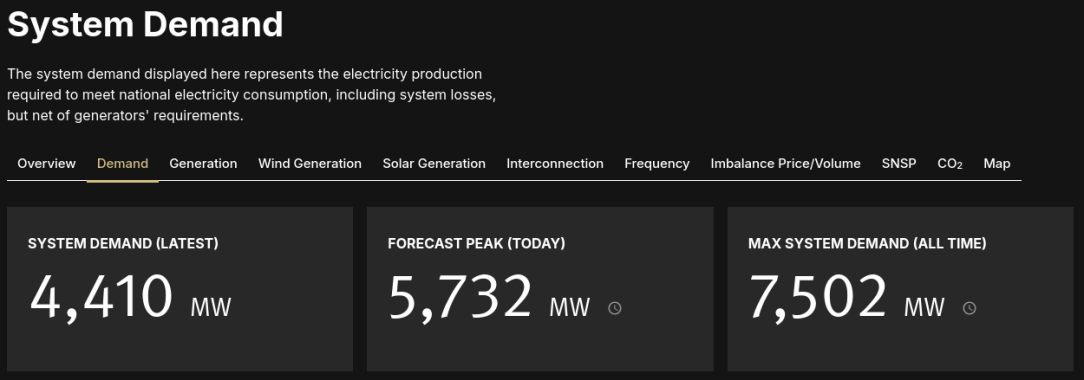
    image.png

    https://www.smartgriddashboard.com/all/demand/

    Your claim is that renewables would have 3 times the cost of renewables, after me showing you that the UK currently need 10 generators to have 6 generators worth of electricity. Which is the minimum you'd need to meet our Max Demand which is twice our average demand of 3 reactors.

    10 reactors needed to produce an average of 3 reactors worth of power ie. the actual cost of nuclear would already be 3.3 times the cost of nuclear because it isn't reliable and peak demand is much higher than average demand.

    And you still need to provide 20 years worth of low carbon electricity until the earliest possible commission of a nuclear power plant here. That's one of several show stoppers.


  • Moderators, Recreation & Hobbies Moderators, Science, Health & Environment Moderators, Technology & Internet Moderators Posts: 98,144 Mod ✭✭✭✭Capt'n Midnight


    Average capacity factor for global nuclear is 80%. Assume a month or two of downtime every 18-14 months all going well. Over longer periods Nuclear doesn't have the capacity factor you'd like to pretend , especially if you include the late completions and early decommissions.

    Last year the US had 50 SCRAMs , nearly one a week. Nuclear isn't as reliable as you'd like to pretend.

    France lost 50% of nuclear plants at one stage. UK, Ukraine and Germany too. Japan lost them all. Nuclear isn't as reliable as you'd like to pretend. It absolutely needs backup and spinning reserve.


  • Registered Users, Registered Users 2 Posts: 16,599 ✭✭✭✭charlie14


    I quoted you Eirgrid`s 2024 Annual Report that clearly states maximum demand for last year was 5.557GW. If you doubt it look up the report and if you believe it is incorrect then take it up with Eirgrid as I have no reason to doubt it. Especially with it being all over the media that for this year the maximum peak demand had risen to somewhere around 6 GW as an all time high.

    I did not just "claim" that renewables would be 3 times that of nuclear. I posted the figures to prove it on the 37 GW offshore wind/hydrogen plan quite a few times and you neither contested it or posted any figures for whatever your own plan is no matter how many times you were challenged to do so. Those figures were based on Eirgrid`s projection for our 2050 demand. Same as the 37 GW plan was to cater for - which it would not - but feel free to call that Eirgrid figure Max Demand, Peak Demand or whatever Demand takes your fancy. It would not change the percentage by one iota as the volume of generation required from both would be the same.

    You have a history of predictions that, to say the least, do not pan out, and worst case scenarios that were worst case until they were not.

    Hinkley C being one for strike price until it wasn`t when the strike price for Hinkley became 50% less compared to the strike price to the consumer for just the electricity from that 37 GW plan due to the huge rise in a very short space of time of offshore, and over 3 times the strike price with hydrogen included. And that would be without all the other storage, distribution costs etc for hydrogen. I have neither the time nor interest in chasing around rabbit holes with you on bad faith picky posts on the capacity factor of nuclear. I could do the same for renewables. I could even give you a few from the U.K. alone that would make what you post as the capacity factor for our offshore look very dodgy.

    Certainly not when despite all the times I posted those figure you neither contested them with those of you own, nor with a single figure for your own proposal each and every time you have been challenged too. Not even as much as the mix of that 100% renewables plan you are proposing that even the leading country in wind generation in Europe, Denmark, do not regard as doable. Why is that ?

    Post edited by charlie14 on


  • Registered Users, Registered Users 2 Posts: 16,599 ✭✭✭✭charlie14


    As I said in my previous post I have no interest in running around rabbit holes after you on selective picky bad faith posts on capacity factors. If you cannot male your point using the generally accepted capacity factors that is your problem.

    I find it weird tbh that someone proposing a 100% intermittent renewables grid keeps banging on about the unreliability of nuclear, and the absolute need for backup and spinning reserves who seems to believe that neither would be needed for his own proposed 100% renewables grid, but no matter.

    You would imagine that all those countries would have learned what you know by this stage, but apparently not.

    About the only thing that Democrats and Republicans House Members have agreed on in a decade is the need to increase their nuclear fleet. France are building 6 new plant and considering a further 8. Not surprising when you see the volumes of electricity they are exporting and profiting from. U.K. has just committed to Sizewell C, Ukraine in case you haven`t noticed are in a war with Russia at present, Even Greta Thunberg could not see the logic in Germany`s last government shutting down their plants, Plants the present government are considering re-opening, and Japan has 14 of those plants back up and running while working on doing the same for others. That does not take account of those that are either increasing their fleet, have opened their first or going to build their first.

    You ever hear the story of the mother watching her son marching in a military parade telling anyone who would listen that they were all out of step except her own darling Johnny.


  • Moderators, Recreation & Hobbies Moderators, Science, Health & Environment Moderators, Technology & Internet Moderators Posts: 98,144 Mod ✭✭✭✭Capt'n Midnight


    If you cannot male your point using the generally accepted capacity factors that is your problem.

    You mean. "generally advertised". The problem with nuclear lobbyists is that they cherry pick statistics for the better plants. About a third of nuclear plants in the USA have closed down in a "devil take the hindmost" fashion. The average was worse.

    Only Romania and Finland have had a Lifetime Unit Capability Factor over 90%

    However the figure for Finland excludes the missing third of total output for 14 years in a row.

    Romania has two working reactors that were delivered many, many years late. And three partially completed reactors. Two of which they've been trying to complete since 2008. So measured from the 5 reactors that were supposed to come on line from 1985 onwards they got one in 1997 another in 2007 they have 47 operation years out of a nearly 200. So it's 90% of 25%. Luckily they have lots of hydro.

    The actual real world figures for the last three years https://pris.iaea.org/PRIS/WorldStatistics/ThreeYrsUnitCapabilityFactor.aspx are well below the 90% "generally accepted capacity factor" , as it's a downhill with the wind behind you figure.

    Hint: look at the lowest % to see how much backup electricity you need to provide in a below average year. If as you claim nuclear would produce power for 60 years you'd need to look at previous years and extrapolate to find out the what the worst year likely to occur was and plan accordingly.

    Also 5% of reactors by output are "suspended" ( 19687 MW / 376261 MW ) in Japan and India So in reality the actual average output from nuclear is under 80% - and that's excluding delays in commissioning or early shutdowns. eg: Hinkley-C alone represents another 0.85% missing global nuclear capacity. And it's not the only late plant.

    There's also the plants in Japan that were outside the disaster area that have been decommissioned.

    From an outage prospective Nuclear power is high risk on our small grid. You can't rely on a plant becoming fully commercially operation on time, or to be fully reliable from day one, to not have unplanned outages or extended outages or being shutdown early.

    Note : Two of the highest output % countries like Taiwan and Germany have stopped nuclear. And if you remove the older Gen II plants which you can't build anymore it looks worse.


  • Advertisement
  • Moderators, Recreation & Hobbies Moderators, Science, Health & Environment Moderators, Technology & Internet Moderators Posts: 98,144 Mod ✭✭✭✭Capt'n Midnight


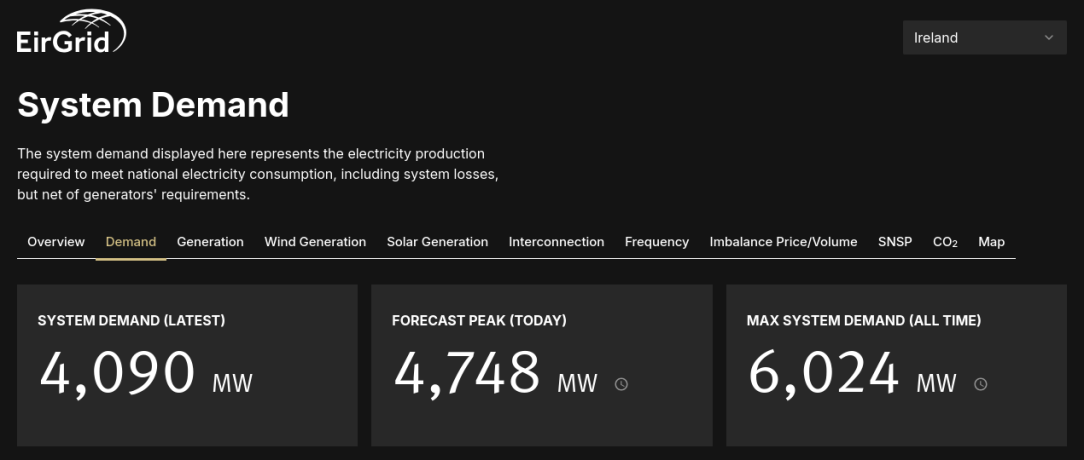
    My apologies I was looking at the all-island figure. Because we are on the same grid.

    image.png

    The max demand in Ireland was 6.024 GW so the point of needing more reactors than average still stands.

    We'd need a minimum of 4 x 1.6 GW reactors + a hot spare. so 5 reactors to provide an average of under 3 reactors worth of power. And pray to whatever god you believe in that there aren't any reactors on extended outages at max demand or that one tripping won't take out another.

    On top of that 40% of demand is being met by renewables. So those 5 reactors could only sell 1.8 reactors worth of electricity. Which means they are going to cost nearly three times as much as baseload reactors that could sell 100% of their electricity.

    And we'd likely get to 50% with existing renewables if we could increase SNSP to 95% with more spinning things for local frequency control.

    And the % of renewables will keep increasing over the next 20 years.

    It really doesn't matter how you slice and dice it. Nuclear isn't flexible enough for the Irish grid without the sort of upgrades that allow renewables to completely undermine any case for nuclear.


  • Registered Users, Registered Users 2, Paid Member Posts: 1,513 ✭✭✭riddlinrussell


    I do still take issue with 'grid upgrades for nuclear will undermine the nuclear case because also benefits renewables'

    Assuming we keep all our renewable capacity and keep expanding it (and as a result do all the grid work requiredti support nuclear), is there no case for a reactor at some point to avoid the small amount of gas we will be using to cover lulls in solar/wind?

    Boards is in danger of closing very soon, if it's yer thing, go here (use your boards.ie email!)

    👇️ 👇️


  • Moderators, Recreation & Hobbies Moderators, Science, Health & Environment Moderators, Technology & Internet Moderators Posts: 98,144 Mod ✭✭✭✭Capt'n Midnight


    At present we could probably just about use batteries to replace the largest generator going off line until power can be restored. "325 MW must be available" and there's demand shedding too.

    There's Temporary Emergency Generators (TEG) at North Wall (NW8) 193MW, Huntstown (DG1) 50MW, Shannonbridge (SQ1) 256MW and Tarbert (TB5) 150MW. The North Wall one can startup from cold in 15 minutes.

    Be interesting to see if/when batteries and TEGs can displace running gas plant at partial load.

    However, in order to support nuclear we'd have to increase spinning reserve by a factor of four. Without any more demand shedding. At present running open cycle gas at partial load is the only way to provide that much power that quickly. That's a lot of gas being used inefficiently 24/7/365.

    Or if we add another 1.2GW of reserved batteries with enough storage to keep the grid up until there's 1.6GW of dispatchable power up and running, which would be a lot longer than 15 minutes unless we commit to more TEGs that would only ever be used if nuclear had a hiccup.

    But that's 1.2GW on top of the storage that would be going in anyway so the total amount of storage that could be powered by solar would take the sting out of evening peak demand for a lot of the year.

    And there will be a 620MW biodiesel and (later maybe hydrogen) plant down in Tarbert replacing some gas anyway.

    One way of looking at it is that when renewables increase from 40% to 61% then a 1.6GW reactor would only be replacing 624MW of gas on average because most of the time you would be using renewables instead of using gas.

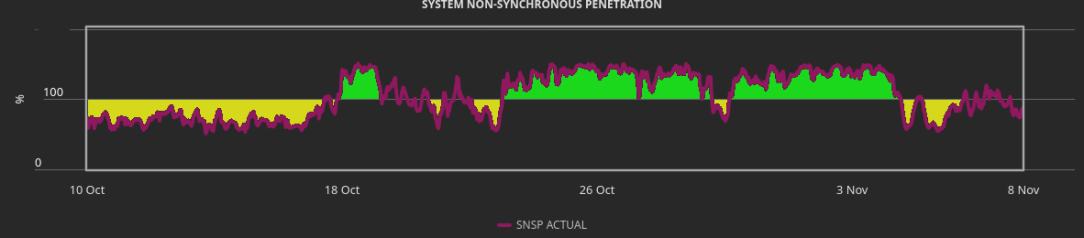
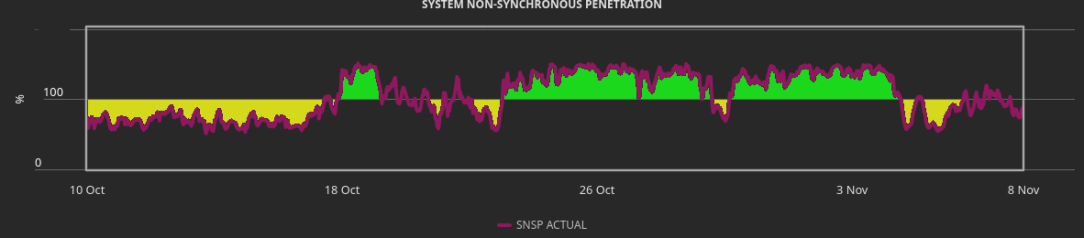
    Another way of looking at is the SNSP Look at how long we exceed 50% most of time. If we already had a grid that could take 95% SNSP and had twice as much renewables and storage and interconnectors then that 50% would be 100%,

    snsp.png

    I'll have to figure out a more concise way to say that the yellow areas between the purple line and 50% are the only possible time nuclear electricity here could have fulfilled a role on a such a grid. But remember SNSP is currently curtailed at 75%. And it doesn't include hydro or pumped storage, or bio-energy, or CHP or waste to energy or imports etc. all of which would fill in a lot of those yellow areas.

    The output from nuclear varies year to year so in some years you'd need more backup than others. You are still going to have to go a month or two without power during refuelling so you are back to the problem of how to support nuclear in a low carbon way.

    I find the easiest way to think about it is both renewables and nuclear are intermittent so they both require grid upgrades and storage so there is a huge overlap, but they are on different timescales with nuclear requiring support far less frequently but for far longer periods.

    Demand is set to increase by 45% by 2034 Nuclear won't meet any of that demand. Renewables will.


  • Moderators, Recreation & Hobbies Moderators, Science, Health & Environment Moderators, Technology & Internet Moderators Posts: 98,144 Mod ✭✭✭✭Capt'n Midnight


    "France are building 6 new plant" No they aren't. It's still at least two years to go before construction even starts.

    And there's already a three year delay and they are considering costs that (predictably) are already more than 45% up on the initial estimate.

    This is not an exception, it's normal for nuclear.

    Delayed to 2038, another 3 years. The cost was originally estimated at €51.7bn ($56.4bn), but this was revised upwards to €67.4bn in 2023, according to the Court of Auditors. Taking inflation into account, a total budget of nearly €80bn is now being considered. … Construction is expected to start in 2027

    And if you believe 2038 then here's a reality check on a plant from the same people that was supposed to be powering the grid back in Christmas 2017.

    https://www.bloomberg.com/news/articles/2025-11-07/edf-braces-for-more-delays-at-uk-hinkley-point-nuclear-project

    Hinkley-C will be delayed by yet another year (or more) due to problems with - the installation of electrical systems.

    The UK will need one DRAX worth of replacement power for yet another year.


  • Registered Users, Registered Users 2 Posts: 16,599 ✭✭✭✭charlie14


    I have already pointed out to you that the title of this thread is "Nuclear - future for Ireland?" Far as I can see that is the question of how we get from where we are now to where we need to be by 2050 using whichever generation sources are the most viable and cost effective. In simple terms, what renewables, nuclear or a mixture of both, being added to the generation we now have in terms of the installed capacity required, their capacity factors and their costs. You are unwilling to do that on the basic of their generally accepted capacity factors, preferring to cherry pick those that suit your arguement. I have already told you that is a pointless exercise that as far as I am concerned is nothing much more than an attempt to muddy the waters, and as such, a game I have no interest in playing as it is a double edged sword meh. But seeing as you insist.

    U.K. Offshore Capacity Factors 19/6/2022. Rolling 12 month capacity factors

    Aberdeen 35.3%, Burbo Bank 26.2%, Barrow 30.8%, Beatrice 32.1%, Blyth 28%, Fife 12.7%, Gwynt-y-Mor 31.4%, Kentish Flats 28.3%, Moray East 26.3%, North Hoyle 27.3%, Ormond 25.1%, Teeside 31.7%, Trinton Knoll 25%, Trancy 31.7%.

    There are more that do not come even close to the generally accepted 42% for offshore wind`s for a country geographically situated such as we are. As I said, being selectively picky on capacity factors is very much a double edged sword,

    The rest of your post has been done to death here, but there were a few variants from your post . One being your "the actual average output from nuclear is under 80%.

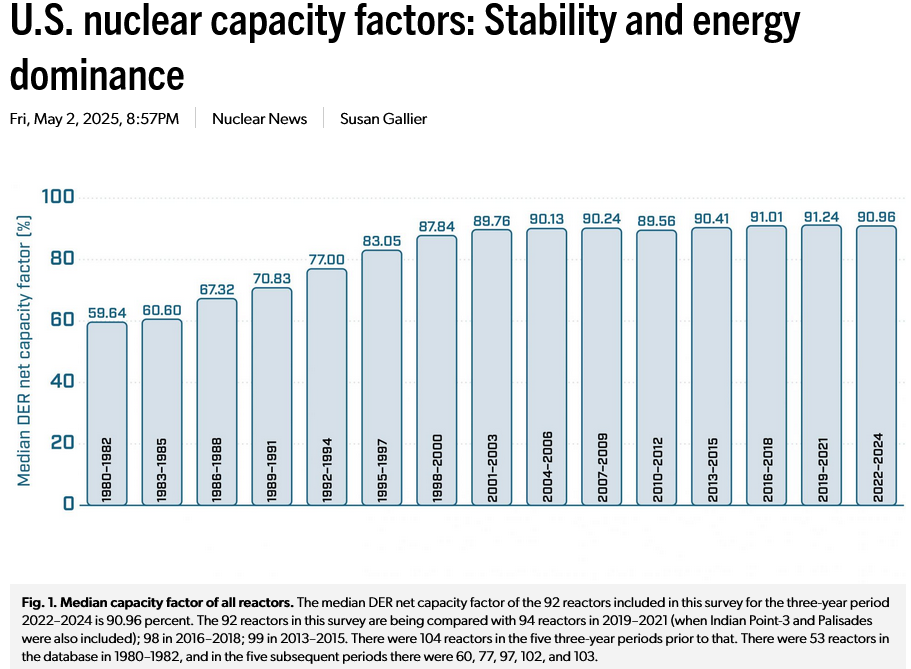
    Screenshot 2025-11-08 at 14-49-06 U.S. nuclear capacity factors Stability and energy dominance -- ANS _ Nuclear Newswire.png

    Over 92 reactors the capacity factor was 90.96%. With the age profiles of those 92 reactors, not unreasonable to expect that from newly installed reactors the level would be at least 94%.

    The other is the PRIS - last three years factors.

    For last year French nuclear`s capacity factor is given as 74.2%. From that 74.2% French nuclear supplied 68% of their demand, earned them a profit from exports of over €5 Bn. while being under the obligation of the ARENH Mechanism of supplying 100 TWh (28% of their total generation) to their renewables competitors at a bargain basement price of €42/MWh to prevent them going bust. All of that generation with little or no emissions and the French electricity price to the consumer was still one third cheaper than ours.

    Yeah, we really are blessed we are not France.


  • Registered Users, Registered Users 2 Posts: 16,599 ✭✭✭✭charlie14


    Apology accepted. Not that it made the slightest bit of difference as to what the percentage price difference between renewables and nuclear would be based on the Eirgrid projected demand for 2050. On your posted figure of demand, while the percentage difference would have remained the same, the difference in cost would have been even greater.

    I have just yesterday pointed out to you what the title of this thread is, and it`s not about now.

    It`s about how we get from where we are now to where we need to be in 2050 in the most viable and economic way possible. Yet here you are again on about how we would get from zero generation to generation now for nuclear compared to renewables with nuclear at zero and renewables already bought and paid for in the now generation. And then going on to actually talk about future generation on increasing SNSP for renewables to 95% and the percentage of renewables increasing over the next 20 years - which I can only assume from your previous posts - is about getting to your 95% renewables grid by 2050, with no idea what "your more spinning things" would be, the back-up required when renewables go for their prolonged sleeps, the make up of this 95% renewables grid, or a costing for all three. It`s like trying to hold a conversation with someone bouncing around alternate universes in a time machine.

    The problems with our grid have nothing to do with nuclear. It`s using a grid to do what it was not designed to do. Carry generation from 400 wind farms plus DC electricity from solar farms and other sources to supply an AC grid that requires inverters which would increase exponentially the more solar is added. The same inverters that blacked out the Iberian Peninsula.


  • Moderators, Recreation & Hobbies Moderators, Science, Health & Environment Moderators, Technology & Internet Moderators Posts: 98,144 Mod ✭✭✭✭Capt'n Midnight


    Nuclear has no role in the 45% of extra energy needed by 2034.

    In 20 years time it would have to compete with renewables that have been paid for and are no longer subsidised. The marginal cost of solar is sweet FA.

    The surviving US reactors can do over 90% The ones that couldn't closed down. Like I keep saying we can't use Gen II plants anymore. Also since the late 1978 50% of reactor constructions were abandoned in the US.

    image.png

    Using this month's figures for SNSP , a doubling of renewables, storage and interconnectors would mean the yellow areas are the only places where nuclear could operate but in competition with dispatchable generators.


  • Moderators, Recreation & Hobbies Moderators, Science, Health & Environment Moderators, Technology & Internet Moderators Posts: 98,144 Mod ✭✭✭✭Capt'n Midnight


    The spinning things are the synchronous flywheel thingies.

    The prolonged sleeps of renewables are shorter than the fuelling outages for nuclear.

    To suggest nuclear as an option you must suggest how we power the grid until they arrive otherwise there is no reason to wait for nuclear.

    The fact that nuclear will be late and over budget is even more reason to explain how to keep the lights on for the next 20 years during which most of the decarbonisation of heating and transport will take place largely through increased electrical demand. ie. in 20 years time there won't be much left for nuclear to do. And it will have to wait another 20 years for the wind and solar etc to reach it's 30 year lifespan and nuclear can't compete with refurb costs of wind or the zero cost of leaving solar where it is.

    Nuclear missed the boat. It can't deliver anything in the next 20 years.

    Because of grid expansion to decarbonise transport and heating it will miss the next one too because it can't replace the new generators on the grid. So no role in the next 20 years either.

    The boat after that in about 60 years time will see nuclear competing with the marginal cost of solar + storage.


  • Registered Users, Registered Users 2 Posts: 16,599 ✭✭✭✭charlie14


    If France are not building 6 new plants then to follow your train of "logic" Ireland is not building offshore wind farms either.

    Again another arguement based on sauce for the goose but none for the gander.

    If you want to include inflation in the costs of nuclear as to what the present capital cost would be in 60 years times then you have to do the same for offshore wind which is currently twice that of nuclear and would require at least 3 further rounds of capital investment in that 60 years. Renewables are not going to win on that score either.

    The combined installed capacity factor of the 6 new French reactor will be 9.6 GW. With even the average 92% capacity factor of the U.S. Gen 11 reactor of various ages that revised price of €67.4 Bn. will deliver electricity at €7.63 Bn per GW. U.K. offshore wind at a capacity factor of 42% would cost at least €15 Bn. to do the same.

    Even in that alternate universe where inflation is applicable to nuclear but not renewables, at €80 Bn nuclear would deliver 1GW for €9.06 Bn compared to offshore wind costing €15 Bn for the same.

    Still on about Hinkley, the most expensive nuclear you could find when its cfd is €147/MWh, whereas if we were to get the offer that Orsted ran away from for Hornsea under our current plan the strike price to the Irish consumer would be €194/MWh for the offshore generation alone. With green hydrogen included that would rise to €660/MWh based on the three granted U.K. cfds of £9.5 per Kg for green hydrogen. And that is before all the addition costs that would come from using hydrogen.

    I have mentioned this to you before on a number of occasions, so I do not see why you are still referring to Drax in posts addressed to me. I have already made it clear that far as I am concerned Drax is indicative of the farce on many of the rules relating to emissions.


  • Advertisement
  • Registered Users, Registered Users 2 Posts: 16,599 ✭✭✭✭charlie14


    The present plan is not for what electricity will be needed by 2034. It`s what will be needed by 2050. How many times does that have to be pointed out to you!

    Strike price contracts for renewables are for 20 years. After that - as per your onshore Galloway example - it`s a completely new project with new capital costs every 20 years. Capital costs for offshore wind are up to twice that of nuclear for a twenty year lifespan project alone, and from the cfd that Orsted ran away from for Hornsea, they are still rising. Over the 60 year lifespan of nuclear, renewables would require capitalization at least 3 times. Over that 60 years the capital costs of renewables would be as close as makes no real difference to 6 times that of nuclear.

    When the average capacity factor of 92 Gen II reactors of various ages is 92% it defies common sense that new reactors would not have even higher capacity factors.

    We have been through all your theories on a 100% renewables grid to supply our needs by 2050 using storage, interconnectors etc. but they have been based on magic thinking and money trees so until you provide the cost there is no case to be made for renewables v nuclear.


Advertisement
Advertisement