Advertisement
Help Keep Boards Alive. Support us by going ad free today. See here: https://subscriptions.boards.ie/.
https://www.boards.ie/group/1878-subscribers-forum

Private Group for paid up members of Boards.ie. Join the club.
Hi all, please see this major site announcement: https://www.boards.ie/discussion/2058427594/boards-ie-2026

Nuclear - future for Ireland?

1858688909199

Comments

  • Registered Users, Registered Users 2 Posts: 16,597 ✭✭✭✭charlie14


    But neither do you know if it was demand following or not, and if it was for refueling or maintenance it would have been scheduled and not have dropped off suddenly with no warning which intermittent renewables are prone to doing.

    We are supposedly building generation to reach our projected demand for 2050, which is what Finland`s, - a country with the same population as we have - peak demand now is and they are currently generating 40% of their electricity using nuclear, so why would nuclear be too big for our grid!

    Note : We cannot continue spending the kind of money on what you are advocating now and then repeat that spend at least twice within the next 60 years. Just continuing to do it over the next 25 years would bankrupt the state - as in Hemingways`s "First gradually and then suddenly" - as well as make our present electricity charges look like peanut.

    At least unlike renewables that plant did not cause a cascade that shut down the electricity supply to two countries and 53 million people that happened this year on the Iberian Peninsula which is now generally accepted as being caused by the inverters needed to deal with solar generation.


  • Moderators, Recreation & Hobbies Moderators, Science, Health & Environment Moderators, Technology & Internet Moderators Posts: 98,142 Mod ✭✭✭✭Capt'n Midnight


    https://pris.iaea.org/PRIS/CountryStatistics/ReactorDetails.aspx?current=607

    The Annual time on line and Annual Load Factor in the original link I posted clearly show that it's not demand following. Check the hours vs. % and it looks to be on full load during the year that it's not refuelling. Mostly.

    It appears to be refuelling every second year , so would need backup during that time. The dips in those years look to be more than just the refuelling times though.

    Like I said the other reactor at that site went offline and took out another power plant too. Spinning reserve is essential. I don't know how we'd provide enough spinning reserve on our grid to handle that much failure and keep emissions low.


  • Registered Users, Registered Users 2 Posts: 16,597 ✭✭✭✭charlie14


    It`s refueling, so what.

    Refueling of a nuclear plant is done to a schedule when demand is low when, like France, other plants have the capacity to ramp up to fill the void. When turbines and solar panels run low on wind and sun for long periods you cannot ramp up either to fill the void. You need an insane level of installed capacity along with storage. Both costing insane amounts of capitalization resulting in insanely expensive electricity for the consumer And not just the domestic consumer but for the companies that keep our economy alive.

    Again so what.

    You have been casting doubts on the safety of nuclear plants, and this is a plant almost 60years in operation with no plans to decommission it and the safety protocols did exactly what they were meant to do. A far cry from the Iberian Peninsula going totally black where it appears there were no safety protocols in place or they didn`t work, to stop the whole grid collapsing.


  • Moderators, Recreation & Hobbies Moderators, Science, Health & Environment Moderators, Technology & Internet Moderators Posts: 98,142 Mod ✭✭✭✭Capt'n Midnight


    You need to provide low/zero carbon replacement power while it's refuelling. Typically for a month but inspections and maintenance take longer. Outages get extended too.

    What's your plan for when an automatic shutdown takes out one plant and then starts to cascade ?

    You can't ramp up nuclear. As for refuelling at low demand ? Only half the generators in the UK are at nominal full load in a country that imports 20% of it's electricity,

    Haysham 1, Reactor 1 is now at 397MW raising load , Reactor 2 will be down till December

    Hartlepool , Reactor 1 is at 134MW , raising load , Reactor 2 is till on unplanned outage , turbine rotor work

    Heysham 2 Reactor 7 is at 291 MW - At reduced load due to boiler feed flow restrictions

    For renewables the simple argument is that the amount of storage and backup and peaking needed to support nuclear outages would cater for forecast drops in wind and solar. And renewables are providing power now , not in 20 years time.

    image.png

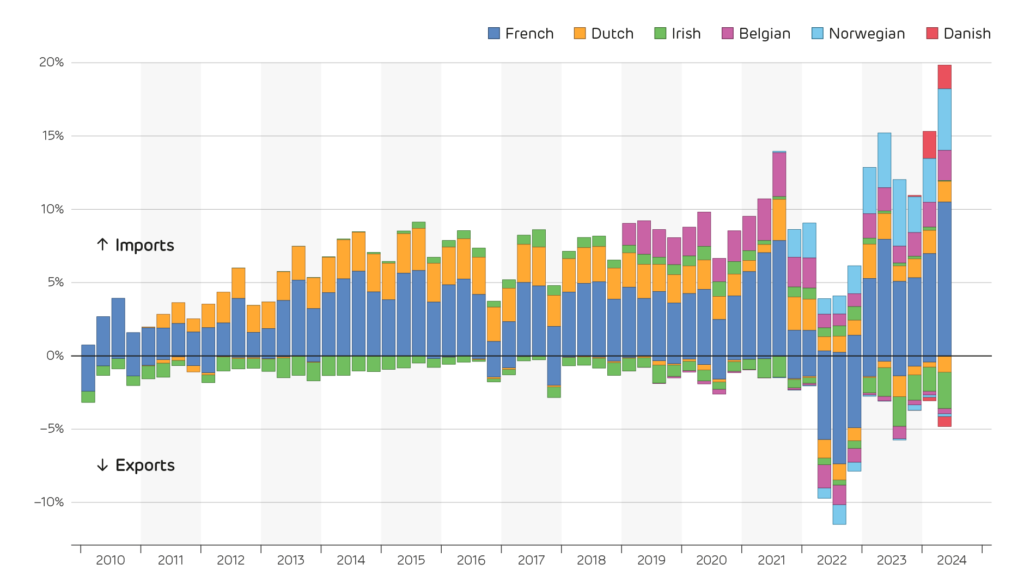
    Gross electricity imports and exports as a share of British electricity demand each quarter.

    https://reports.electricinsights.co.uk/?p=2226

    You will notice how France had to import a lot of electricity in 2022 when nuclear had systemic failure. But 2010, 2016, 2017, 2021 also saw large imports by France especially in Q4. Nuclear simply isn't as reliable as often claimed.


  • Moderators, Recreation & Hobbies Moderators, Science, Health & Environment Moderators, Technology & Internet Moderators Posts: 98,142 Mod ✭✭✭✭Capt'n Midnight


    Re Safety - It was the other reactor No 2 that tripped. The old one didn't because it had older settings, so no it's safety protocols didn't behave the same way as the newer reactor. And you are still ignoring that another plant then tripped too.

    Also it wasn't anything to do with nuclear safety. It was an electrical breaker in the turbine hall. Could have happened in a fossil fuel plant too, but it wouldn't have taken such a large generator offline so probably wouldn't have taken out that other plant.

    The amount of backup and spinning reserve that nuclear depends on 24/7/365 that make it completely unsuitable for the Irish grid because of emissions and cost and stability.


  • Advertisement
  • Registered Users, Registered Users 2 Posts: 16,597 ✭✭✭✭charlie14


    Will you ever stop with this nonsense. France have been ramping up and down nuclear generation for decades, and modern nuclear reactors are built to operate in a load following mode and can adjust their output by 5% of power per minute. Refueling is scheduled for when demand is low so there is extra capacity in the system.

    The simple reason that this idea of yours that we should have 100% of our electricity generated by renewables is absolute bonkers is that we could not print enough money to finance it, and even if we did we would still have the the worlds`s most expensive electricity with a strike price at least 4X we have now.

    But the real bonkers is that you know that. You are constantly on here with facts, figures and speculation on nuclear, yet you will not provide as much as a single figure for what you propose because you know how financially suicidal it would be for our economy and consumers.

    French nuclear was hit by greens madness from all sides, yet it is still going strong providing 70% of their electricity resulting in the lowest emissions in the E.U. has earned a profit of over €5 Bn per year for the last two years from exports, and due to the intermittent nature of renewables will continue to do so with 6 new plants to be added and a possible 8 more to follow.


  • Moderators, Recreation & Hobbies Moderators, Science, Health & Environment Moderators, Technology & Internet Moderators Posts: 98,142 Mod ✭✭✭✭Capt'n Midnight


    We are taking about a grid. Nuclear can have good uptimes. But the downtimes are scary and require support. France lost half it's 56 reactors. Japan lost them all. I've posted many times about how the UK and Germany had half their reactors offline. We probably won't get invaded like Ukraine did. In Germany, Italy and Taiwan it was politics, what's Sinn Fein's policy on foreign stuff if they get into a collation government sometime in the next 60 years ?? Climate change (rivers too warm to cool, ice, floods) and jellyfish are affecting more and more reactors too.

    You suggested that the UK's new nuclear plant would cost ten billion when five times that amount has already been earmarked for it. As for safety delays in construction meant Hinkley C couldn't rely on grandfathering the original design. We had to substantially adapt the EPR design to satisfy British regulations, requiring 7000 changes, adding 35% more steel and 25% more concrete

    Nuclear vs renewables is like saving up for a Annual Commuter Ticket vs Cycling. With the ticket there's no extra cost no matter how many days you use it. With cycling you have to pay for a taxi when the weather doesn't suit.

    You can argue about how much you pay in a year for taxies vs. the ticket BUT you have to save up for a year to buy the ticket, And you can guarantee that it will be more expensive then, and that there will be a delay of several months before you can actually get it. And you will need to pay for taxies for 5-10% of the time anyway because of strikes or being in on bank holidays.

    Do you keep saving for the ticket which is at least a year away or do you invest in better raingear and/or e-bike which will benefit you now ? Because you still need to keep commuting in the meantime.


  • Moderators, Recreation & Hobbies Moderators, Science, Health & Environment Moderators, Technology & Internet Moderators Posts: 98,142 Mod ✭✭✭✭Capt'n Midnight


    Nuclear here is at least 20 years away because of the lead times on Public Relations, legal challenges, tendering process, pre-construction works, actual construction of the roads, pylons, site works, reactor / nuclear island, turbines , commissioning and ramping up to full commercial operation.

    Our emissions plan is to reduce to 5% by then and decrease by 1% a year, So the best nuclear could do is only reduce emissions by 5+4+3+2+1 = 15% of one year compared to what we have to do anyway. And nuclear like renewables is dependent on grid upgrades (eg: pylons) , peaking plant and storage.

    However, nuclear requires way more spinning reserve. Unless and until we have 1.6GW of batteries fully charged and ready to to go we would need gas turbines running at partial load (inefficient so lots more CO2) except we can't because of the emissions. Or we could have 7 Turlough Hill's spinning in air which would require about 2% of that power being wasted, and the construction and planning permission for 6 more of them, But that would mean nearly 10GWh of dispatchable storage which within the emissions limits would allow us to keep going for yonks.


  • Registered Users, Registered Users 2 Posts: 16,597 ✭✭✭✭charlie14


    Japan in it`s latest Strategic Energy Plan has dropped the reference " reducing reliance on nuclear energy" that appeared in the three precious plans in favour of "a maximising the use of nuclear power". Japan currently has 14 of its plants re-opened and operating providing ~8% of its needs and expects that figure to increase to 20% by 2040 and between 30% - 40% by 2050. Similar to many other countries Japan now sees it cannot reach net zero by 2050 without using nuclear.

    France is doing just fine. 70% of it`s needs from nuclear, - even while keeping its renewables competitors in business having to provide them with up to 30% of it`s generation at a bargain basement price - is earning a profit of over €5 Bn a year from exports and is planning on adding a further 6 nuclear plants with a possible 8 more to follow.

    The U.K. has committed to Sizewell C and intents to have 25% of it`s generation in 2050 from nuclear compared to 14% at present. Not surprising as 15% of their demand is being supplied by net imports.

    Italy`s deciding to shutter it nuclear plants was political, but the present government intends to have nuclear providing up to 22% of their demand from nuclear by 2050. No surprise there either. In 2023 they were the 2nd largest importers in the world of electricity.

    Germany`s decision to shut down their nuclear plants was also political, but it was a green ideological political decision that had nothing to do with emissions and everything to do with their dislike of nuclear. Which they used their political muscle within the E.U. attempting to push through legislation forcing other countries to do the same. Germany actively campaigned within the E.U. not to include nuclear - with virtually no greenhouse gas emissions - as a transitional source while they were substituting Putin`s gas for nuclear and encouraging others to do the same. And we all know how well that worked out! Not happy with creating a E.U. wide clusterfcuk with Putin`s gas, they still could not let go of the ideology. Shutting down their remaining nuclear plants during an energy crisis they went a long way to creating but still happy to drain Sweden of their nuclear generation when needed. Thankfully for Germany the present government recognises the ideological insanity for what it was and are actively considering the re-introduction of nuclear.

    Taiwan, as I have posted here before is a basket case that makes even the previous German administration look sane. They are now funding a fixed offshore wind farm costing €16 Bn for 1 GW while having brand new never used nuclear plants in mothballs.

    The €10 Bn for Sizewell was based on your own link, and the current price is €38 Bn. not €50Bn. If we could get someone to build offshore at the price Orsted walked away from because it was financially unviable the strike price for the generation alone would be 50% higher than Hinkley C. Add in the green hydrogen strike price and it becomes 3X times higher before all the extra add-ons from using hydrogen.

    You can take all the bicycles, taxis, commuter trains etc you wish. It does not disguise that you have consistently refused to give as much as a single figure for what you are championing because you know it is dream world financially and practically unviable.


  • Registered Users, Registered Users 2 Posts: 16,597 ✭✭✭✭charlie14


    Please stop with the nonsense. You know better.

    Our peak demand for 2050 is projected to be ~ 15GW.

    7 Turlough Hill,s would generate 2.04 GW and require 2.72 GW to pump that water back up the hill.

    What you would have is a one shot generation of 2.04 GW that would require an extra one third of electricity to recharge compared to what they supplied, where you would be only using them when little or nothing is being provided by renewables for extended periods to supply the grid, let alone wasting electricity recharging these Turlough Hill,s

    It`s a negative sum game attempting to turn mathematics on its head.


  • Advertisement
  • Registered Users, Registered Users 2, Paid Member Posts: 1,513 ✭✭✭riddlinrussell


    What is the proposed reserve supply that, from what I gather, needs to be spinning at all times to provide backup generation in the event of a trip/shutdown on such a large plant?

    I would imagine something needs to be in the system to level things off in case of emergency shutdown?

    Boards is in danger of closing very soon, if it's yer thing, go here (use your boards.ie email!)

    👇️ 👇️


  • Moderators, Recreation & Hobbies Moderators, Science, Health & Environment Moderators, Technology & Internet Moderators Posts: 98,142 Mod ✭✭✭✭Capt'n Midnight


    Primary Operating Reserve needs to be 75% of the largest generator on the grid. And runs for 5 - 15 seconds. Batteries or demand shedding (including stopping the pumped storage pumps) or gas turbines running at reduced power can respond this fast.

    You can't use batteries or pumped storage if they're empty.

    Batteries are Non-Synchronous Generation which needs to be kept below 75% at present so even if you had enough batteries you may have to curtail nuclear's output such that if it fell off the network you'd still have 25% met from synchronous generators.

    For Secondary Operating Reserve (15 - 90 seconds) in addition to the above you can also use pumped storage but only if you already have the turbines using electricity to spin them in air so they are already up to speed. And that's no use if there's a unplanned outage because it takes longer than 15 seconds for the water to fall down to the turbines AND then bring them up to speed.

    https://www.sem-o.com/publications/general-publications has Week 45 Operational Constraints because you still need local voltage stability too. And nuclear plants generally aren't near cities.


  • Registered Users, Registered Users 2 Posts: 1,589 ✭✭✭Emblematic


    Don't know if it has been mentioned already on this thread but with Google (and probably other companies to follow) purchasing small modular nuclear reactors for their data centres, would it be an idea to offer to host some of these in Ireland? The spare capacity could be bought by the grid for domestic use.


  • Moderators, Recreation & Hobbies Moderators, Science, Health & Environment Moderators, Technology & Internet Moderators Posts: 98,142 Mod ✭✭✭✭Capt'n Midnight


    The lovely thing about SMR's is that there is no danger of them actually going into production any time soon.

    So the multinationals can kick the climate change can down the road by announcing major future investments instead of investing in other technologies that would deliver real results now.

    In theory SMR's would be a good match for data centres with their constant loads. In the real world every half decent data centre already has backup like flywheels or batteries until they can get their generators on line, So they could export power, or by using their own generators they could shed demand. They are already flexible. Exporting excess heat for use as district heat is already happening so there's that reduction in fossil fuel by others.


  • Moderators, Recreation & Hobbies Moderators, Science, Health & Environment Moderators, Technology & Internet Moderators Posts: 98,142 Mod ✭✭✭✭Capt'n Midnight


    latest update on UK's reactors only 5 out of 10 generators are at Nominal full load.

    https://web.archive.org/web/20251101203942/https%3A//www.edfenergy.com/energy/power-station/daily-statuses

    Haysham 1, Reactor 1 is now at 399 MW raising load ,"At reduced load" - Took a week to get to 2/3rds of rated power ,using other reactors as backup doesn't work, (The French tried to use to use "the other reactor on a site" for redundancy and then had to spend huge sums of money to do it properly after it was eventually realised that floods affected them both.)

    Hartlepool , Reactor 1 is at MINUS 41MW ,"Automatically tripped while raising load" - ANOTHER EXAMPLE OF WHY NUCLEAR RELIES ON SPINNING RESERVE AND BACKUP.

    Hartlepool , Reactor 2 is "Outage extended due to turbine rotor work" Expected to return Nov 14th - BOTH REACTORS AT HARTLEPOOL HAVE NON PLANNED OUTAGES.

    Heysham 2 Reactor 7 is 293 MW Still - "At reduced load due to boiler feed flow restrictions"

    And that's better than when 6 out of 10 were offline on 28/9

    https://web.archive.org/web/20250928213758/https://www.edfenergy.com/energy/power-station/daily-statuses

    But it's OK , we can repeat the mantra "this time it'll be different" when talking about new power plants.

    Just like we've always done since 1943 when General Grove asked the nuclear scientists to run the first reactor for a longer time in case there was a problem. They didn't and it was only because the first breeder reactors were so over-engineered that only three months were lost on the Atomic Bomb project.


  • Registered Users, Registered Users 2 Posts: 1,589 ✭✭✭Emblematic


    So your main problem with them is not that they are bad in theory but rather that they would be a long time in development? You say, also, that current data centres can already export waste heat to district heat schemes, but would this benefit not also be the case if they were nuclear-powered, with the added benefit that fossil fuels are not used in the production of this heat.

    Do you see any harm then in Ireland offering to host such small reactors? Is it the safety risk you are worried about, or is it the difficulty of handling nuclear waste?


  • Moderators, Computer Games Moderators, Recreation & Hobbies Moderators Posts: 11,314 Mod ✭✭✭✭CatInABox


    Personally, I wouldn't have a major problem with the use of SMRs as data centre power plants, or even SMRs in general in Ireland. Plenty would though, which makes it fairly unviable.

    Anyway, SMRs sound great, but there's so many question marks around them. No one knows yet if they're financially viable at all, despite all the money being pushed into it. For example, the reason nuclear power went big (reactors in the 1GW+ range) in the first place was to benefit from economies of scale. As it turns out, this didn't really work, which left many plants failing to be completed. SMRs try to combat this by attempting to turn it into a factory commodity like Henry Ford. Thing is, there's so many elements that mitigate against this. You still need all the safety measures and safety equipment, all of which is very expensive, only now instead of one set for a 1.2 GW plant, you now need 4 sets for 4 300 MW SMRs. At the end of the day, you're also left with a significant amount of irradiated material, more than you would with a larger plant.

    If SMRs ever get off the ground, I'd be incredibly shocked. If a private company wants to use private money on it, I don't really see a problem with it. I would say that the demand for these is also somewhat questionable, as the flows into AI could just as easily stop if shareholder and consumer value doesn't start to appear from it.


  • Moderators, Recreation & Hobbies Moderators, Science, Health & Environment Moderators, Technology & Internet Moderators Posts: 98,142 Mod ✭✭✭✭Capt'n Midnight


    It doesn't matter how safe they are if they can't be delivered in time. There is no point in even considering them until they are in production and fully debugged.

    We'd need to keep the lights on in the meantime and you'd need to suggest how to do that in a way that doesn't remove the need for nuclear. It doesn't matter if nuclear can do this if we've already solved the problem.

    Nuclear projects are high risk and low reward.

    According to their own timelines Rolls Royce would have working ones by now, had they had invested their own money. Unlike most of the rest of the snakeoil salesmen RR have been making SMR's since the 1950's. They have a pile of assets and guaranteed income from thousands of airliners on order and the maintenance contracts through the life of those airliners. If they aren't willing to invest their money , we shouldn't either.

    There's still no commercial SMR's. Even though hundreds have been made in series production since the 1950's.

    Lots of companies looking for venture capital but nothing actually built. China and Russia have small reactors but they aren't ready for mainstream grid use even if they were selling and even if we were buying.


  • Registered Users, Registered Users 2 Posts: 1,589 ✭✭✭Emblematic


    You say one of the risks would be that the financial flows into AI could stop if value doesn't appear from it. True, but this risk would be fully borne by Google and the like. The state would not be taking on this risk, provided we have guarantees that they decommission the SMR if the bubble bursts before they have the station up and running. If the bubble bursts after they have it up and running, then they will have to recoup whatever costs they have sunk into it by selling cheap electricity to the grid.


  • Moderators, Recreation & Hobbies Moderators, Science, Health & Environment Moderators, Technology & Internet Moderators Posts: 98,142 Mod ✭✭✭✭Capt'n Midnight


    image.png

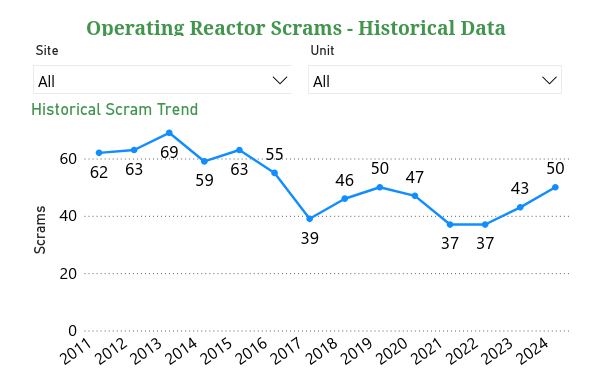
    https://ww2.nrc.gov/reactors/operating/ops-experience/scrams

    I hadn't realised that nuclear was that unreliable. A SCRAM a week in the USA.

    It reinforces the point that nuclear need spinning reserve. Since nuclear generators are multiples of the size of the next largest generators the capital and running costs of additional spinning reserve must be met by nuclear alone or it's a backdoor subsidy.

    The problem for nuclear is how to provide that reserve without increasing carbon emissions. And that reserve makes renewables look more attractive.


  • Advertisement
  • Registered Users, Registered Users 2 Posts: 1,599 ✭✭✭gjim


    Do you see any harm then in Ireland offering to host such small reactors?

    No harm at all. We could also offer to host the tooth fairy, big foot and a fusion reactor while we’re at it.


    Viable non-military SMRs have been “just around the corner” since the 1950s but have never actually been built. Nearly every year or two, we see a SMR hype company go bust having swallowed 100s of millions of naive investor or government money.


  • Registered Users, Registered Users 2 Posts: 1,589 ✭✭✭Emblematic


    Again, that would not be Ireland's problem. The companies that want to go ahead with this to power their data centres would be taking this risk.


  • Registered Users, Registered Users 2 Posts: 1,589 ✭✭✭Emblematic


    @Capt'n Midnight wrote: "We'd need to keep the lights on in the meantime and you'd need to suggest how to do that in a way that doesn't remove the need for nuclear. It doesn't matter if nuclear can do this if we've already solved the problem."

    I can see where you are coming from if you think this is what was suggested. You think the proposed plan would be to shut down all existing power generation now in the hope that at some point SMRs are up and running. I can see why you would object to it.


  • Moderators, Recreation & Hobbies Moderators, Science, Health & Environment Moderators, Technology & Internet Moderators Posts: 98,142 Mod ✭✭✭✭Capt'n Midnight


    I doubt there'd be enough money held in escrow for the decommissioning and cleanup.

    If the data centres then needed power they would enter the bidding war with everyone else which would push up prices.


  • Moderators, Recreation & Hobbies Moderators, Science, Health & Environment Moderators, Technology & Internet Moderators Posts: 98,142 Mod ✭✭✭✭Capt'n Midnight


    We are already getting 40% of our electricity from renewables even though we have to curtail them at 75% which would suggest that we could get to 50% tomorrow if the grid could handle 95% renewables. And get higher %'s as more renewables are rolled out.

    It's going to be at least 20 years before we could have nuclear here.

    And that's if we could afford the massive support infrastructure needed because it's inflexible. And that massive support infrastructure would facilitate renewables too.

    I don't see us reducing the amount of gas turbines during that time apart for older plant that will be shutdown due to old age or because it can't be upgraded. Existing fossil fuel plants will have reduced hours and be weaned off fossil fuel on to things like bio-methane , hydrogen and fuel to energy products. So lower total emissions by running them less often and using lower emission fuels. Or they'll be replaced by newer greener plant.

    Since peak demand will increase we will need more dispatchable plant.

    The further you go above half of peak annual demand the shorter the time. You'd get rapidly diminishing returns for each extra nuclear plant on the gird as you get closer to peak demand. So in theory you can't get much beyond 50% unless like France and Sweden you have dispatchable hydro and connections to the neighbours. So you still need dispatchable plant to cover the other 50% + enough to cover a reactor SCRAM.

    During Winter it's windy so nuclear would only be used half the time. And then it's only able to provide half the peak demand.

    Nuclear can't compete with solar during daylight hours. This halves the time you can sell the electricity that's needed to pay for construction costs. The lowest demand is during summer nights so no premium prices then especially if you have the storage needed to backup nuclear for a few hours.

    So at best nuclear could only provide half the power half the time during the dark half of the year.


  • Moderators, Recreation & Hobbies Moderators, Science, Health & Environment Moderators, Technology & Internet Moderators Posts: 98,142 Mod ✭✭✭✭Capt'n Midnight


    The €10 Bn for Sizewell was based on your own link, and the current price is €38 Bn. not €50Bn

    Which link? And you then need to explain how you didn't twig it was unbelievable low compared to the costs regularly being posted here for it and similar plants. The nuclear industry has a long history of bait and switch when it comes to pricing.

    The current amount earmarked for it is €52Bn and the extra money is as good as spent because the contractors won't leave it on the table unless they've had a conversion on the road to Damascus.


  • Registered Users, Registered Users 2 Posts: 16,597 ✭✭✭✭charlie14


    You have either no sense of irony or shame asking me to explain a figure when regardless of how often you have been challenged you have not provided a single one for what you are proposing.

    For the third time that figure was based on a link you posted (#Post 2593) "The UK has already trialled 2% green hydrogen" where on Centrica buying a 15% stake in of Sizewell C in July, the figure for that 15% is given as £1.3 Bn. Even with you being notoriously shy where mathematics are concerned you should still be able to understand based on that figure for a 15% stake, that 100% is €10 Bn.

    The current price for Sizewell C is €38 Bn. and the funders have said they are confident that cost will not be exceeded. Even if they had not, I would not pay much attention to somebody`s predicting when a prior prediction was the cost of offshore was going to decrease dramatically where just a few months later it rose by 60%. And even when the CFD price was increased by that 60%, contractors still walked away because it was financially unviable.

    Now that I have cleared that up for you, perhaps you would be good enough to withdraw the lie that you you have twice posted here and have ignored when pointed out to you, that consumers pay for nuclear "all day every day whether they need it or not" and acknowledge that consumers pay for nuclear on the same basis they pay for renewables. On what they use based on the CFD.


  • Moderators, Recreation & Hobbies Moderators, Science, Health & Environment Moderators, Technology & Internet Moderators Posts: 98,142 Mod ✭✭✭✭Capt'n Midnight


    I will take that accusation as an admission. You are quoting €38Bn when you know it's £38Bn (€43.4Bn)

    Regardless it still has to be paid. If you can sell full load output for 8,000 hours (uptime of >90% in a good year) then the hourly rate will be lower than if you only need it when wind dips during the darker months. In which case you'd only have 4,000 hours and only be able to sell half your output. And suddenly nuclear electricity costs four times as much because those billions still have to be paid even though you are only selling a quarter of the energy.

    Conmen being confident ? Will wonders ever cease. It's bait and switch 101, and the key decisions makers will be safely retired before the fertiliser impacts the spinning thing so there's no back pressure there against corruption.

    Since nuclear isn't going to produce any power for the next 20 years we have to keep investing in renewables and storage and grid upgrades. So the cost savings during this time are exactly zero.

    It's not a choice of nuclear or renewables you have to pay for both and given the history of delays in nuclear you can't stop investing in renewables until nuclear is up and running. Even then Chinese EPR had fuel rod issues soon after startup and had to go offline for a year. With OLK3 it was pumps that took it offline for months. Flammanville will need an extended outage too.

    For nuclear you need a grid that can replace 75% of a reactor output within 5 seconds. That can also provide replacement power for the month or two every 18 - 24 months when reactors are refuelling or doing maintenance. Yes , predictable nuclear outages last longer than dunkelflauten. Unpredictable outages can last even longer and can and do happen when you already have another reactor offline.

    A grid that could handle nuclear would be easily able to handle the changes in output of wind farms which are forecast days ahead. In twenty years time the likelihood is that we should be able to forecast another 2 days further ahead.

    Enough storage to keep the lights on most nights during the months with longer days will look more attractive as the costs of solar and batteries continues to fall.


  • Moderators, Recreation & Hobbies Moderators, Science, Health & Environment Moderators, Technology & Internet Moderators Posts: 98,142 Mod ✭✭✭✭Capt'n Midnight


    UK nuclear https://www.edfenergy.com/energy/power-station/daily-statuses update. It's not just the number of outages, it's the unpredictability of when the power will come back. Other countries are similar but it's easier to show the UK data. Yes the AGR's suck but the people running them should have figured them out by now and set expectations accordingly rather than drip-drip the bad news.

    Today's excuses. 4 have non-nuclear issues that could affect other types of steam plant but nuclear is bigger so there's a larger effect on the grid.

    https://web.archive.org/web/20251103221019/https%3A//www.edfenergy.com/energy/power-station/daily-statuses

    Torness

    Reactor 1 Turbine Generator 1 594 MW Status Nominal full load
    Reactor 2 Turbine Generator 2 619 MW Status Nominal full load Date of next statutory outage Jan 2026


    Sizewell B (one reactor, two generators)
    Reactor 1 Turbine Generator 1 603 MW Status Nominal full load
    Reactor 1 Turbine Generator 2 601 MW Status Nominal full load

    Heysham 2
    Reactor 7 Turbine Generator 7 295 MW Status At reduced load due to boiler feed flow restrictions
    Reactor 7 Turbine Generator 8 625 MW Status Nominal full load


    Heysham 1
    Reactor 1 Turbine Generator 1 401 MW Status Load limited due to condenser performance
    Reactor 2 Turbine Generator 2 0 MW Shutdown category Planned Expected return to service date December 6 2025

    Hartlepool
    Reactor 1 Turbine Generator 1 -34 MW Shutdown category Non planned Expected return to service date November 27 2025
    Status Outage extended to address boiler tube leak - ( This was supposed to be back online for Nov 5 )

    Reactor 2 Turbine Generator 2 -4 MW Shutdown category Non planned Expected return to service date November 14 2025
    Status Outage extended due to turbine rotor work


  • Advertisement
  • Registered Users, Registered Users 2 Posts: 16,597 ✭✭✭✭charlie14


    The accusation was that you had lied twice posting that consumers pay for nuclear "all day every day whether they need it or not" and still no admission from you. Poor posting form imo.

    The €10 Bn. was not an accusation. It was the price based on your own post that Centrica bought a 15% stake in Sizewell for £1.3 Bn.

    Where in any sane world would anyone look at intermittent - (definition : occurring at irregular intervals, not continuous or steady) - renewables as a base load supply when nuclear can do it with it having over twice the capacity factor of offshore wind and do it for a third of the capital cost ?

    You do not seem to understand that the price to the consumer is based on the strike price/cdf contracts, but even to follow your latest claim on the Capex cost of nuclear having to be paid regardless, why would the same not apply to renewables with 3X the Capex ??

    You have been rambling on about needing to have a grid that can replace 75% of a reactor output in 5 seconds. What is going to replace 90%+ of your grid when wind goes for one of it`s extended sleeps ? And no, forecasting wind two days further ahead is not going to make any difference.

    Btw far as I recall didn`t two gas plants that were supplying half the demand on a Winters night trip out within seconds of each other a few years ago and not only did the grid not go black, the lights stayed on.

    You can stop pretending you do not know the financial cost and impact of what you are proposing would be. It`s been very obvious for a long time now you do by refusing to give any cost for anything you favour because you know how ludicrous it is.

    Same as you know we will not even make the 23% reductions by 2030 never mind 51%. Net zero by 2050 following what you are proposing will not really be a problem though for emissions fines. We would be so bankrupt long before that due to bankrolling your proposal and paying for the most expensive electricity on the planet that those looking to collect them would be lucky to get 5 cents on the euro.


Advertisement
Advertisement