Advertisement
Help Keep Boards Alive. Support us by going ad free today. See here: https://subscriptions.boards.ie/.
https://www.boards.ie/group/1878-subscribers-forum

Private Group for paid up members of Boards.ie. Join the club.
Hi all, please see this major site announcement: https://www.boards.ie/discussion/2058427594/boards-ie-2026

Irish Property Market chat II - *read mod note post #1 before posting*

1929930932934935944

Comments

  • Registered Users, Registered Users 2 Posts: 5,879 ✭✭✭BlueSkyDreams


    I raised the same question recently, Of our 30k new homes annually, how many are being purchased or rented by the govt?

    The Podcast suggests the vast majority of them, although there will be forward funded schemes with private investment funds also, but I agree that the state is likely the largest purchaser of private homes, which is unreal and is inflating prices further, as it is gobbles up the supply before it ever reaches the market.

    The state needs to mobilise its own house building programme and should be barred from purchasing on the open/private market.


  • Registered Users, Registered Users 2 Posts: 5,046 ✭✭✭Villa05


    OK I concede that the census is gospel and should not be questioned.

    Let try some other facts

    The census for 2011 was carried out in April at which point renting was considerably cheaper than buying. The supply was greater than demand, with the state warehousing land and property. Mortgage arrears were rocketing while it was not yet apparent that repayment was voluntary

    We were a year out from the rollout of the property price register which would give buyers much more informed buying decisions

    We were 4 months into an IMF bailout

    Renting was the safe prudent option at that point so not really a shocker that the numbers choosing to rent over buying at that point and in the 3 years running up to that point had increased, thus reducing homeowner rates.

    I'd be careful about using terms like explosion when describing first time buyer numbers

    Scratching the surface would suggest continued dysfunction, while the numbers have risen. How many are for self builds, used properties etc. New marginal supply is priced well beyond the majority of prospective first time buyers

    This is from a 2024 analysis on 2023 numbers

    It all conveys the impression of a market that is operating at full tilt, but in fact, mortgage lending activity remains at levels seen four decades ago, despite massive growth in the population and in earnings in the meantime


  • Registered Users, Registered Users 2 Posts: 3,526 ✭✭✭Blut2


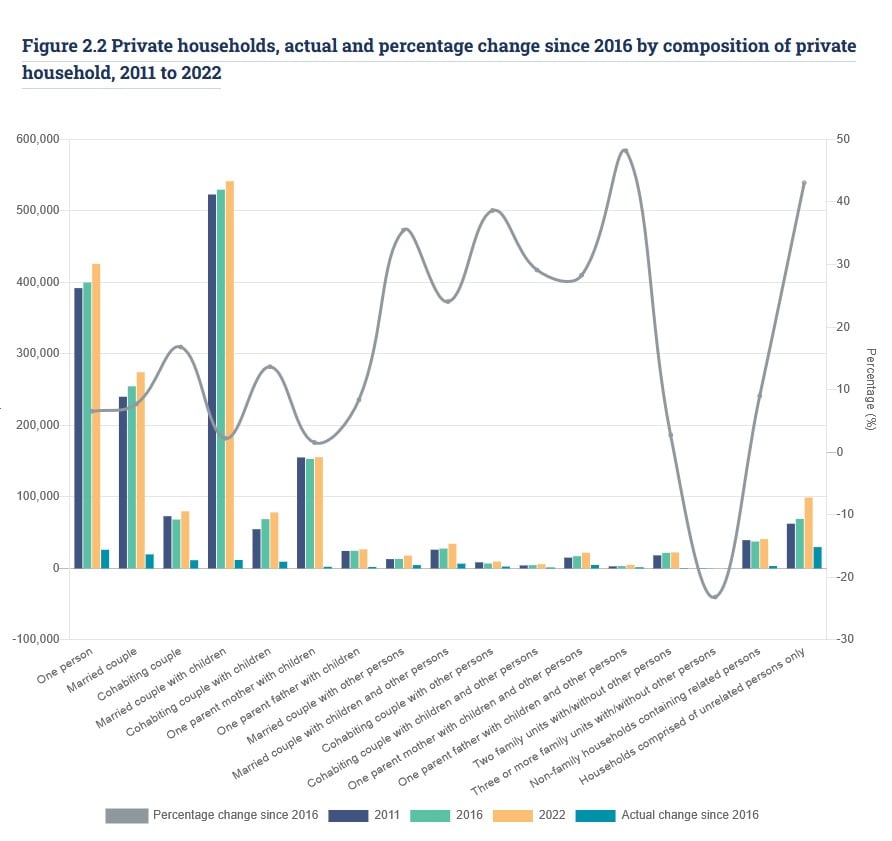
    Recently arrived single men, or students, do live in shared accomodation sometimes yes but usually only for short periods of time. They fairly quickly move into their own households generally. Thats true of people living here of all backgrounds.

    Households of multiple unrelated persons living together are very rare still in Ireland, they're under 5% of total households, or 100k or so total. Households of 3+ of such are even rarer again. They're really not a common thing at all on a national basis, despite the media focusing on some grim slumhouse highlights.

    households.jpg

    And the ratio of single people to families with children is much higher in immigrant groups than Irish born/resident, which means more living in one-person households, the second most common household type.

    We're recieving 120k+ immigrants a year, or over 2% of the population of Ireland, so its absolutely enough to have statistical impact on things like household size quite quickly.

    And, to tie it back into my original point, its enough to have an extremely negative impact on the housing market for people already here. Its an absolutely huge amount of extra demand for housing added, every year, at any household size.


  • Registered Users, Subscribers, Registered Users 2 Posts: 6,803 ✭✭✭hometruths


    This has pointless internet argument written all over it so lets agree to disagree on the specifics of household composition and move on to the nub of the issue - the demand for the population growth.

    For simplicity's sake, say the population increased by 50k in 1 year. Forgetting about the problem of whether or not we have enough existing built stock for the existing population, how many units do you think need to be built simply to accommodate the 50k increase?

    20k houses for 50k people would be AHS of 2.5 which seems ample to me given as you say vast bulk of houses overall are occupied by married couples with children.

    Do you think we need more than 20k? Or less?

    Post edited by hometruths on


  • Registered Users, Registered Users 2 Posts: 5,046 ✭✭✭Villa05


    Remember the good ole days of the Celtic tiger when 90% of new builds were for private buyers (predominantly ftb) with 10% for social

    Even the developers could buy out the requirement of 10% social with a donation to the local council to make the entire estate private or more units in a separate development

    The huge amounts the taxpayer is putting in is achieving nothing except changing the eventual occupier, pumping developer margins and significantly reducing developers costs and pricing out the vast majority of first time buyers

    Remember on top of all the listed benefits in the podcast the developer also benefits from water and service charges waiver plus the grant for each individual apartment delivered. Nearly all of the soft costs are being covered by the state

    It is possible that developers could reduce output as it would be next to impossible to deliver the same margins building for private buyers in comparison to what the state is paying for social housing. This can be seen in recent figures showing home builders PMI (a measure of home building activity) contracting for 3 consecutive summer months.

    We had better outcomes in the days of Brown envelopes, now the robbery is embedded, widespread, systemic and legal

    According to the S&P Global AIB Ireland Construction PMI report for July 2025, the residential construction sector experienced a contraction for the third consecutive month, with activity decreasing at an accelerated pace. While overall commercial activity continued to expand, the housing sector saw a slowdown in growth in the prior month's report, with the latest data showing a faster reduction in housing activity. 


  • Advertisement
  • Registered Users, Registered Users 2 Posts: 927 ✭✭✭littlefeet


    Do you ever reread your own posts?. I am always suspicious of anyone in 2025 talking about property developers instead of house builders.


  • Registered Users, Registered Users 2 Posts: 5,046 ✭✭✭Villa05


    I feel it's very important to distinguish between the developer/lobbyists and the actual people that build the homes

    An out an out builder did not design this system


  • Registered Users, Registered Users 2 Posts: 157 ✭✭cleanfarmer2025


    Talk of a slowdown in jobs and wage growth currently happening.

    That will have a knock on effect with house prices as it's rising wages that are driving up prices. Every 1 euro in a wage increase = 4 euro extra to add to a house bid.


  • Registered Users, Registered Users 2 Posts: 15,042 ✭✭✭✭Red Silurian


    https://www.bbc.com/news/articles/cpdjjp681p7o

    Something similar in the Indo for Ireland but behind a paywall

    The Trump factor causing uncertainty in the markets earlier this year is likely the main driver of this, but also if people can't afford their own houses they'll go elsewhere. Less people in the country paying taxes is not a good thing for the economy


  • Registered Users, Registered Users 2 Posts: 1,918 ✭✭✭DataDude


    The only happy path to better affordability that doesn’t crater building, lending and subsequently home ownership is elevated levels of wage inflation with house price inflation dampened by increased supply.

    If we could choose a trajectory for both you’d be looking for a 10 year period of wage inflation at +3-4% and house price inflation at +0%-2%. That is the ideal world. Affordability is dramatically improved and building/lending can thrive.


    Wage inflation has maybe been running slightly too hot of late (>5%) but a significant reduction will be very bad for home ownership levels.


  • Advertisement
  • Registered Users, Registered Users 2 Posts: 3,526 ✭✭✭Blut2


    The population is increasing by far more than 50k each year. The real world figures are that its been increasing by over 100k per year for the last 4 years running now.

    If we went with a household size figure of 2.5 (which is still likely too high given the demographics of our population growth drivers) that would mean we would need 40,000 new housing units a year just to account for our population increase, at 100k per year (and nevermind the number is actually above that).

    In addition to that the CIF and Housing Commission give an estimate of 10,000+ housing units a year needed to replace existing stock. That brings it up to 50,000 units a year required.

    And then theres whats needed to actually make a dent in the housing crisis and bring supply levels closer to demand levels. Being very conservative here and allowing 10,000 units a year for that would bring us up to 60,000 units a year required. Which is the number the Housing Commission, the CIF, and Dublin Chamber have all recommended.

    But instead we're building 30-35k a year, still. We built 30k in 2024, 5+ years into this housing crisis. And numbers for 2025 will likely be below 2024 now it seems. Its an utter failure of policy making.


  • Registered Users, Subscribers, Registered Users 2 Posts: 6,803 ✭✭✭hometruths


    I said 50k for simplicity, but OK let's say it is 100k population growth.

    Park making dent in deficit, obsolescence etc for now and just focus, on the population growth - how many houses do you think we need to build to accommodate a population increase of 100k?


  • Registered Users, Registered Users 2 Posts: 3,526 ✭✭✭Blut2


    I answered that in my post? But if you want more detail, sure.

    At the current Irish household size of 2.73 100k yearly population increase would require 37k new housing units a year being built, just to house the yearly population growth. Thats the absolute lowest figure.

    Because 1) Irish household has been declining steadily over the years due to lower family sizes and increased urbanisation (Dublin's average household size in 2022 was 2.48) and 2) most of our population growth is a result of immigration, which has been discussed at length above as resulting in lower household sizes. Therefore a middling estimate would be 2.5, which would require 40,000 housing units just to house the population.

    If household sizes drop even faster, and approach the norm thats common with our neighbours in Europe (2.05 in Germany, 2.07 in Sweden, 2.21 in Switzerland, 2.22 in France), and land at 2.10 we'd need 48k new housing units a year just to house the yearly population growth. And with every year that goes by our society is getting more like theirs - lower birth rates, later marriage age, more immigration, more apartment living etc - and converging with the average.

    So that gives a range of 37k-48k new housing units per year required just to house our population growth. Nevermind the obsolesence, housing crisis, or anything else. And we're only building 30k a year total. We're not building nearly enough to house the population growth, nevermind the rest.

    (and bear in mind this is all based on an average 100k per year population growth rate, which we're surpassing frequently - the figure was 183k (!!) population growth in 2023)

    Sooner rather than later it needs to get more discussion that our out of control population growth is now up there with too low building as the arguable number one factor in our housing crisis.


  • Registered Users, Registered Users 2 Posts: 5,879 ✭✭✭BlueSkyDreams


    Pop growth was only 78k this year and 100k the year previous. The large number in 2023 was Ukraine related, so not a number we will see repeated.

    Population growth has halved this year vs 2023.

    Despite this, we do still need to get past 50k new homes per year alright.


  • Registered Users, Registered Users 2 Posts: 3,526 ✭✭✭Blut2


    Estimates vary,

    "The AMECO (annual macroeconomic database of the European Commission’s Directorate General for Economic and Financial Affairs) estimates that the Irish population reached 5,348,700 at the end of 2023, compared to 5,165,000 at the end of 2022. That is a rise of 183,000 in a single year."

    The CSO figures are usually low and get revised upwards later, and aren't across a calendar year, but even they're consistent. Our population growth, and immigration levels, have been increasing yearly. Its absolutely not just the Ukrainian refugees in 2022 (not 2023).

    And its not remotely sustainable given our housing output of 30k housing units per year.

    CSO April 2024:

    "In the 12 months to the end of April 2024:

    • The population in Ireland rose by 98,700 people
    • There were 149,200 immigrants which was a 17-year high. This was the third successive 12-month period where over 100,000 people immigrated to Ireland. "

    CSO April 2023:

    "In the 12 months to the end of April 2023:

    • The population rose by 97,600 people
    • There were 141,600 immigrants which was a 16-year high. "

    CSO April 2022:

    In the 12 months to the end of April 2022:

    • The population increased by 88,800 persons
    • There were 120,700 immigrants, a 15-year high."


  • Registered Users, Subscribers, Registered Users 2 Posts: 6,803 ✭✭✭hometruths


    Therefore a middling estimate would be 2.5, which would require 40,000 housing units just to house the population.

    That's perfectly reasonable logic that I (and I think most people) would agree entirely with. An increase of 40,000 houses is a realistic figure to house a population increase of 100,000.

    The bit I struggle with is this:

    If it is reasonable logic to accept 40k houses will accommodate a population increase of 100k why is not reasonable to expect the equivalent number to house the existing population?

    By the same maths a population of 5,149,139 (census 2022) would require a housing stock of 2,059,655.

    The actual housing stock in Census 2022 was 2,112,121.

    That would indicate a surplus of 50k.

    How is possible that 40k houses for 100k people is sufficient but 2,112,121 houses for 5,149,139 people is a chronic housing shortage of crisis proportions?

    It defies all logic.


  • Registered Users, Registered Users 2 Posts: 3,526 ✭✭✭Blut2


    Our population in August 2025 is estimated at 5,458,600 according to RTE and the CSO. That would require an additional ~125k housing units from your calculation for starters. And thats almost certainly a population underestimate given the way those figures usually get revised upwards subsequently these days, not downwards.

    But more importantly we're in an estimated deficit of 200k housing units because a significant % of our housing stock at any moment is used up by holiday homes, long term vacant homes, homes in probate, short term vacant homes between buyers/renters, homes currently vacant while under reconstruction / development, airBNB properties, etc. Every house is not currently lived in by a household.


  • Registered Users, Subscribers, Registered Users 2 Posts: 6,803 ✭✭✭hometruths


    Our population in August 2025 is estimated at 5,458,600 according to RTE and the CSO. That would require an additional ~125k housing units from your calculation for starters. And thats almost certainly a population underestimate given the way those figures usually get revised upwards subsequently these days, not downwards

    No doubt the population figure has risen since April 2022, but I was comparing the population at a point in time with the housing stock at a point in time, as that is the most comprehensive data we have available. Incidentally the exact same point time at which there was supposedly a 200k deficit.

    But more importantly we're in an estimated deficit of 200k housing units because a significant % of our housing stock at any moment is used up by holiday homes, long term vacant homes, homes in probate, short term vacant homes between buyers/renters, homes currently vacant while under reconstruction / development, airBNB properties, etc. Every house is not currently lived in by a household.

    The above and others are accounted for by almost 12.5% of the 2,112,121 existing housing stock in April 2022. It's impossible to have a 200,000 deficit and over 200,000 unoccupied homes at the same time. Again it totally defies logic.

    No matter how much you squint it is impossible to make a credible mathematical argument for a 200k deficit in April 2022.

    If you don't believe me, try to do the maths yourself using the census data. You'll find it impossible without veering into the old census data is wrong chestnut.


  • Registered Users, Registered Users 2 Posts: 5,046 ✭✭✭Villa05


    You make the strongest case for doing the exact opposite to government policy

    Shift away from demand to supply side policies

    Affordable rentals have to be a priority as that is where the most damage is being done to the economy. Continue as we are and the situation corrects the 08 way.

    Rents as high as a net average wage artificially increases buyer demand, sub prime lending and daft government incentives that make the situation worse

    The numbers of Irish leaving for Australia are at all time highs, you don't get into Oz unless you are well trained and qualified.


  • Registered Users, Registered Users 2 Posts: 3,526 ✭✭✭Blut2


    You can't discount 3.5 years of runaway population growth, literally the fastest growth in the history of the state, quite literally hundreds of thousands of people, when attempting to claim we have enough housing stock for every human in the country.

    And the official vacancy rate the CSO uses doesn't come close to accounting for the real vacancy rate in the state. Far too many homes are temporarily vacant and missed by it, or are registered as non-vacant for tax purposes but are actually vacant. Or are registered as lived in but are actually used as airbnbs / holiday rentals. etc.

    The idea that most Irish people are being honest with the CSO about the vacancy status of their home, when vacant homes are liable to be taxed, is very naive.


  • Advertisement
  • Registered Users, Subscribers, Registered Users 2 Posts: 6,803 ✭✭✭hometruths


    I'm not discounting the undoubted huge population growth. I am disputing the claim that were was a deficit of 200k+ houses in April 2022. The data tells us that at a national level we had enough housing stock to house the entire population in April 2022.

    Your theory about the CSO undercounting vacancies only bolsters the argument that there was no deficit in April 2022.


  • Registered Users, Registered Users 2 Posts: 3,526 ✭✭✭Blut2


    But nobody is talking about if there was a deficit or not in early 2022 years ago, the point is theres a huge, and growing, deficit now in late 2025.

    Using figures from when the population was hundreds of thousands of humans smaller, to claim there is enough housing for every human in the country now, is entirely irrelevant.

    The CSO undercounting vacancies means there were, and are, far more vacant properties in Ireland than its report says. Which means there were less houses for humans to live in. Which means more of a deficit.


  • Registered Users, Subscribers, Registered Users 2 Posts: 6,803 ✭✭✭hometruths


    But nobody is talking about if there was a deficit or not in early 2022 years ago, the point is theres a huge, and growing, deficit now in late 2025.

    Really? When you're talking about the 200k odd deficit of homes - where did you get that figure from?

    Using figures from when the population was hundreds of thousands of humans smaller, to claim there is enough housing for every human in the country now, is entirely irrelevant.

    I didn't claim there is enough housing for every human in the country now, I claimed there was enough in April 2022. I think you missed the point, which may have been entirely my fault for explaining it badly.

    The CSO undercounting vacancies means there were, and are, far more vacant properties in Ireland than its report says. Which means there were less houses for humans to live in. Which means more of a deficit.

    The more vacant properties we have in the existing housing stock is evidence of a higher deficit? Which in turn means we need to build even more new stock to reduce the deficit in the existing stock? That strikes me as a little counterintuitive to say the least.

    I think we're looking at this very differently, just like the necessary/likely average household size for single male immigrants.


  • Registered Users, Registered Users 2 Posts: 5,046 ✭✭✭Villa05


    Fresh data out of Cairn homes this morning show there forward order book has increased by 1,700 in the first 6 months of this year, which has almost doubled

    This is the figure David McWilliams was using to demonstrate state buying of new homes in his podcast


  • Registered Users, Registered Users 2 Posts: 5,879 ✭✭✭BlueSkyDreams


    Where is the breakdown of state purchased homes in the article?

    Of the 1731 new homes that were delivered since January this year, how many have been state purchased?


  • Registered Users, Registered Users 2 Posts: 5,046 ✭✭✭Villa05


    Total sales 708 units

    4.1 private sales per week = 106.6 units

    Figures for January to June

    1 unit in 7 makes it to a private buyer

    Total Output is reducing as the state buys more


  • Registered Users, Registered Users 2 Posts: 5,879 ✭✭✭BlueSkyDreams


    Thats sales from active selling sites only. This may not include all new build sales.


  • Registered Users, Registered Users 2 Posts: 3,526 ✭✭✭Blut2


    Conall MacCoille, Davy's Chief Economist estimated the deficit at heading towards 200k in mid 2021

    Leo Varadkar when serving as Taoisech in mid 2023 said there was a deficit of 250,000 homes in the country

    Property group Knight Frank in early 2024 said the "actual shortfall could well be north of 200,000 units "

    The Commission on Housing in mid 2024 estimated the deficit as between 210k and 250k homes

    The Construction Industry Federation (CIF) in 2024 stated Ireland has a significant housing deficit, estimated at between 212,500 and 256,000 homes

    Every expert analysis comes to a similar conclusion, which would suggest its broadly correct.

    And all of the analysis also states we need in excess of 60k units a year being built, so at the current rate of 30k per year completions the deficit is only getting higher with every passing year. As the continually increasing deficit estimates also show.

    "I didn't claim there is enough housing for every human in the country now, I claimed there was enough in April 2022."

    But nobody in this thread ever asked about April 2022. The point under discussion is the state of the Irish housing market in late 2025.

    "The more vacant properties we have in the existing housing stock is evidence of a higher deficit? Which in turn means we need to build even more new stock to reduce the deficit in the existing stock?"

    Yes, rather obviously I would think. The more houses that are vacant in reality, but that aren't listed as vacant in CSO stats, the fewer houses there are actually available for humans to live in - far fewer than the CSO total housing statistic would suggest. And so the bigger deficit of available houses for humans to live in.


  • Registered Users, Subscribers, Registered Users 2 Posts: 6,803 ✭✭✭hometruths


    The Commission on Housing in mid 2024 estimated the deficit as between 210k and 250k homes

    They published their findings in 2024. Presumably you hadn't read it before citing it, hence the misunderstanding about the significance of April 2022. Page 30:

    "Taken together, the above implies that, as of April 2022, the best estimate of Ireland’s housing deficit was between 212,500 and 256,000 homes."

    But as shown above the census data doesn't indicate a deficit at all never mind one as high as 256k. Hence the question I asked.

    But nobody in this thread ever asked about April 2022. The point under discussion is the state of the Irish housing market in late 2025.

    I asked about April 2022 precisely because (a) that was the census date and thus is the most recent count of both the population and the housing stock that is not wholly reliant on guesstimates and assumptions and (b) that was the date on which the Housing Commission claimed there was a deficit of up to 256k houses.

    April 2022 is a hugely relevant date in any discussion or calculation about overall housing need right now.

    Yes, rather obviously I would think. The more houses that are vacant in reality, but that aren't listed as vacant in CSO stats, the fewer houses there are actually available for humans to live in - far fewer than the CSO total housing statistic would suggest. And so the bigger deficit of available houses for humans to live in.

    I think this is a pretty mad way of looking at things TBH, is that your own understanding of the vacancy problem? presumably you don't think that on this point "every expert analysis comes to a similar conclusion" as well?


  • Advertisement
  • Registered Users, Registered Users 2 Posts: 3,526 ✭✭✭Blut2


    The Commission on Housing published their findings, and gave analysis for the situation in 2024.

    And, again, plenty of other experts have all given similar estimates.

    You repeatedly in this thread say "thats wrong", and seem fairly obsessed with the April 2022 figures for some reason, but never offer a single expert analysis to back up your stance. It seems entirely based on your own personal vibes, which doesn't really count for much when we have a cross-spectrum consensus of expert opinion across the country that say the exact opposite to you.

    "I think this is a pretty mad way of looking at things TBH, is that your own understanding of the vacancy problem? presumably you don't think that on this point "every expert analysis comes to a similar conclusion" as well?"

    Its entirely logical. Any home thats deliberately kept vacant is one thats not actively housing humans in the Irish housing market. It may as well not exist as housing stock. So they can't be counted as available homes, they're not accessible to the housing market.


Advertisement
Advertisement