Advertisement
Help Keep Boards Alive. Support us by going ad free today. See here: https://subscriptions.boards.ie/.
https://www.boards.ie/group/1878-subscribers-forum

Private Group for paid up members of Boards.ie. Join the club.
Hi all, please see this major site announcement: https://www.boards.ie/discussion/2058427594/boards-ie-2026

Northern Ireland 2125?

14041434546188

Comments

  • Registered Users, Registered Users 2 Posts: 690 ✭✭✭michael-henry-mcivor


    Gerry was hit a number of times- the doctors saved his life-

    Brit paid for that at Brighton hotel-


  • Registered Users, Registered Users 2 Posts: 690 ✭✭✭michael-henry-mcivor


    Aye- the Stoops are not 32 Irish- so they are not really Irish-

    Sinn Féin defeated those that wanted to keep them quiet- the noise they made was to much-


  • Registered Users, Registered Users 2 Posts: 10,846 ✭✭✭✭maccored


    could be earlier - brits are getting really really fed up with unionism/loyalism. Scroll through tt or any social media app and you'll find british people wondering what all the marching malarky is about and how unbritish it is. Add that to the failing Unionist strong hold on the north and the dwindling unionist population (thought to be fair, depopulation worldwide is starting to be a bit of a thing). never mind how worse brexit is going to get. Put it all together and its inevitable.


  • Registered Users, Registered Users 2 Posts: 690 ✭✭✭michael-henry-mcivor


    Yes- and then the locals beat his type in portadown-

    The Orange men tried to walk into a Catholic area and they were smacked to a stop 27 years ago and have never dared to try again-


  • Posts: 0 [Deleted User]


    People Before Profit operate island wide too I believe. What about Southern only parties like FF & FG, are they 'Irish' too in your view?


  • Advertisement
  • Registered Users, Registered Users 2 Posts: 690 ✭✭✭michael-henry-mcivor


    People before profit supported the brit brexit-

    The brit foreigner said partition- and FFG said yes master-


  • Registered Users, Registered Users 2 Posts: 17,438 ✭✭✭✭markodaly


    He was under the same pressure to meet and marry within his own community that Catholics were.

    That is also a lie. He never said this.


  • Posts: 0 [Deleted User]


    Feckin hell, are you ever worried you won't have much of a choice when election time comes around?


  • Registered Users, Registered Users 2 Posts: 81,281 ✭✭✭✭FrancieBrady


    Replace Catholic for Protestant here and you’d be describing the lived experience of a lot of my generation. The pressure to stay within your religious group. Wasn’t huge pressure but it was there. Norton and I are within a year of each other age wise.

     You had to go to these special Protestant hops and Protestant socials and the idea was you met a nice Protestant girl and had Protestant babies

    Both of us broke the mould too.


  • Registered Users, Registered Users 2 Posts: 1,219 ✭✭✭itsacoolday


    No actually he was consistent and told the truth to everyone, he had no reason to change the story of his life.

    Graham, "I never came out. It didn’t seem practical.

    "Living in a small town in rural Ireland in the early eighties there was no context for me to be gay in, so why tell anyone?

    "I would just have been gay watching afternoon TV or riding my bike into town.

    "With no prospect of being gay in the very important boy meets boy scenario, I felt it would just have upset everyone without any real benefit.

    "Instead, I resolved to go to where the boys were."

    He went to California on a J1. Do not forget homosexuality was against the law in Ireland at the time. He did say

    Graham Norton: My Protestant upbringing in Cork left me friendless and lonely | Irish Independent

    he said there was an "under siege" mentality felt by Protestants when he was growing up in Cork in the Seventies.

    He said: "If you married outside of the faith there was real pressure for the kids to be brought up Catholic and priests would make people convert.


  • Advertisement
  • Registered Users, Registered Users 2 Posts: 1,873 ✭✭✭ittakestwo


    The 70's was 50 years ago when kids still went to church.

    Which would you say was/is tougher. Growing up as protestant in Cork in 70's or growing up Catholic in east belfast or as a protestant in the Bogside in Derry in 2025?


  • Registered Users, Registered Users 2, Paid Member Posts: 12,424 ✭✭✭✭downcow


    You did not even begin to address my question. It was quite simple, i.e. why do you find it strange that a unionist living in the UK for over 60 years does not refer to themselves as Irish (as well as British), but you do not find it strange that a nationalist living in the UK (Northern Ireland) does not regard themselves as British (as well as Irish). 

    Being prejudiced is nothing to be ashamed of.  We all have prejudice.  The challenge is recognising it when it’s pointed out to us I’m trying to reduce it.


  • Registered Users, Registered Users 2, Paid Member Posts: 12,424 ✭✭✭✭downcow


    You really are struggling to get your head around this. You say Great Britain and others, yet northern Ireland is the only region/country in the United Kingdom to get specifically named on the passport - and then you have all the others i.e. with the ones that are situated on the British mainland or the ones that are dotted around the world – none of them are named. Just the one and only Great Northern Ireland.  


  • Registered Users, Registered Users 2 Posts: 4,220 ✭✭✭Fionn1952


    You asked me whether I found it strange that Gerry Adams does not consider himself British, which I answered. The why of that is quite obvious; NI is not the same as Ireland or the rest of the UK when it comes to nationality/identity. That is why it is enshrined in the GFA. Dual nationality at birth and the history we share in NI makes questions around nationality/identity more complex than for those born elsewhere.

    I find it strange that your father, born in Ireland would not consider himself Irish (but do not think that lessens his identity as British as well), much like I would find it strange if my friends did not consider themselves Indian (without thinking that lessens their Irishness), I would find it strange if someone moved from England to Ireland in the same manner as your father and decided they were no longer English too.

    But I don't find it strange that Gerry Adams doesn't consider himself British despite being born in the UK for the same reason I don't find it strange that you don't consider yourself Irish despite being born in Ireland.....NI isn't the same as the other places I've discussed. It isn't prejudice on my part, but rather sticking your head in the sand on your part trying to pretend that the situation in NI is no different to that in Ireland or the rest of the UK.

    While not the norm, I don't think this is unique to NI by the way; I would not find it strange when some people from Catalonia consider themselves Catalan rather than Spanish, or from Flanders who consider themselves Flemish rather than Belgian (likewise I wouldn't find the opposite cases strange, if they did consider themselves Belgian or Spanish as many do)..... but I'd find it pretty weird if someone moved from Germany to Barcelona and insisted they were only Catalan or Spanish and said they weren't German.


  • Registered Users, Registered Users 2 Posts: 1,219 ✭✭✭itsacoolday


    Definitely the protestant community in cork in the 1970s had it tougher. No access to contraception, censorship, homosexuality not legal, high unemployment, having to pay fees to go to a school of your own ethos ( as most protestant schools not subsidized as much as catholic ones - even today fees in Bandon G. are close to €5,000 a year to help pay for repairs, maintenance, heat etc ), having to have Irish to get a job in government or go to University etc. Graham even touched on the topic of mixed marriages and said the protestant community felt under siege back then. He said "

    "If you married outside of the faith there was real pressure for the kids to be brought up Catholic and priests would make people convert."

    Reminds me of the Fethard on Sea boycott, Co. Wexford. When a partner in a mixed marriage refused to have their child brought up as catholic, the local priest , endorsed by his bishop, organized a boycott of local protestant population and businesses. So nearly all children in mixed marriages were brought up as catholics in those dark days in Ireland.


  • Registered Users, Registered Users 2 Posts: 4,220 ✭✭✭Fionn1952


    Getting shot or bombed for being what you are is probably a bit tougher than those things....


  • Registered Users, Registered Users 2, Paid Member Posts: 12,424 ✭✭✭✭downcow


    back to the original question. A few posters were struggling with my British passport giving special recognition to OWC on the front cover.
    got me thinking 🤔

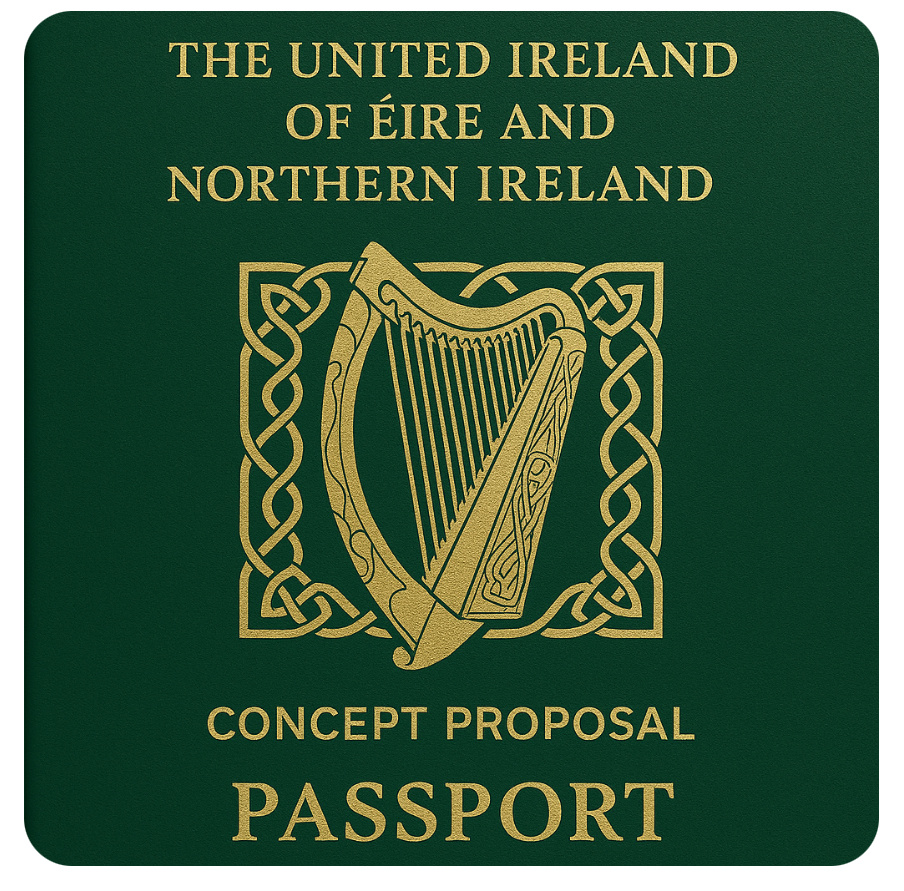
    If the unthinkable happened and we had a united ireland, with the inevitable devolution for the two nations, what would the new passport look like?

    I told AI what I thought and it generated one I would be very happy to embrace - and there was me thinking I would never be able to own an Irish passport - but I quite like this one.
    what do you guys think of this - in the unthinkable circumstances?

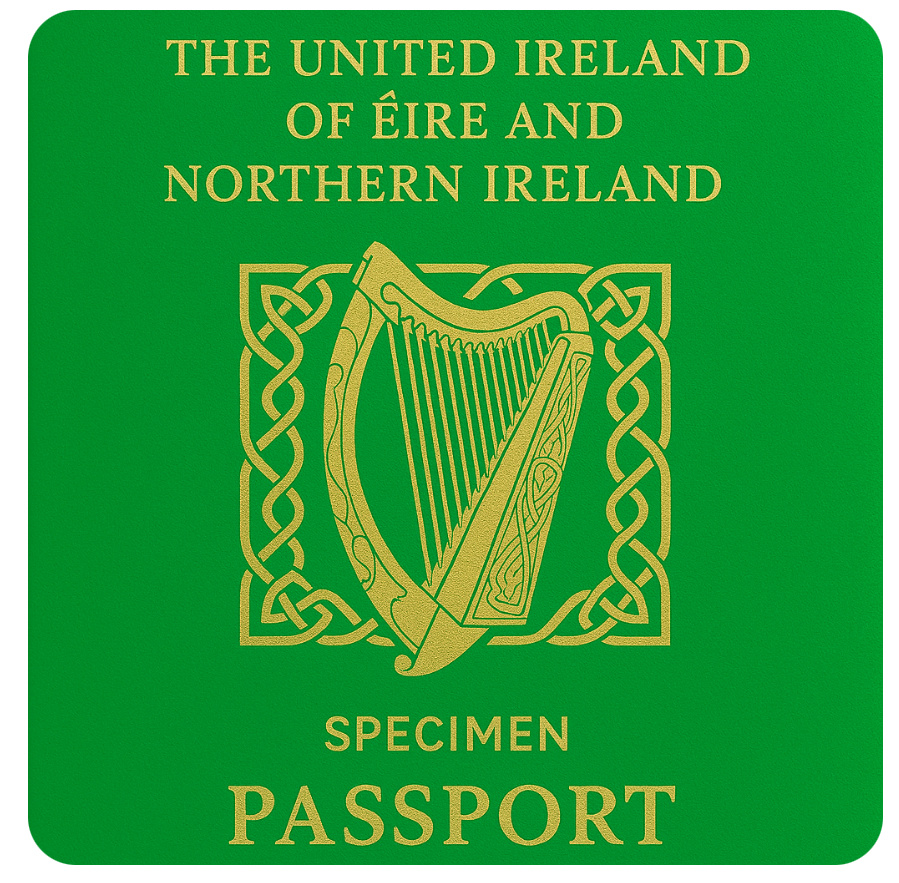
    And I’d like it the green of the OWC shirt, I think the beggars actually were the same colour, so win win

    IMG_0384.jpeg


  • Registered Users, Registered Users 2, Paid Member Posts: 12,424 ✭✭✭✭downcow


    this is a better colour to reflect our shirt.
    also I would prefer it to say, ‘The United Island of Eire and Northern Ireland’, but as always, being reasonable, I thought I could live with united ireland

    IMG_0385.jpeg


  • Registered Users, Registered Users 2, Paid Member Posts: 12,424 ✭✭✭✭downcow


    I have been quite surprised by this thread:

    A unionist, who loves Northern Ireland and it’s place in the UK, opens a thread to discuss what a united island might look like in the future. 

    Nationalist and Republicans run scarred from the discussion and spend 34 pages talking about history 🤔


  • Registered Users, Registered Users 2, Paid Member Posts: 12,424 ✭✭✭✭downcow


    Error deleted


  • Advertisement
  • Registered Users, Registered Users 2, Paid Member Posts: 12,424 ✭✭✭✭downcow


  • Registered Users, Registered Users 2 Posts: 81,281 ✭✭✭✭FrancieBrady


    And he told Gay Byrne and Terry Wogan, he didn't know he was gay until he went to London and he thought the 'feeling' different thing was because he was a Protestant. All here;

    In other words it was funny and a trivial thing.

    When he was doing the book promotion tours for his latest novel or something the story changed and became a more serious thing.

    "If I had come out, it would have been more than difficult. I may have been dead in a ditch."

    image.png

    There seems to be a big discrepancy and it is far from consistent.

    If I was an interviewer I would certainly ask about it.

    In the 80s/90s Protestants in Cork 'under siege' is a bit of an exaggeration too.

    Ian D'Alton, another Corkman funnily enough included this quote from the Protestant Bishop of Limerick in his work examining the Protestant experience:

    It wasn't always easy, and the very Catholic ethos of the State was often jarring and uncomfortable - but by and large Protestants reached an equitable accommodation with independent Ireland. The proof of that lies in a continued community vibrancy - in Bishop Hodges of Limerick's words in 1944, more than ever able 'to express a method of living valuable to the State'.

    Note the date he said that - 1944.

    Southern Irish Protestants by Ian D’Alton: A work of great originality and scholarship – The Irish Times


  • Registered Users, Registered Users 2 Posts: 690 ✭✭✭michael-henry-mcivor


    The Others Are British that's why-

    ( Northern ) Ireland is wrote AND on the brit passport because AND is maybe separate from Great Britain-


  • Registered Users, Registered Users 2 Posts: 690 ✭✭✭michael-henry-mcivor


    Anyone can pretend to predict the future- U have what U think will be the new Irish passport printed up and U still have U down as a AND-

    Its ingrained into U - AND-


  • Posts: 0 [Deleted User]


    Never underestimate the republican revisionist downcow. If they spot the tiniest opportunity, they’re gonna give you a history lesson.


  • Registered Users, Registered Users 2 Posts: 1,981 ✭✭✭csirl


    Clondalkin has a vibrant Protestant community. There's a COI church and a COI primary school that is oversubscribed.


  • Registered Users, Registered Users 2, Paid Member Posts: 12,424 ✭✭✭✭downcow


    I am not ‘pretending to predict the future’.  

    I opened a thread which I thought was taking me outside my comfort zone to consider what Northern Ireland might look like in the unlikely scenario that there was ever a successful united Ireland referendum.   

    I have been very surprised that Republicans are running a mile from the discussion, and want to simply hark back to 1690-1980.  

    At one level, it is a surprise, but at another level it makes total sense


  • Registered Users, Registered Users 2 Posts: 81,281 ✭✭✭✭FrancieBrady


    Nobody has run a mile.
    My view is that by 2125 'Northern Ireland' will be long since history and you will have an Ireland with all the challenges to face as a country as others are facing.

    What else is it you want to know? How your fantasy 'satellite to the motherland' works out? Well given that I think the motherland (UK) will break up in the next few decades and that GB (dependent on the English reaction) itself might go to, not much point me indulging your fantasies.


  • Registered Users, Registered Users 2, Paid Member Posts: 12,424 ✭✭✭✭downcow


    So there is nothing to talk about. Republicans believe that a united Ireland will be their romantic version that wannabe soldiers, wearing GAA proclamation shirts and kneecap hats, sit and talk about into the night and smoky pubs?   

    I wouldn’t hold your breath, Francie


  • Advertisement
  • Registered Users, Registered Users 2, Paid Member Posts: 12,424 ✭✭✭✭downcow


    https://www.boards.ie/discussion/comment/123745955#Comment_123745955

    francie you are one of the keyboard warriors doing Sinn Féin’s work for them. Here is a great piece (from this week, I believe), if you are struggling to understand:

    If you missed Eilis O'Hanlon's "Sunday Independent" article critiquing IRA leader Gerry Adams' book about her sister, Siobhan O'Hanlon (then the sole survivor of the IRA terrorist Gibraltar bomb gang), here is the text of her article below the photo:

    ADAMS REWRITES MY SISTER'S STORY TO WHITEWASH THE IRA'S BRUTAL PAST

    If republicans believe their cause is just, why paint over the reality of what it involved, as they do with my late sibling?

    The Sinn Féin book shop is not the sort of place where 1 can normally be found lurking, but I wanted a copy of Gerry Adams's new book, Siobhán O'Hanlon: A Sound Woman, which gathers memories of the late IRA volunteer and Sinn Féin activist who died of breast cancer in 2006 at the age of 44.

    Siobhán was my sister. I was naturally curious what the book had to say. The book offers an affectionate portrait of a woman who was hugely admired and liked by her republican comrades. She was part of the Sinn Féin team that negotiated the Belfast Agreement. A framed picture of her standing outside Downing Street used to hang in my late mother's house.
    Siobhán and I eventually ended up disagreeing about most things politically, and my memories of her will inevitably differ from those of the people close to her who shared her thinking. That's fine. "Recollections may vary," as the famous phrase has it. I am always slightly baffled by people who find the fact that Siobhán and I did not see eye to eye when it came to the IRA in any way remarkable.
    Families having political differences? Imagine that. In the divisive cauldron of the Troubles, as during the Civil War, it happened routinely. Just because our family was well known in Belfast (our maternal uncle was IRA Chief of Staff Joe Cahill) does not make it more noteworthy. It wasn't nothing, but it wasn't everything either. These things happen.
    What struck me was how the book describes some aspects of Siobhan's life that I knew very well, because I was there. I lived through them, too. The very first page acknowledges that she was an IRA volunteer, but when it comes to describing her activities it becomes oddly coy.
    It says: "In 1982 she was arrested and charged on the word of a paid perjurer and im- prisoned in Armagh Women's Prison." That is certainly one way to put it. Another would be to state that Siobhán was arrested in a two-car convoy carrying a bomb. The man in the vehicle behind the car carrying the bomb did implicate her. I shall take Adams's word that the man was paid. He may even have perjured himself on some matters. I wouldn't know.
    What I do know is that he was not of the IRA team that day. She was. It lying when he said Siobhán was part was one of many operations in which she took part at the time. I remember it well. She was never at home. We all knew what she was doing.
    I find this refusal to give a thing its real name perplexing. I do not believe that anyone should have been carting bombs around Belfast in 1982. There were other, peaceful, ways to protest against British rule. Those who chose a different path can have had no complaint if they were arrested and jailed.
    Republicans do not agree with this analysis. They believe that "armed struggle", to use their favourite euphemism, was not only a legitimate response to the "situation" (another euphemism), but was inevitable and a noble cause. That being the case, why be so coy about what the IRA did?
    If you're not ashamed of it, why not just say she was transporting a bomb instead of tiptoeing around it like a Victorian lady novelist too delicate to describe someone's bare ankles?
    Siobhán was released on bail for that offence just before Christmas 1982, and duly picked up where she left off. Just over six months later, she was back in prison again as "one of a group of women who were arrested at a house" and, the book says, "charged with possession of explosives".
    The reason that Siobhán was charged with possession of explosives is because she was in possession of explosives. The house was what was commonly known as a "bomb factory".
    Again, one can disagree as to the validity of such actions, but let's not beat about the bush. The bombs were being assembled to kill people - members of the security services - republicans would say, but if there is one thing that history has taught us it is that bombs are by their nature indiscriminate. They blow up anyone in the vicinity, not just those designated as legitimate targets. If such acts were justified by the circumstances of the time, then own it. Why present it in such passive, detached terms?
    Siobhán was sentenced to seven years for that offence, of which she did three and a half behind bars.
    On release, she recommenced her IRA career, and is said in this book to have been "shocked" by events in Gibraltar in 1987, when three unarmed volunteers on active duty were shot dead by the SAS while heading to the border after a scouting mission.
    The book leaves out one salient detail, which is that Siobhán was the fourth member of the Gibraltar cell.
    She was named as such a year later by The Sunday Times, under the headline, 'Revealed: IRA girl who survived Gibraltar”. It was a sloppy piece of journalism in many ways. Numerous details were dangerously wrong. The description given of Siobhán bore no resemblance to her. The closest match to it was me and another sister, and I was the only one living in the family home at the time. If anyone had decided to come to the door with evil intent, they would probably have assumed that I was her. I was genuinely terrified for my life.
    Those errors aside, the report was right in its central detail, which is that Siobhán was part of the IRA operation to bomb Gibraltar. That is on public record. Surveillance photos have been published showing her on reconnaissance in the British-run enclave.
    So, the same question was plotting to plant a bomb in the packed tourist streets of Gibraltar for the changing of the guard a defensible act? I would argue, strongly, that it was not. Those who contributed to this new book about Siobhán presumably disagree. That is for them to defend. But if they really don't believe there is any shame in risking so many lives, why not say what she was doing there without equivocation or apology?
    Siobhán herself was certainly proud of her time in the IRA. It defined her. In a way, it almost feels disrespectful to skirt around the details of her activities while purporting to offer a true portrait of her for posterity.
    Then again, the book is written by Gerry Adams (together with Sinn Féin press officer Richard McAuley). Reticence has ever been his watchword when it comes to facing up to the atrocities that the IRA committed during the darkest years.
    This evasiveness is baked into the culture of the republican movement.
    During one of the fruitless phone calls that we occasionally had after I started writing critically about republicanism, Siobhán insisted that she was simply trying to make Northern Ireland (not that she would have called it that) a "better place". My reply was that this was a bit rich when it was people like her and her comrades who had only helped to make it worse.
    I can't recall her response to that, but it was unlikely to have been congenial. We were both of a feisty nature, not inclined to back down in the face of confrontation. I wasn't asking her to change her mind. I simply expected her to respect mine.
    After Gibraltar, Siobhán was too well known to be a safe bet for the organisation. She would have presented a risk to other IRA members sent on any operation with her. She switched instead to working in Sinn Féin, where she seems to have tirelessly organised the heck out of anything that needed organising, before cancer sadly struck.
    Those who knew Siobhán best during those years can write and talk about her in any way they choose. We must all tell stories in our own way.
    What makes this book about her politically problematic is that it comes as part of a relentless ideological drive to minimise what the Provos did during those decades of conflict.
    Putting the face of IRA terrorist Brendan 'Bik' McFarlane on a giant screen on the final day of Féile an Phobail last weekend was another example. Do those behind these stagings really think we don't know what they're doing? They are weaponising false memories.
    Adams's book about Siobhán is typical of that republican mindset, which wallows in victimhood, wildly sentimentalising the past, while simultaneously celebrating but also downplaying the Provo campaign.
    The former Sinn Féin president writes with almost toxic nostalgia of being part of a "community under military occupation", and its "culture of resistance against... oppression", as if the Belfast Agreement never happened. That agreement explicitly binds its signatories to respect the legitimacy of the decision of a majority in the North to remain part of the United Kingdom if that is their choice.
    To still throw around slogans such as "occupation" and "resistance" 27 years on, ignoring all historical and demographic complexities, is childish stuff. These people's thinking hasn't progressed or acquired any levels of nuance or moral depth in decades.
    Adams writes in this book about Catholic families being put out of their homes by loyalists during those years. My own was among them. It was an awful time. No one who went through it will ever forget what it was like. Innocent people were being attacked and killed, as Adams says.
    What the book conveniently leaves out is that the same thing was also happening to people on the other side of the divide, and the IRA played a shameful role in it, terrorising the Protestant/unionist community and wrecking any hope of reconciliation.
    This book about my sister is just another front in an ongoing attempt to whitewash the past to make it seem as if violence was both inevitable and noble.
    We all grew up in the same conditions, but it should never be forgotten that the overwhelming majority of people in the North never killed or hurt a single other person. These are the people who are being erased in favour of a cartoonish fake history,
    Adams is right about one thing. Siobhán's life was far too short.
    So, too, were those of legions of innocent victims, sent to their graves by a republican movement that had the shameful conceit to choose who lived or died.
    The IRA never had that right. It must not be given it retrospectively.


Advertisement
Advertisement