Advertisement
Help Keep Boards Alive. Support us by going ad free today. See here: https://subscriptions.boards.ie/.
https://www.boards.ie/group/1878-subscribers-forum

Private Group for paid up members of Boards.ie. Join the club.
Hi all, please see this major site announcement: https://www.boards.ie/discussion/2058427594/boards-ie-2026

British TV viewers react with horror to portrayal of famine in ITV drama Victoria.

1468910

Comments

  • Banned (with Prison Access) Posts: 3,875 ✭✭✭A Little Pony


    [font=georgia, "times new roman", times, serif]Almost all state-funded primary schools — nearly 97 percent — are under church control, and Irish law allows them to consider religion the main factor in admissions. As a practical matter, that means local schools, already oversubscribed, often choose to admit Catholics over non-Catholics.[/font]
    [font=georgia, "times new roman", times, serif]That has left increasing numbers of non-Catholic families, especially in the fast-growing Dublin area, scrambling to find alternatives for their children and resentful about what they see as discrimination based on religion.[/font]


  • Registered Users, Registered Users 2 Posts: 5,385 ✭✭✭Duffy the Vampire Slayer


    Oh, I agree. There is no moral highground in the 1798 rebellion and the atrocities carried out by both sides have to be taken in context.

    I guess what I am getting at, is that you have posters stating things like "The Protestant population was given a higher status than the native Irish". which just seems to highlight that there is a real belief in this country that to be Irish meant to be Catholic and all Catholics were poor and persecuted by Protestants, who were all wealthy.

    Well, the vast majority of Protestants were descended from settlers. Contrasting them with the native Irish makes perfect sense.

    If I said 'In the Jim Crow South, whites were given a higher status than blacks' it would be entirely uncontroversial. But, for some reason, making such ( equally accurate) statements about Irish history is wrong.


  • Closed Accounts Posts: 16,768 ✭✭✭✭tomwaterford


    [font=georgia, "times new roman", times, serif]Almost all state-funded primary schools — nearly 97 percent — are under church control, and Irish law allows them to consider religion the main factor in admissions. As a practical matter, that means local schools, already oversubscribed, often choose to admit Catholics over non-Catholics.[/font]
    [font=georgia, "times new roman", times, serif]That has left increasing numbers of non-Catholic families, especially in the fast-growing Dublin area, scrambling to find alternatives for their children and resentful about what they see as discrimination based on religion.[/font]

    So no law passed discriminating on religious grounds for admittion to school??


    I hope your sitting Down for this newest revelation.....ireland also has second level schools :D:D. ...

    Unless they don't count in your world where you use half truths to push the 90% halffact


    *but yes it's time to buy the schools off the church as no republic should be that aligned to a religion


  • Registered Users, Registered Users 2 Posts: 9,463 ✭✭✭marienbad


    [font=georgia, "times new roman", times, serif]Almost all state-funded primary schools — nearly 97 percent — are under church control, and Irish law allows them to consider religion the main factor in admissions. As a practical matter, that means local schools, already oversubscribed, often choose to admit Catholics over non-Catholics.[/font]
    [font=georgia, "times new roman", times, serif]That has left increasing numbers of non-Catholic families, especially in the fast-growing Dublin area, scrambling to find alternatives for their children and resentful about what they see as discrimination based on religion.[/font]

    So what ? what makes you assume therefore the teaching of history can't be objective ?


  • Registered Users, Registered Users 2 Posts: 27,565 ✭✭✭✭steddyeddy


    91% of the primary schools aren't secular. State funded schools, well over 90% of them. It is written into your laws that religion is the determining factor on who gets into those schools. State religious education and people say the Church has lost it's grip on the country, they must be joking.

    I think you're confusing us with your part of the country lawd. It's not as polarised into Catholic VS Protestant here.

    Interestingly the part of Ireland still under British rule had the same discrimination of Catholics and sectarianism that the Republic had under British rule. It's hard to seperate those two facts.


  • Advertisement
  • Registered Users, Registered Users 2 Posts: 8,182 ✭✭✭SafeSurfer


    SafeSurfer wrote: »
    That sums up the Irish Republic perfectly. 

    What is to take responsibility for it? The British Empire did what many other Empires did around the time. I don't know how far back people would want to go with this.

    Acknowledgement of what was done would be a start. If reparations will help to fix what was done, then pay those reparations.

    When we as a nation found out what the church had done here, we sided with the victims in seeking redress and acknowledgment. The church, as a result is a shadow of it's former self as is it's influence.

    There is really no excuse for the British people not facing up to the damage their colonial past did.
    91% of your primary schools are Catholic schools. Children go into school everyday and get an education slanted from the Catholicism perspective. By controlling the views of the children you control the views of the country. Most don't back away from said cultural beliefs even if in later life they don't believe in it. Census records show us this.

    Catholicism still has influence on the Irish state, which I'm not knocking but the dishonesty about it and then talking about reparations, well it is lunacy.

    I don't see how census records can show a link between religious education and identifying as a catholic later in life. Countries such as France, Poland and a Belgium with secular schools also have high numbers of citizens identifying as catholic even with participation rates considerably less than ours.
    91% of the primary schools aren't secular. State funded schools, well over 90% of them. It is written into your laws that religion is the determining factor on who gets into those schools. State religious education and people say the Church has lost it's grip on the country, they must be joking.

    The proposals under the Education (Admission to Schools) Bill will protect minority religion schools where acceptance of non, for example Presbyterians would effect the Presbyterian ethos of the school.

    Given a common curriculum among schools of all religions in the state I don't see how this is relevant to thread title.

    Multo autem ad rem magis pertinet quallis tibi vide aris quam allis


  • Registered Users, Registered Users 2 Posts: 18,184 ✭✭✭✭Galwayguy35


    There is a famine graveyard near where I live where the children who starved to death are buried.

    Poor people who were tenants and didn't even own the land they worked were the ones who died while food was exported.


  • Closed Accounts Posts: 26,566 ✭✭✭✭Fratton Fred


    I think the British government owe the Irish people reparations for the famine.

    I like British people, I have no chip on my shoulder about them, but I think objectively they 'owe' us.

    Our population still hasn't recovered to pre famine levels. Basically every country in the world has a bigger population today than 150-200 years ago except Ireland (Armenia are the only other country I can think of off hand).

    The famine had a profound and devastating to Ireland, and I think that should be acknowledged.

    reparations?

    so tax the millions of Irishpeople who have flocked to the UK for centuries, to give it back to the ones that didn't?
    Well, the vast majority of Protestants were descended from settlers. Contrasting them with the native Irish makes perfect sense.

    If I said 'In the Jim Crow South, whites were given a higher status than blacks' it would be entirely uncontroversial. But, for some reason, making such ( equally accurate) statements about Irish history is wrong.

    You will often hear statements like "The Irish were prevented from having an education" or the "Irish were prevented from owning land", which is untrue. Catholics were and Catholics in England and Scotland had the exact same restrictions on them, in fact they were more strictly adhered to in England than in Ireland.

    If A Catholic wanted to inherit their family's land, they just had to nip along to the local Anglican church every Sunday and pretend to be protestant.

    A black person in the Jim Crow South couldn't pretend to be white, could they?


  • Closed Accounts Posts: 16,768 ✭✭✭✭tomwaterford


    reparations?

    so tax the millions of Irishpeople who have flocked to the UK for centuries, to give it back to the ones that didn't?


    You will often hear statements like "The Irish were prevented from having an education" or the "Irish were prevented from owning land", which is untrue. Catholics were and Catholics in England and Scotland had the exact same restrictions on them, in fact they were more strictly adhered to in England than in Ireland.

    If A Catholic wanted to inherit their family's land, they just had to nip along to the local Anglican church every Sunday and pretend to be protestant.

    A black person in the Jim Crow South couldn't pretend to be white, could they?

    Would the Irish catholic population not have been >90% at the time....so it's not exactly a stretch to say the irish were denied x,y and z...if that's the case


  • Registered Users, Registered Users 2 Posts: 27,565 ✭✭✭✭steddyeddy


    reparations?

    so tax the millions of Irishpeople who have flocked to the UK for centuries, to give it back to the ones that didn't?


    You will often hear statements like "The Irish were prevented from having an education" or the "Irish were prevented from owning land", which is untrue. Catholics were and Catholics in England and Scotland had the exact same restrictions on them, in fact they were more strictly adhered to in England than in Ireland.

    If A Catholic wanted to inherit their family's land, they just had to nip along to the local Anglican church every Sunday and pretend to be protestant.

    A black person in the Jim Crow South couldn't pretend to be white, could they?

    And Jews could also pretend otherwise. Also Protestants in Ireland who felt discriminated against could pretend to be Catholic. All's good with the world now that we've solved religious discrimination.

    The majority of Ireland was Catholic. I'm sure that was known when the popery law was passed. If you pass laws to discriminate against the vast majority of the native population you've invaded you're targetting the native peoples.

    So yes Fred the Irish natives were prevented from getting an education, retaining large landshares, holding office and voting.


  • Advertisement
  • Registered Users, Registered Users 2 Posts: 27,565 ✭✭✭✭steddyeddy


    Apologies for the long post I just want to denounce the belief that the penal laws were applied to English Catholics as much as Irish. The Irish were subjected to further restrictions.

    It is true that restrictions (like the Clarendon Code) imposed on Catholics in England, Scotland and Wales also applied to Catholics in Ireland. But Irish Catholics were subject to an additional, comprehensive system of penal laws that reduced them to helotry and illiteracy in their own land. The Irish penal laws were inaugurated in the late 17th century and not finally removed until 1829 (though the worst of them had been repealed by the mid-1790s).

    Laws like the Clarendon Code (which mainly barred Catholics from public office) were only the beginning of it where Ireland was concerned. In England, Wales, and Scotland the vast majority of the people adhered to the established churches. The penal laws affected only a minority, and their purpose was to ensure that that minority (perceived as potentially seditious) was excluded from power.

    In Ireland, on the other hand, where close to 90 percent of the population was Catholic, the point of the penal laws was to render the majority so powerless in every respect—economically and culturally as well as politically—that they could never threaten the ruling elite.

    Consequently, the penal laws that applied in Ireland from the 1690s onward were much more comprehensive than their equivalents in the other two kingdoms. They had the effect, over a few generations, of reducing the Irish Catholics to poverty and illiteracy. They also provided incentives for Catholics to convert to Protestantism. Some of the key provisions included:

    Catholics could not purchase land (and most of them had been dispossessed of their holdings in the aftermath of the Cromwellian and Williamite wars of the 17th century). Further, Catholics could not lease land for a period of more than 31 years.
    Catholics were required to practice gavelkind, a system of inheritance whereby a deceased person's land is divided equally among all male heirs. Therefore, Catholics’ leased landholdings became successively smaller and poorer with each passing generation (leading Catholic peasants to become dependent on potato monoculture, which had catastrophic effects in the 1840s).
    Protestants, on the other hand, practiced primogeniture so that holdings remained intact over time. But if one son of a Catholic family converted to Anglicanism, he inherited all the family land and his brothers got nothing.
    Even if sons of a Catholic family were inclined to (illegally) forgo their inheritance so that one son could inherit and keep the land intact, there were few other options available. Many occupations, including the professions and the officer ranks of the army were closed to Catholics.
    Catholics were severely restricted in their access to education. At the primary or secondary levels, Catholic schoolmasters or clerics were banned from teaching. (This gave rise to the hedge schools, illegal schools in the fields or hedgerows taught by itinerant schoolmasters.) Catholics were of course barred from Trinity College, the country’s only university. Many Catholic families, if they could afford it, sent sons abroad (usually to France or Spain) to be educated. But … you guessed it, that became illegal too.
    The Irish cavalry had performed well in the wars of the 17th century. Well, that was not going to happen again: no Catholic was allowed to own a horse worth more than £5. Besides, Catholics were not permitted to own or bear arms.
    There were also severe restrictions on the practice of the Catholic religion, which became essentially a furtive, private affair.
    Dissenters (which, in the Irish context, largely meant Presbyterians) were subject to some restrictions, mainly with respect to participating in politics and in the public practice of their faith. But the full panoply of the penal laws applied only to the Catholics in Ireland.

    The specifically Irish penal laws were enacted by the Irish Parliament, an institution for which only members of the established (Anglican) Church of Ireland could vote and in which only members of that Church could sit—a minority within a minority (known as the “Ascendancy”). These men looked with fear and a certain horror at the ragged Catholic masses. As they saw it, the Papists were down and it was the Ascendancy’s job to keep them down.


  • Registered Users, Registered Users 2 Posts: 27,565 ✭✭✭✭steddyeddy


    Would the Irish catholic population not have been >90% at the time....so it's not exactly a stretch to say the irish were denied x,y and z...if that's the case

    But it doesn't matter. According to Fred's theory they should put on a cockney accent and pretended to be English! No more discrimination.


  • Closed Accounts Posts: 26,566 ✭✭✭✭Fratton Fred


    Would the Irish catholic population not have been >90% at the time....so it's not exactly a stretch to say the irish were denied x,y and z...if that's the case

    it depends what your motives are. If you want to be accurate, then it is incorrect to say the Irish were denied those rights, because he irish had the exact same rights as the English, the Welsh and the Scots.

    If you want to imply that being Irish and Catholic are synonymous, or that specific laws were enacted targeted solely at the Irish, then fine, work away.


  • Closed Accounts Posts: 16,768 ✭✭✭✭tomwaterford


    it depends what your motives are. If you want to be accurate, then it is incorrect to say the Irish were denied those rights, because he irish had the exact same rights as the English, the Welsh and the Scots.

    If you want to imply that being Irish and Catholic are synonymous, or that specific laws were enacted targeted solely at the Irish, then fine, work away.

    I'm implying that 90% of the population of Ireland were denied x,y and z based on religious grounds?


    Its a simple yes or no??


    It would be like going out to middle east country and begin denying people stuff for being muslim....but trying to pass it off as ok if a tiny proportion of the population wasn't muslim


  • Registered Users, Registered Users 2 Posts: 27,565 ✭✭✭✭steddyeddy


    it depends what your motives are. If you want to be accurate, then it is incorrect to say the Irish were denied those rights, because he irish had the exact same rights as the English, the Welsh and the Scots.

    If you want to imply that being Irish and Catholic are synonymous, or that specific laws were enacted targeted solely at the Irish, then fine, work away.

    Yes it does depend on motives, but first a correction. Irish Catholics were subject to a futher more comprehensive set of restrictions. See my post above.

    As for motives, they passed laws that discriminated against the natives. I don't equate Catholic with Irish, but British governments did, hence the penal laws.


  • Registered Users, Registered Users 2 Posts: 27,565 ✭✭✭✭steddyeddy


    Dr.Mary Hickman, University Of London wrote an excellent book detailing equality of race and religion. Here's an excerpt from an article about the book. It demonstrates that the English very much equated the Irish with Catholicism. The general populace were none to kind about the Irish either. Racism against the Irish was also expressed in terms of laws enacted in parilment.

    "Dr Mary Hickman, director of the Irish Studies Centre at the University of London, says in her book, Religion, Class and Identity, that since the Anglo-Norman invasion in the 12th century the English have tried to justify their attacks on Ireland by racism. She said yesterday: "Many people assume that current English hostility or discrimination towards the Irish is the result of events in Northern Ireland so they see it as regrettable but understandable."

    Dr Hickman, who is conducting a nationwide study of discrimination against the Irish for the Equal Opportunities Commission, argues that Ireland is important to the security of England and successive generations have tried to justify invasion and colonisation by stereotyping the Irish as wild and uncivilised.The Pope sanctioned the Anglo-Norman invasion on the grounds that Ireland was alleged to be only nominally Christian. Dr Hickman says: "The evidence for dominating Ireland has involved lengthy discussions on the Irish national character directly linked to notions about the Celts as a "race" or the Irish as a nation.

    The emphasis prior to the 16th century was on the paganism, superstition and barbarism of the Irish. Before then, Dr Hickman says, the caricature concentrated on their wildness and savagery.

    From the reign of Elizabeth 1, the English began systematically to colonise Ireland and the stereotype became more detailed: in particular the notion of the Irish as "stupid" became common. "Most of this was designed to show how English rule could be used to benefit the Irish," says Dr Hickman.

    An anonymous contemporary of Shakespeare included a very ignorant and wild Irishman in the play Sir John Oldcastle, based partly, scholars think on MacMorris in Henry V.

    During the 16th and 17th centuries, the stereotype changed: the half- human savage became a figure of contempt. In the 19th century more details of the stereotype, such as idleness and drinking, were filled in.

    English attitudes to the Irish are closely connected to anti-Catholicism. Dr Hickman's book points out that a separate system of Roman Catholic schools grew up because of the hostility of English working class parents to having their children educated alongside Irish children. It was not the case that the Catholics insisted on their own schools.

    A spokesman for the Commission of Racial Equality said they had commissioned their study because there was mounting concern about discrimination against those of Irish origin in the workplace and at schools.

    t Religion, Class and Identity; Mary J Hickman; Avebury; pounds 37.50.

    Words from the history of a nation's prejudice


    12th century: "A most filthy race ... sunk in vice, a race more ignorant than all other nations of the first principles of the faith ... They pay neither tithes nor first fruits; they do not contract marriage, nor shun incestuous connections" - Giraldus Cambrensis.

    18th century: The Irish are "buried in the most profound barbarism and ignorance" - David Hume.

    1836: Irish immigration into Britain "is an example of a less civilised population spreading itself as a substratum beneath a more civilised community" - parliamentary inquiry into the Irish in Britain.

    1930s: "They (the Irish) have settled into the closest poor quarter and turned the settlement into a slum" - J. B. Priestley.

    1950s: "No Irish need apply" - lodging house notice."


  • Registered Users, Registered Users 2 Posts: 27,565 ✭✭✭✭steddyeddy


    I'm implying that 90% of the population of Ireland were denied x,y and z based on religious grounds?


    Its a simple yes or no??


    It would be like going out to middle east country and begin denying people stuff for being muslim....but trying to pass it off as ok if a tiny proportion of the population wasn't muslim

    Yes. The much less restrictive laws which were applied to English Catholics and dissenters affected a small few.

    Apply much more restrictive laws to an entire country and you reduce on of the most literate countries (land of saints and scholars was well earned) to a poor, illiterate and divided country.

    In other words you can't equate targetting a few Catholics in your own country with targetting the entire population of another country.


  • Closed Accounts Posts: 26,566 ✭✭✭✭Fratton Fred


    I'm implying that 90% of the population of Ireland were denied x,y and z based on religious grounds?

    that is it, exactly.

    Religious grounds, not nationality.


  • Closed Accounts Posts: 2,379 ✭✭✭donegaLroad


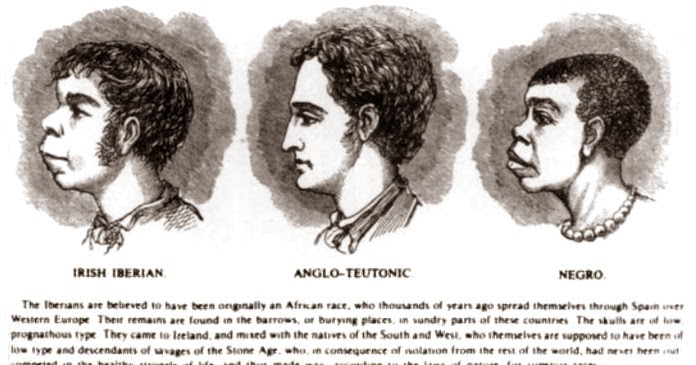
    It happened here as well:

    scientific_racism_irish-1899.jpg

    1.gif

    wow.. this is the kind of hatred that was being taught in Germany on the run up to WW2


  • Moderators, Science, Health & Environment Moderators, Society & Culture Moderators Posts: 60,387 Mod ✭✭✭✭Wibbs


    steddyeddy wrote: »
    12th century: "A most filthy race ... sunk in vice, a race more ignorant than all other nations of the first principles of the faith ... They pay neither tithes nor first fruits; they do not contract marriage, nor shun incestuous connections" - Giraldus Cambrensis.
    Cambrensis was a real political hatchet job alright. Designed to legitimise Norman rule in the country. The same country and people who were so "ignorant" a couple of centuries previously that the royal houses of Europe, including early Norman ones fell over each other to secure a few Irish scholar monks as a bragging right to show how civilised they were and to educate their own. Without Irish scholars it's unlikely the Carolingian renaissance would have started.

    This was also around the time that Augustine became the saint who converted the Britons in the official history, one that remains to this day. Which is a nonsense of course. Christianity had a much longer history in Britain. Hell, Patrick a Briton had a father and grandfather that were clerics. So Britain likely had a few Christians in the mix from late Roman settlement times. Then he gets nicked by the Irish and escapes, then comes back to convert them and they in turn go over to Britain and spread the existing faith all over the place. Augustine was centuries out of date by the time he showed up. This also suited the Vatican. They were deeply suspicious of the success and influence of the Irish church and its local idiosyncrasies as they saw them. For a start they didn't charge for education which the Roman church did. They were openly against slavery which the Roman church turned a blind eye to*. They were more open to married clerics and even more WTF as far as Rome was concerned they had women clerics seen as equals. They studied and copied "dubious" classical literature and some of their scholars went well beyond the accepted notions of Rome.

    This stuff is a lot more complex and subtle than culturally accepted histories tend to reflect.


    *Augistine himself was sent to England by the pope of the time, because he encountered two English children in a Roman slave market. Asked where these youths were from, was told they were angles and made a lame joke about how they were like "angles"(Facebook or wha :D) and sent Auggie to England to convert them. Which tells you that there were slave markets in Rome, the pope didn't have an issue with them and he didn't free the two kids.

    Many worry about Artificial Intelligence. I worry far more about Organic Idiocy.


  • Advertisement
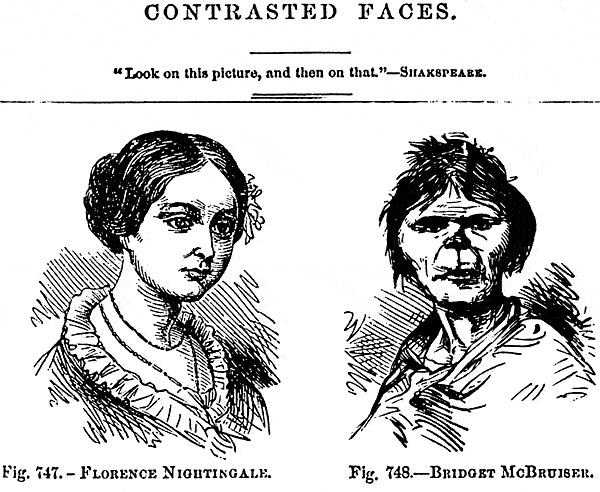
  • Moderators, Science, Health & Environment Moderators, Society & Culture Moderators Posts: 60,387 Mod ✭✭✭✭Wibbs


    1.gif
    And what old Flo actually looked like...

    220px-Florence_Nightingale_three_quarter_length.jpg

    Bit of the oul airbrushing going on there. :D

    Many worry about Artificial Intelligence. I worry far more about Organic Idiocy.


  • Registered Users, Registered Users 2 Posts: 27,565 ✭✭✭✭steddyeddy


    that is it, exactly.

    Religious grounds, not nationality.

    Apart from the laws enacted in the Irish parliment. Apart from that you know what you posted is utter denial.


  • Banned (with Prison Access) Posts: 3,875 ✭✭✭A Little Pony


    marienbad wrote: »
    [font=georgia, "times new roman", times, serif]Almost all state-funded primary schools — nearly 97 percent — are under church control, and Irish law allows them to consider religion the main factor in admissions. As a practical matter, that means local schools, already oversubscribed, often choose to admit Catholics over non-Catholics.[/font]
    [font=georgia, "times new roman", times, serif]That has left increasing numbers of non-Catholic families, especially in the fast-growing Dublin area, scrambling to find alternatives for their children and resentful about what they see as discrimination based on religion.[/font]

    So what ? what makes you assume therefore the teaching of history can't be objective ?
    Yes it does because culturally it gives one side of the argument in most cases. The opening of this thread kind of shows it. I pointed out you had Irish people making money during the famine sending wheat and grains to England. Go look at the role  the Catholic Church played, not exactly clean.


  • Registered Users, Registered Users 2 Posts: 9,463 ✭✭✭marienbad


    Yes it does because culturally it gives one side of the argument in most cases. The opening of this thread kind of shows it. I pointed out you had Irish people making money during the famine sending wheat and grains to England. Go look at the role the Catholic Church played, not exactly clean.

    Examples please


  • Registered Users, Registered Users 2 Posts: 27,565 ✭✭✭✭steddyeddy


    Yes it does because culturally it gives one side of the argument in most cases. The opening of this thread kind of shows it. I pointed out you had Irish people making money during the famine sending wheat and grains to England. Go look at the role  the Catholic Church played, not exactly clean.

    Of course they did. It's not Catholics good Protestants bad. It was the sectarian laws that were put in place that led to the situation in the first place.


  • Registered Users, Registered Users 2 Posts: 27,565 ✭✭✭✭steddyeddy


    Wibbs wrote: »
    Cambrensis was a real political hatchet job alright. Designed to legitimise Norman rule in the country. The same country and people who were so "ignorant" a couple of centuries previously that the royal houses of Europe, including early Norman ones fell over each other to secure a few Irish scholar monks as a bragging right to show how civilised they were and to educate their own. Without Irish scholars it's unlikely the Carolingian renaissance would have started.

    This was also around the time that Augustine became the saint who converted the Britons in the official history, one that remains to this day. Which is a nonsense of course. Christianity had a much longer history in Britain. Hell, Patrick a Briton had a father and grandfather that were clerics. So Britain likely had a few Christians in the mix from late Roman settlement times. Then he gets nicked by the Irish and escapes, then comes back to convert them and they in turn go over to Britain and spread the existing faith all over the place. Augustine was centuries out of date by the time he showed up. This also suited the Vatican. They were deeply suspicious of the success and influence of the Irish church and its local idiosyncrasies as they saw them. For a start they didn't charge for education which the Roman church did. They were openly against slavery which the Roman church turned a blind eye to*. They were more open to married clerics and even more WTF as far as Rome was concerned they had women clerics seen as equals. They studied and copied "dubious" classical literature and some of their scholars went well beyond the accepted notions of Rome.

    This stuff is a lot more complex and subtle than culturally accepted histories tend to reflect.


    *Augistine himself was sent to England by the pope of the time, because he encountered two English children in a Roman slave market. Asked where these youths were from, was told they were angles and made a lame joke about how they were like "angles"(Facebook or wha :D) and sent Auggie to England to convert them. Which tells you that there were slave markets in Rome, the pope didn't have an issue with them and he didn't free the two kids.

    Wibbs cpuld you recommend a book on the Irish church. It seems a fascinating subject. I read previously that Irish clerics were influenced by pilgramges to Egypt and other places. One theory was that the designs on the celtic cross were influenced by hieroglyphics.


  • Registered Users, Registered Users 2 Posts: 8,182 ✭✭✭SafeSurfer


    Yes it does because culturally it gives one side of the argument in most cases. The opening of this thread kind of shows it. I pointed out you had Irish people making money during the famine sending wheat and grains to England. Go look at the role  the Catholic Church played, not exactly clean.

    I think you are confusing culture and religion.

    An Irish protestant is much closer culturally, to an Irish catholic than to an English protestant.

    An Irish catholic is much closer culturally, to an Irish protestant than to an English catholic.

    Multo autem ad rem magis pertinet quallis tibi vide aris quam allis


  • Closed Accounts Posts: 26,566 ✭✭✭✭Fratton Fred


    steddyeddy wrote: »
    Apart from the laws enacted in the Irish parliment. Apart from that you know what you posted is utter denial.

    Denial of what?

    Hell, the penal laws weren't even directed at the poor. no one gave two ****s about them regardless of what their particular brand of communion was. They wouldn't have been able to vote, own a horse of get educated anyway.

    The Penal laws were directed at the wealthy in an attempt t get people to convert. I guess they could have used the french or Spanish methods, they were a bit more aggressive in their attempts at stamping out religious flavours they didn't like.


  • Banned (with Prison Access) Posts: 3,875 ✭✭✭A Little Pony


    steddyeddy wrote: »
    Yes it does because culturally it gives one side of the argument in most cases. The opening of this thread kind of shows it. I pointed out you had Irish people making money during the famine sending wheat and grains to England. Go look at the role  the Catholic Church played, not exactly clean.

    Of course they did. It's not Catholics good Protestants bad. It was the sectarian laws that were put in place that led to the situation in the first place.

    Sectarian laws created the famine? It was a fungus type infection which destroyed the potato which was the main source of food people had then. No one is saying the British government handled it well but they certainly didn't start it. The Irish famine of 1740 was nearly as bad and was started because of weather effects, again the humble potato took a battering due to frost which made them inedible.


  • Advertisement
  • Registered Users, Registered Users 2 Posts: 27,565 ✭✭✭✭steddyeddy


    Denial of what?

    Hell, the penal laws weren't even directed at the poor. no one gave two ****s about them regardless of what their particular brand of communion was. They wouldn't have been able to vote, own a horse of get educated anyway.

    The Penal laws were directed at the wealthy in an attempt t get people to convert. I guess they could have used the french or Spanish methods, they were a bit more aggressive in their attempts at stamping out religious flavours they didn't like.

    Denial of facts. You're confusing penal laws general to the population of both countries to laws specifically passed in Ireland. You're in denial about specific anti-Irish sentiment.


Advertisement
Advertisement