Advertisement
Help Keep Boards Alive. Support us by going ad free today. See here: https://subscriptions.boards.ie/.
https://www.boards.ie/group/1878-subscribers-forum

Private Group for paid up members of Boards.ie. Join the club.
Hi all, please see this major site announcement: https://www.boards.ie/discussion/2058427594/boards-ie-2026

The rise of scepticism?

13567

Comments

  • Registered Users, Registered Users 2 Posts: 26,578 ✭✭✭✭Turtwig


    Don't wish to derail this thread with a discussion on climate change but that last paragraph is a terrible false representation of how the AGW hypothesis was established and became accepted.

    Keeping it short, climate of earth is well understood. Without contributing anthropogenic forcing you can't reproduce the climate as accurately. So, until some other forcing best explains the data AGW is what you have.


  • Closed Accounts Posts: 24,461 ✭✭✭✭darkpagandeath


    Don't get me started on "climate change" Again.... I have been made out to be a climate denier. When in actual fact I just refute bias data in models that are inherently geared towards proving the data rather than showing data. 99% argument of we have had an input into climate change. Please tell us how much is caused by humans 1% ? 10% if the majority is natural we cant really do anything about it. But it’s reported that the 99% is what we have caused.

    As above I Don't want to make this a climate thread


  • Registered Users, Registered Users 2 Posts: 26,578 ✭✭✭✭Turtwig


    No it's reported that 99% of climatologists believe the human factor is important. Water vapor is the biggest green house contributer. It only takes a tiny amount of cyanide to kill you. It takes a lot of water. Methane is the most potent GHG but the amount in the atmosphere is thankfully low. My point? Relative percentage only matters if your comparison is fair and accurate.


  • Registered Users, Registered Users 2, Paid Member Posts: 7,929 ✭✭✭Calibos


    If the Sumatran villagers showed a visiting zoologist a partial pelt that he didn't recognize. He got them to describe the living animal which they described as monkey like, or marsuipial like or orangutan like etc.. He showed them photo's of all known known Sumatran primates and the villagers were adamant that the creature they were talking about was not pictured. He came back with a group of other zoologists and primatologists sponsored by National Geographic Magazine to search the jungle for this possible new species of Primate.

    I doubt you'll find one skeptic that'll say its a waste of time and theres nothing there. I'd imagine to the last man and woman they'd say, "Cool, can't wait to see what they turn up".

    When the Sumatran villagers show a visiting ***??? a foot print and describe a hairy upright walking man sized primate living in the Jungle and he comes back with a NatGEO TV crew and a show host that may or may not have been a janitor at some un-named biotech firm. Well colour me surprised if the skeptics don't say, "Hold on a minute..........."

    You've picked a very poor example for your OP IMHO

    PS Bringing the Flores Man controversy into it would weaken your argument as much as strengthen it.


  • Closed Accounts Posts: 24,461 ✭✭✭✭darkpagandeath


    You mean dodgy villagers figured out there is money to be made conning western media nonsense shows ? I'm sure all the people they interviewed did it to further scientific knowledge. And not to make a fast buck. :pac: Just like those serial UFO shows rehashing the same sightings over and over and over.


  • Advertisement
  • Registered Users, Registered Users 2 Posts: 27,565 ✭✭✭✭steddyeddy


    Calibos wrote: »
    If the Sumatran villagers showed a visiting zoologist a partial pelt that he didn't recognize. He got them to describe the living animal which they described as monkey like, or marsuipial like or orangutan like etc.. He showed them photo's of all known known Sumatran primates and the villagers were adamant that the creature they were talking about was not pictured. He came back with a group of other zoologists and primatologists sponsored by National Geographic Magazine to search the jungle for this possible new species of Primate.

    I doubt you'll find one skeptic that'll say its a waste of time and theres nothing there. I'd imagine to the last man and woman they'd say, "Cool, can't wait to see what they turn up".

    When the Sumatran villagers show a visiting ***??? a foot print and describe a hairy upright walking man sized primate living in the Jungle and he comes back with a NatGEO TV crew and a show host that may or may not have been a janitor at some un-named biotech firm. Well colour me surprised if the skeptics don't say, "Hold on a minute..........."

    You've picked a very poor example for your OP IMHO

    PS Bringing the Flores Man controversy into it would weaken your argument as much as strengthen it.

    Wait what are you talking about?? What programme is this and when did I mention one?


  • Registered Users, Registered Users 2 Posts: 1,922 ✭✭✭fergalr


    Turtwig wrote: »
    Keeping it short, climate of earth is well understood. Without contributing anthropogenic forcing you can't reproduce the climate as accurately. So, until some other forcing best explains the data AGW is what you have.

    So, I'm not at expert there, but seeing as we are discussing scepticism, we should bear in mind that that's a very difficult and fraught form of argument; its very difficult to establish facts in that way, without controlled trials or even natural experiments, predictive validation etc.


  • Registered Users, Registered Users 2 Posts: 26,578 ✭✭✭✭Turtwig


    fergalr wrote: »
    So, I'm not at expert there, but seeing as we are discussing scepticism, we should bear in mind that that's a very difficult and fraught form of argument; its very difficult to establish facts in that way, without controlled trials or even natural experiments, predictive validation etc.

    I agree and you can say that though about most forms of scientific theories. Gravity probably being our weakest theory at the moment.

    Off topic:
    A generalised sketch would be:
    Controlled trials: recreate and 'predict' past climates.
    Natural experiments: other planets and ours.
    Predictive validations: Various climate models, each designed for different principles. Some for simplistic tests of concepts to establish ballparks, baselines, error principles etc. Others to establish actual predictions of temperature, precipitation (which is where a huge proportion of inconsistency and uncertainty lies).

    It's a vast field encompassing many many different sciences like pretty much all fields of science.

    On topic:
    At the core though I'm demonstrating a scientific principle: you stick to the one hypothesis until the evidence against it is over whelming (which isn't necessarily true for Climate Science because it might not be a weak hypothesis considering it was rejected initially.) . You can't just jump to alternate models because they explain gaps in the current ones. These models still have to account for everything that was previously explained. Currently lots of pseudoskepticism that gets published and soapboxed in the media doesn't even attempt to do that. Basically what I'm saying is even if the current hypothesis is wrong it still has to take a few decades for opinions to shift. If it didn't; then it wouldn't be good science.

    Slightly OT again.
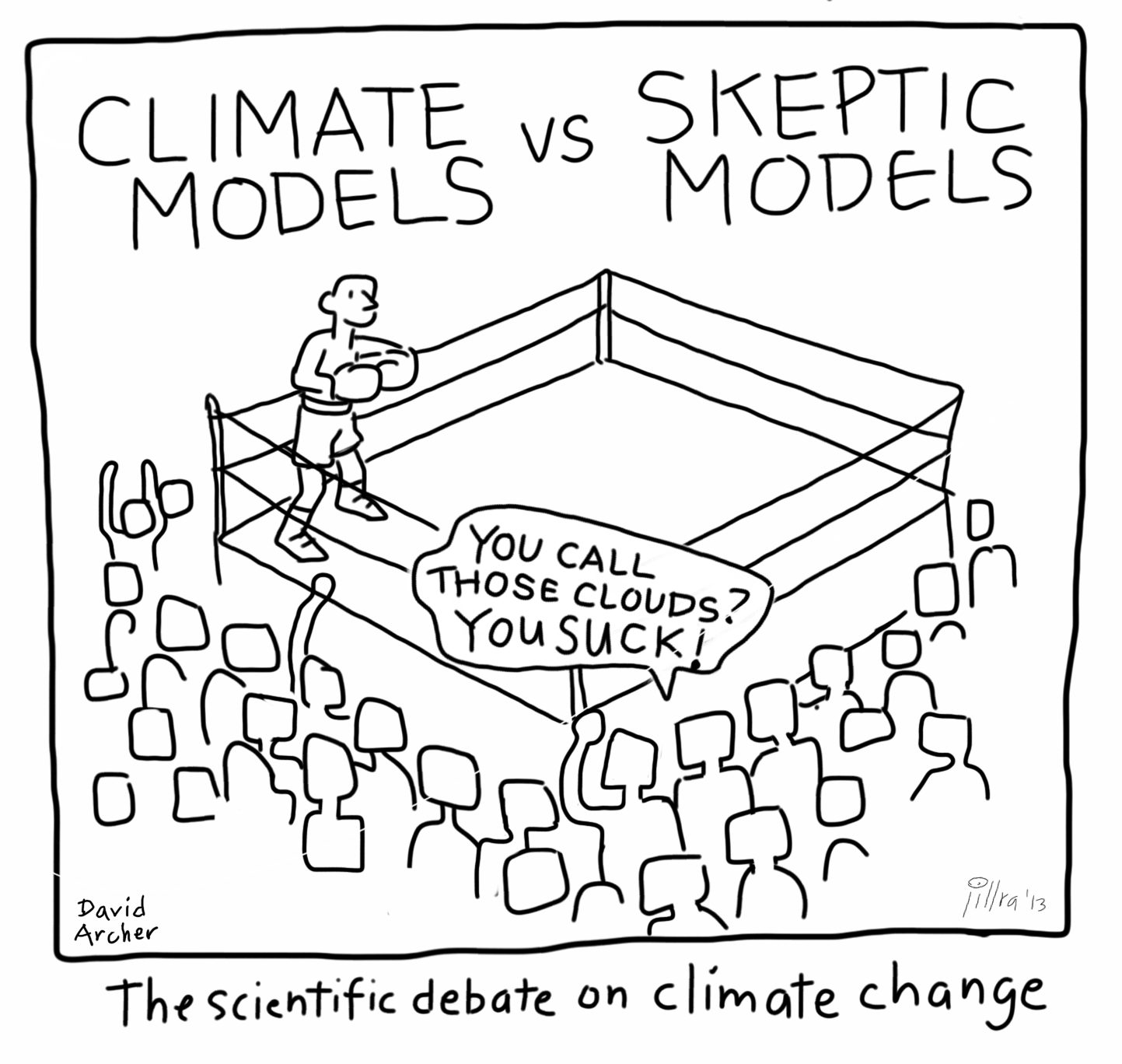
    I like this graphic
    http://geosci.uchicago.edu/~archer/cartoons/climate-models-vs-skeptic-models.png


  • Registered Users, Registered Users 2 Posts: 1,922 ✭✭✭fergalr


    Turtwig wrote: »
    I agree and you can say that though about most forms of scientific theories. Gravity probably being our weakest theory at the moment.

    What's wrong with gravity? At least at a newtonian level? Do you mean beyond that? Because its a wonderful example, at a newtonian level, of validating a theory - something we don't have the equivalent of for climate change.

    I mean, only the other night I was watching something about the discovery of neptune.

    After Newton's theory of gravity had been roughly validated on the inner planets, and after they knew where Uranus was, there was a problem: the orbit of uranus wasn't quite right.

    So they figured out another planet could do this, and then, went looking, with where it was mathematically predicted, using newtons theory, that another planet might be, and they found neptune.

    I'm sure a lot is glossed over there, but that's huge evidence gravity was working right.

    Gravity was the nice simple short theory that was making successful predictions about where entire unknown planets could be found.


    If we had validations like that about climate change, we'd be in a great position.


  • Registered Users, Registered Users 2, Paid Member Posts: 7,929 ✭✭✭Calibos


    steddyeddy wrote: »
    Wait what are you talking about?? What programme is this and when did I mention one?

    Googling National Geographic and Sumatran ape only brings up the NAT GEO cryptozoology programme, 'Beastman' Sumatran Ape episode. I gave up searching after 5 or 6 pages of same.

    Perhaps you could link to the Natioanal Geographic Sumatran Ape expedition that you are talking about then?


  • Advertisement
  • Closed Accounts Posts: 24,461 ✭✭✭✭darkpagandeath


    On the gravity end of things we still don't really understand why it's such a weak force compared to the others.


  • Closed Accounts Posts: 6,106 ✭✭✭catallus


    An interesting aside; scepticism has wholly religious foundations.

    Saints and Popes had Sceptres. Which means that they invented scepticism.

    And all the Holy Inquisitions were based on helping people to sceptically question their heretical beliefs, much like the current peer-review system.

    Quod Erat Demonstrandum!


  • Registered Users, Registered Users 2 Posts: 26,578 ✭✭✭✭Turtwig


    fergalr wrote: »
    What's wrong with gravity? At least at a newtonian level? Do you mean beyond that? Because its a wonderful example, at a newtonian level, of validating a theory - something we don't have the equivalent of for climate change.

    I mean, only the other night I was watching something about the discovery of neptune.

    After Newton's theory of gravity had been roughly validated on the inner planets, and after they knew where Uranus was, there was a problem: the orbit of uranus wasn't quite right.

    So they figured out another planet could do this, and then, went looking, with where it was mathematically predicted, using newtons theory, that another planet might be, and they found neptune.

    I'm sure a lot is glossed over there, but that's huge evidence gravity was working right.

    Gravity was the nice simple short theory that was making successful predictions about where entire unknown planets could be found.


    If we had validations like that about climate change, we'd be in a great position.

    Newton's theory is fundamentally wrong. We know that now on many levels, but it's also right. Like the example you gave it works under a set of limited circumstances. Very useful circumstances. Another prediction, which is far more fun a story to follow up for hollywood, was the prediction of the earth being a little squashed at the poles and bulging at the equator. The scientific expedition that went to measure that encountered catastrophe after catastrophe. Horror movie right there! :D

    Climate change does have its validations. If a warming is CO2 forced you expect to observe more warming occurring at night times than during the day. If a large volcanic eruption occurs* e.g Pinatubo you expect less moisture and over all precipitation with a slight cooling effect. There's always going to be predictions that emerge which you can test.

    *Slight aside here: Volcanic forcing is most significant through various sulphur gases. Volcanic degassing of CO2 only contributes towards a climate change in the order of 10,000s of years.

    Clouds are an uncertainy, the altitude they're at and the areas (and volume) they encompasses make it difficult to ascertain their contribution. Aersols though are the biggest uncertainty though. So I guess, to bring the analogy back to Newton. Aersols are the precession of the perhelion of Mercury only we have yet to come up with a way of accurately modelling it. Still, though we still have an idea of Aersols impact, not the precise one, but like Mercury's orbit back then we can predict most of the time where about the current values will lie. Just don't understand why they do and would really like to reduce the range of uncertainty. But in general, we still can predict where all the planets are and we can still predict that the Earth is warming.


  • Registered Users, Registered Users 2, Paid Member Posts: 7,929 ✭✭✭Calibos


    Because if it was any stronger we or the universe wouldn't be here to measure its strength or weakness against the others. Think it's called the anthropic principle or something. The analogy I've read is that it's like the puddle being amazed at the odds of the pothole it resides in being the exact shape to the micrometer for him to sit in.


  • Registered Users, Registered Users 2 Posts: 1,922 ✭✭✭fergalr


    catallus wrote: »
    An interesting aside; scepticism has wholly religious foundations.

    Saints and Popes had Sceptres. Which means that they invented scepticism.

    And all the Holy Inquisitions were based on helping people to sceptically question their heretical beliefs, much like the current peer-review system.

    Quod Erat Demonstrandum!

    That's an interesting fact about the etymology of the word; but doesn't tell us much about the phenomenon which the word describes of 'being questioning'; which I'm inclined to believe was around long before any popes.


  • Registered Users, Registered Users 2 Posts: 26,578 ✭✭✭✭Turtwig


    catallus wrote: »
    An interesting aside; scepticism has wholly religious foundations.

    Saints and Popes had Sceptres. Which means that they invented scepticism.

    And all the Holy Inquisitions were based on helping people to sceptically question their heretical beliefs, much like the current peer-review system.

    Quod Erat Demonstrandum!

    Nowadays most people don't associate with Thor when speaking about Thursday. Word origins and meaning change. Interesting origin nonetheless. :)

    Off topic: But seeing as this is skepticism is that actually true about Thorsday?
    Edit: According to wiki yes. :o


  • Closed Accounts Posts: 6,106 ✭✭✭catallus


    :eek:


  • Registered Users, Registered Users 2 Posts: 1,922 ✭✭✭fergalr


    Turtwig wrote: »
    Newton's theory is fundamentally wrong. We know that now on many levels, but it's also right. Like the example you gave it works under a set of limited circumstances. Very useful circumstances. Another prediction, which is far more fun a story to follow up for hollywood, was the prediction of the earth being a little squashed at the poles and bulging at the equator. The scientific expedition that went to measure that encountered catastrophe after catastrophe. Horror movie right there! :D

    'All models are wrong; some are useful'.

    Don't know if I'd describe the circumstances as limited, but ok.


    Newton published Principia in 1687 which described gravity.
    Nepture was discovered in 1846, using, basically, as I understand it, the same core theory.

    The fact that the theory was very simple and short, and then that it, largely unmodified as I understand it, gave predictions of massive phenomenon a long time later, looks pretty good for that theory.


    Turtwig wrote: »
    Climate change does have its validations. If a warming is CO2 forced you expect to observe more warming occurring at night times than during the day. If a large volcanic eruption occurs* e.g Pinatubo you expect less moisture and over all precipitation with a slight cooling effect. There's always going to be predictions that emerge which you can test.
    But, as far as I'm aware, people are constantly having to tune the climate models, in response to new data; the climate models are constantly being recalibrated, and none of them have come close to an impressive ahead-of-time prediction like gravity has?

    There's no climate model that someone developed in the 80s that's still making surprising but good testable predictions now? Nothing like neptune was for gravity?


    I mean, thats ok - some things are just harder to study than others - that doesn't mean we shouldn't study them - but we should be commensurately less sure about their predictive abilities and hence accuracy.
    Turtwig wrote: »
    *Slight aside here: Volcanic forcing is most significant through various sulphur gases. Volcanic degassing of CO2 only contributes towards a climate change in the order of 10,000s of years.

    Clouds are an uncertainy, the altitude they're at and the areas (and volume) they encompasses make it difficult to ascertain their contribution. Aersols though are the biggest uncertainty though. So I guess, to bring the analogy back to Newton. Aersols are the precession of the perhelion of Mercury only we have yet to come up with a way of accurately modelling it. Still, though we still have an idea of Aersols impact, not the precise one, but like Mercury's orbit back then we can predict most of the time where about the current values will lie. Just don't understand why they do and would really like to reduce the range of uncertainty. But in general, we still can predict where all the planets are and we can still predict that the Earth is warming.

    I mean - just reading that last sentence - its not quite in the same league of evidence, is it? If our models from 1995 had accurately predicted the temperature change each year thereafter, we'd be in business.

    That's probably unreasonable, given how weather works as opposed to climate - ie. its a fundamentally hard domain. But hence we shouldn't treat our models as if they were as solid, as if it had been possible to make those predictions.


  • Closed Accounts Posts: 24,461 ✭✭✭✭darkpagandeath


    Calibos wrote: »
    Because if it was any stronger we or the universe wouldn't be here to measure its strength or weakness against the others. Think it's called the anthropic principle or something. The analogy I've read is that it's like the puddle being amazed at the odds of the pothole it resides in being the exact shape to the micrometer for him to sit in.

    This is kind of the point on a large scale we can understand gravity but when you get down to atom scale and so on the other forces are on orders of magnitude greater. Large scale gravity is quite powerful black holes and so on. but the smaller you go the weaker it gets. On large scale bodies it’s like the analogy of a sheet the large body deforms this. This is why smaller mass objects go into orbits for example. little off topic trying to keep this in relatively general terms btw.


  • Registered Users, Registered Users 2 Posts: 26,578 ✭✭✭✭Turtwig


    Agree in spirit with everything you say.

    Newton produced a model. It works very bloody well, but it doesn't always work. Climate models being more nuanced need to be continuously refined but a key point is the simplisitic models for 80s are still true (unless there was a error) in a similar vein to Newton. Unless, of course, you apply them incorrectly to the wrong thing. The nature of prediction is also different. Newton is used for predicting a single event; climate is a statistical thing so it's looking at correlations of events. Maybe a more succinct analogy would be something like Gutherberg Richter's law. Actually scratching my head to think of a good analogy here. Interesting challenge!

    This may interest, or bore you, depending. :)

    Yeah caution should be taken and all models are wrong. All scientific publications are wrong period, as long as we ensure they progress towards being less wrong than before is all that matters.


  • Advertisement
  • Registered Users, Registered Users 2 Posts: 19,166 ✭✭✭✭nullzero
    °°°°°


    People like to feel like they are always right, and I think that feeds into the attitudes of the people described by the OP.
    It's just human nature, in a strange way the "scientific" attitude people have of somewhat reminiscent of the reactionary fear mongering of earlier peoples in human history; like burning people at the stake as witches if they were found to be "heretics" of any type. The burning at the stake had been replaced with the projected shame from the crowd described by the OP.
    Basically it feels good to say "you're wrong about that " because it appeals to people's egotism and so it is a phenomenon which will continue to exist in varying guises as long as there are human beings.


  • Registered Users, Registered Users 2 Posts: 1,922 ✭✭✭fergalr


    nullzero wrote: »
    People like to feel like they are always right, and I think that feeds into the attitudes of the people described by the OP.
    It's just human nature, in a strange way the "scientific" attitude people have of somewhat reminiscent of the reactionary fear mongering of earlier peoples in human history; like burning people at the stake as witches if they were found to be "heretics" of any type. The burning at the stake had been replaced with the projected shame from the crowd described by the OP.
    Basically it feels good to say "you're wrong about that " because it appeals to people's egotism and so it is a phenomenon which will continue to exist in varying guises as long as there are human beings.

    Its awfully easy to fall into cult-like practices, where differences to the group opinion are shunned just because they are different.

    This can happen any group - even groups that claim to preach 'goodwill to all' have on occasion been found to put their dissenters to death, historically.

    So, yeah, even people who claim to be scientific and sceptical should watch out for such tendencies.


    At the same time, you seem to be coming awfully close to equating people who are scientifically sceptical about things, and vocal about it, with those who burned people at a stake.


    There's kind of a difference in magnitude there.

    But secondly, there's a difference in spirit. As long as people believe that experiment and evidence is the arbiter of truth, and not "what joe said because joe's the leader" then that's some defence against the worst pitfalls of human nature.

    Like, even these allegedly vicious sceptics, wanting to shun our noble cryto-zoologists, will probably quickly recant the error of their ways when eventually presented with a specimen bigfoot.

    I reckon that as long as that's true, it puts them a class above the witch burners.


  • Registered Users, Registered Users 2, Paid Member Posts: 31,693 ✭✭✭✭looksee


    steddyeddy wrote: »
    By this I mean the rise of so called scientific scepticism eg people who say ghosts, loch ness monster and other things are made up. Have they got any merit in society or are they pointless. My view is they're pointless and often completely misrepresent how science works.

    They say they educate the public on how science works ect but surely that's what scientists do? I work in the science world and I can tell you a large number of scientists have no time for this crowd.

    Don't get me wrong I agree with a lot of their conclusions but they completeyl misrepresent the scientific process. An example, National geographic are looking for a potential new type of ape in Sumatra based on eye witness accounts and footprints but the sceptic community have a big problem with this. They say that the locals are mistaken and there is no new animal and National Geographic shouldn't be funding this. In short a load of armchair scientists are telling a group of scientists and locals that they are wrong. The starting point for any scientific experiment is "we don't know". work from the hypothesis that there is no

    Why does it matter? They are just talking, anyone can say anything in a pub or on a forum, ultimately it makes no difference. Why should National Geographic concern themselves with what these people are saying, if there is a chance of making a few bob - even indirectly - they will do the research.

    Who are 'they' anyway? Can we have an example of a credible group who are doing all this dismissing? You know, like some evidence that these people exist and are making coherent statements, otherwise my scepticism might lead me to assume that the OP is just waffling.


  • Registered Users, Registered Users 2 Posts: 6,696 ✭✭✭Jonny7


    steddyeddy wrote: »
    By this I mean the rise of so called scientific scepticism eg people who say ghosts, loch ness monster and other things are made up. Have they got any merit in society or are they pointless. My view is they're pointless and often completely misrepresent how science works.

    Seems a bit generalised..

    but anyway the Loch Ness monster is a good example..

    A team ran a fleet of boats up and down the Loch, pinging it, using sonar, etc - so they obviously took the hearsay accounts strongly enough to raise funds and examine the claims

    With that knowledge, a modern viewpoint and the fact that many of the photos and stories have been debunked as hoaxes - it puts us in an easier position to dismiss

    People have always had a propensity to literally just make stuff up, mermaids, banshees, faeries, etc.. and an even bigger propensity to believe it

    There isn't a need for rigid scientific testing in each case to dismiss each and every claim - in fact the onus is on those making the claim to prove their case

    We see this in action every year as Bigfoot believers keep finding what they believe is the "smoking gun", and each time it turns out to be a hoax, a misunderstanding, or just another crank - but the belief persists.


  • Closed Accounts Posts: 24,461 ✭✭✭✭darkpagandeath


    Jonny7 wrote: »
    Seems a bit generalised..

    but anyway the Loch Ness monster is a good example..

    A team ran a fleet of boats up and down the Loch, pinging it, using sonar, etc - so they obviously took the hearsay accounts strongly enough to raise funds and examine the claims

    With that knowledge, a modern viewpoint and the fact that many of the photos and stories have been debunked as hoaxes - it puts us in an easier position to dismiss

    People have always had a propensity to literally just make stuff up, mermaids, banshees, faeries, etc.. and an even bigger propensity to believe it

    There isn't a need for rigid scientific testing in each case to dismiss each and every claim - in fact the onus is on those making the claim to prove their case

    We see this in action every year as Bigfoot believers keep finding what they believe is the "smoking gun", and each time it turns out to be a hoax, a misunderstanding, or just another crank - but the belief persists.

    Not to mention it's one of the most surveyed lakes in the world now ... Simple explanation is the Giant sturgeon


  • Registered Users, Registered Users 2 Posts: 27,565 ✭✭✭✭steddyeddy


    fergalr wrote: »
    There is a 'cargo-cult' scepticism and atheism that's out there too. (not what I would call 'scientific scepticism'.

    I mean, I think I see what eddy is getting at, if that's what he's referring to.
    Its not ideal either, but I reckon it does less harm the the opposite, at least at the moment.


    You do get what I mean. I don't agree with the opposite either but I do think we should achieve a happy medium (no dig at the spiritualists intended :P). The chap currently talking about national geographic's Tv programme about an Ape in Sumatra is the type of scepticism that I don't like. I still think a lot of sceptics missrepresent or hold views that are not representative of the scientific community either.


    I also wouldn't be super confident in 'actual scientists'. I'm really not sure how well most 'actual scientists' understand these issues. I'm not trying to be mean, here, but the questions in Eddy's posts I would see as an example of this.

    What issues and who does understand them?
    But at the same time, there's a lot of merit in the process, in the long run. People complain about publication bias, peer review problems etc - all valid complaints, but there's a very important baby not to be thrown out with the bathwater, when criticising these things.

    Of course there is. I'm all for scientific process. My point is there's no point in the sceptic community continuously attacking other people using the scientific process.


  • Registered Users, Registered Users 2 Posts: 27,565 ✭✭✭✭steddyeddy


    looksee wrote: »
    Why does it matter? They are just talking, anyone can say anything in a pub or on a forum, ultimately it makes no difference. Why should National Geographic concern themselves with what these people are saying, if there is a chance of making a few bob - even indirectly - they will do the research.

    Who are 'they' anyway? Can we have an example of a credible group who are doing all this dismissing? You know, like some evidence that these people exist and are making coherent statements, otherwise my scepticism might lead me to assume that the OP is just waffling.


    Read the James Randi forum and listen to a sceptic talk about this stuff. No scientists generally don't have time for the sceptic community.


  • Registered Users, Registered Users 2 Posts: 27,565 ✭✭✭✭steddyeddy


    Jonny7 wrote: »
    Seems a bit generalised..

    but anyway the Loch Ness monster is a good example..

    A team ran a fleet of boats up and down the Loch, pinging it, using sonar, etc - so they obviously took the hearsay accounts strongly enough to raise funds and examine the claims

    With that knowledge, a modern viewpoint and the fact that many of the photos and stories have been debunked as hoaxes - it puts us in an easier position to dismiss

    People have always had a propensity to literally just make stuff up, mermaids, banshees, faeries, etc.. and an even bigger propensity to believe it

    There isn't a need for rigid scientific testing in each case to dismiss each and every claim - in fact the onus is on those making the claim to prove their case


    We see this in action every year as Bigfoot believers keep finding what they believe is the "smoking gun", and each time it turns out to be a hoax, a misunderstanding, or just another crank - but the belief persists.


    Yes there is if there's a question or unknown in the equation. Yes indeed most people who put forward their claims want to prove them via investigation. Until they do that there is no point in the sceptic community attacking their claim repeatedly.


  • Registered Users, Registered Users 2 Posts: 26,578 ✭✭✭✭Turtwig


    Ah c'mon that likes saying the atheist or Christian forums of boards is representative of atheists and christians in general.


  • Advertisement
  • Registered Users, Registered Users 2 Posts: 27,565 ✭✭✭✭steddyeddy


    Calibos wrote: »
    Googling National Geographic and Sumatran ape only brings up the NAT GEO cryptozoology programme, 'Beastman' Sumatran Ape episode. I gave up searching after 5 or 6 pages of same.

    Perhaps you could link to the Natioanal Geographic Sumatran Ape expedition that you are talking about then?

    Can you not see the fallacy in disputing a scientific claim based on a tv show? I'll have a look at the show now and get back to you.


Advertisement
Advertisement