Advertisement
Help Keep Boards Alive. Support us by going ad free today. See here: https://subscriptions.boards.ie/.
https://www.boards.ie/group/1878-subscribers-forum

Private Group for paid up members of Boards.ie. Join the club.
Hi all, please see this major site announcement: https://www.boards.ie/discussion/2058427594/boards-ie-2026

Swiftway - Bus Rapid Transit (BRT)

11517192021

Comments

  • Registered Users, Registered Users 2 Posts: 4,905 ✭✭✭Aard


    Is that really international best practice though? I've read about routes (can't remember the name of the journal article, sorry) where having an increased density of stops in central areas leads to longer aggregate dwell times and overall increased average journey time, while not providing significantly improved coverage. This is exacerbated where multiple routes come together and share stops.


  • Registered Users, Registered Users 2, Paid Member Posts: 19,633 ✭✭✭✭LXFlyer


    bk wrote: »
    Actually that isn't necessarily true, this is a very good article on the subject:

    http://www.humantransit.org/2011/04/basics-walking-distance-to-transit.html


    I think BRT would certainly fall under this.

    Also I've a bit of a bone to pick about Dublin Bus supposed to be a social service.

    If they are such a great social service, why aren't they servicing the people of Grace Park Road/Richmond Road/Charlemont Estate?

    The truth is that as a social service DB are failing miserably. They are caught between two different opposing goals. Deliver a fast, efficient, mass transit public transport service or a slow service that brings everyone right to their door step. And the truth is they aren't achieving either.

    You want to see a true social service, look to Atlanta. There the integrated bus/train company has mini buses that go around the local neighbourhoods, that elderly/disabled people can call up and which pick them up right at their door and brings them to the local integrated train/bus hub from where high speed mass transit trains and buses operate.

    Now that is a company delivering both a social service and a true mass transit service at the same time.

    Ok, so lets say for whatever crazy reason we keep the 44 and also have it service the few extra stops along the Swords Road. Well we still have moved the 1, 11, 13, 16, 33 and 41 off the BRT route, which easily means probably 95% of the buses on the route and would free it up for a very fast and efficient BRT service.

    And with some of the freed up 16/41 buses, maybe they could run a new bus route from Santry, through Beaumont, down Grace Park Road and Richmond Road, thus actually servicing lots of people with no public transport at the moment. You could also have the 44 do this.

    A win win for everyone.


    Whatever you want to think, I will guarantee you that you will not be seeing the cancellation/re-routing of all those bus routes, despite how convinced you are.

    Whatever about the 41, which will probably be cancelled, I suspect that the remaining routes will remain in situ in some form or another to:

    1 - Retain the existing capacity - BRT does not have the capacity to replace them all even at a frequency of every 4 minutes. It ain't going to happen.

    2 - Retain a stopping service along the corridor to serve those people not near the proposed BRT stops.

    As I've said before - the two are not incompatible.


  • Registered Users, Registered Users 2, Paid Member Posts: 19,633 ✭✭✭✭LXFlyer


    Aard wrote: »
    Is that really international best practice though? I've read about routes (can't remember the name of the journal article, sorry) where having an increased density of stops in central areas leads to longer aggregate dwell times and overall increased average journey time, while not providing significantly improved coverage. This is exacerbated where multiple routes come together and share stops.


    Well I have seen it quoted in several journals, and in terms of designing a bus service - not a BRT, not express buses, and not LUAS, I would think that yes it is appropriate.

    No one stop should be served by more than 25 buses in an hour - they should be split out if that is the case.

    Bus services are designed to serve everyone, including elderly and disabled people. With that in mind, you do need to have bus stops within that 400m distance.

    If people want express services - that's an entirely different matter, and they would obviously have by design less stops.


  • Registered Users, Registered Users 2, Paid Member Posts: 19,633 ✭✭✭✭LXFlyer


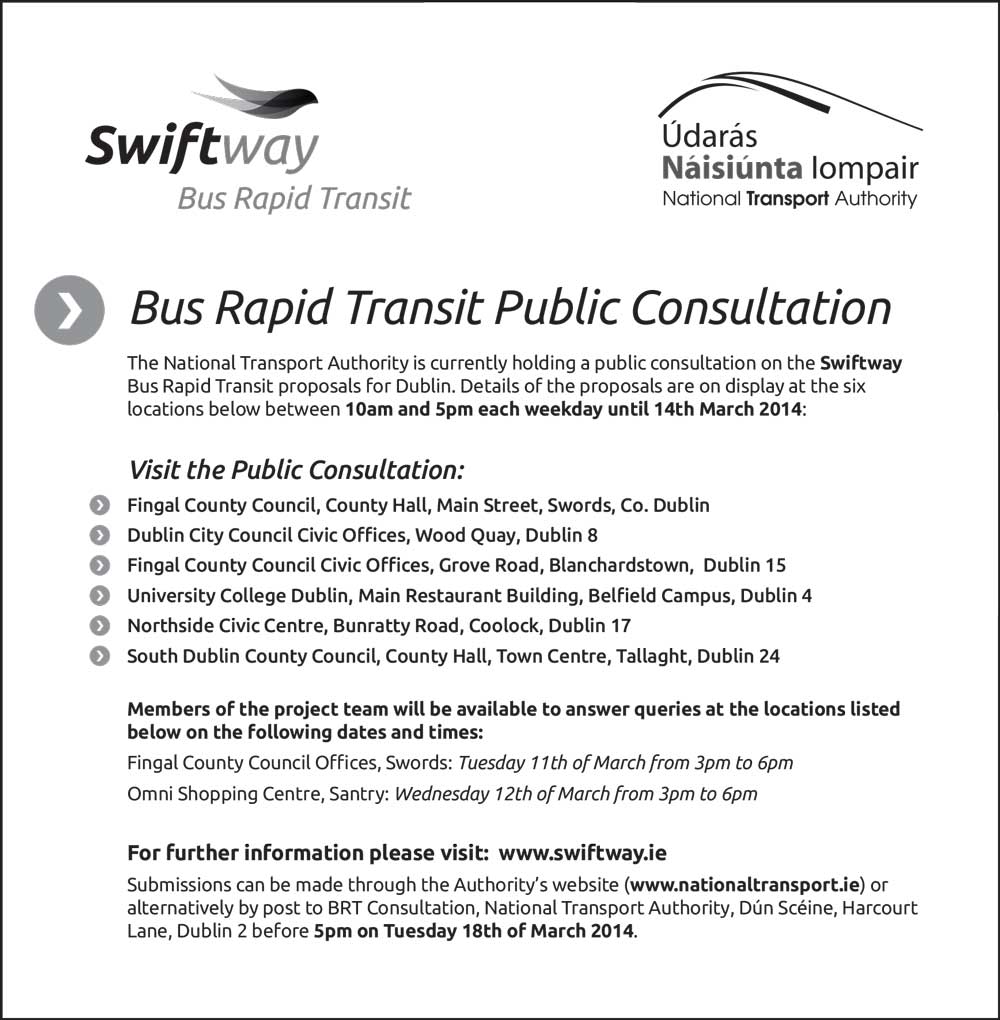
    Swiftway-NEW-AD.jpg


  • Registered Users, Registered Users 2 Posts: 12,318 ✭✭✭✭Grandeeod


    I know people don't like hearing this, but the BRT thing is nothing more than a political fudge. Carry on talking.

    It was once predicted that when recession hit, combined with a change of Government, that a reinvention of the public transport wheel would appear. BRT is it along with the PPT plan, which depends on a signalling project going ahead to make it anyway workable. Some good and some bad, but the reinvention will continue and T21 will disappear into the oblivion that it always set out to disappear into in the first place.

    That's politics!


  • Advertisement
  • Moderators, Motoring & Transport Moderators, Technology & Internet Moderators Posts: 24,122 Mod ✭✭✭✭bk


    Bambi wrote: »
    Still I like the idea of scrapping northside routes so that the good people of swords can have a high frequency route, that will keep commuters out of their cars

    Sensationalism here. I was only suggesting scraping the 1 and 44 routes, two routes that almost exactly match the 16 with just a few extra stops in an estate, two routes which were supposed to be scrapped under network direct anyway, even without the presence of BRT.

    The presence of BRT will make it politically easier to scrap these routes as they can now say we are scrapping them to make way for a faster, higher frequency BRT service.

    The 16 and 41 are almost completely replicated by the BRT route anyway.

    11, 13 and 33 could all be rerouted to more sensible routes anyway. Almost every neighbourhood would continue to be sensibly served.
    Aard wrote: »
    Is that true?

    That route went from being not considered at all, to (apparently) top of the list pretty fast!

    Yes, I believe it is because the Swords route was supposed to be serviced by Metro North by now. But given that isn't going to happen for the foreseeable future, the Swords route has been re-erected and is getting priority as it is one of the highest demand routes, while also being one of the easiest to do.
    lxflyer wrote: »
    Whatever you want to think, I will guarantee you that you will not be seeing the cancellation/re-routing of all those bus routes, despite how convinced you are.

    Whatever about the 41, which will probably be cancelled, I suspect that the remaining routes will remain in situ in some form or another to:

    1 - Retain the existing capacity - BRT does not have the capacity to replace them all even at a frequency of every 4 minutes. It ain't going to happen.

    2 - Retain a stopping service along the corridor to serve those people not near the proposed BRT stops.

    As I've said before - the two are not incompatible.

    1 - There is no reason at all why BRT wouldn't have the capacity. Specially as the BRT buses will have significantly higher capacity (at least 25%) then all buses on this route (no tri-axles are used on any of these routes as far as I know).

    The limitation of a route is how many buses can stop at a bus stop per hour. There is no reason why an equal number of BRT buses can't replace an equal number of DB buses if the DB buses are removed.

    2 - Really, with the exception of a stop around Tolka River, there really isn't that big a gap between stops. Every other stop there is a 500 meter or less gap (some are just a 250 meter gap!). Really with the exception of somewhere outside the Tesco's in Drumcondra, every major stop on the 16 route is hit. There really isn't a need for a stopping service on this route.

    You are right, most of these routes might not end up being scrapped or re-routed, but not for the reasons you state above, they simply aren't valid reasons IMO. No unfortunately they might not happen purely due to lack of vision and politics.

    Isn't it ironic that people first complain that BRT won't have dedicated lanes and will have to mix with buses. But then when I point out that when it comes to at least the Swords BRT route, it would be relatively easy to re-route with a minimum of fuss, most if not all DB routes away from the BRT lane, you have people jumping on saying it shouldn't be done for one illogical reason on the other.

    It just goes to show that no matter what you try and do, you will always have someone complain.


  • Closed Accounts Posts: 1,844 ✭✭✭Banjoxed


    bk wrote: »

    It just goes to show that no matter what you try and do, you will always have someone complain.

    Too bad for you bk that you seem to be unable to grasp that most of what is on this thread is critique. Would you prefer BRT to be implemented badly, in a "look at the shiny buses" way, or in a way that actually provides a rapid transit system in areas not served by trams or trains?


  • Closed Accounts Posts: 5,761 ✭✭✭cdebru


    bk wrote: »
    Sensationalism here. I was only suggesting scraping the 1 and 44 routes, two routes that almost exactly match the 16 with just a few extra stops in an estate, two routes which were supposed to be scrapped under network direct anyway, even without the presence of BRT.

    The presence of BRT will make it politically easier to scrap these routes as they can now say we are scrapping them to make way for a faster, higher frequency BRT service.

    The 16 and 41 are almost completely replicated by the BRT route anyway.

    11, 13 and 33 could all be rerouted to more sensible routes anyway. Almost every neighbourhood would continue to be sensibly served.


    Yes, I believe it is because the Swords route was supposed to be serviced by Metro North by now. But given that isn't going to happen for the foreseeable future, the Swords route has been re-erected and is getting priority as it is one of the highest demand routes, while also being one of the easiest to do.


    1 - There is no reason at all why BRT wouldn't have the capacity. Specially as the BRT buses will have significantly higher capacity (at least 25%) then all buses on this route (no tri-axles are used on any of these routes as far as I know).

    The limitation of a route is how many buses can stop at a bus stop per hour. There is no reason why an equal number of BRT buses can't replace an equal number of DB buses if the DB buses are removed.

    2 - Really, with the exception of a stop around Tolka River, there really isn't that big a gap between stops. Every other stop there is a 500 meter or less gap (some are just a 250 meter gap!). Really with the exception of somewhere outside the Tesco's in Drumcondra, every major stop on the 16 route is hit. There really isn't a need for a stopping service on this route.

    You are right, most of these routes might not end up being scrapped or re-routed, but not for the reasons you state above, they simply aren't valid reasons IMO. No unfortunately they might not happen purely due to lack of vision and politics.

    Isn't it ironic that people first complain that BRT won't have dedicated lanes and will have to mix with buses. But then when I point out that when it comes to at least the Swords BRT route, it would be relatively easy to re-route with a minimum of fuss, most if not all DB routes away from the BRT lane, you have people jumping on saying it shouldn't be done for one illogical reason on the other.

    It just goes to show that no matter what you try and do, you will always have someone complain.


    The simpliest way to do it is to make the current bus services local feeder bus services for the BRT, that way you can retain local services in around housing estates but not block up the BRT lanes.
    These local services could also operate as express buses during peak hours were they would not be setting down or picking up along the BRT lane so would not delay BRT buses.
    For example the 41 would service the estates around swords and have an bus interchange stop in swords with the BRT bus. During peak hours you could have 41x which would interchange with the BRT at that stop but would then continue straight into the city without setting down or picking up till it left the BRT lane.
    This would improve capacity on the BRT route without really delaying the line.
    The same principle could operate on all the BRT routes


  • Moderators, Motoring & Transport Moderators Posts: 14,144 Mod ✭✭✭✭monument


    Godge wrote: »
    Not at all random.

    Sorry, you're right, it's an effort to push anything but the planned route.
    Godge wrote: »
    Two advantages:

    (1) Much quicker travel time from Blanchardstown to city centre, most of the route would be segregated.
    (2) Less disruption to existing transport for the Blanch/Heuston section than the proposed BRT through the extensive use of open space alternatives.

    1. Blanchardstown and the city centre are only two of the locations being seved. It's supposed to be rapid bus transport, not an express bus service.

    2. You still have not even slightly attempted to deal with explaining your travel time estimates.

    3. It's a planned upgrade of existing transport -- disruption happens as part of any such project.
    Godge wrote: »
    Simple measures like the elimination of the right-turn to Infirmary Road from Parkgate Street which is hardly used and the elimination of parking spaces would free up enough space on Parkgate Street, (which wouldn't need a bus gate like the Old Cabra Road). You could use the main entrance to the Park. Upgrading the next entrance on Conyngham Road could cater for car traffic (wider entrance, traffic controlled etc).

    There are also alternatives to running trams down the quays.

    You could go send the Red Line all the way down Thomas Street to TCD for a start.

    http://www.rpa.ie/en/projects/luas_lucan/identify_route_options/Pages/default.aspx


    It is not like someone hasn't thought of it before.

    http://www.rpa.ie/Maps/Luas%20Line%20F/Luas%20Line%20F%20Route%20Options%20Map%20Jul%202007.map.pdf

    Here it is with coloured lines drawn on the map.


    Even if you wanted to keep the Red Line as is, going down the wide Wolfe Tone Quay and a new bridge at Watling Street could take you up to Thomas Street that way.

    Again you're showing that you're all up for changes and disruption as long as it's not happening on the planned Blanch BRT route.

    Interfere with parking? You seem to think it's just dandy to remove parking on Parkgate Street on front of businesses when there's very limited parking around but you think it's next to impossible to interfere with access to Blanch shopping centre.

    Pushing brt/LRT up narrow roads? According to you it's fine for Infirmary Road or Watling Street but not for the Old Cabra Road!

    More disruptive on-street public transport? No thanks on the route near me but sure go ahead with Luas Line F! (Btw I'm likely the person with the least problems on these boards with that route)

    Traffic restrictions? None please on the BRT route in case the school run is interrupted, but on Parkgate Street residents of the area, court staff, gardai heading to HQ and prisoner transport can all get stuffed.

    And then there's suggestions of new bridges where historic ones are already in place, and widening historic park gates to push traffic onto narrow back roads in the park. Unreal stuff. Any disruption and changes go ahead! But Not On My Route!

    And as for your suggestions that no bus gates type arrangements would be needed with your plans -- that's unrealistic, it would be required to make your suggestions of using the main park gate or Infirmary Road for trams.

    Grandeeod wrote: »
    I know people don't like hearing this, but the BRT thing is nothing more than a political fudge. Carry on talking.

    It was once predicted that when recession hit, combined with a change of Government, that a reinvention of the public transport wheel would appear. BRT is it along with the PPT plan, which depends on a signalling project going ahead to make it anyway workable. Some good and some bad, but the reinvention will continue and T21 will disappear into the oblivion that it always set out to disappear into in the first place.

    That's politics!

    BRT is far from a reinvention of the public transport wheel. It's just another turn of the wheel.

    It's a well established mode of transport and a natural progression for Dublin given that the QBC project has advanced to this stage - with most routes largely complete and a number of key projects at or nearing construction (North wall Quay, James St - Thomas Street, Cat and Cage widening etc).

    A huge chunk of T21 was completed, just not those larger PT projects which were interrupted by the largest world downturn in a 100 years. And things are looking up for Dart Underground with a minister with ambition pushing for it.


  • Registered Users, Registered Users 2 Posts: 9,990 ✭✭✭Macy0161


    A couple of things...

    I'm not convinced Taxis should be allowed in the BRT lanes. Every commute, whether on my bike or in the car, I see taxi's blocking bus and/or cycle lanes. Only allowing them in with passengers won't be enforced, and therefore it'll be abused, and it doesn't get around them pulling in to let passengers out and blocking the lane.

    The Blanch - UCD line should go out to Loughlinstown/ Cherrywood. The hard bit for them to do on the N11 is going to be Donnybrook - beyond that there wouldn't even be that much work on the road really. It doesn't make sense to me to stop it in UCD, especially given the traffic issues from before Whites Cross on that route. Bring it up to Cherrywood luas stop, and have a shared park and ride.


  • Advertisement
  • Closed Accounts Posts: 1,844 ✭✭✭Banjoxed


    Macy0161 wrote: »
    A couple of things...

    I'm not convinced Taxis should be allowed in the BRT lanes. Every commute, whether on my bike or in the car, I see taxi's blocking bus and/or cycle lanes. Only allowing them in with passengers won't be enforced, and therefore it'll be abused, and it doesn't get around them pulling in to let passengers out and blocking the lane.

    The Blanch - UCD line should go out to Loughlinstown/ Cherrywood. The hard bit for them to do on the N11 is going to be Donnybrook - beyond that there wouldn't even be that much work on the road really. It doesn't make sense to me to stop it in UCD, especially given the traffic issues from before Whites Cross on that route. Bring it up to Cherrywood luas stop, and have a shared park and ride.

    Part of my submission on the BRT project is to stop the nonsense of allowing taxis and bicycles, and the toleration of motorbikes, into bus lanes.


  • Registered Users, Registered Users 2, Paid Member Posts: 19,633 ✭✭✭✭LXFlyer


    bk wrote: »
    Sensationalism here. I was only suggesting scraping the 1 and 44 routes, two routes that almost exactly match the 16 with just a few extra stops in an estate, two routes which were supposed to be scrapped under network direct anyway, even without the presence of BRT.

    The presence of BRT will make it politically easier to scrap these routes as they can now say we are scrapping them to make way for a faster, higher frequency BRT service.

    The 16 and 41 are almost completely replicated by the BRT route anyway.

    11, 13 and 33 could all be rerouted to more sensible routes anyway. Almost every neighbourhood would continue to be sensibly served.


    Yes, I believe it is because the Swords route was supposed to be serviced by Metro North by now. But given that isn't going to happen for the foreseeable future, the Swords route has been re-erected and is getting priority as it is one of the highest demand routes, while also being one of the easiest to do.


    1 - There is no reason at all why BRT wouldn't have the capacity. Specially as the BRT buses will have significantly higher capacity (at least 25%) then all buses on this route (no tri-axles are used on any of these routes as far as I know).

    The limitation of a route is how many buses can stop at a bus stop per hour. There is no reason why an equal number of BRT buses can't replace an equal number of DB buses if the DB buses are removed.

    2 - Really, with the exception of a stop around Tolka River, there really isn't that big a gap between stops. Every other stop there is a 500 meter or less gap (some are just a 250 meter gap!). Really with the exception of somewhere outside the Tesco's in Drumcondra, every major stop on the 16 route is hit. There really isn't a need for a stopping service on this route.

    You are right, most of these routes might not end up being scrapped or re-routed, but not for the reasons you state above, they simply aren't valid reasons IMO. No unfortunately they might not happen purely due to lack of vision and politics.

    Isn't it ironic that people first complain that BRT won't have dedicated lanes and will have to mix with buses. But then when I point out that when it comes to at least the Swords BRT route, it would be relatively easy to re-route with a minimum of fuss, most if not all DB routes away from the BRT lane, you have people jumping on saying it shouldn't be done for one illogical reason on the other.

    It just goes to show that no matter what you try and do, you will always have someone complain.


    For the record I'm not complaining about anything, so please do not misrepresent my views - I just have a different view on how the public transport service should be offered to yours.


    My view is that both BRT and normal bus services will still be needed. The fact that bus services have been retained parallel to every LUAS line in the city tends to bear that out.


    If you think that having
    • No stops between Airside and the Airport,


    • No stops between Airport and Oscar Traynor Road (the stops at Collinstown and Turnapin Lane are denoted as potential "future stops"),


    • No stops between Oscar Traynor Road and Shantalla Road (bypassing Omni Park),


    • No stops along Dorset Street at all from Drumcondra Station until Mountjoy Square,
    is adequate public transport provision along the Swords corridor, then there's not really much more that I can add. Even if Turnapin were added, there's still quite a distance from the very busy Northwood bus stops.


    You are going to still need a bus service all along that corridor to serve the intermediate points. There are industrial parks, hotels, shopping centres and plenty of other locations that will still generate sufficient traffic.


    At the risk of repeating myself, I want to see a properly designed BRT operation. However, I also am firmly of the belief that a standard bus service along the route will still be needed, the gaps at certain points are just too long. The two are not mutually exclusive - they complement one another.


  • Closed Accounts Posts: 5,761 ✭✭✭cdebru


    lxflyer wrote: »
    For the record I'm not complaining about anything, so please do not misrepresent my views - I just have a different view on how the public transport service should be offered to yours.


    My view is that both BRT and normal bus services will still be needed. The fact that bus services have been retained parallel to every LUAS line in the city tends to bear that out.


    If you think that having
    • No stops between Airside and the Airport,


    • No stops between Airport and Oscar Traynor Road (the stops at Collinstown and Turnapin Lane are denoted as potential "future stops"),


    • No stops between Oscar Traynor Road and Shantalla Road (bypassing Omni Park),


    • No stops along Dorset Street at all from Drumcondra Station until Mountjoy Square,
    is adequate public transport provision along the Swords corridor, then there's not really much more that I can add. Even if Turnapin were added, there's still quite a distance from the very busy Northwood bus stops.


    You are going to still need a bus service all along that corridor to serve the intermediate points. There are industrial parks, hotels, shopping centres and plenty of other locations that will still generate sufficient traffic.


    At the risk of repeating myself, I want to see a properly designed BRT operation. However, I also am firmly of the belief that a standard bus service along the route will still be needed, the gaps at certain points are just too long. The two are not mutually exclusive - they complement one another.

    I don't believe you can have both and give any kind of reliable journey time.
    If you continue with non BRT services using the BRT lane particularly where the proposed bendibuses are used overtaking opportunities are very limited particularly at peak times, it will not be physically possible to provide laybys or overtaking opportunities.
    All that will result is all buses in the BRT will be reduced to the slowest vehicle. The benefits of off bus ticketing and multidoor loading and unloading will be for nothing as BRT buses are held up behind buses without any of these improvements.

    You are compromising the entire system, and it is already compromised enough, compromised on kerb side running, taxis, bicycles, and then throw in standard bus fleet with all the current bus stops, it would IMO be a waste of time.

    People appear to manage just fine on the LUAS without tram stops every 400 meters or less.


  • Registered Users, Registered Users 2, Paid Member Posts: 19,633 ✭✭✭✭LXFlyer


    cdebru wrote: »
    I don't believe you can have both and give any kind of reliable journey time.
    If you continue with non BRT services using the BRT lane particularly where the proposed bendibuses are used overtaking opportunities are very limited particularly at peak times, it will not be physically possible to provide laybys or overtaking opportunities.
    All that will result is all buses in the BRT will be reduced to the slowest vehicle. The benefits of off bus ticketing and multidoor loading and unloading will be for nothing as BRT buses are held up behind buses without any of these improvements.

    You are compromising the entire system, and it is already compromised enough, compromised on kerb side running, taxis, bicycles, and then throw in standard bus fleet with all the current bus stops, it would IMO be a waste of time.

    People appear to manage just fine on the LUAS without tram stops every 400 meters or less.


    It would obviously require laybys - that will be in the detail of whatever plans they come up with.

    Also, the distances are not 400-500m.

    Airport to Santry north is 4.6km, and even with Turnapin and Collinstown stops, that is over 1km between each stop.

    Santry North to Santry South is 1.7km.

    Drumcondra Station to Mountjoy Square is 800m.

    Do you seriously think those are acceptable distances to expect people (including elderly people and anyone who isn't able bodied) to walk to a bus?


    As for LUAS - I think you will find that each line still has conventional bus routes along the entirety of each route.


  • Registered Users, Registered Users 2 Posts: 10,552 ✭✭✭✭cgcsb


    this is what's proposed for Belfast, I assume similar for Dublin, however, Dublin's streets might be less accommodating.


  • Registered Users, Registered Users 2 Posts: 14,002 ✭✭✭✭AlekSmart


    Macy0161 wrote: »
    A couple of things...

    I'm not convinced Taxis should be allowed in the BRT lanes. Every commute, whether on my bike or in the car, I see taxi's blocking bus and/or cycle lanes. Only allowing them in with passengers won't be enforced, and therefore it'll be abused, and it doesn't get around them pulling in to let passengers out and blocking the lane.

    This issue would be A in my ABC of BRT book. ;)

    A significant amount of Dublins current traffic malaise is in fact CAUSED by the totally unsupervised,unregulated and uncontrolled nature of it's Tax service.

    Dublin City Council spent a significant amount of it's administrative time and energy in "getting rid" of parked buses from Dublin's streets.

    This was done without any due consideration of a City's requirement for a certain level of Terminating Bus Services,and was,in no small part,responsible for some of the frustration which accompanied Network Direct (1).

    However,having banished the bus,we see the same City Council,rendered powerless in the face of widespread continuing illegality by the Taxi fraternity,up to and including placing public safety at risk in locations such as Gratfton Street/Suffolk Street.

    Much of the issue lies with the success of the Taxi "Industry" in portraying itself as an integral part of Mainstream Public Transport,something which it has never been,and is not now.

    Whilst Taxi's can,and should,complement an effective Public Transport system,the fact is that Taxi's remain a individually focused,private-hire service,provided at suitably inflated rates of charge to those wishing to pay.

    If it was somehow deemed acceptable or desirable for DCC to chase parked buses from Dublin's streets,then the same Authority cannot stand over maintaining significant stretches of Public Roadway as long-term daily parking for several thousand Cars...it simply does not make sense.

    One thing is becoming clear from this thread and elsewhere,and that is the battle now faced by the NTA to even get an agreed notion of what BRT (Ás Gaeilge) actually IS.

    Already we see anti-BRT groups starting their campaigns,which aligned with the lack of clarity surounding the Swiftway concept IN IT'S ENTIRETY,does not bode well for a smooth well ordered startup.

    The City's (and NTA's) all too apparent problems with Taxi and Hackney regulation cannot be allowed to set-the-pace for the Swiftway/BRT concept as a whole.

    If this conflict is not admitted to and catered for,then BRT Irish-Style will simply swallow that €650 Million whole in a very Swiftway indeed ! :(


    Men, it has been well said, think in herds; it will be seen that they go mad in herds, while they only recover their senses slowly, and one by one.

    Charles Mackay (1812-1889)


  • Registered Users, Registered Users 2 Posts: 14,002 ✭✭✭✭AlekSmart


    cgcsb wrote: »
    this is what's proposed for Belfast, I assume similar for Dublin, however, Dublin's streetsCity Council might be less accommodating.

    A very well designed and simple Bus Bay layout,which has been comprehensively avoided by Dublin City's administrators for decades.

    Bus Bays for modern Long Wheelbase/Tri-Axle/Articulated vehicles operating to Low-Floor Disabled Access requirements MUST have a clear "Glide-Slope" into and away from the Bus-Stop itself.

    That Belfast design illustrates that concept very clearly, as it shows a SINGLE Double Deck Vehicle illustrating clearly the road-space necessary to safely manouvere the Bus into a Close and Parallell position to the kerb.

    Other than at Westmoreland Street (:rolleyes: :rolleyes: :rolleyes:) I have not,as yet,seen ANY evidence that Dublin City's Roads & Traffic designers actually comprehend the mechanics of Bus Based Public Transport operation.


    Men, it has been well said, think in herds; it will be seen that they go mad in herds, while they only recover their senses slowly, and one by one.

    Charles Mackay (1812-1889)


  • Registered Users, Registered Users 2 Posts: 1,194 ✭✭✭KD345


    bk wrote: »
    I was only suggesting scraping the 1 and 44 routes, two routes that almost exactly match the 16 with just a few extra stops in an estate, two routes which were supposed to be scrapped under network direct anyway, even without the presence of BRT.

    The presence of BRT will make it politically easier to scrap these routes as they can now say we are scrapping them to make way for a faster, higher frequency BRT service.

    The 16 and 41 are almost completely replicated by the BRT route anyway.

    11, 13 and 33 could all be rerouted to more sensible routes anyway. Almost every neighbourhood would continue to be sensibly served.

    Really with the exception of somewhere outside the Tesco's in Drumcondra, every major stop on the 16 route is hit. There really isn't a need for a stopping service on this route.

    There are serious capacity issues in Drumcondra at present. If the 41 is being replaced by Swiftway and not stopping along Drumcondra then this will seriously impact on services in the area.

    I believe every service currently running along this corridor should be retained. The 1, 16, 44, 11 and 13 all filter into a busy corridor but play their part in carrying passengers from here. Where the 1,11, and 44 terminate is irrelevant, the fact is that they offer additional capacity at the right points and offer unique connections to Ringsend, Sandymount, Dundrum, Sandyford etc. The BRT will not change this.


  • Closed Accounts Posts: 21,717 ✭✭✭✭Godge


    monument wrote: »
    Sorry, you're right, it's an effort to push anything but the planned route.

    The planned route won't work so of course anything else should be looked at.

    There are plenty of better alternatives, none of them have zero disruption of change.

    monument wrote: »
    1. Blanchardstown and the city centre are only two of the locations being seved. It's supposed to be rapid bus transport, not an express bus service.

    2. You still have not even slightly attempted to deal with explaining your travel time estimates.

    3. It's a planned upgrade of existing transport -- disruption happens as part of any such project.

    I was suggesting a LUAS alternative. Travel time estimates are faster because you are not travelling along existing roads and the LUAS is segregated.
    monument wrote: »

    Again you're showing that you're all up for changes and disruption as long as it's not happening on the planned Blanch BRT route.

    I never said I was against changes and disruption. I did say that most local communities are and that the history of subservient councillors suggests that they support local communities and businesses because of rates and votes and that means the type of changes needed for BRT will fail.

    The alternatives I suggest are to avoid the type of changes which councillors usually successfully resist.

    monument wrote: »
    Interfere with parking? You seem to think it's just dandy to remove parking on Parkgate Street on front of businesses when there's very limited parking around but you think it's next to impossible to interfere with access to Blanch shopping centre.

    We are talking about the stretch of street from the Ashling Hotel to the main Phoenix Park Gate which has about 20 parking places. It is hardly akin to ending Stoneybatter as a village.

    As for the Blanch centre, the evidence suggests that the owners of the Centre have been very successful in

    (1) re-positioning the buses to the periphery of the Centre
    (2) ensuring the Metro West skirts the very edge of the Centre beyond the car parks.

    I have no doubt they will be equally successful in respect of BRT. You spoke in an earlier post that people like me and the Blanch Centre owners will have to learn etc. Well that is not the way to win friends and influence people.

    There are other ways - tying in a LUAS station to an integrated extension of the Centre would be one.
    monument wrote: »
    Pushing brt/LRT up narrow roads? According to you it's fine for Infirmary Road or Watling Street but not for the Old Cabra Road!

    Actually, with the use of the LUAS Line F proposal along Thomas Street and the main park gates, no need to clog up Infirmary Road or Watling Street.

    Watling Street has very little traffic anyway, it is like the use of Marlborough Street for LUAS cross-city - minimal effect.
    monument wrote: »
    More disruptive on-street public transport? No thanks on the route near me but sure go ahead with Luas Line F! (Btw I'm likely the person with the least problems on these boards with that route)

    Only the section of Luas Line F within the city centre.

    If you cannot distinguish between closing a main commuter route to the city and closing part of a city centre street (most if not all of Thomas Street will still be wide enough for two traffic lanes, unlike the Cabra Road), well I can't help you there.
    monument wrote: »
    Traffic restrictions? None please on the BRT route in case the school run is interrupted, but on Parkgate Street residents of the area, court staff, gardai heading to HQ and prisoner transport can all get stuffed.

    In one case you are talking about several kilometres all the way down through Stoneybatter which will be completely disrupted, in the other I am talking about a couple of hundred yards on Parkgate Street which be partially disrupted, again there is a difference.

    monument wrote: »
    And then there's suggestions of new bridges where historic ones are already in place, and widening historic park gates to push traffic onto narrow back roads in the park. Unreal stuff. Any disruption and changes go ahead! But Not On My Route!

    It is a Blanchardstown to City Centre route in both cases.

    What is wrong with widening historic park gates? Why do the narrow back roads have to stay narrow? To suggest there is not plenty of space to run a LUAS through the Phoenix Park is funny.
    monument wrote: »
    And as for your suggestions that no bus gates type arrangements would be needed with your plans -- that's unrealistic, it would be required to make your suggestions of using the main park gate or Infirmary Road for trams.

    LUAS could use the main park gates, up to the first roundabout, right, over past the ZOO and along the wall up to the Ashtown Gates.

    The main change that would be needed would be to widen Wellington Road and bring road traffic either through a widening of the existing Islandbridge gate or a new one at the South Circular Road junction.
    monument wrote: »
    BRT is far from a reinvention of the public transport wheel. It's just another turn of the wheel.

    It's a well established mode of transport and a natural progression for Dublin given that the QBC project has advanced to this stage - with most routes largely complete and a number of key projects at or nearing construction (North wall Quay, James St - Thomas Street, Cat and Cage widening etc).

    BRT is a turn of the wheel away from Transport 21 and a further downgrade. It is a million miles away from that vision.
    monument wrote: »
    A huge chunk of T21 was completed, just not those larger PT projects which were interrupted by the largest world downturn in a 100 years. And things are looking up for Dart Underground with a minister with ambition pushing for it.

    Saying that a huge chunk of T21 was completed is like saying we put in the drains for the motorways, the bridges for the motorways, even the interchanges and even the food stops on the motorways but we didn't build any of the mainline motorway so we have delivered a huge chunk of the motorway system.


  • Registered Users, Registered Users 2, Paid Member Posts: 19,633 ✭✭✭✭LXFlyer


    Godge wrote: »
    As for the Blanch centre, the evidence suggests that the owners of the Centre have been very successful in

    (1) re-positioning the buses to the periphery of the Centre

    I'm not sure I quite agree with this.

    I took a 39a to Blanchardstown Centre and within 2 minutes of getting off the bus, I was inside the shopping centre.

    I could also access the Northern and Western retail parks far more easily than I could from the old terminus.

    Plus the 39a just goes in and out without double backing on itself.


  • Advertisement
  • Closed Accounts Posts: 5,761 ✭✭✭cdebru


    lxflyer wrote: »
    It would obviously require laybys - that will be in the detail of whatever plans they come up with.

    Also, the distances are not 400-500m.

    Airport to Santry north is 4.6km, and even with Turnapin and Collinstown stops, that is over 1km between each stop.

    Santry North to Santry South is 1.7km.

    Drumcondra Station to Mountjoy Square is 800m.

    Do you seriously think those are acceptable distances to expect people (including elderly people and anyone who isn't able bodied) to walk to a bus?


    As for LUAS - I think you will find that each line still has conventional bus routes along the entirety of each route.


    Where will these laybys be fitted ? Because the only places really on that route where you could fit them they probably won't need them. Nevermind our history of laybys is dismal realistically to get a double decker bus properly into a layby they need to be about 3m wide and about 30m long and even longer depending on the maximum number of buses per hour operating at that stop.


  • Registered Users, Registered Users 2, Paid Member Posts: 19,633 ✭✭✭✭LXFlyer


    cdebru wrote: »
    Where will these laybys be fitted ? Because the only places really on that route where you could fit them they probably won't need them. Nevermind our history of laybys is dismal realistically to get a double decker bus properly into a layby they need to be about 3m wide and about 30m long and even longer depending on the maximum number of buses per hour operating at that stop.


    That is why I've said from the outset that I'm not going to pass judgement on this scheme until I see the detailed EIS plans. That's what the engineers are paid to sort out.


    But if anyone is seriously trying to suggest to me that removing all existing stops on distances of between 1 and almost 5 km and asking people to walk to the nearest stop (which is what certain people here are currently proposing) is acceptable then they're living in cloud cuckoo land.


  • Moderators, Motoring & Transport Moderators, Technology & Internet Moderators Posts: 24,122 Mod ✭✭✭✭bk


    KD345 wrote: »
    I believe every service currently running along this corridor should be retained. The 1, 16, 44, 11 and 13 all filter into a busy corridor but play their part in carrying passengers from here. Where the 1,11, and 44 terminate is irrelevant, the fact is that they offer additional capacity at the right points and offer unique connections to Ringsend, Sandymount, Dundrum, Sandyford etc. The BRT will not change this.

    But there is absolutely no reason why BRT can't replace all of these buses on this corridor. That is the whole point.

    If the corridor is currently handling 20 buses an hour, there is absolutely no reason why these 20 buses can't be replaced by 20 BRT buses, which in turn have at least 25% more capacity.

    I agree maybe two extra stops would berequired then what is currently being proposed, but really it isn't as big a deal as you are making out. I'll detail the gaps you mentioned and how they could be solved when I've more time.


  • Closed Accounts Posts: 5,761 ✭✭✭cdebru


    lxflyer wrote: »
    That is why I've said from the outset that I'm not going to pass judgement on this scheme until I see the detailed EIS plans. That's what the engineers are paid to sort out.


    But if anyone is seriously trying to suggest to me that removing all existing stops on distances of between 1 and almost 5 km and asking people to walk to the nearest stop (which is what certain people here are currently proposing) is acceptable then they're living in cloud cuckoo land.


    You are talking bull sorry, there is no 5km gap in stops there is one at Collinstown and one at Turnapin there is very little else on that road anyway.

    Simple fact is and you don't have to wait to see what the engineers come up with you can not maintain the current bus services and bus stops along that route and deliver a fast reliable journey time. it is simply not possible.
    The NTA are talking about 2 to 4 minutes headway if the BRT lane is clogged up with current services, taxis and bicycles there is no way you can maintain that headway evenly and there is no way you can build the laybys you would need to allow the BRT buses to maintain a steady progress.


  • Registered Users, Registered Users 2, Paid Member Posts: 19,633 ✭✭✭✭LXFlyer


    cdebru wrote: »
    You are talking bull sorry, there is no 5km gap in stops there is one at Collinstown and one at Turnapin there is very little else on that road anyway.

    Simple fact is and you don't have to wait to see what the engineers come up with you can not maintain the current bus services and bus stops along that route and deliver a fast reliable journey time. it is simply not possible.
    The NTA are talking about 2 to 4 minutes headway if the BRT lane is clogged up with current services, taxis and bicycles there is no way you can maintain that headway evenly and there is no way you can build the laybys you would need to allow the BRT buses to maintain a steady progress.


    If you look at the NTA site, the schematic shows Collinstown and Turnapin as future stops - they are not included in the initial phase. Look at the graphic at the top of this page: http://www.nationaltransport.ie/bus-rapid-transit/swordsairport-to-city-centre/

    That is a 4.7km gap in the route.

    Even with those stops - the gap is over 1.1km between those stops, with no stop near Northwood, one of the busiest on the corridor. There are plenty of industrial sites and other businesses along that section.

    Also in the FAQs on the NTA site, it says:
    How frequent will the Swiftway service be?
    It is intended to operate Swiftway at a frequency of approximately every four minutes during peak times.

    So I'm not sure where you reckon it will be every two minutes?

    Please do not suggest I am talking "bull" - I do tend to read these proposals very carefully, and I am making my posts based on what it says on the site. I think that is frankly insulting my intelligence and totally unnecessary.


  • Registered Users, Registered Users 2, Paid Member Posts: 19,633 ✭✭✭✭LXFlyer


    For the record I am not suggesting that you would have anything like the existing frequency of conventional buses on the corridor. Of course you wouldn't.

    But you will still need a normal bus service.


  • Closed Accounts Posts: 5,761 ✭✭✭cdebru


    lxflyer wrote: »
    If you look at the NTA site, the schematic shows Collinstown and Turnapin as future stops - they are not included in the initial phase. Look at the graphic at the top of this page: http://www.nationaltransport.ie/bus-rapid-transit/swordsairport-to-city-centre/

    That is a 4.7km gap in the route.

    Even with those stops - the gap is over 1.1km between those stops, with no stop near Northwood, one of the busiest on the corridor. There are plenty of industrial sites and other businesses along that section.

    Also in the FAQs on the NTA site, it says:


    So I'm not sure where you reckon it will be every two minutes?

    Please do not suggest I am talking "bull" - I do tend to read these proposals very carefully, and I am making my posts based on what it says on the site. I think that is frankly insulting my intelligence and totally unnecessary.


    Well they are all future stops as nothing has been built yet, but the point remains that the plan has 2 stops at turnapin and Collinstown so the 5km claim as a basis for keeping existing services and stops is bull.

    Secondly you can't have it both ways either you want to wait till the engineers plans are finished before you rush to judgement or you don't.
    If you read the proposal carefully you would notice it says proposed stops, indicative location. So you can't hide behind the we haven't seen the full plan defense and then use proposed stops with indicative locations to argue that current routes and stops are absolutely required, pick which one you want to use.


    Oh BTW it is simple mathematics

    NTA claimed maximum capacity of 3600 each direction, 120 people per bus is 30 buses, 30 buses in a hour is a 2 minute headway. Hence I said 2 to 4 minutes as their figures for a 4 minute headway would only give a maximum capacity of 1800 in each direction.


  • Registered Users, Registered Users 2, Paid Member Posts: 19,633 ✭✭✭✭LXFlyer


    cdebru wrote: »
    Well they are all future stops as nothing has been built yet, but the point remains that the plan has 2 stops at turnapin and Collinstown so the 5km claim as a basis for keeping existing services and stops is bull.

    As I said above - I don't think you need to use that sort of language.

    You're only demeaning your own argument.

    A bit of mutual respect does go a long way.


  • Closed Accounts Posts: 5,761 ✭✭✭cdebru


    lxflyer wrote: »
    As I said above - I don't think you need to use that sort of language.

    You're only demeaning your own argument.

    A bit of mutual respect does go a long way.

    What would you prefer to call it, you are using a spurious claim that there will be a 5km gap between stops as a justification for your argument that current routes and stops should be maintained but hide behind the oh we haven't seen the full plans yet to defend that position. Like I said you can't have it both ways.

    BTW I edited the post to explain the 2 minute headway.

    And lastly the NTA FAQ also state that stops will be 500 to 800 metres apart and conveniently located to suit the maximum number of passengers.


  • Advertisement
  • Closed Accounts Posts: 5,761 ✭✭✭cdebru


    Macy0161 wrote: »
    A couple of things...

    I'm not convinced Taxis should be allowed in the BRT lanes. Every commute, whether on my bike or in the car, I see taxi's blocking bus and/or cycle lanes. Only allowing them in with passengers won't be enforced, and therefore it'll be abused, and it doesn't get around them pulling in to let passengers out and blocking the lane..


    Agreed someone mentioned earlier about Amsterdam taxis being allowed on tram lines, it is true but only partially.
    They are limited express taxis that need a special license so there are not 22,000 taxis clogging up the tramlines.

    What you could possibly do is similar a special license to allow taxis use the BRT line with a different colour roof sign, and limit what they can do so say no picking up or setting down in the BRT lane they can just use it as an express lane that could work and offer a compromise.

    But like all things it would need to be policed and that is where we fall flat on our face in this country. The Gardai are now saying to DB that sections of bus lanes are too difficult to police so they are just not going to bother try. This is why spending 650m on BRT lanes is IMO a waste of money, you can paint as many lines as you like on the road but if the gardai refuse to enforce them it is merely a waste of paint.


This discussion has been closed.
Advertisement
Advertisement