Advertisement
Help Keep Boards Alive. Support us by going ad free today. See here: https://subscriptions.boards.ie/.
https://www.boards.ie/group/1878-subscribers-forum

Private Group for paid up members of Boards.ie. Join the club.
Hi all, please see this major site announcement: https://www.boards.ie/discussion/2058427594/boards-ie-2026

Swiftway - Bus Rapid Transit (BRT)

18911131421

Comments

  • Registered Users, Registered Users 2 Posts: 1,419 ✭✭✭Cool Mo D


    cdebru wrote: »
    The clongriffin to tallaght is going to be down the malahide road down the quays up patrick st and out through harolds cross, terenure, plenty of bottlenecks, pinch points, shared space to fill your boots without even looking at Swords and drumcondra, westland row, pearse st, etc etc.

    Apart from 100 metres of the Malahide road north of fairview, and a short stretch coming into Artane (both of which could be fixed by taking parts of front gardens, with no demolition), the Clongriffen route is wide enough for dedicated bus lanes all the way to Harold's Cross.


  • Registered Users, Registered Users 2, Paid Member Posts: 19,628 ✭✭✭✭LXFlyer


    I know people have reservations about this project (including myself), but I think we need to try and look at it in a different way.

    Rather than coming up with reasons why it won't work, we really need to be looking at what needs to happen to make it work.


  • Registered Users, Registered Users 2 Posts: 10,552 ✭✭✭✭cgcsb


    Cool Mo D wrote: »
    Apart from 100 metres of the Malahide road north of fairview, and a short stretch coming into Artane (both of which could be fixed by taking parts of front gardens, with no demolition), the Clongriffen route is wide enough for dedicated bus lanes all the way to Harold's Cross.

    Indeed, that route seems the most doable. So long as the BRT runs in the central reserve and has some sort of bridge over the roundabouts, I'd say that corridor is an excellent candidate for BRT. As is most of the Swords route up until it gets to O'Connell st.(It could be segregated all the way to the south side if it went via Gardiner st.


  • Registered Users, Registered Users 2 Posts: 9,666 ✭✭✭Shedite27


    I used to work in the Vancouver trasnport body (Translink) while they were looking at 3 alternatives for a route (Subway, Luas-style trams, or BRT). We settled on BRT there (mainly for cost).

    The main points IMO are...
    1. Get people to pay before getting on (as currently on luas)
    2. Minimise stops - one stop per every 3 we currently have. No need to have them every 200m.
    3. Get the busses segregated from the road. Think that's stil up for discussion on the Dublin plan. There's 3 alternatives...
    ctfhz_alignment_brt.ashx

    If anyone wants to read the Vancouver report it's here


  • Closed Accounts Posts: 1,844 ✭✭✭Banjoxed


    There are four aspects to this.

    The first one is ensuring a right of way without the inherent problem that buses face in Dublin, mixing it with general traffic at various pinch points and far too many stops.

    The second is capacity. One articulated bus carries a lot fewer people than one tram, and one tram carries a lot fewer people than a metro/train.

    Let's not fool ourselves that BRT = Tram in terms of capacity.

    The third aspect is how private motorists and their pet journalists will react to having capacity taken from them.

    Given that the reaction to the Donnybrook QBC was, as Frank McDonald once wrote, not dissimilar to the Germans facing the Normandy Landings in 1944, to what extent will political expedience nibble away at the efficacy of the bus corridors? From experience, quite a lot.

    Finally the vehicles themselves. An articulated bus with a diesel engine is still that and not an electrically powered tram. Forget all the spin and guff that will arise over the next while, hoping to pull the wool over the eyes of the public. This will not have the capacity, speed and acceleration of Luas.

    There will be a hell of a lot of misinformed guff on this over the next few years. Expect the end result to be far less than the hype at the end of it.


  • Advertisement
  • Moderators, Science, Health & Environment Moderators Posts: 20,712 Mod ✭✭✭✭Sam Russell


    Banjoxed wrote: »

    Finally the vehicles themselves. An articulated bus with a diesel engine is still that and not an electrically powered tram. Forget all the spin and guff that will arise over the next while, hoping to pull the wool over the eyes of the public. This will not have the capacity, speed and acceleration of Luas.

    There is another option - electric powered trolley buses. These are basically trams on tyres. The vehicles need to have at least 4 axles or they are just the old bouncy bendy-buses. To power the (trolley)buses, overhead wires are used (two wires) or an earth track and a single overhead wire. The latter would be the better solution. The French, I think used the latter somewhere (iirc). Geneva has trolley buses and trams, but trolley buses are in loads of cities.


    The vehicles are key if this system is ever to be successful. Unless they are quick and can carry loads of passengers then the project is doooomed. Having a bus every 3 minutes is impossible unless they have a dedicated space. Otherwise they will just queue up in a jam.

    bi-articulated buses http://en.wikipedia.org/wiki/Bi-articulated_bus


  • Registered Users, Registered Users 2 Posts: 14,002 ✭✭✭✭AlekSmart


    lxflyer wrote: »
    I know people have reservations about this project (including myself), but I think we need to try and look at it in a different way.

    Rather than coming up with reasons why it won't work, we really need to be looking at what needs to happen to make it work.

    Indeed.

    The city of Curitiba in Brazil has what is probably the oldest operational Bus Rapid Transit system in the world.

    There is a reasonably good description here....


    http://www.urbanhabitat.org/node/344

    However Curitiba's undoubted success did not simply happen...it required Long-Term vision,planning and committment....
    Thirty years ago, Curitiba’s forward-thinking and cost-conscious planners integrated public transportation into all the other elements of the urban planning system. They initiated a system that focused on meeting the transportation needs of all people—rather than those using private automobiles—and consistently followed through with a staged implementation of their plan. They avoided large-scale and expensive projects in favor of hundreds of modest initiatives.

    Before embarking on a spend of €600 Million + of money we do not actually have,I believe we (The People) need some hard evidence that the principles so successfully carried through in Curitiba could be similarly pursued in Dublin.

    Under our current Civic Administrative setup,I have grave reservations as to whether this can occur.

    If we look again at the Brazilian experience we see it developing from the realization that projections desirable in 1943 were no longer so worthy a decade later....

    A previous comprehensive plan for Curitiba, developed in 1943, had envisioned exponential growth in automobile traffic with wide boulevards radiating from the core of the city to accommodate it. Rights of way for the boulevards were acquired, but many other parts of the plan never materialized. Then in 1965, prompted by fears among city officials that Curitiba’s rapid growth would lead to unchecked development and congested streets, they adopted a new Master Plan. Curitiba would no longer grow in all directions from the core, but would grow along designated corridors in a linear form, spurred by zoning and land use policies promoting high density industrial and residential development along the corridors. Downtown Curitiba would no longer be the primary destination of travel, but a hub and terminus. Mass transit would replace the car as the primary means of transport within the city, and the development along the corridors would produce a high volume of transit ridership. The wide boulevards established in the earlier plan would provide the cross section required for exclusive bus lanes in which an express bus service would operate.

    Sticking with Curitiba,but this time a 2007 New York Times article.....

    http://select.nytimes.com/gst/abstract.html?res=F30E1FF839550C738EDDAC0894DF404482&pagewanted=2
    When the bus system was inaugurated, it transported 54,000 passengers daily. That number has ballooned to 2.3 million, in large part because of innovations that permit passengers to board and exit rapidly. In 1992, Lerner and his team established the tubular boarding platforms with fare clerks and turnstiles, so that the mechanisms for paying and boarding are separated, as in a subway. To carry more people at a time, the city introduced flexible-hinged articulated buses that open their doors wide for rapid entry and egress; then, when the buses couldn't cope with the demand, the Lerner team called for bi-articulated buses of 88 feet with two hinges (and a 270-passenger capacity), which Volvo manufactured at Curitiba's request. Comparing the capacities of bus and subway systems, Lerner reels off numbers with a promoter's panache. ''A normal bus in a normal street conducts x passengers a day,'' he told me. ''With a dedicated lane, it can transport 2x a day. If you have an articulated bus in a dedicated lane, 2.7x passengers. If you add a boarding tube, you can achieve 3.4x passengers, and if you add double articulated buses, you can have four times as many passengers as a normal bus in a normal street.'' He says that with an arrival frequency of 30 seconds, you can transport 36,000 passengers every hour -- which is about the same load he would have achieved with a subway.

    But,even in Brazil,the essence of human nature still gnaws away at the sensible elements...
    Unfortunately, the trends of bus usage are down. While the system has expanded to cover 13 of the cities in the metropolitan region, charging a flat fare that in practice subsidizes the trips of the mostly poorer workers who live in outlying areas, bus ridership within the Curitiba municipality has been declining. ''We are losing bus passengers and gaining cars,'' says Luis Fragomeni, a Curitiba urban planner. He observes that, like potential users of public transport everywhere, many Curitibanos view it as noisy, crowded and unsafe. Undermining the thinking behind the master plan, even those who live alongside the high-density rapid-bus corridors are buying cars. ''The licensing of cars in Curitiba is 2.5 times higher than babies being born in Curitiba,'' he says. ''Trouble.''

    Again,I want to see and hear evidence of connected-thinking and agreement at the Highest Levels here in Dublin,and I'm not getting that.....yet :)

    What I am seeing thus far (and I agree,it's early days ),is far too low a resolution of clarity and yet again some quite confining points such as committing to 18 Mtr Long SINGLE Articulation vehicles.....I would much prefer somewhat less focus on the vehicles at this stage and a far stronger focus on the "Permanent Way" Infrastructure....we shall see ;)


    Men, it has been well said, think in herds; it will be seen that they go mad in herds, while they only recover their senses slowly, and one by one.

    Charles Mackay (1812-1889)


  • Registered Users, Registered Users 2 Posts: 18,706 ✭✭✭✭Idbatterim


    Rather than coming up with reasons why it won't work, we really need to be looking at what needs to happen to make it work.
    The argument against metro north and DU at the moment is funding, yet we have 650,000,000 to be wasted on this joke? Why not just implement some of the very cheap and simple suggestions that have already been posted on this thread first? The comparisons in that report to other English "cities" are a joke, where Dublin ranks in the scheme of things can be seen below.

    http://en.wikipedia.org/wiki/Global_city

    We need a proper 21st century integrated rail network, end of!

    With very frequent buses, could they not stop at every second stop, for people that didnt want to or couldnt walk very far? Time lost if one passed your desired stop, would quickly be made up by not stopping every two hundred meters...


  • Closed Accounts Posts: 1,844 ✭✭✭Banjoxed


    AlekSmart wrote: »
    Indeed.

    The city of Curitiba in Brazil has what is probably the oldest operational Bus Rapid Transit system in the world.

    There is a reasonably good description here....


    http://www.urbanhabitat.org/node/344

    However Curitiba's undoubted success did not simply happen...it required Long-Term vision,planning and committment....


    Before embarking on a spend of €600 Million + of money we do not actually have,I believe we (The People) need some hard evidence that the principles so successfully carried through in Curitiba could be similarly pursued in Dublin.

    Under our current Civic Administrative setup,I have grave reservations as to whether this can occur.

    If we look again at the Brazilian experience we see it developing from the realization that projections desirable in 1943 were no longer so worthy a decade later....

    A previous comprehensive plan for Curitiba, developed in 1943, had envisioned exponential growth in automobile traffic with wide boulevards radiating from the core of the city to accommodate it. Rights of way for the boulevards were acquired, but many other parts of the plan never materialized. Then in 1965, prompted by fears among city officials that Curitiba’s rapid growth would lead to unchecked development and congested streets, they adopted a new Master Plan. Curitiba would no longer grow in all directions from the core, but would grow along designated corridors in a linear form, spurred by zoning and land use policies promoting high density industrial and residential development along the corridors. Downtown Curitiba would no longer be the primary destination of travel, but a hub and terminus. Mass transit would replace the car as the primary means of transport within the city, and the development along the corridors would produce a high volume of transit ridership. The wide boulevards established in the earlier plan would provide the cross section required for exclusive bus lanes in which an express bus service would operate.

    Sticking with Curitiba,but this time a 2007 New York Times article.....

    http://select.nytimes.com/gst/abstract.html?res=F30E1FF839550C738EDDAC0894DF404482&pagewanted=2


    But,even in Brazil,the essence of human nature still gnaws away at the sensible elements...


    Again,I want to see and hear evidence of connected-thinking and agreement at the Highest Levels here in Dublin,and I'm not getting that.....yet :)

    What I am seeing thus far (and I agree,it's early days ),is far too low a resolution of clarity and yet again some quite confining points such as committing to 18 Mtr Long SINGLE Articulation vehicles.....I would much prefer somewhat less focus on the vehicles at this stage and a far stronger focus on the "Permanent Way" Infrastructure....we shall see ;)

    It's the focus on the vehicles that makes me suspicious of the whole point of this project. If the focus was on dedicated busways, then there would be a reasonable chance that they could be uprated to good tramways when demand outstripped capacity.

    Instead it's "look at the shiny buses". This is more froth than porter.


  • Moderators, Motoring & Transport Moderators, Technology & Internet Moderators Posts: 24,122 Mod ✭✭✭✭bk


    Idbatterim wrote: »
    The argument against metro north and DU at the moment is funding, yet we have 650,000,000 to be wasted on this joke? Why not just implement some of the very cheap and simple suggestions that have already been posted on this thread first?

    In terms of infrastructure, 650m is cheap and BRT seems to be doing exactly the cheap and simple suggestions that we all have been making for years:

    - Removing pinch points like the cat & cage.
    - Off bus ticketing
    - Multidoor operation
    - Better quality bus stops.
    - Less bus stops.
    - Longer running hours
    - Higher frequency.

    People here seem to be focusing on the Blanchardstown route and maybe there isn't the space to do that route properly, I don't know, I don't know the route very well.

    However it is the Swords/Airport route that they will be doing first and that route looks like it could be done extremely well and have a real impact in potentially halving the journey time. Swords to the city in just 35 minutes would be fantastic. Looking at the plan, it looks lie they will achieve this by:

    - Removing the pinch point at the cat & cage pub in Drumcondra, where it currently goes from 4 lanes down to just 2 lanes. This is currently being worked on and expanded to 4 lanes and will make a big difference.

    - Changing Parnell Square East so now the BRT goes up and down in both directions, this will certainly save a few minutes compared to the current set up of going around Parnell Square West when heading North.

    - Using the very wide and quiet back streets around Mountjoy Square rather then the Drumcondra Road will help.

    Other then these the rest of the route is pretty wide and has plenty of space for a fast bus service.

    Now combine the above changes with all the other positive elements of BRT:

    - Off bus ticketing
    - Multi door operation
    - Higher capacity buses
    - Proper bus stops.
    - High frequency (up to every 2 minutes!)
    - Longer Luas style running hours
    - Fewer bus stops.
    - Priority at junctions.

    As a person who lives on this route, with all of the above, I'm damn excited about this project. It will mean I will get into town in half the time, with a very high frequency (thus also reducing my total journey time, less waiting) and longer running hours. What isn't there to like?

    There are a few things I worry about and I hope they consider:

    - This service should really run 24 hours a day, particularly the route to the airport. The Airport operates and is busy all night, so I think this would be a great opportunity to trial a normal (non nitelink) 24/7 bus service. I think it will be very successful.

    - The existing bus services that use the route, need to be removed and changed as much as possible to local feeder routes so that they don't get in the way of the faster BRT.

    - I'd like to see Taxi's banned from the BRT lanes.

    But on the whole, I'm very excited about this project. I still want MN and DU, but I do think this will be a good short term compromise and if successful, I'm also hoping it will have a positive impact on DB operations and force them to also take on some of these operational procedures.


  • Advertisement
  • Closed Accounts Posts: 21,717 ✭✭✭✭Godge


    monument wrote: »
    You can comment now as part of the public consultation here: http://www.nationaltransport.ie/public-consultations/current/public-consultation-on-bus-rapid-transit/


    BRT can be done one route at a time, while DU is a commitment to spend billions.

    These projects are not really competing for money or on routes.


    Blanchardstown/City Centre is analagous to the Maynooth line electrification and the Broomdridge Luas extension. While DU is not competing on routes for other sections, it is for that one.

    monument wrote: »

    Sorry, I picked that up wrong.

    But at the same time all modes have that extra travel time west of the Blanch centre (and indeed BRT gets closer to many areas).

    Luas-like hours of operation (ie 5.30 to 12.30), compared to DB which runs fewer hours of the day.

    Even DB's current timetable is sub 50 minutes to the most western parts of D15 so I'm unsure where the extra 20 minutes is coming from. That's the outer reaches of D15 -- much of the area is closer to the city.

    30-45 minutes should cover most of D15 and I can't see the justification for much quicker transport to an outer suburb area.

    Great for you but BRT is largely aimed at getting more people on buses who are not as convinced as you.

    The Blanchardstown route has plenty of problems. The solution proposed for the city centre is quite interesting and could work. However, it will inevitably clog the Cabra Road and Stoneybatter with buses, taxis and cars and the BRT will be delayed significantly in that section. The only solutions to that are radical, either the banning of cars or a one-way system through the use of Aughrim St/Blackhorse Ave/Nephin Road for traffic travelling out from the city centre and Old Cabra Road/Prussia Street for traffic travelling in. However, the old problem of the residents and businesses of Stoneybatter weighing in with objections would kill that.

    The second major issue relates to Blanchardstown Town Centre itself, a privately owned property which relies on car access to sustain itself. The bus lanes regularly clog there particularly in the evening and from the middle of October to the end of the year at all times. I cannot see the owners agreeing to change this (unless of course it was linked to getting planning permission for more car parking, more shops and the government paying for better access from the N3).

    Finally, it seems you don't know Blanchardstown very well. Describing it as an outer suburb only needing a 30/45 minute bus service to the city centre doesn't capture the size of the place now. The population and density (remember to exclude those areas not yet developed but in line for development) of Blanchardstown would deserve a heavy rail service much more than any proposal out there (or the existing ones such as the southern half of the DART where half the catchement area is under water).
    monument wrote: »
    The infrastructure and ticketing improvements are a key part of the BRT plan. Branding is an important element also and the DB brand is damaged goods at this stage.

    BRT is not a competing mode to DB routes -- BRT will cohesively consume and/or complement the old routes.

    As above, DU is on a larger spending scale and it does not serve even half of the the same trips (even if there is some crossover).

    Higher frequency, higher capacity, more reliability, better accessibility... Not sure what's so questionable at this stage.

    Yes, this project will include considerable street layout changes.

    They may be designing the route, NTA planning it from the start.

    I am not objecting to this in principle. Certainly it seems some of the routes may be justified but the priority for the Blanchardstown area should be the electrification of the Maynooth line together with better transport links to the stations.


  • Registered Users, Registered Users 2 Posts: 18,706 ✭✭✭✭Idbatterim


    - Removing the pinch point at the cat & cage pub in Drumcondra, where it currently goes from 4 lanes down to just 2 lanes. This is currently being worked on and expanded to 4 lanes and will make a big difference.
    This is being worked on as you say.
    - Changing Parnell Square East so now the BRT goes up and down in both directions, this will certainly save a few minutes compared to the current set up of going around Parnell Square West when heading North.
    This can be implemented at very little cost Id imagine.
    - Using the very wide and quiet back streets around Mountjoy Square rather then the Drumcondra Road will help.
    Same as above.

    I'm all for changes, but maybe try it on the Swords route first and then go from there. I can see it as a way of kicking the can down the road nearly indefinitely on Metro North from a political perspective, ah shure we now have a glorified bus service to the airport, who needs a fancy metro. We must be one of the only european capitals that dont have a rail link to the airport, its nearly embarrassing.

    Also in relation to the port tunnel, why dont they massively decrease the charge or make it free for certain periods to cars, to get them off the congested northside city centre streets, again saving all road users time? AFAIK there is a limit to the amount of vehicles that are permitted in the tunnel at any one time, so just set the pricing accordingly...


  • Registered Users, Registered Users 2 Posts: 14,002 ✭✭✭✭AlekSmart


    bk wrote: »

    However it is the Swords/Airport route that they will be doing first and that route looks like it could be done extremely well and have a real impact in potentially halving the journey time. Swords to the city in just 35 minutes would be fantastic. Looking at the plan, it looks lie they will achieve this by:

    - Removing the pinch point at the cat & cage pub in Drumcondra, where it currently goes from 4 lanes down to just 2 lanes. This is currently being worked on and expanded to 4 lanes and will make a big difference

    - Changing Parnell Square East so now the BRT goes up and down in both directions, this will certainly save a few minutes compared to the current set up of going around Parnell Square West when heading North.

    - Using the very wide and quiet back streets around Mountjoy Square rather then the Drumcondra Road will help..


    Other then these the rest of the route is pretty wide and has plenty of space for a fast bus service.

    Now combine the above changes with all the other positive elements of BRT:

    - Off bus ticketing
    - Multi door operation
    - Higher capacity buses
    - Proper bus stops.
    - High frequency (up to every 2 minutes!)
    - Longer Luas style running hours
    - Fewer bus stops.
    - Priority at junctions.

    As a person who lives on this route, with all of the above, I'm damn excited about this project. It will mean I will get into town in half the time, with a very high frequency (thus also reducing my total journey time, less waiting) and longer running hours. What isn't there to like?

    There are a few things I worry about and I hope they consider:

    - This service should really run 24 hours a day, particularly the route to the airport. The Airport operates and is busy all night, so I think this would be a great opportunity to trial a normal (non nitelink) 24/7 bus service. I think it will be very successful.

    - The existing bus services that use the route, need to be removed and changed as much as possible to local feeder routes so that they don't get in the way of the faster BRT.

    - I'd like to see Taxi's banned from the BRT lanes.

    But on the whole, I'm very excited about this project. I still want MN and DU, but I do think this will be a good short term compromise and if successful, I'm also hoping it will have a positive impact on DB operations and force them to also take on some of these operational procedures.

    With the ongoing,and long awaited modifications,at St Patricks College (Outbound) one might be forgiven for thinking that BRT style stuff was already on the way.....However,closer inspection reveals a worrying continuation of the "Usual Stuff"....installing a NEW Bus-Stop directly opposite the C&C shops....c.300 Mtrs from the existing one :rolleyes:....It appears that utilising the new space to relocate the existing Bus-Stop c.100 Mtrs Northwards is totally untenable to the "Authorities"...who instead are totally comfortable with several hundred Bus movements per day stopping,accellerating uphill then almost immediately stopping again within a very short distance....A huge,and I mean HUGE Fuel Penalty involved,before we get into any Traffic Flow considerations.

    The Opportunity to SPEED-UP outbound Bus movements thrown casually aside,most likely due to "Safety" considerations which will not be satisfied until we have a Man with Red Flag walking in front of our Public Transport once more !

    It's also worth pointing out that the "Positive Elements" referred to are all immediately implementable IF the Authorities can come up with the funding and administrative packages.

    The 24 Hour 746 Dun Laoire-Airport service was probably the closest BAC got,but it was pulled at a minute to midnight after the then Dept of Transport got cold-feet following "representations" ;)

    Suggestions have already been made to the effect of using the roads around Drumcondra Railway Station to facilitate short-running,or termination of routes,all however stymied by the requirement to consider the on-street Car Parking currently making good use of the space.

    Also,as bk points out,routing services via Mountjoy Square-Fitzgibbon St-Jones Road-Clonliffe Road would open up a vast tract of RESIDENTIAL Dublin currently without ANY Bus service,whilst also reducing Bus Clutter on Dorset St itself.....However if one is looking at the situation with a patch over one eye,then one sees what one sees with one eye....;)

    The constant need to take a swipe at DB itself,only serves to keep the questioning gaze away from the anonymous "Suits" who have kep their "Safe Pairs of Hands" on the tiller for so long now !


    Men, it has been well said, think in herds; it will be seen that they go mad in herds, while they only recover their senses slowly, and one by one.

    Charles Mackay (1812-1889)


  • Registered Users, Registered Users 2 Posts: 1,069 ✭✭✭tommythecat


    I live on the proposed Clongriffin/Tallaght route at Terenure. It seems like a good idea if implemented well. But my major concern is the sharing of the Bus lane with standard DB. Whats the point of all this great ticketing, less stops etc if the BRT is stuck behind the 16 or 49 collecting 10-15 people at every stop who have to all pay the driver individually? How is that going to solve anything?

    4kwp South East facing PV System. 5.3kwh Weco battery. South Dublin City.


  • Registered Users, Registered Users 2 Posts: 10,552 ✭✭✭✭cgcsb


    Dublin is the 22nd busiest airport in Europe in terms of passenger numbers, it is likely that Dublin will rise to the top 15 in the coming decades as our population expands and the rest of Europe declines and relies more on their high speed railways for international journeys. Despite this, Dublin and palma de Mallorca(an airport mostly serving island holiday resorts rather than an actual European capital) are the only European airports in the top 30 with no rail connection. Let's take a step back and realise how backward we are.


  • Registered Users, Registered Users 2 Posts: 18,706 ✭✭✭✭Idbatterim


    Dublin is the 22nd busiest airport in Europe in terms of passenger numbers, it is likely that Dublin will rise to the top 15 in the coming decades as our population expands and the rest of Europe declines and relies more on their high speed railways for international journeys. Despite this, Dublin and palma de Mallorca(an airport mostly serving island holiday resorts rather than an actual European capital) are the only European airports in the top 30 with no rail connection. Let's take a step back and realise how backward we are.
    I reckon it will be in the top 20 next year, quite a few new routes and capacity increases have been announced for this year, currently it can cater for a capacity of 30 million. Once it hits 23.5 million, 2-3 years I reckon, the new runway has the all clear to proceed, which will further boost numbers...


  • Moderators, Motoring & Transport Moderators Posts: 14,144 Mod ✭✭✭✭monument


    Godge wrote: »
    Blanchardstown/City Centre is analagous to the Maynooth line electrification and the Broomdridge Luas extension. While DU is not competing on routes for other sections, it is for that one.

    My comments you replied to was on funding and funding alone -- and funding for the two isn't comparable for reasons already outlined.

    I also already went into detail elsewhere on catchment crossover, which is the norm.

    Godge wrote: »
    The Blanchardstown route has plenty of problems. The solution proposed for the city centre is quite interesting and could work. However, it will inevitably clog the Cabra Road and Stoneybatter with buses, taxis and cars and the BRT will be delayed significantly in that section. The only solutions to that are radical, either the banning of cars or a one-way system through the use of Aughrim St/Blackhorse Ave/Nephin Road for traffic travelling out from the city centre and Old Cabra Road/Prussia Street for traffic travelling in. However, the old problem of the residents and businesses of Stoneybatter weighing in with objections would kill that.

    As I said before: can't wait until I see the plans for the area south of the Navan Road. In any case, a large part of the problem in Stoneybatter is through-traffic and limiting that (for example, closing the Old Cabra Road to through-traffic) would in-turn help Stoneybatter.

    Enforcing current bus and cycle lanes* on Blackhall Place and in Stoneybatter would do wonders for flows of peak time buses -- and extending bus lanes would only add to that effect.

    * = A large problem in Stoneybatter is cars illegally parking partly in the cycle lane and partly in the traffic lane and sometimes at the bus stop too -- this all slows down buses.

    Godge wrote: »
    The second major issue relates to Blanchardstown Town Centre itself, a privately owned property which relies on car access to sustain itself. The bus lanes regularly clog there particularly in the evening and from the middle of October to the end of the year at all times. I cannot see the owners agreeing to change this (unless of course it was linked to getting planning permission for more car parking, more shops and the government paying for better access from the N3).

    If all else fails there's the option of CPO.

    Price of CPOs are based on current land use and value. If the roads are not already in Fingal's name, the bulk of the route through the Blanch centre are already marked as bus lanes -- so we're not talking about massive amounts of money.

    But the owners should be welcoming BRT -- it would link the centre with most of D15 and areas on the city side of the M50. It can carry more people into the centre than adding extra car parks and more congestion ever will.

    Godge wrote: »
    Finally, it seems you don't know Blanchardstown very well. Describing it as an outer suburb only needing a 30/45 minute bus service to the city centre doesn't capture the size of the place now.

    It is an outer suburb area. That's a fact.

    And I never said it only needed buses. I'm clearly on record as supporting DU.

    Godge wrote: »
    The population and density (remember to exclude those areas not yet developed but in line for development) of Blanchardstown would deserve a heavy rail service much more than any proposal out there (or the existing ones such as the southern half of the DART where half the catchement area is under water).

    Again, I support DU but it's worth saying that just as Dart now has -- as you put it -- "half the catchement area under water", Dart on the Maynooth line will have large sections where there little but fields on one or both sides.

    My point is that talk of half of the catchement area under water is simplistic.

    Godge wrote: »
    I am not objecting to this in principle. Certainly it seems some of the routes may be justified but the priority for the Blanchardstown area should be the electrification of the Maynooth line together with better transport links to the stations.

    Leo is calling for Dart Underground to be progressed (as well as BRT).

    BRT will offer a connection to Navan Road Parkway. Providing feeder bus services to most / all of the other D15 current stations would make for a slow or costly service given the restrictive road access to stations -- which would be inefficient use of money given that providing for walking and cycling puts the stations in range of more of D15 than a feeder service ever could.


  • Closed Accounts Posts: 21,717 ✭✭✭✭Godge


    monument wrote: »

    As I said before: can't wait until I see the plans for the area south of the Navan Road. In any case, a large part of the problem in Stoneybatter is through-traffic and limiting that (for example, closing the Old Cabra Road to through-traffic) would in-turn help Stoneybatter.

    Enforcing current bus and cycle lanes* on Blackhall Place and in Stoneybatter would do wonders for flows of peak time buses -- and extending bus lanes would only add to that effect.

    * = A large problem in Stoneybatter is cars illegally parking partly in the cycle lane and partly in the traffic lane and sometimes at the bus stop too -- this all slows down buses.

    The problem with limiting through-traffic in Stoneybatter is the lack of alternatives.

    Both Aughrim Street and Prussia Street feed into Stoneybatter and the traffic currently using those streets will have nowhere to go. The only viable options for those commuters are through Chapelizod village or the Phoenix Park, both of which for their own reasons are becoming more and more hostile to through traffic. Remember, leaving the car at home is not an option for a lot of people for various reasons.

    The QBCs for Stoneybatter failed because of the objections from local businesses and residents to the removal of on-street parking. The commuters from the "outer suburbs" were ignored. A real litmus test for this project will be whether they proceed over objections with the plan for bus lanes on both sides of the Navan Road all the way in and out from the junction with the Old Cabra Road to the Halfway House at Ashtown. If it happens, it will go some way towards convincing sceptics like myself that the BRT project has a chance of being successful.

    People say give a project a chance and don't be putting it down, well if the Navan Road bus lanes fail, you wonder how many projects you need to give a chance to.

    monument wrote: »

    If all else fails there's the option of CPO.

    Price of CPOs are based on current land use and value. If the roads are not already in Fingal's name, the bulk of the route through the Blanch centre are already marked as bus lanes -- so we're not talking about massive amounts of money.

    But the owners should be welcoming BRT -- it would link the centre with most of D15 and areas on the city side of the M50. It can carry more people into the centre than adding extra car parks and more congestion ever will.

    This is a little naive when you consider past experience. You only need to look at the way the route for the Metro West was decided, keeping it on the periphery of the Centre, going through Council-owned lands etc. rather than having a stop bang at the Centre.

    Then there is the way the buses were moved from the Blue Entrance to the side of the Centre where there is no access to get an idea what the owners of the Centre think of public transport. Remember, the Centre doesn't need more people, it needs more shoppers and shoppers tend to travel in cars to outer surburban shopping centres.

    As for the existing bus lanes, these do not work as they are so what use is the fact that they are there.

    monument wrote: »

    It is an outer suburb area. That's a fact.

    And I never said it only needed buses. I'm clearly on record as supporting DU.

    Again, I support DU but it's worth saying that just as Dart now has -- as you put it -- "half the catchement area under water", Dart on the Maynooth line will have large sections where there little but fields on one or both sides.

    My point is that talk of half of the catchement area under water is simplistic.

    Leo is calling for Dart Underground to be progressed (as well as BRT).

    BRT will offer a connection to Navan Road Parkway. Providing feeder bus services to most / all of the other D15 current stations would make for a slow or costly service given the restrictive road access to stations -- which would be inefficient use of money given that providing for walking and cycling puts the stations in range of more of D15 than a feeder service ever could.

    DART to Clonsilla will have little in the way of fields apart from the Navan Road Parkway station. The land around there will be built on before the line is done (apart from the old Dunsink dump). They are already advertising new houses to be built later this year on the Phoenix Park racecourse site.

    As for access to the Dart, a new bridge over the M50 to link from Corduff area to Navan Road Parkway, even if it was public transport/cycling/pedestrian only would be better than any other option.


  • Registered Users, Registered Users 2 Posts: 75,477 ✭✭✭✭L1011


    monument wrote: »
    Dart on the Maynooth line will have large sections where there little but fields on one or both sides.

    Due to dreadful planning by Dublin CC, Fingal CC and Kildare CC, in allowing Leixlip, Clonsilla and formerly Ashtown develop *away* from the sodding railway line and stations.


  • Moderators, Motoring & Transport Moderators Posts: 14,144 Mod ✭✭✭✭monument


    Godge wrote: »
    The problem with limiting through-traffic in Stoneybatter is the lack of alternatives.

    Both Aughrim Street and Prussia Street feed into Stoneybatter and the traffic currently using those streets will have nowhere to go. The only viable options for those commuters are through Chapelizod village or the Phoenix Park, both of which for their own reasons are becoming more and more hostile to through traffic.

    My suggestions you quoted did not include closing Stoneybatter to traffic, only to prioritise BRT and most of what I suggested was to enforce current law.

    And prioritising public transport is simply and clearly policy (approved by elected members of the city council) for the area within the canals (or in this case inside the NCR). Things have being going in this direction for years but people kept/keep buying or renting houses in places like D15 and expect to be prioritised in a car on their own traveling into the city centre at peak times (I'm clearly not saying nobody needs to drive).

    Godge wrote: »
    Remember, leaving the car at home is not an option for a lot of people for various reasons.

    That only stands true for a small percentage of the driving population going into Dublin City Centre and DU and BRT will mean one less excuse for those people who say there's no decent public transport.

    Godge wrote: »
    The QBCs for Stoneybatter failed because of the objections from local businesses and residents to the removal of on-street parking. The commuters from the "outer suburbs" were ignored. A real litmus test for this project will be whether they proceed over objections with the plan for bus lanes on both sides of the Navan Road all the way in and out from the junction with the Old Cabra Road to the Halfway House at Ashtown. If it happens, it will go some way towards convincing sceptics like myself that the BRT project has a chance of being successful.

    Agreed, it might be an uphill struggle.
    Godge wrote: »
    People say give a project a chance and don't be putting it down, well if the Navan Road bus lanes fail, you wonder how many projects you need to give a chance to.

    Navan Road QBC was halted at the same time as BRT was started to be progressed. If you think those two things are not linked, I'm not going to bother to convince you otherwise.

    Godge wrote: »
    This is a little naive when you consider past experience. You only need to look at the way the route for the Metro West was decided, keeping it on the periphery of the Centre, going through Council-owned lands etc. rather than having a stop bang at the Centre.

    The centre and the connected retail-park-type outlets are so dispersed, there is no centre, it depends on what shop you're going to and which direction you're leaving in.

    For buses, bus priority is already built into the bus-only exit to the N3, and that priority can be increased with two-way BRT in and out of the centre, so it does not make a huge amount of logic to use a different route for BRT.

    Godge wrote: »
    Remember, the Centre doesn't need more people, it needs more shoppers and shoppers tend to travel in cars to outer surburban shopping centres.

    People tend to be shoppers and workers starting and finishing at all sorts of times are also people (better if staff come by bus/walk/cycle rather fill parking spaces shoppers could use).

    Generally you'll find that public transport users do manage to shop -- to the surprise it seems of you and some retailers. Where higher amounts and quality of public transport options are provided, than you get more traveling.

    Few travel to out of town centres now because options are poor or just don't suit people's trips. This BRT route will be only a second for Dublin in making a high frequency link from the city to a major out-of-town shopping centre and then beyond. Luas to Dundrum was the first and this BRT is far closer to any shops than the Luas stop is.

    A lot of high value shopping does not need a car or often needs to be delivered (or won't fit in smaller cars or even larger ones packed with people), and there's more to do in Blanch than just shop.

    At peak times of the year getting as many people/shoppers/film goers/workers as posable into and out of the centre in the most effective way should be a priority for business because it's good for business.

    Godge wrote: »
    As for the existing bus lanes, these do not work as they are so what use is the fact that they are there.

    If any are on private lands (public roads can be on private land, ie the Docklands and IFSC), then CPO takes into account of current use and the value of bus lanes is lower than that of BRT lanes, so if needed it should not cost much to CPO the bus lane land and a little extra.

    If already on public lands, there's even less of an issue redesigning roads.

    Godge wrote: »
    DART to Clonsilla will have little in the way of fields apart from the Navan Road Parkway station. The land around there will be built on before the line is done (apart from the old Dunsink dump). They are already advertising new houses to be built later this year on the Phoenix Park racecourse site.

    Dart only as far as Clonsilla isn't on the table and from Porterstown onwards westbound, it's fields only on one side!


  • Advertisement
  • Closed Accounts Posts: 21,717 ✭✭✭✭Godge


    monument wrote: »
    My suggestions you quoted did not include closing Stoneybatter to traffic, only to prioritise BRT and most of what I suggested was to enforce current law.

    And prioritising public transport is simply and clearly policy (approved by elected members of the city council) for the area within the canals (or in this case inside the NCR). Things have being going in this direction for years but people kept/keep buying or renting houses in places like D15 and expect to be prioritised in a car on their own traveling into the city centre at peak times (I'm clearly not saying nobody needs to drive).

    That only stands true for a small percentage of the driving population going into Dublin City Centre and DU and BRT will mean one less excuse for those people who say there's no decent public transport.!

    Apart from those who for mobility reasons need to drive, as has been pointed out repeatedly, until the DU project is prioritised, there will be no proper integration of public transport in Dublin and large numbers of commuters will not have viable commuting options.

    monument wrote: »
    Agreed, it might be an uphill struggle.

    Navan Road QBC was halted at the same time as BRT was started to be progressed. If you think those two things are not linked, I'm not going to bother to convince you otherwise. !

    An uphill struggle is an understatement. We have the QBC through Stoneybatter as a clear example of what happens when councillors listen to local businesses who pay commercial rates.

    Have a listen to residents groups along the Navan Road about their precious diseased trees when really it is on-street parking they are concerned about.

    Look at the history of botched transport projects in Ireland from motorways that were never rationalised to public transport projects that were stymied by local pressure groups.

    Some of your ideas are great, the problem is what happens in real life when they go through the planning process. It is one thing to paint colours on a map and say it will be great, it is another to get the project implemented in reality.
    monument wrote: »

    The centre and the connected retail-park-type outlets are so dispersed, there is no centre, it depends on what shop you're going to and which direction you're leaving in.

    For buses, bus priority is already built into the bus-only exit to the N3, and that priority can be increased with two-way BRT in and out of the centre, so it does not make a huge amount of logic to use a different route for BRT. !

    It isn't possible to facilitate two-way BRT without taking away from the current road access. The only way that the Centre owners would agree to anything is with better car access.
    monument wrote: »
    People tend to be shoppers and workers starting and finishing at all sorts of times are also people (better if staff come by bus/walk/cycle rather fill parking spaces shoppers could use).

    Generally you'll find that public transport users do manage to shop -- to the surprise it seems of you and some retailers. Where higher amounts and quality of public transport options are provided, than you get more traveling.

    Few travel to out of town centres now because options are poor or just don't suit people's trips. This BRT route will be only a second for Dublin in making a high frequency link from the city to a major out-of-town shopping centre and then beyond. Luas to Dundrum was the first and this BRT is far closer to any shops than the Luas stop is.

    A lot of high value shopping does not need a car or often needs to be delivered (or won't fit in smaller cars or even larger ones packed with people), and there's more to do in Blanch than just shop.

    At peak times of the year getting as many people/shoppers/film goers/workers as posable into and out of the centre in the most effective way should be a priority for business because it's good for business.!

    Tallaght is served by the Luas and it has suffered in comparison to Liffey Valley and Blanchardstown, both of whom have seen greater development and expansion since the Luas went to Tallaght which runs counter to your belief that public transport links work for shopping centres.

    The evidence for out-of-town centres is that people drive to them, no matter how good the public transport options are. And the retailers and owners know this and who is it that pays the commercial rates to the council? Who is it that the Council wants to develop and extend their property?

    Commercial rates takes precedence over colours on maps again and again whether it is Stoneybatter or Blanchardstown Centre. I don't like that but it is the constraint that you and the planners ignore.
    monument wrote: »
    If any are on private lands (public roads can be on private land, ie the Docklands and IFSC), then CPO takes into account of current use and the value of bus lanes is lower than that of BRT lanes, so if needed it should not cost much to CPO the bus lane land and a little extra.

    If already on public lands, there's even less of an issue redesigning roads.!

    I have gone through this already with you. They have already downgraded the bus access to the Centre by shoving it to the side. They have already made sure the Metro West would skim the periphery. What basis have you for saying the Centre owners will treat BRT any differently? what basis have you for saying it will be different this time.

    I don't disagree with your ideas, they are just not going to happen in the way that is planned. That being said the other BRT options look better in terms of how they deal with these issues, it may only be a Blanchardstown issue.
    monument wrote: »
    Dart only as far as Clonsilla isn't on the table and from Porterstown onwards westbound, it's fields only on one side!


  • Registered Users, Registered Users 2 Posts: 14,002 ✭✭✭✭AlekSmart


    Godge wrote: »


    An uphill struggle is an understatement. We have the QBC through Stoneybatter as a clear example of what happens when councillors listen to local businesses who pay commercial rates.

    Have a listen to residents groups along the Navan Road about their precious diseased trees when really it is on-street parking they are concerned about.


    It isn't possible to facilitate two-way BRT without taking away from the current road access. The only way that the Centre owners would agree to anything is with better car access.

    Tallaght is served by the Luas and it has suffered in comparison to Liffey Valley and Blanchardstown, both of whom have seen greater development and expansion since the Luas went to Tallaght which runs counter to your belief that public transport links work for shopping centres.

    The evidence for out-of-town centres is that people drive to them, no matter how good the public transport options are. And the retailers and owners know this and who is it that pays the commercial rates to the council? Who is it that the Council wants to develop and extend their property?

    I have gone through this already with you. They have already downgraded the bus access to the Centre by shoving it to the side. They have already made sure the Metro West would skim the periphery. What basis have you for saying the Centre owners will treat BRT any differently? what basis have you for saying it will be different this time.

    Valid points indeed,and based firmly on reality and National Precedent....whatever happened to the National Spatial "Plan"and it's guiding principles !

    The Square in Tallaght is a very clear example of Godge's points...and for a long time too....what was once a vibrant Public Transport Hub,is now a windswept emptiness,with most Bus Services skirting the periphery and even eschewing the Luas Terminus,tucked away,as it is,off the beaten track.....It's how we do it !! Will BRT be different,mould breaking and strike a huge blow for sanity......???? I'm reminded of James Gogarty's remark about getting a reciept.....:rolleyes:


    Men, it has been well said, think in herds; it will be seen that they go mad in herds, while they only recover their senses slowly, and one by one.

    Charles Mackay (1812-1889)


  • Moderators, Motoring & Transport Moderators Posts: 14,144 Mod ✭✭✭✭monument


    Godge wrote: »
    Apart from those who for mobility reasons need to drive, as has been pointed out repeatedly, until the DU project is prioritised, there will be no proper integration of public transport in Dublin and large numbers of commuters will not have viable commuting options.

    As I said: what you said only stands true for a small percentage of the driving population going into Dublin City Centre. You're just confirming that.

    Agreed on DU, but even with BRT on its own will offer a large amount of people another option for travel into the city centre.

    BRT as outlined is an improvement in public transport for people with a range of mobility issues – level boarding so better access for those who find it hard to step up onto a bus and quicker and more normalised access for those using wheelchairs, more access points closer to seats so no need to be struggling up and down a bus, and the space for more wheelchair spaces if the NTA puts that in the specs.

    Godge wrote: »
    An uphill struggle is an understatement. We have the QBC through Stoneybatter as a clear example of what happens when councillors listen to local businesses who pay commercial rates.

    Have a listen to residents groups along the Navan Road about their precious diseased trees when really it is on-street parking they are concerned about.

    Look at the history of botched transport projects in Ireland from motorways that were never rationalised to public transport projects that were stymied by local pressure groups.

    Some of your ideas are great, the problem is what happens in real life when they go through the planning process. It is one thing to paint colours on a map and say it will be great, it is another to get the project implemented in reality.

    These are important factors:

    QBCs on Navan Road and Stoneybatter both would be a Part 8 planning matters heard by councillors.

    The NTA is however taking a more connected approach with BRT, the plans of which will be heard by An Bord Pleanala.

    Things have changed in the area and in the city in recent years, for example in the following areas things have changed:

    The make up of the area around Stoneybatter and that section of the city has changed and will change further in coming years: The Grangegorman Development Agency (who will likely lend their support for BRT) are progressing the Grangegorman campus and that will mean a further influx of people to the area. The city’s population is growing and the giving more space to more effective modes of transport is happening as it needs to happen for the city centre to keep growing.

    On transport projects: Phibsboro QBC progressed on a heavily congested route without a whimper of notable opposition; North Quays QBC has advanced and is progressing further without notable opposition; Thomas Street / James Street QBC is progressing; Luas Cross City is progressing; Grand Canal cycle route taking out a large amount of parking was constructed; the College Green bus gate was put in place and remains despite strong initial opposition.

    Before Phibsboro was done without issue, the ill-fated (and in my view, also ill-conceived and poorly designed) Berkeley Road QBC was defeated. The point was made at the time by objectors that they would be more likely to be in favour of the project if it was part of a wider and joint-up plan – BRT is that plan. Despite the wall of negativity on here, the transport planners have learned at least something from past mistakes.

    Policy has also changed: The NTA has powers over planning for transport, the DCC Public Realm Strategy prioritises public transport in the wider city centre area (inside the canals and the NCR), national transport policy firmly supports public transport priority, new national guidelines on street design puts most of the streets and roads on the routes as being below the expected standard, and nearly all roads inside the M50 have been declassified and taken out of the reach of the NRA.

    With all of these things councillors can bush them aside without too much trouble, but the same cannot be said for An Bord Pleanala.

    Godge wrote: »
    Tallaght is served by the Luas and it has suffered in comparison to Liffey Valley and Blanchardstown, both of whom have seen greater development and expansion since the Luas went to Tallaght which runs counter to your belief that public transport links work for shopping centres.

    Tallaght shopping centre is not as attractive as the newer centres – I don’t recall saying transport links alone work miracles. Because it’s nothing short of a miracle you’d need to fairly compare Tallaght to Blanch or Liffey Valley. I’ve visited Blanch, Liffey Valley, Dundrum a number of times by public transport and car in recent years – I’ve never wanted to go to Tallagh SC in the last ten years or more. It’s low on the attractiveness scale.

    Maybe just as importantly, you also missed my point regarding BRT to Blanch only being a second for Dublin, here’s how the examples compare:

    Green Line:
    City Centre – inner suburbs – Dundrum – more suburbs

    BRT:
    City Centre – inner suburbs – Blanch – more suburbs

    Red line:
    City Centre – inner/outer suburbs – Tallaght

    Luas terminates at the Tallaght centre and serves relatively little of the wider area. BRT in Blanch will cover and serve a higher percentage of D15 than Luas does of the Tallaght area. The point about terminating at the centre and not going further into the suburb is an important one.

    But regardless: Tallaght also suffers because of its poorer offering.

    Godge wrote: »
    The evidence for out-of-town centres is that people drive to them, no matter how good the public transport options are. And the retailers and owners know this and who is it that pays the commercial rates to the council? Who is it that the Council wants to develop and extend their property?

    What evidence? Do you have a link?

    Godge wrote: »
    Commercial rates takes precedence over colours on maps again and again whether it is Stoneybatter or Blanchardstown Centre. I don't like that but it is the constraint that you and the planners ignore.

    An Bord Pleanala will strike a balance.

    But policy and planning tends to take precedence with them.

    Godge wrote: »
    I have gone through this already with you. They have already downgraded the bus access to the Centre by shoving it to the side. They have already made sure the Metro West would skim the periphery. What basis have you for saying the Centre owners will treat BRT any differently? what basis have you for saying it will be different this time.

    I don't disagree with your ideas, they are just not going to happen in the way that is planned. That being said the other BRT options look better in terms of how they deal with these issues; it may only be a Blanchardstown issue.


    It isn't possible to facilitate two-way BRT without taking away from the current road access. The only way that the Centre owners would agree to anything is with better car access.

    I’ll deal with these points together and they are much of the same issue...

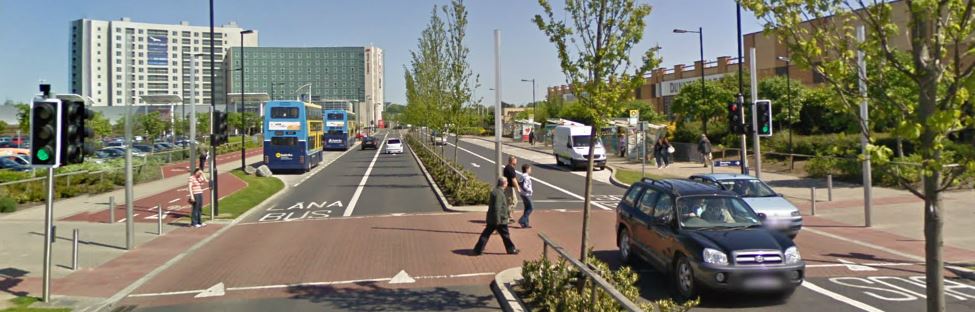
    This is part of the route along the Blanch centre, from Google Street View:

    295023.JPG

    There’s no way BRT won’t fit on the route, all three configurations types of BRT lanes with stops can fit here. And the road design will have to be fixed to comply with the Manual for Urban Streets and Roads, so that’s good bye to the slip access to car park for one.

    If the owners do not want to play ball with keeping access but having BRT priority, I’ve already mentioned the CPOs a number of times but you seem to be ignoring it -- compulsory purchase orders can be used if extra land is needed or if the current roads with bus lanes are for some reason still in private hands.

    The outline routing is available on the NTA’s site if you have not looked at the maps posted on this thread already. The route and stop locations suit priority access to the N3 and that priority is more important that any perceived issues with walking 5-10mins to another entrance of a shopping centre. Regardless of where you put a transport stop of any kind, it will not suit everybody perfectly as the centre is so spread out (and it’s often the same with parking there).


  • Registered Users, Registered Users 2 Posts: 13,511 ✭✭✭✭expectationlost


    Aard wrote: »
    I would encourage everybody who feels strongly about BRT (either for or against) to make a submission as part of the public consultation. Your opinion needs to be heard; the NTA aren't psychic. Believe it or not, the people designing it have the best interests of the people at heart and want to achieve consensus.

    the people proposing this know exactly what they are doing


  • Registered Users, Registered Users 2 Posts: 4,905 ✭✭✭Aard


    I presume you are drawing a distinction between those proposing it, and those designing it. If you have a problem with the design, you make a submission. If you have a problem with the project as a whole, then that is a political matter and not dealt with by the planning system.


  • Registered Users, Registered Users 2 Posts: 582 ✭✭✭annfield1978


    Arup awarded tender to take scheme through planning and develop Swords to City into detailed design , tender evaluation and award and construction over the next five years. Assume AECOM/ Roughan O Donovan acting as Sub consultants to them working on the city section of the scheme up to royal canal


  • Registered Users, Registered Users 2 Posts: 14,002 ✭✭✭✭AlekSmart


    Arup awarded tender to take scheme through planning and develop Swords to City into detailed design , tender evaluation and award and construction over the next five years. Assume AECOM/ Roughan O Donovan acting as Sub consultants to them working on the city section of the scheme up to royal canal

    As Claude Rains might say..."Round up the usual suspects".


    Men, it has been well said, think in herds; it will be seen that they go mad in herds, while they only recover their senses slowly, and one by one.

    Charles Mackay (1812-1889)


  • Registered Users, Registered Users 2 Posts: 4,905 ✭✭✭Aard


    Does anybody know offhand why the Blue route was curtailed at UCD? I hear it said a lot that the 46a is the busiest route in the country -- surely the BRT could be extended down the dualler to Stillorgan or even Foxrock Church. The space is certainly there and there is precedent of this being a heavily used public transport corridor.


  • Registered Users, Registered Users 2 Posts: 1,512 ✭✭✭strassenwo!f


    Is this a good idea, or is it yet another DOT back-of-an-envelope job? I think it could be great for Dublin, but it really has to be done right. Much of what I've seen persuades me that the way to go is to work from the centre out.


  • Advertisement
  • Closed Accounts Posts: 879 ✭✭✭TheBandicoot


    Dunno, it doesn't serve College Green :D


This discussion has been closed.
Advertisement
Advertisement