Advertisement
Help Keep Boards Alive. Support us by going ad free today. See here: https://subscriptions.boards.ie/.
https://www.boards.ie/group/1878-subscribers-forum

Private Group for paid up members of Boards.ie. Join the club.
Hi all, please see this major site announcement: https://www.boards.ie/discussion/2058427594/boards-ie-2026

Why are the British so anti Europe?

1323335373858

Comments

  • Registered Users, Registered Users 2, Paid Member Posts: 14,176 ✭✭✭✭Lemming


    Your post seems to indicate you may not want to believe there may be growing scepticism across Europe, rather than coming up with any evidence that it’s the British who are so anti Europe, as the title of the thread asks. .

    No, my post would seem to point out that polls can be very, very easily led by how questions are phrased; so unless the polls also provide their method they are worth about as much as a pinch of salt in the reliability stakes.

    89.7% of all people know that.
    *cough*


  • Closed Accounts Posts: 397 ✭✭georgesstreet


    Lemming wrote: »
    No, my post would seem to point out that polls can be very, very easily led by how questions are phrased; so unless the polls also provide their method they are worth about as much as a pinch of salt in the reliability stakes.

    89.7% of all people know that.
    *cough*

    If you want to disregard the French Poll for support for the EU and for the National front. the actual results of the Dutch election etc etc, then thats your choice. If you really believe that polls of party support usually get it wrong, you really seem to have not studied any of the evidence of polling over the last 20 years or so. But if you want to believe, against all the evidence, that polling companies consistently get it completely wrong when polling party voting intentions, thats your decision. But it also seems to show your bias.


  • Closed Accounts Posts: 397 ✭✭georgesstreet


    First Up wrote: »
    Are you talking about Dutch support for the Euro or for EU membership? Or are you confusing the two?

    The UK research includes polls as well as in depth qualitative research, focus groups and the like. There is a lot more to assessing voter intentions that asking black and white questions, or asking which party you will vote for (you vote for candidates)

    "Support" for UKIP in a straw poll is one thing; voting for their candidates is something else. They will probably do well in the European Parliament elections but we'll see when it comes down to a real thing.

    Apologies, my mistake. The Dutch support at 28% is for the EU, according to the Irish times article. Did you read it in the link I gave?

    Again, you seem to think that pollsters get it wrong often when polling for party support. The evidence of polling before an election and the election results seem to contradict that view.

    Qualitative Research is not the same as polling. Are you confusing the two?


  • Registered Users, Registered Users 2 Posts: 14,823 ✭✭✭✭First Up


    Apologies, my mistake. The Dutch support at 28% is for the EU, according to the Irish times article. Did you read it in the link I gave?

    Again, you seem to think that pollsters get it wrong often when polling for party support. The evidence of polling before an election and the election results seem to contradict that view.

    Qualitative Research is not the same as polling. Are you confusing the two?

    As I thought - confused. Read the article again.

    Yes pollsters tend to be pretty accurate - when they are polling before an election. The next Dutch election is on or before March 2017.

    And maybe read my post again - the bit where I said "The UK research includes polls as well as in depth qualitative research, focus groups and the like.


  • Registered Users, Registered Users 2 Posts: 14,823 ✭✭✭✭First Up


    Lemming wrote: »
    No, my post would seem to point out that polls can be very, very easily led by how questions are phrased; so unless the polls also provide their method they are worth about as much as a pinch of salt in the reliability stakes.

    89.7% of all people know that.
    *cough*

    Not just that; Europe (as much of the world) has been in recession. In such times people like to express dissatisfaction with the establishment and the status quo. It is common to see a rise in populist politics that try to exploit discontent and turn it to political advantage. The EU is an easy target - people can sound off about it (as in here) with no consequence.

    Personally, I wouldn't want to base an argument on Dutch politics, and especially opinion polls.

    Dutch politics are pretty complex; there's 11 parties in the 150 seat parliament (a party that represents animals has 2 seats.) The largest party has 41. This makes coalitions inevitable and all the horse trading that goes with them. Governments fall regularly when one or more coalition partners drop out.

    The Freedom Party runs on an anti Islam, anti immigration and anti Euro (not anti EU) platform. They won 9 seat in 2006, rising to 24 seats in 2010 (15% of the votes.) During further political turmoil later that year, polls projected them to win 35 seats if another election was held. They tried to form a government after the 2010 election but nobody would do business with them.

    When the next election happened (in 2012), they dropped from 24 seats to 15. The poll (six months ago) that our contributor likes so much, projects them to get back to 29. The next election is 2-3 years away. Even if they win 29 seats (and I'll bet they won't), nobody will do business with them then either.

    So for the anti-whatever sentiments of the Freedom Party to do anything more than grab a few headlines (and inspire a few mob lynchings), they would need to win an overall majority in the Dutch parliament, because that is the only way they could implement their policies.


  • Advertisement
  • Registered Users, Registered Users 2, Paid Member Posts: 14,176 ✭✭✭✭Lemming


    If you want to disregard the French Poll for support for the EU and for the National front. the actual results of the Dutch election etc etc, then thats your choice. If you really believe that polls of party support usually get it wrong, you really seem to have not studied any of the evidence of polling over the last 20 years or so. But if you want to believe, against all the evidence, that polling companies consistently get it completely wrong when polling party voting intentions, thats your decision. But it also seems to show your bias.

    No; it shows your bias. Nothing more.

    As I have said - again - polls are extremely easy to manipulate and lead by choice of question. Any poll that does not show its method is at best to be taken lightly and at worst downright dishonest. At what point in any of the above have I said that I dismiss said polls out of hand? The answer would be that you cannot find anywhere that I have indicated such. Maybe the polls are hyper-accurate, but as first up has elaborated about Dutch politics, probably not so hyper-accurate, and less reliable on reflection.

    So, what am I saying to you exactly georgestreet? "hold your horses with them there poll citations".


  • Closed Accounts Posts: 19,777 ✭✭✭✭The Corinthian


    Lemming wrote: »
    As I have said - again - polls are extremely easy to manipulate and lead by choice of question.


  • Banned (with Prison Access) Posts: 969 ✭✭✭JacquesDeLad


    I think Britain fears Europe for the same reason they fear Scottish Independence. The dissolution of power from the Southern English Counties.

    Nuclear reactors don't get built in Berkshire and the Nuclear submarine deterent isn't based in the Thames estuary.

    Capital Gains Tax!

    EU control over information sharing with foreign goverments.


  • Closed Accounts Posts: 9,085 ✭✭✭SpaceTime


    I think Britain fears Europe for the same reason they fear Scottish Independence. The dissolution of power from the Southern English Counties.

    Nuclear reactors don't get built in Berkshire and the Nuclear submarine deterent isn't based in the Thames estuary.

    Yeah they do! There were protests in Berkshire about some mysterious nuclear facility a few years ago but it was installed anyway.

    Sizewell is in Suffolk, Bradwell is in Derbyshire both in proximity to the home counties and Dungeness is in Kent, one of the home counties!

    So, it's a little inaccurate to say they put everything 'up north' or in Wales and Scotland.

    The only put most unpleasant things 'up north' :)


  • Banned (with Prison Access) Posts: 969 ✭✭✭JacquesDeLad


    SpaceTime wrote: »
    Yeah they do! There were protests in Berkshire about some mysterious nuclear facility a few years ago but it was installed anyway.

    Sizewell is in Suffolk, Bradwell is in Derbyshire both in proximity to the home counties and Dungeness is in Kent, one of the home counties!

    So, it's a little inaccurate to say they put everything 'up north' or in Wales and Scotland.

    I meant Home Counties, excuse my geography. I actually only mean those who benefit at the expense of others. (A bit like Dun Laoghaire-Rathdown or Howth)


  • Advertisement
  • Closed Accounts Posts: 9,085 ✭✭✭SpaceTime


    I meant Home Counties, excuse my geography. I actually only mean those who benefit at the expense of others. (A bit like Dun Laoghaire-Rathdown or Howth)

    Eh, I'm still not really getting your point...Some of those facilities are *in* the home counties.

    Neither Dun Laoghaire-Rathdown nor Howth benefit at the expense of others either.
    One's a small recently-created county in Dublin that happens to contain a few pricy areas, the other's a rather expensive coastal location in North Dublin and former / current fishing village.

    I accept your point on the concentration of power in the greater London area and over-concentration of everything in London.
    England suffers from very big imbalances in regional development due to that mentality.

    The UK's devolution of power doesn't really make a lot of sense as it only applies to Scotland and Northern Ireland and to a more limited extent Wales while completely ignoring any need for devolution in the English regions which have huge populations e.g. Yorkshire has over 5million people! "Northern England" has 14.5 million. They're BIG, BIG regions with no devolution of power / regional governments.


  • Banned (with Prison Access) Posts: 969 ✭✭✭JacquesDeLad


    SpaceTime wrote: »
    Neither Dun Laoghaire-Rathdown nor Howth benefit at the expense of others either.

    Is there a hub supply of any service in either of them?

    -ed. This matters not a bit. The point remains that a small affluent area of English Britain benefits to the cost of those who sacrifice their health and environment to make ends meet.


  • Closed Accounts Posts: 9,085 ✭✭✭SpaceTime


    Is there a hub supply of any service in either of them?

    "Hub supply?"


  • Banned (with Prison Access) Posts: 969 ✭✭✭JacquesDeLad


    SpaceTime wrote: »
    "Hub supply?"

    Or vice versa


  • Banned (with Prison Access) Posts: 969 ✭✭✭JacquesDeLad


    Google "Hub Supply" I'm feeling lucky.


  • Closed Accounts Posts: 9,085 ✭✭✭SpaceTime


    Is there a hub supply of any service in either of them?

    -ed. This matters not a bit. The point remains that a small affluent area of English Britain benefits to the cost of those who sacrifice their health and environment to make ends meet.

    Actually, London's probably got some of the worst levels of environmental pollution of any part of England due to consistently low air quality because of high density and traffic. Historically, it had really horrendous environmental problems with smog from coal smoke, raw sewage in the Themes estuary being an issue until relatively modern times etc etc.
    The air quality in the tube network's also very bad as it's not really ventilated other than by passing trains!
    While it has some of the highest average incomes, it also has some of the poorest quality accommodation in the UK due to very high demand and low standards and it has relatively poor wealth distribution.

    You're painting a quite over-simplistic picture to be perfectly honest.


  • Banned (with Prison Access) Posts: 969 ✭✭✭JacquesDeLad


    I paint nothing. South East England is terrified it's control of financial and economic policy is under threat.

    Thatcherism is dead.


  • Registered Users, Registered Users 2 Posts: 2,091 ✭✭✭marmurr1916


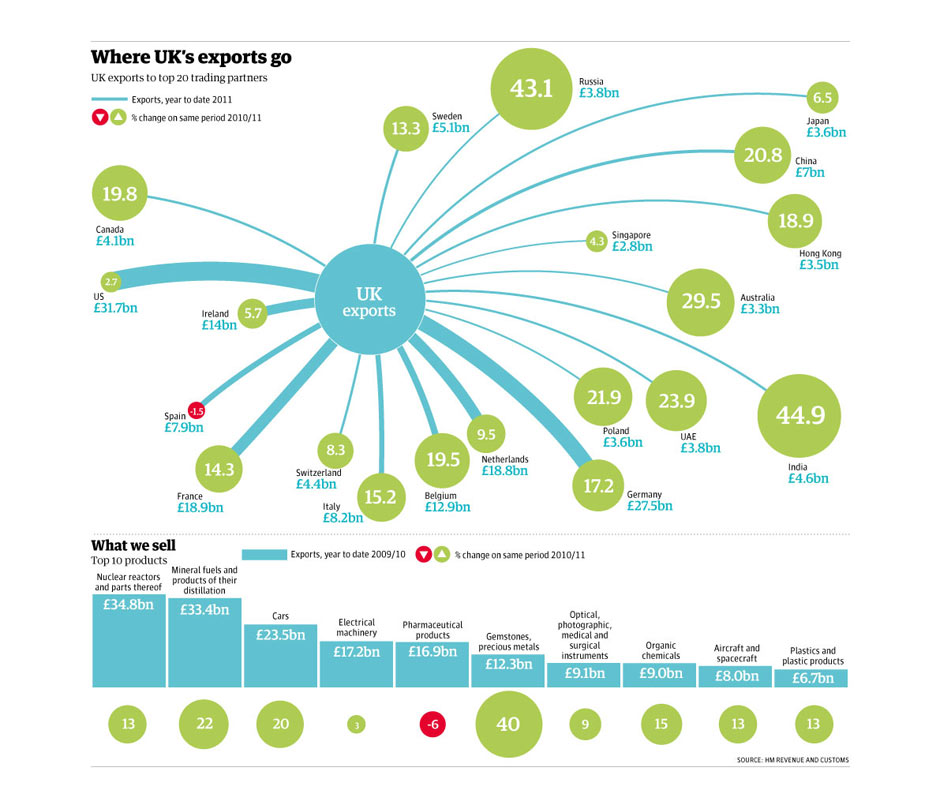
    UK-Trade-exports-graphic-001.jpg

    The total value of all UK exports to 9 out of the other EU countries according to that graph was £116.9 billion, compared to £72.6 billion to the 11 non-EU countries shown.

    According to the UK's Office for National Statistics, 50% of its exports in services go to the rest of the EU:
    Europe now accounts for 50% of the total value of UK exports of services and 51% of the total value of UK imports of services.

    The value of these service exports nearly doubled between 2005 and 2011:
    UK exports of services to Europe have increased at a steady rate with the 2011 value of £48.9 billion being almost double the 2005 value of £26.7 billion. In comparison, UK imports of services from Europe have experienced more laboured growth in recent years, with growth remaining relatively static.

    http://www.ons.gov.uk/ons/rel/itis/international-trade-in-services/2011/sty-international-trade-in-services.html


  • Banned (with Prison Access) Posts: 969 ✭✭✭JacquesDeLad


    Exports of goods are only a fraction of the UK economy.

    It the Financial Services where they make most in tax revenue, and so does Ireland. That's why we're all very quiet about the tax situation.

    Next time a Brit calls Ireland a tax haven I suggest the Central Bank goes Ed Snowden on their off shore transactions.


  • Banned (with Prison Access) Posts: 79 ✭✭Boroso


    Its interesting that the UK is on target to continue to grow its economy and become the 4th largest economy in the world, while the economy of France seems destined to shrink and fall down the rankings.

    Why anyone wants to see the UK, or any country, in black and white terms seems a mystery. My guess is the the forthcoming Euro elections will dispel the myth that the UK is out of step with the rest of Europe. Curiously, while most countries now have large and active anti EU parties, Ireland seems to be more out of step with the rest of the EU, being one of the few countries left with no political discourse or meaningful position other than to be flag wavers for anything suggested by the EU.


  • Advertisement
  • Closed Accounts Posts: 19,777 ✭✭✭✭The Corinthian


    Boroso wrote: »
    Its interesting that the UK is on target to continue to grow its economy and become the 4th largest economy in the world, while the economy of France seems destined to shrink and fall down the rankings.
    LOL. Psychedelic rather than interesting, I would have thought. Where did you get this 'on target' fantasy prediction, out of interest?


  • Registered Users, Registered Users 2 Posts: 2,398 ✭✭✭McDave


    Boroso wrote: »
    Its interesting that the UK is on target to continue to grow its economy and become the 4th largest economy in the world, while the economy of France seems destined to shrink and fall down the rankings.

    Why anyone wants to see the UK, or any country, in black and white terms seems a mystery. My guess is the the forthcoming Euro elections will dispel the myth that the UK is out of step with the rest of Europe. Curiously, while most countries now have large and active anti EU parties, Ireland seems to be more out of step with the rest of the EU, being one of the few countries left with no political discourse or meaningful position other than to be flag wavers for anything suggested by the EU.
    Well, it seems you're quite prepared to see France and Ireland in black and white terms.

    A case of the pot calling the kettle black? Or white?


  • Banned (with Prison Access) Posts: 79 ✭✭Boroso


    LOL. Psychedelic rather than interesting, I would have thought. Where did you get this 'on target' fantasy prediction, out of interest?

    You may well consider the Centre for Economic and Business Research to be psychedelic fantasists. Others may disagree. However, the tone of your reply is both rude and discourteous, both of which are unnecessary in any grown up discussion.


    “I always cheer up immensely if an attack is particularly personal because I think, well, if you attack one personally, it means you have not a single argument left.”
    McDave wrote: »
    Well, it seems you're quite prepared to see France and Ireland in black and white terms.

    A case of the pot calling the kettle black? Or white?


    You seem to confuse a report by the Centre for Economic and Business Research with your guess about whether my views on France or Ireland may be black and/or white. If the full extent of your argument on the topic is to make wild (and incorrect) guesses about the individuals you are discussuing with, then thats interesting information about your discussion style.


  • Closed Accounts Posts: 9,085 ✭✭✭SpaceTime


    I wouldn't pin France's current economic stagnation on the EU.

    France is quite capable of stagnating and shrinking its own economy without any help from the EU.

    The knee jerk reaction in Paris is pile on the taxes and increase the bureaucratic burden.

    If anything, EU policies have kept France a little more competitive.

    France is not the EU nor are French economic policies that close to the EU. The French would generally see the EU as far too economically liberal and 'Anglo-American' in terms of its economic outlook.

    They're also not big fans of Merkel and her fiscal rectitude. That's never how France operated and it's not going to wash with French voters in the medium term either.

    If anything, the French are euro sceptic for many reasons that are totally the opposite to the UK...
    For example they're not keen on CAP reforms and would have liked to increase the spending.
    They're not as keen on liberalising markets or privatising state assets.
    They'd also probably go for a big spend your way out of a recession plans.
    Historically, when France slumps it slashes cash into a few Grand Projets like the TGV, the complete rebuild off France Telecom in the 70s 80s etc etc... The vast energy programmes, state aid to 'national champion' companies etc etc etc
    Merkel will not allow that kind of approach and that's where the BIG Euro political clash will happen when France suddenly backs the non austerity line.

    It's amazing that I've seen French people being quite strongly defensive of the Irish situation and appalled on our behalf at the austerity measures that only caused a whimper here. I was quite taken aback by the level of solidarity and warmth towards us from a lot of French ppl I was talking to.

    There are some huge difference in economic philosophy between major EU countries.

    If anything current EU policy is actually very close to a UK agenda. Much more so than a French one


  • Banned (with Prison Access) Posts: 79 ✭✭Boroso


    SpaceTime wrote: »
    I wouldn't pin France's current economic stagnation on the EU.

    Of course, Frances predicted slide economically is due to a number of factors, and not just to one factor. A Government following the wrong policies, instinctively interventionist, seemingly unable to control labour or pension costs is one thing, and seemingly unable to plan wisely for the economy.

    Historically devaluation of the Franc has been the most useful tool to ease the pressures caused by interventionist French governments, but now they are forced into the straightjacket of the “one-size-fits-all” Euro, this is not an option open to them. The cracks are beginning to show, and the consequences for France is to see it’s economy become less and less competitive, more sluggish, and the consequent political pressure between France and Germany grow. None of which is good for the EU or the Euro.

    France is competing with China, India and now with increasingly with the USA which is returning to a much higher level of efficiency and competitiveness. The Euro is part responsible for France (and Germany) becoming less and less able to compete on the world stage, due to the fact that it, combined with the comparatively very high EU’s labour and energy costs, seems to ensure those countries in the EU and the Euro are at an increasing economic disadvantage to competitors outside the EU.


  • Closed Accounts Posts: 9,085 ✭✭✭SpaceTime


    Ultimately, I think you'll see the Euro devalue.
    Its not the DM and shouldn't be behaving like the only economy in the EZ is Germany and to hell with everyone else.

    EZ policy has to reflect the French, Spanish and Italian economies too.

    Ireland is very similar to the UK economically and is used to steadily high inflation. I think that's probably why many of us had notions that you should borrow a huge mortgage you barely afford.
    In the past, that's exactly what our parents and grandparents did. Then the high inflation magicked it all away to a tiny and highly affordable loan!

    In low inflation EZ economics, it just wont shrink


  • Registered Users, Registered Users 2 Posts: 23,283 ✭✭✭✭Scofflaw


    Boroso wrote: »
    Of course, Frances predicted slide economically is due to a number of factors, and not just to one factor. A Government following the wrong policies, instinctively interventionist, seemingly unable to control labour or pension costs is one thing, and seemingly unable to plan wisely for the economy.

    Historically devaluation of the Franc has been the most useful tool to ease the pressures caused by interventionist French governments, but now they are forced into the straightjacket of the “one-size-fits-all” Euro, this is not an option open to them. The cracks are beginning to show, and the consequences for France is to see it’s economy become less and less competitive, more sluggish, and the consequent political pressure between France and Germany grow. None of which is good for the EU or the Euro.

    France is competing with China, India and now with increasingly with the USA which is returning to a much higher level of efficiency and competitiveness. The Euro is part responsible for France (and Germany) becoming less and less able to compete on the world stage, due to the fact that it, combined with the comparatively very high EU’s labour and energy costs, seems to ensure those countries in the EU and the Euro are at an increasing economic disadvantage to competitors outside the EU.

    Facts should precede analysis, rather than be created to fit it - the new franc was only devalued once.

    cordially,
    Scofflaw


  • Banned (with Prison Access) Posts: 79 ✭✭Boroso


    Scofflaw wrote: »
    Facts should precede analysis, rather than be created to fit it - the new franc was only devalued once.

    cordially,
    Scofflaw

    I assume the definition of "devaluation" is where your rather semantic looking point falls down, coupled with the cunning introduction of the word "new" . It should be noted I never mentioned theh nouveau franc, and was talking about the franc over a longer period. However, the nouveau franc was devalued almost continuously, (and not as you claim just once), ending up in 1999 at less than one eight of what its value had been in 1960.

    The outbreak of WW1 caused France to leave the gold standard of the LMU. The war severely undermined the franc's strength: war expenditure, inflation and postwar reconstruction, financed partly by printing ever more money, reduced the franc's purchasing power by 70% between 1915 and 1920 and by a further 43% between 1922 and 1926. After a brief return to the gold standard between 1928 and 1936, the currency was allowed to resume its slide, until in 1959 it was worth less than 2.5% of its 1934 value.

    After World War II, France devalued its currency within the Bretton Woods system on several occasions. Beginning in 1945 at a rate of 480 francs to the British pound (119.1 to the U.S. dollar), by 1949 the rate was 980 to the pound (350 to the dollar). This was reduced further in 1957 and 1958, reaching 1382.3 to the pound (493.7 to the dollar, equivalent to 1 franc = 1.8 mg pure gold).

    In January 1960 the French franc was revalued, with 100 existing francs making one nouveau franc. The abbreviation "NF" was used on the 1958 design banknotes until 1963. Old one- and two-franc pieces continued to circulate as centimes (no new centimes were minted for the first two years). Inflation continued to erode the franc's value, but much more slowly than that of some other countries. The one-centime coin never circulated widely. Only one further major devaluation occurred (in August 1969) before the Bretton Woods system was replaced by free-floating exchange rates. When the euro replaced the franc on 1 January 1999, the franc was worth less than an eighth of its original 1960 value.

    If you consider all that to be one devaluation, then I'll give you that as it's not worth arguing about, and seems to, in any case, focus on the trival and unimportant. The franc, and the nouveau franc, value was eroded devaluation, inflation and by 30 years of floating exchange rates which resulted in massive devaluation over the 30 years.


  • Technology & Internet Moderators Posts: 28,865 Mod ✭✭✭✭oscarBravo


    Boroso wrote: »
    Historically devaluation of the Franc has been the most useful tool to ease the pressures caused by interventionist French governments, but now they are forced into the straightjacket of the “one-size-fits-all” Euro, this is not an option open to them.
    Boroso wrote: »
    The franc, and the nouveau franc, value was eroded by inflation which is "devaluation", this happened almost continuously.

    So inflation has ceased with the introduction of the Euro?


  • Advertisement
  • Registered Users, Registered Users 2 Posts: 23,283 ✭✭✭✭Scofflaw


    Boroso wrote: »
    I assume the definition of "devaluation" is where your rather semantic looking point falls down, coupled with the cunning introduction of the word "new" . It should be noted I never mentioned theh nouveau franc, and was talking about the franc over a longer period. However, the nouveau franc was devalued almost continuously by inflation, ending up in 1999 at less than one eight of what its value had been in 1960.

    The outbreak of WW1 caused France to leave the gold standard of the LMU. The war severely undermined the franc's strength: war expenditure, inflation and postwar reconstruction, financed partly by printing ever more money, reduced the franc's purchasing power by 70% between 1915 and 1920 and by a further 43% between 1922 and 1926. After a brief return to the gold standard between 1928 and 1936, the currency was allowed to resume its slide, until in 1959 it was worth less than 2.5% of its 1934 value.

    After World War II, France devalued its currency within the Bretton Woods system on several occasions. Beginning in 1945 at a rate of 480 francs to the British pound (119.1 to the U.S. dollar), by 1949 the rate was 980 to the pound (350 to the dollar). This was reduced further in 1957 and 1958, reaching 1382.3 to the pound (493.7 to the dollar, equivalent to 1 franc = 1.8 mg pure gold).

    In January 1960 the French franc was revalued, with 100 existing francs making one nouveau franc. The abbreviation "NF" was used on the 1958 design banknotes until 1963. Old one- and two-franc pieces continued to circulate as centimes (no new centimes were minted for the first two years). Inflation continued to erode the franc's value, but much more slowly than that of some other countries. The one-centime coin never circulated widely. Only one further major devaluation occurred (in August 1969) before the Bretton Woods system was replaced by free-floating exchange rates. When the euro replaced the franc on 1 January 1999, the franc was worth less than an eighth of its original 1960 value.

    If you consider all that to be one devaluation, then I'll give you that as it's not worth arguing about, and seems to, in any case, focus on the trival and unimportant. The franc, and the nouveau franc, value was eroded by inflation which is "devaluation", this happened almost continuously.

    You suggested devaluation as a 'tool', in order to say that it's not available any more:
    Historically devaluation of the Franc has been the most useful tool to ease the pressures caused by interventionist French governments, but now they are forced into the straightjacket of the “one-size-fits-all” Euro, this is not an option open to them.

    Devaluation through inflation isn't a 'tool', but an outcome, so I'm afraid it's you who is playing semantic dodgeball. Unless you're suggesting that France deliberately created high inflation, which you're welcome to do, since I can always do with a laugh. As for the relevance of the old franc, and the exigencies of the immediate post-war period in France, I'm reasonably sure you're not suggesting that this was also some kind of clever plan on the part of the French government.

    In order to grasp a stick with which to beat the euro, you're reduced to claiming as policy tools things that weren't policy tools, but were universally regarded at the time as the outcome of poor policy. Inflation has been erected into a policy goal, which it never was, because it is now convenient to do so, and because it is so long since we had serious inflation that people can ignore its downsides - but the ECB's inflation goal isn't there just to make life difficult for debtors.

    And even the good side of inflation is being represented without any reference to the inevitable adjustments it causes - the new proponents of inflation say "look how it erodes the capital of debt", but seem to be happy to ignore the fact that lenders invariably factor inflation into interest - the happy-clappy inflationistas are ignoring the main real cost of servicing debt, which is not, and never has been, capital repayment.

    cordially,
    Scofflaw


Advertisement
Advertisement