Advertisement
Help Keep Boards Alive. Support us by going ad free today. See here: https://subscriptions.boards.ie/.
https://www.boards.ie/group/1878-subscribers-forum

Private Group for paid up members of Boards.ie. Join the club.
Hi all, please see this major site announcement: https://www.boards.ie/discussion/2058427594/boards-ie-2026

Exactly what percentage of the population is "christian"?

17810121370

Comments

  • Registered Users, Registered Users 2 Posts: 7,224 ✭✭✭alaimacerc


    ninja900 wrote: »
    I don't think so - they just wanted people who were genuinely not religious to not tick a religious box out of habit / culture / upbringing etc.

    But having 'no religion' and then write-ins for atheist and agnostic is splitting the vote, as it were. I think No Religion couldn't be clearer tbh, and it's one of the few things atheists and agnostics can agree on :pac:

    Well certainly that's the nub of it, and the actual "campaign" part as such. But checking their website, it seems to confirm my hazy recollection:
    atheism.ie wrote:
    If you are an atheist or agnostic or humanist and you have no religion, please tick the ‘No Religion’ box.

    And later on the same page:
    Please don’t write in ‘Atheist’. It’s not a religion.

    Go, remaining synapses, go!


  • Registered Users, Registered Users 2 Posts: 7,224 ✭✭✭alaimacerc


    A) What "prejudices" are you referring to?
    Your attachment to inflated measurements of Catholicism and Christianity, and the blinkered stridency of your rejection
    B) You are merely "rebutting" a strawman that you have created.
    Feel free to expand on the subtle nuance on your position that I'm supposedly missing.
    I never said the surveys are "wrong". I said that they are are flawed in that they only get the opinions of a fraction-of-a-fraction of the population which is then made to represent the whole.
    That's precisely what you've been saying. You referred to their supposed "inaccuracies". And nonsense like... well, this:
    A census by definition has no such error, it is the ultimate survey. It is self-evident that a sample survey can never supercede or contradict a census - now matter how much you wish it to be true.
    It's self-evidence that you're happy to play bait-and-switch with your definitions. The census counts how many people are willing to tick a box (or, have it ticked for them) associating them (in no clearly, much less "officially", defined manner) with a religious denomination. Copious data are available to show that this is utterly dissonant with people's actual beliefs -- up to and including "believe god exists", mind you. Much less their practices. You're the person trying to play the "superseding" game, by dismissing the latter by appeal to the supposed gold standard of the former. And as people have explained to you endlessly, it's silly and futile.


  • Registered Users, Registered Users 2 Posts: 9,552 ✭✭✭TheChizler


    darjeeling wrote: »
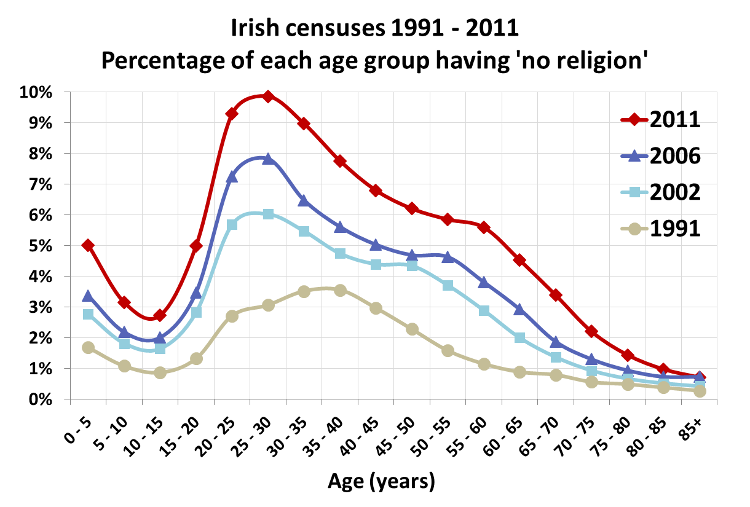
    Here are the figures for people of 'no religion' for all age groups for the 1991, 2002, 2006 and 2011 censuses:

    287779.png

    The figures show that in the last 20 years new generations of young adults have become more likely to declare that they and their children have no religion. As people age, though, they don't tend to become less religious with time.

    Very interesting! So it seems that on average children are much more religious than their parents until they roughly come to moving-out-of-home age. That or the boxes are being ticked on their behalf...

    Interesting as well that the 0-5 range are consistently less religious than those 5-15 ish, are parents putting down no religion for them until christening/communion? At least there's some attempt at honesty there if that's the case.


  • Registered Users, Registered Users 2 Posts: 7,224 ✭✭✭alaimacerc


    TheChizler wrote: »
    Very interesting! So it seems that on average children are much more religious than their parents until they roughly come to moving-out-of-home age. That or the boxes are being ticked on their behalf...
    I think that if they're ticking their own boxes, laws are being broken!
    Interesting as well that the 0-5 range are consistently less religious than those 5-15 ish, are parents putting down no religion for them until christening/communion? At least there's some attempt at honesty there if that's the case.

    Bear in mind there's a cohort effect there. If you want to see the curve for the same group of people, you'd have to replot the points across different censuses. (i.e. age 0-5 in 1991 - age 10-15 in 2002 - age 15-20 in 2006 - age 20-25 in 2011 -- age 5-10 in 1991 - age 15-20 in 2002 - age 20-25 in 2006 - age 25-30 in 2011 -- and so on.) But there is anecdotal support for some sort of effect such as you describe, including some remarkably self-serving-sounding "grabbing the communion loot" juvenile self-conversions...


  • Registered Users, Registered Users 2 Posts: 9,552 ✭✭✭TheChizler


    alaimacerc wrote: »
    I think that if they're ticking their own boxes, laws are being broken!


    Bear in mind there's a cohort effect there. If you want to see the curve for the same group of people, you'd have to replot the points across different censuses. (i.e. age 0-5 in 1991 - age 10-15 in 2002 - age 15-20 in 2006 - age 20-25 in 2011 -- age 5-10 in 1991 - age 15-20 in 2002 - age 20-25 in 2006 - age 25-30 in 2011 -- and so on.) But there is anecdotal support for some sort of effect such as you describe, including some remarkably self-serving-sounding "grabbing the communion loot" juvenile self-conversions...

    Ah you know what I mean, falce representation of religion being described on their behalf.

    Yeah I was trying to replot that third axis in my mind, would love to see it done properly.


  • Advertisement
  • Registered Users, Registered Users 2 Posts: 7,224 ✭✭✭alaimacerc


    TheChizler wrote: »
    Ah you know what I mean, falce representation of religion being described on their behalf.

    Yeah I was trying to replot that third axis in my mind, would love to see it done properly.

    If I get sufficiently bored this week... :) Are the raw data available? Better that than reading it off the above graph.

    Obviously it'll produce a lot of very short plots, since there's only four censuses. (At least in the above -- is 1991 the first time this question was asked in that form?)


  • Registered Users, Registered Users 2 Posts: 544 ✭✭✭AerynSun


    Piliger wrote: »
    Appalling as the church's behaviour is ... I personally believe that the numbers used nowadays in political and ancillary discussions tend to be those taken from the census. Correct me if I am wrong.

    They tend to be, but they shouldn't be, for a whole range of reasons - discussed at length in the "Exactly what percentage of the population is Christian?" thread.


  • Registered Users, Registered Users 2 Posts: 544 ✭✭✭AerynSun


    Where are your comments on the "class" of the suggestion that immigrants responses to the census count as less?

    Ah here, I was the one who made that comment, and I was being sarcastic - because of the discussion that was ongoing in the AH and Motors forums at the time about an ad for someone selling a car who wanted "No Polish" to contact him in a bid to buy it. Sorry if that point went over your head, so let me make a categorical statement here:

    Immigrant responses don't 'count as less' - I was being facetious when I suggested that they might, in an attempt to make the point that statistics can (and usually are!) manipulated to suit the agenda of the person quoting the figures.

    EDIT: It's interesting how you clearly remember things that were said pages back in this thread when it suits you, yet you seem to struggle to grasp the many objections that have been raised about why it's disingenuous to insist on using the census count as an incontrovertible measure of "Christianity" in Ireland.


  • Moderators, Technology & Internet Moderators, Regional South East Moderators, Paid Member Posts: 28,656 Mod ✭✭✭✭Cabaal


    And the moment you don't agree you stop becoming Catholic...???

    Is that what you are saying?

    Effectively yes,
    You don't agree/follow the rules of the catholic church.

    So if you are pro gay marriage, ok with divorce, think priests should be allowed marry ok with abortions happening in certain situations, think there should be women priests and cardinals you are not at all inline with catholic teachings and thinking.

    These are all big issues which the catholic church are very much against, so to claim you are catholic but are against them is a farce. As we've seen, the vatican really really hate even when a priest says there should be women priests...infact they'll go out of their way to silence them.

    You can still however be a christian, so you believe in god/jesus but don't subscribe to the catholic church crap.

    If tomorrow you suddenly didn't believe in the Virgin Mary and all then goes with it, but you still believed in god and jesus would you consider yourself catholic?

    Of course you wouldn't,


  • Registered Users, Registered Users 2 Posts: 544 ✭✭✭AerynSun


    alaimacerc wrote: »
    They're happy to speak for "the 84%", ignoring that said 84% don't actually themselves believe what they're saying, on the basis that they've failed to actually leave.

    A lot of practicing Catholics have no intention of changing what they believe (or don't, as the case may actually be), but would rather the Church change its collective position, than concede that probably a third (at least - I'd say the actual figure is higher) hold views for which they could be 'excommunicated'.

    It's a bit like the argument that Christians are making "Christmas is what we want it to be" and ignoring the lived reality that it is now a very different thing for a lot of people. If we want to argue that the Christians cop on, then we also need to argue that the Catholic church cop on - and not tell the dissenting Catholics that they 'should leave': rather the Church should pay attention to what a significant portion of their membership is saying on religious grounds (e.g. "Love your neighbour" means "stop denying LGBTQ people equal rights under law").
    It's a bit like the old Soviet joke of "they pretend to pay us, and we pretend to work".

    Soviet jokes usually come with vodka... are you buying? :pac:
    While it's become trendy to talk about freedom of conscience, that's not to be construed as the freedom to disagree with them on doctrine. Well, you're free to do so, and they're free to kick you out if they can be bothered, rather than just endlessly threatening. Rather, it's just new gloss on "grant the church more special privileges (or its old privileges under separate cover) by giving people the 'freedom' to ignore the law of the state when it's something we've told them to do."

    I don't think it's all that trendy... you'd be surprised how many self-identifying Catholics aren't aware of primacy of conscience. What I want to know, when we're talking about legitimacy of Catholic doctrine: why are we so willing to accept that 'they' have absolute right to decide about doctrine (and use that to imply the 'rightness' of their position/s) when as far as I'm concerned, a lot of the doctrine should be open to question when the leadership who has the privilege of making decisions about 'what the faithful should believe' are NONE of them women? Surely we should be arguing against the legitimacy of the Church hierarchy, instead of insisting that they are right and that everyone who holds different views on some aspects of the teachings should leave 'their' institution, instead of claiming their right to influence its policy and direction?

    If they admitted women and minorities to the decision making bodies who sign and seal doctrine and amendments to Canon Law, maybe the RCC would be a more humane institution and not the pain in the tuchus it currently is?


  • Advertisement
  • Registered Users, Registered Users 2 Posts: 544 ✭✭✭AerynSun


    Cabaal wrote: »
    These are all big issues which the catholic church are very much against, so to claim you are catholic but are against them is a farce.

    There are a great many people who are on the 'wrong' side of those big issues, and they firmly believe that they are the proper Catholics, and that the ones refusing to budge are the ones who've got it wrong. Why should the right-thinking Catholics have to leave? Surely the wrong-thinking ones should be made to cop on and change some very archaic rules?

    [Says me, who left out of pure exhaustion... it's no fun trying to reason with people who insist that they're right even when their being 'right' is done in the most unloving and uncharitable way, and is - in my view - contrary to the imperative to love God and neighbour.]


  • Moderators, Technology & Internet Moderators, Regional South East Moderators, Paid Member Posts: 28,656 Mod ✭✭✭✭Cabaal


    AerynSun wrote: »
    There are a great many people who are on the 'wrong' side of those big issues, and they firmly believe that they are the proper Catholics, and that the ones refusing to budge are the ones who've got it wrong. Why should the right-thinking Catholics have to leave? Surely the wrong-thinking ones should be made to cop on and change some very archaic rules?

    But how exactly do you want the "wrong one's" to leave when the rules are set down by the Vastican and the Pope (who is the leader of the church) says theser things are wrong, do they want the Vatican to leave?

    Bottom line is if you don't like how the catholic church is setup then create a new splinter church which doesn't view the Vatican as the head of your church.

    But as long as you call yourself a Catholic, go to mass in church's that view the Vatican and Pope as the head of the church then you should be following its rules and teachings.

    If these rules and teachings are incompatible with your life and how you think people should live then you can't truly call yourself a catholic. To do so is to lie.

    You can however call yourself a christian,
    [Says me, who left out of pure exhaustion... it's no fun trying to reason with people who insist that they're right even when their being 'right' is done in the most unloving and uncharitable way, and is - in my view - contrary to the imperative to love God and neighbour.]

    You can't reason with an organization who view their leader as doing no wrong.


  • Registered Users, Registered Users 2 Posts: 544 ✭✭✭AerynSun


    Cabaal wrote: »
    But how exactly do you want the "wrong one's" to leave when the rules are set down by the Vastican and the Pope (who is the leader of the church) says theser things are wrong, do they want the Vatican to leave?

    You misunderstand me: the 'wrong ones' ARE the Vatican. And they don't have to leave, they just have to listen to the voice of the people and make some changes, then everyone can stay and the world be a better place.
    Bottom line is if you don't like how the catholic church is setup then create a new splinter church which doesn't view the Vatican as the head of your church.

    And that was the basis for the schism, the origin of Protestant Christianity. And there started a long history of splinters splintering off every time there's a difference of opinion.
    But as long as you call yourself a Catholic, go to mass in church's that view the Vatican and Pope as the head of the church then you should be following its rules and teachings.

    If these rules and teachings are incompatible with your life and how you think people should live then you can't truly call yourself a catholic. To do so is to lie.

    Well, I don't call myself a Catholic or go to Mass... but my point is, that it's ridiculous to say that if you disagree with something you should turn around and walk away without trying to engage in dialogue to effect a mutually agreeable solution to the differences. That's like saying the first time someone has a difference of opinion with a spouse, they should immediately divorce or else they're living a lie.
    You can however call yourself a christian.

    But if my theology, my understanding of God, is a totally Catholic theology, why would I want to call myself a Christian instead of a Catholic? Just because I disagree with some of the doctrine that the hierarchy has imposed, doesn't mean my theology must (or could!) change to suit my political dissent against ecclesial structures and practice.
    You can't reason with an organization who view their leader as doing no wrong.

    You speak as though the organisation is a unified whole, when it's not. Your argument would be stronger if you had said "you can't reason with the members of an organisation who view their leader as doing no wrong". And my reply would be: you can reason with a good number of them, but some of them are as obstinate as some of the posters on Boards.ie ;)

    I wonder how many in-person conversations you've had with Catholics who are quite serious about their faith and don't hold or agree with the 'official Church teaching' on a number of issues? And how many of them have been brave enough to be honest about their views? I think you would be surprised how many of them there are!


  • Registered Users, Registered Users 2 Posts: 579 ✭✭✭Qs


    TheChizler wrote: »
    Interesting as well that the 0-5 range are consistently less religious than those 5-15 ish, are parents putting down no religion for them until christening/communion? At least there's some attempt at honesty there if that's the case.

    Seems natural that if the largest number of No Religion people arise at 20-35ish then there will be an upswing in children not being raised with religion between 0-5.


  • Registered Users, Registered Users 2 Posts: 9,552 ✭✭✭TheChizler


    Qs wrote: »
    Seems natural that if the largest number of No Religion people arise at 20-35ish then there will be an upswing in children not being raised with religion between 0-5.

    I'm sorry, I don't follow?


  • Registered Users, Registered Users 2 Posts: 579 ✭✭✭Qs


    If you have an higher rate of non religious people at the most typical child having ages then you will see a higher number of 0-5 year olds being listed as no religion on the census by those parents.


  • Closed Accounts Posts: 3,232 ✭✭✭Brian Shanahan


    TheChizler wrote: »
    Very interesting! So it seems that on average children are much more religious than their parents until they roughly come to moving-out-of-home age. That or the boxes are being ticked on their behalf...

    No. It just means that at that particular time (ignoring the major issue of people filling out on behalf of others for this post) that the young are more likely to be arreligious or irrelegious than older. These longtidudinal studies are only indicative of attitudes amongst groups at one instant.

    For example if you look at attitudes to gays among age group in the 60's and today, what you'll see is back in the 60's the old were anti-gay a lot more than the young, whereas today the figures are about the same level for young and old. That is mainly due to the young people back in the 60's who supported gay rights growing up and persuading their peers the right of their views. When we look at this type of survey (on social matters), the older generations tend on average to be more conservative than the younger generations, but rarely tend to be more conservative than their younger selves.


  • Registered Users, Registered Users 2 Posts: 13,016 ✭✭✭✭vibe666


    It has nothing to do with perspective. I mentioned the word "facts" in the post you quoted. Which of the following isn't a fact?

    1. Ireland is officially 90% Catholic.
    2. Every dictionary will tell you that Christmas is a Christian festival which celebrates the birth of Jesus.
    and yet they ALSO state that Christmas is...
    Christmas (ˈkrɪsməs) — n
    1. a. the annual commemoration by Christians of the birth of Jesus Christ on Dec 25
    b. Also called: Christmas Day Dec 25, observed as a day of secular celebrations when gifts and greetings are exchanged
    c. ( as modifier ): Christmas celebrations
    2. Lady Day Midsummer's Day Compare Michaelmas Also called: Christmas Day (in England, Wales and Ireland) Dec 25, one of the four quarter days
    3. Also called: Christmastide the season of Christmas extending from Dec 24 (Christmas Eve) to Jan 6 (the festival of the Epiphany or Twelfth Night)
    also, my wife ticked the "Catholic" box on the census even though she no more believes in Jesus or God or fairies or anything else of that nature.

    she even chose to get married abroad so that her family could not force us into a church wedding here because she specifically didn't want to be married in a catholic church by a priest and go through all the religious bullshit (her words) that would be expected of her (and me) by her family and I'll be honest, neither did I given my atheistic tendencies.

    The last time either of us were even near a church was about 4 years ago for a christening of a 'catholic' couple who decided to get their daughter christened purely so they would have better school choices despite neither of them being even remotely religious.

    the last time she even attended a mass or confession was when she was 16 before she left home and moved away for work after a big bust up with her family and we are only ever near churches for weddings, funerals, christenings etc. but neither of us is even remotely religious.

    However, none of that stopped my wife (or a lot of other people I know) ticking the Catholic box on the census though because for a significant number of people (at least the ones I know here) being irish = being catholic, culturally speaking.

    of course as you count yourself in the 90% 'majority' you (and I'm sure the church agrees) want to consider every single one of that 90% to be proper God fearing Catholics as it strengthens your arguments the standing of your church in this country and anything that dilutes that percentage weakens any argument about ireland being 'a catholic country'.

    the problem with that is that a lot of us here know of significant numbers of people who are not catholic in any meaningful way who still ticked the catholic box on the census, so the figure of 90% is clearly wrong.

    the vegetarian argument is a good comparison. exactly how vegetarian do you have to be for it to count? is it enough to call yourself a vegetarian if you still have the odd bacon sarnie or is it reasonable to expect that if someone identifies as a vegetarian that they shouldn't eat meat at all ever?

    how little of the catholic faith is it acceptable for someone to not believe or not practice before they are no longer considered catholic?


  • Closed Accounts Posts: 4,678 ✭✭✭I Heart Internet


    One could spend every day leading up to the NEXT census attempting to put ones own spin on the last census results. But this is pointless.

    The straightforward answer to "Exactly what percentage of the population is "christian"?" is "Whatever the last census figures say." 90% or so.

    Stop second-guessing how or why people ticked a particular box or not.


  • Registered Users, Registered Users 2 Posts: 7,224 ✭✭✭alaimacerc


    Cabaal wrote: »
    If tomorrow you suddenly didn't believe in the Virgin Mary and all then goes with it, but you still believed in god and jesus would you consider yourself catholic?

    Of course you wouldn't,

    Bear in mind that the Bishop's Conference themselves are factoring in a "don't actually believe in god" rate of around 10%, yet are still quite happy to describe such respondents as "Catholic". (Obviously this is done by one of what BB would call one of those "inaccurate" surveys of a random sample. Presumably only a complete population survey conducted by the pope himself would be Infallible. *da-doom-tish*.) Never mind Marianology and transubstantiation and all that.


  • Advertisement
  • Registered Users, Registered Users 2 Posts: 6,741 ✭✭✭Piliger


    AerynSun wrote: »
    They tend to be, but they shouldn't be, for a whole range of reasons - discussed at length in the "Exactly what percentage of the population is Christian?" thread.

    There is no argument of any merit there against the use of the census figures where people record their choice of how they see themselves. This is by far the best and most accurate number that it is possible to attain and the one that should be used as the basis of any discussion.


  • Closed Accounts Posts: 4,678 ✭✭✭I Heart Internet


    AerynSun wrote: »
    They tend to be, but they shouldn't be, for a whole range of reasons - discussed at length in the "Exactly what percentage of the population is Christian?" thread.

    The main reason seems to be that some people don't like the answer - that 84% of people in the state identify themselves as Catholics.

    There's no other aspect of the census that is so mistrusted, as if people can't be trusted to identify their religious affiliations. Remember, it's not that they are "good" catholics or "holy" catholics or catholics who "follow all the rules". It's just that they describe themselves as catholics.


  • Registered Users, Registered Users 2 Posts: 6,741 ✭✭✭Piliger


    The main reason seems to be that some people don't like the answer - that 84% of people in the state identify themselves as Catholics.

    There's no other aspect of the census that is so mistrusted, as if people can't be trusted to identify their religious affiliations. Remember, it's not that they are "good" catholics or "holy" catholics or catholics who "follow all the rules". It's just that they describe themselves as catholics.

    O think it is perfectly correct to use the 84%. But only as a start for a discussion. It is also perfectly fair to say that many mislabel themselves and also .... does this include children ? But it is impossible to ascertain how many do so.
    Children cannot have a religion imho, because they are not capable of making such a decision.


  • Moderators, Sports Moderators Posts: 26,375 Mod ✭✭✭✭CramCycle


    One could spend every day leading up to the NEXT census attempting to put ones own spin on the last census results. But this is pointless.

    The straightforward answer to "Exactly what percentage of the population is "christian"?" is "Whatever the last census figures say." 90% or so.

    Stop second-guessing how or why people ticked a particular box or not.

    The straight forward answer is you can't, you could hypothesize that it is a maximum of ~90% are Christian, as I can see the reasoning behind ticking if your not, but can't see the reason behind ticking your not if you are but I could be wrong.


  • Closed Accounts Posts: 3,232 ✭✭✭Brian Shanahan


    The straightforward answer to "Exactly what percentage of the population is "christian"?" is "Whatever the last census figures say." 90% or so.

    Stop second-guessing how or why people ticked a particular box or not.

    Well your answer is clearly false, as proper surveys which investigate Irish religiosity shows that the actual % of atheists in this country is at 10%. Given the number of people who are religious but not christian in this country that means the 90% is false, before we even look at how much the soi-disant christians actually believe. Well a poll from last year has shown that 7% of catholics don't believe that there is a god, and 20% don't believe jebus rose from the dead, giving a further 16.8% reduction of christians from the figure as professed in the census. Thus we're now down 63.2% of the population are christian, before we bring up the big problem with these kinds of questions in a census, fraud.

    Because, you see, most people don't fill out for themselves in the census, it is filled out by the householder, so if mammy has a 20 year old Johnny going to college and she knows he's atheist and she's religious she's likely going to lie on the census and put him down as the same religion as herself. And then you've the problem of parents with young children, at any age under five (at least) the only correct answer for your child is "no religion" because no child at that age can grasp the complex ideas of religion (Santa's as close as they come) so given the the age profile of the country we are probably looking at the bulk of the youngest 5% of the country being mislabled, plus a good portion of quite a few of the rest.

    So the figures in the census are for definite very fishy (i.e. at lest 20% of an overcount), and there is a reasonable ground to suspect that if it were more accurately done, the figure would truly be under 50%.

    And all that done with no second guessing required, at all. Just some ability to read statistics.


  • Registered Users, Registered Users 2 Posts: 7,224 ✭✭✭alaimacerc


    The straightforward answer to "Exactly what percentage of the population is "christian"?" is "Whatever the last census figures say." 90% or so.

    Stop second-guessing how or why people ticked a particular box or not.

    Because heaven forfend that people examine a "straightforward" answer that can readily be spun to suit your purposes of astroturfing popular support for some ill-defined sort of Theocracy Lite, to point out any of the huge glaring inconsistencies in that number.

    If you're happy to accept a definition of "Christian" as purely an ethnic identifier, without any implications as to belief or practice whatsoever, then at least explicitly say so. Perhaps we can design a better census form to more closely reflect that next time. ("Which church is it you don't go to, and which god is it you don't believe in?") But in the meantime, spare us the guff that claims that people think or do other than they quite plainly actually do.


  • Registered Users, Registered Users 2 Posts: 13,016 ✭✭✭✭vibe666


    One could spend every day leading up to the NEXT census attempting to put ones own spin on the last census results. But this is pointless.

    The straightforward answer to "Exactly what percentage of the population is "christian"?" is "Whatever the last census figures say." 90% or so.

    Stop second-guessing how or why people ticked a particular box or not.
    it's almost as if you are suggesting that we should all just keep our mouths shut and have 'faith' that the almighty census is completely infallible and that we should not question its accuracy despite the fact that it bears no resemblance to reality?

    now where have i heard that before? :rolleyes:

    I wonder if you'd all be so heartily supporting the results if they didn't happen to coincide with your own beliefs?

    a quick spot check of boards.ie shows 23 people currently browsing this forum and only 4 browsing the christianity forum, so that doesn't tally with the census figures, it should surely at least be the other way around if the census was accurate and less than1% of irish people were atheists? :confused:

    maybe we just have a lot of "A-curious" christians lurking here? :pac:


  • Moderators, Society & Culture Moderators Posts: 24,473 Mod ✭✭✭✭robindch


    Piliger wrote: »
    It is also perfectly fair to say that many mislabel themselves and also .... does this include children ? But it is impossible to ascertain how many do so.
    It's been pointed out in this thread many times before that most people in this country don't meet the RCC's definition of "a catholic".

    So, either people are deluding themselves when they describe themselves as "catholic" according to the statistics that people have produced. Or else the RCC's definition of "catholic" is wrong.

    You may disagree, but I'm inclined to think the more likely possibility is the first one, and that the stats produced are probably broadly accurate within the sample error margins.


  • Registered Users, Registered Users 2 Posts: 7,858 ✭✭✭Mark Hamill


    One could spend every day leading up to the NEXT census attempting to put ones own spin on the last census results. But this is pointless.

    The straightforward answer to "Exactly what percentage of the population is "christian"?" is "Whatever the last census figures say." 90% or so.

    Stop second-guessing how or why people ticked a particular box or not.

    The census only tells us what religion people identify as, not religion they are.


  • Advertisement
  • Registered Users, Registered Users 2 Posts: 6,741 ✭✭✭Piliger


    robindch wrote: »
    It's been pointed out in this thread many times before that most people in this country don't meet the RCC's definition of "a catholic".

    So, either people are deluding themselves when they describe themselves as "catholic" according to the statistics that people have produced. Or else the RCC's definition of "catholic" is wrong.

    You may disagree, but I'm inclined to think the more likely possibility is the first one, and that the stats produced are probably broadly accurate within the sample error margins.

    It's an interesting discussion. My problem with your argument is that is open to wholesale subjective 'interpretation'.

    You say "It has been pointed out ..." well I say BS to that. It is for the individual to say what they are. I don't want anyone telling me what kind of atheist I am. It is arrogant and presumptuous to assign people's religious views to others. It is actually ironic, considering the earlier posts in this thread about the rcc counting people who don't want to be counted .... and now you are saying it is the rcc's prerogative to decide if a person is a proper catholic ?

    If they say they are a catholic then they are a catholic as far as stats are concerned. People should get a grip on that and not make subjective claims based on personal anecdotal experience.

    I thought someone here would be au fait with the censor data - does anyone know the breakdown for adults ? >18 or >21 ?

    This for me is the starting point for any discussion. Once people accept that, then it is fair game to talk in speculative terms about how many of those self labelled catholics are actually catholic, or even theist.


Advertisement