Advertisement
Help Keep Boards Alive. Support us by going ad free today. See here: https://subscriptions.boards.ie/.
https://www.boards.ie/group/1878-subscribers-forum

Private Group for paid up members of Boards.ie. Join the club.
Hi all, please see this major site announcement: https://www.boards.ie/discussion/2058427594/boards-ie-2026

Why are the British so anti Europe?

1313234363758

Comments

  • Technology & Internet Moderators Posts: 28,865 Mod ✭✭✭✭oscarBravo


    Presumably your point is that the Irish government was under no pressure whatever from the EU or anyone else. As you don't say it's hard to know,and if that is your view, then its a valid view.

    I am not sure many would agree with that if it is your view, but its a valid view nonetheless.

    Waffle waffle waffle.

    If you're going to claim - which you have - that Ireland was forced to hold a referendum, be so good as to adduce some evidence for that claim. If you're going to witter on about it being your "view" that Ireland was forced to hold a referendum, spare me.


  • Registered Users, Registered Users 2 Posts: 23,283 ✭✭✭✭Scofflaw


    dlouth15 wrote: »
    Scofflaw wrote:
    How is Ireland a 'shipping port for many exports'? It applies to Belgium (although the difference is moot because Belgium would be the port of entry for much of the Continent), but what UK products are supposed to be shipped via Ireland, and to where? And, most cogently perhaps, why?
    Sorry to but in here but I'm not sure he's talking about a physical "port" like that in Antwerp. He doesn't use that word in his post but rather "point".

    Thanks for the comment - but, to clarify, whether he's referring to 'port' or 'point' makes no difference to my puzzlement, I'm afraid! Perhaps deepens it, if anything. These are the top 5 UK exports to Ireland:
    • Mineral fuels, oils, distillation products, etc – £3.1/3.6 billion
    • Electrical, electronic equipment – £1.2/€1.4 billion
    • Boilers, machinery, etc – £1.14/€1.3 billion
    • Pharmaceutical products – £834/€967 million
    • Plastics and articles thereof – £609/€710 million[3]

    What are the mysterious goods or services for which Ireland is merely a 'transhipment point'?

    cordially,
    Scofflaw


  • Registered Users, Registered Users 2 Posts: 23,283 ✭✭✭✭Scofflaw


    Presumably your point is that the Irish government was under no pressure whatever from the EU or anyone else. As you don't say it's hard to know,and if that is your view, then its a valid view.

    I am not sure many would agree with that if it is your view, but its a valid view nonetheless.

    I think you're beginning to rather noticeably overuse the concept of "views", as if every view was of equal validity. It begins to look as if you're avoiding defending your own assertions by repeating the mantra "well, that's just my view", while dismissing other people's assertions with the mantra "well, that's just your view".

    While, clearly, every political opinion is, at the end of the day, an opinion, the expectation of the forum is that you are offering informed opinion, and that you are therefore able to demonstrate and defend the basis for it - and equally, that you are able to elicit and attack the basis for opinions you disagree with.

    moderately,
    Scofflaw


  • Registered Users, Registered Users 2 Posts: 239 ✭✭Faz6r


    germany thinks of itself as the uncle of europe, and i guess its just the british way of being opposite to the germans by being anti europe


  • Closed Accounts Posts: 397 ✭✭georgesstreet


    Scofflaw wrote: »
    I think you're beginning to rather noticeably overuse the concept of "views", as if every view was of equal validity. It begins to look as if you're avoiding defending your own assertions by repeating the mantra "well, that's just my view", while dismissing other people's assertions with the mantra "well, that's just your view".

    While, clearly, every political opinion is, at the end of the day, an opinion, the expectation of the forum is that you are offering informed opinion, and that you are therefore able to demonstrate and defend the basis for it - and equally, that you are able to elicit and attack the basis for opinions you disagree with.

    moderately,
    Scofflaw

    I don't think anyone would argue that all views have equal validity. that would be absurd. In context, for example, to make a claim that Ireland was under no pressure, either overt or covert, from the EU, and that the EU just sat on their hands and looked benignly on, seems a naive view, but of course no one can come up with actual evidence one way or the other.

    For me, the opinions of others are a matter for themselves and I would never ask someone to defend their sincerely held opinions, no matter how wrong I might them them. I might try to poke a hole here or there, but never ask or expect someone to defend their opinion.

    For example, I think god is bogus, but I also have no quarrel with anyone who holds any opinions to the contrary, or who finds salvation in whatever form the choose to find it. It would be impertinent and wrong of me to ask them to defend their opinions.


  • Advertisement
  • Technology & Internet Moderators Posts: 28,865 Mod ✭✭✭✭oscarBravo


    In context, for example, to make a claim that Ireland was under no pressure, either overt or covert, from the EU, and that the EU just sat on their hands and looked benignly on, seems a naive view, but of course no one can come up with actual evidence one way or the other.
    I didn't claim anything. You claimed that Ireland was forced to hold a referendum.

    If you're now admitting that there's no evidence for this claim, fair enough - but that's basically argument by making stuff up.


  • Registered Users, Registered Users 2 Posts: 23,283 ✭✭✭✭Scofflaw


    I don't think anyone would argue that all views have equal validity. that would be absurd. In context, for example, to make a claim that Ireland was under no pressure, either overt or covert, from the EU, and that the EU just sat on their hands and looked benignly on, seems a naive view, but of course no one can come up with actual evidence one way or the other.

    For me, the opinions of others are a matter for themselves and I would never ask someone to defend their sincerely held opinions, no matter how wrong I might them them. I might try to poke a hole here or there, but never ask or expect someone to defend their opinion.

    For example, I think god is bogus, but I also have no quarrel with anyone who holds any opinions to the contrary, or who finds salvation in whatever form the choose to find it. It would be impertinent and wrong of me to ask them to defend their opinions.

    Two points. The first is that you've been here long enough to read the Charter, and should know that you don't comment on moderation on thread. Hence the yellow card.

    The second is that you are being formally warned not to cite completely unsubstantiated opinion as if it were of any value, because that is what you're doing. You have been given plenty of leeway in this, and all you've done with it is run out more rope.

    If you're going to make claims, back them up or drop them when challenged, or attract penalties. Your choice.

    moderately,
    Scofflaw


  • Registered Users, Registered Users 2 Posts: 1,169 ✭✭✭dlouth15


    Scofflaw wrote: »
    Thanks for the comment - but, to clarify, whether he's referring to 'port' or 'point' makes no difference to my puzzlement, I'm afraid! Perhaps deepens it, if anything. These are the top 5 UK exports to Ireland:
    • Mineral fuels, oils, distillation products, etc – £3.1/3.6 billion
    • Electrical, electronic equipment – £1.2/€1.4 billion
    • Boilers, machinery, etc – £1.14/€1.3 billion
    • Pharmaceutical products – £834/€967 million
    • Plastics and articles thereof – £609/€710 million[3]

    What are the mysterious goods or services for which Ireland is merely a 'transhipment point'?

    cordially,
    Scofflaw
    No mention of services in that list. I believe something of the order of 6 billion stg services are exported from the UK to Ireland. Total exports - goods and services - are around 13 to 14 billion. I'm reluctant to get involved in this argument as it has been initiated byu someone else but I suspect that in services (as well as some of the items on your list) is where you would find exports to Ireland inflated as they are re-exported to the true destination country.


  • Registered Users, Registered Users 2 Posts: 23,283 ✭✭✭✭Scofflaw


    dlouth15 wrote: »
    No mention of services in that list. I believe something of the order of 6 billion stg services are exported from the UK to Ireland. Total exports - goods and services - are around 13 to 14 billion. I'm reluctant to get involved in this argument as it has been initiated byu someone else but I suspect that in services (as well as some of the items on your list) is where you would find exports to Ireland inflated as they are re-exported to the true destination country.

    I'd be interested to see some evidence to back up the suggestion. I appreciate you didn't make it, but I find it interesting that people make this sort of claim without apparently having evidence to hand. Where do they get the claim from to start off with, and why do they believe it apparently without evidence?

    You yourself seem to favour the idea, but why? No evidence has been presented, you don't seem to be offering any yourself, so what makes you think there's any truth at all in it?

    And is the claim supposed to apply, for example, to something like computer software written in the UK and localised here (last time I looked we did a bit of this)? How is that different from any other process of importing 'raw materials' and exporting a product that has been changed in some way? And while I know that there are UK banks in the IFSC, as far as I know the input from the UK to Ireland there is considered as FDI, not imports.

    It just seems odd to me that people repeat these things without knowing whether they've got any truth to them.

    cordially,
    Scofflaw


  • Closed Accounts Posts: 9,085 ✭✭✭SpaceTime


    Scofflaw wrote: »
    Thanks for the comment - but, to clarify, whether he's referring to 'port' or 'point' makes no difference to my puzzlement, I'm afraid! Perhaps deepens it, if anything. These are the top 5 UK exports to Ireland:
    • Mineral fuels, oils, distillation products, etc – £3.1/3.6 billion
    • Electrical, electronic equipment – £1.2/€1.4 billion
    • Boilers, machinery, etc – £1.14/€1.3 billion
    • Pharmaceutical products – £834/€967 million
    • Plastics and articles thereof – £609/€710 million[3]

    What are the mysterious goods or services for which Ireland is merely a 'transhipment point'?

    cordially,
    Scofflaw

    I'd point out in a lot of those cases the UK is a transshipment point.

    With things like electronics and many consumer and industrial products Ireland is treated as an adjunct to the UK market because of language and technical similarities eg we need appliances with English labeling and British plugs pre-fitted.

    Also for marketing and distribution purposes it makes sense to a lot of companies as the same retail chains operate and the same advertising campaigns etc

    So, in may cases these exports are actually things like Chinese manufactured, American or Japanese owned electronics, German industrial equipment, Italian and Chinese white goods etc etc

    You'd really have to drill down a lot more deeply to figure out what's actually a UK to IRL export and what's just using the UK as a distribution hub / transshipment point.

    A very significant % of Irish imports go via the UK

    I actually think we could benefit from looking towards other supply routes as often it's ending up with goods manufactured in the Eurozone ending up being sold to us in Stg£ because of transshipment via the UK distribution network.

    Irish retailers could probably do a lot to stabilise their prices by removing currency fluctuations and dealing with Eurozone distribution directly.

    It's also a reason to avoid using unusual UK standards that end up being technical barriers. The British plug being a good example of this. If we used 'CEE 7' plugs like Germany, France and everyone else in the EU, EEA and fomer USSR countries we could access a hell of a lot more distributors without having to get special orders for for all sorts of consumer and business electrical and electronics.


  • Advertisement
  • Registered Users, Registered Users 2 Posts: 1,169 ✭✭✭dlouth15


    Scofflaw wrote: »
    And is the claim supposed to apply, for example, to something like computer software written in the UK and localised here (last time I looked we did a bit of this)? How is that different from any other process of importing 'raw materials' and exporting a product that has been changed in some way? And while I know that there are UK banks in the IFSC, as far as I know the input from the UK to Ireland there is considered as FDI, not imports.
    The main difference is that raw materials - metals and the like - are a commodity product. Software, on the other hand is not.


  • Registered Users, Registered Users 2 Posts: 23,283 ✭✭✭✭Scofflaw


    dlouth15 wrote: »
    The main difference is that raw materials - metals and the like - are a commodity product. Software, on the other hand is not.

    It's not a raw material in the classic sense, but then a lot of commodities aren't. One of our largest areas of import and export are quite complex organic chemicals which will be part other pharmaceutical products - they're finished products of manufacturing in one sense, but raw materials in another.

    cordially,
    Scofflaw


  • Registered Users, Registered Users 2 Posts: 1,169 ✭✭✭dlouth15


    Scofflaw wrote: »
    It's not a raw material in the classic sense, but then a lot of commodities aren't. One of our largest areas of import and export are quite complex organic chemicals which will be part other pharmaceutical products - they're finished products of manufacturing in one sense, but raw materials in another.
    Yeah there's no distinct dividing line between on the one hand raw materials like minerals, metals, oil etc. and on the other products like software, patented drugs and so on. They exist on a sort of spectrum going from "raw" at one end to "finished" at the other.

    Nevertheless the sorts of activities we're talking about would be expected to occur more towards the "finished" end.


  • Registered Users, Registered Users 2 Posts: 23,283 ✭✭✭✭Scofflaw


    dlouth15 wrote: »
    Yeah there's no distinct dividing line between on the one hand raw materials like minerals, metals, oil etc. and on the other products like software, patented drugs and so on. They exist on a sort of spectrum going from "raw" at one end to "finished" at the other.

    Nevertheless the sorts of activities we're talking about would be expected to occur more towards the "finished" end.

    So how is "Ireland is a transhipment point" be a meaningful claim at all? Every country is a "transhipment point" in that sense, taking in partially finished goods and working on them further.

    Plus, I'm not sure that that was what was meant. The claim was:
    I too was once an exporter (software) while resident in Australia. I would send products to China via India. But that is not how the statistics would show it. To simplify, when comparing the population of Britain against Ireland, I trust you do not consider ireland to be Britain's largest export market? It was just a shipping point for many exports.

    Now, unless Ireland is literally a passive shipping point, where nothing happens to the goods bar rerouting - and I don't see how that's supposed to be the case - then what is actually being referred to is products being exported to Ireland and processed there. I'm not sure how (or why) you would re-export services, except, again, by adding something to them.

    So what seems to be the claim is that Ireland's imports from the UK don't rest primarily on Irish domestic consumption of those imports. And that's an almost completely fatuous claim, because, basically, if true, so what? Irish based companies are buying in from the UK, and selling out of Ireland. The second part of that is totally and utterly irrelevant to the UK's import/export situation.

    Unless, of course, one is saying that the UK could do that itself - do whatever it is that's currently done in Ireland in the UK instead, in the event of a UK exit from the EU. And of course that's true - but it's true right now as well. And if it could be done right now, but isn't, then there's evidently an advantage in exporting to Ireland rather than directly to the end markets.

    So an argument which is supposedly a counter to the point that Ireland is one of the UK's biggest export markets isn't a counter at all. It's basically just empty noise even if it had been backed up with facts, which I can't help but note it hasn't been - it's been "supported" by nothing more than an anecdote and some hand-waving.

    cordially,
    Scofflaw


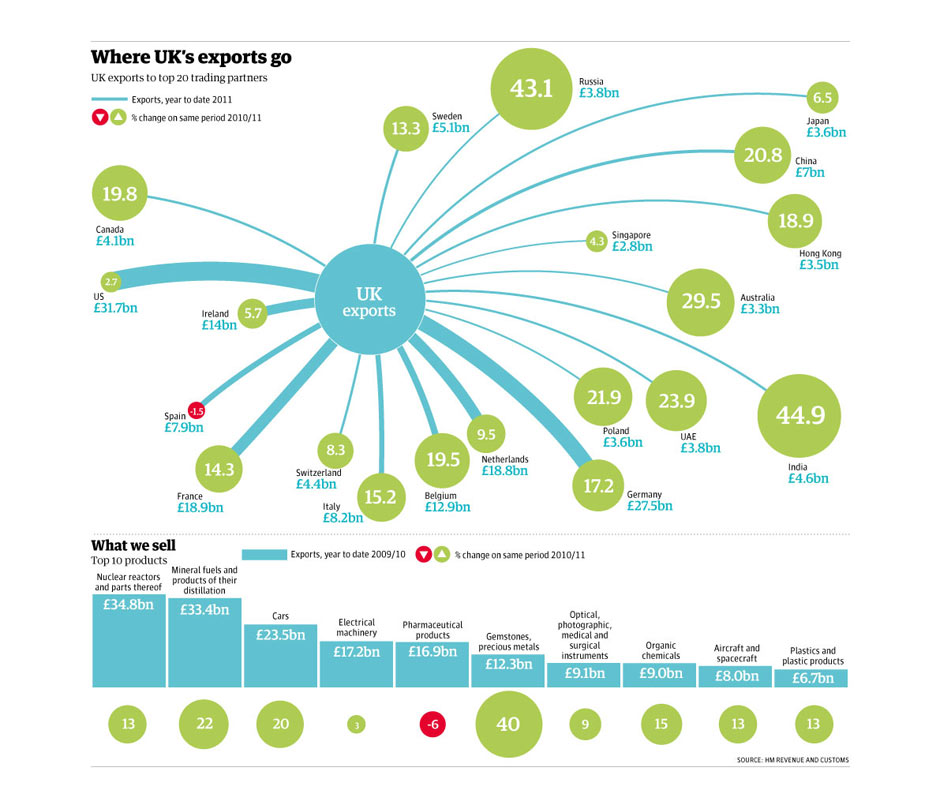
  • Closed Accounts Posts: 397 ✭✭georgesstreet


    UK-Trade-exports-graphic-001.jpg


  • Registered Users, Registered Users 2 Posts: 23,283 ✭✭✭✭Scofflaw


    Well, it's pretty, but potentially misleading, since the size of the circles relates to one year's change in the value of exports rather than the value of exports. That makes India, Australia and Russia look big, whereas all three together are worth less than Ireland.

    I think, too, that we've been over this before - you cannot simply draw straight line projections into the future, particularly from short run data.

    cordially,
    Scofflaw


  • Closed Accounts Posts: 397 ✭✭georgesstreet


    Scofflaw wrote: »
    Well, it's pretty, but somewhat deceptive, since the size of the circles relates to one year's change rather than the value of exports.

    cordially,
    Scofflaw

    The value of the sales are the figures with the "£" in front of them.


  • Registered Users, Registered Users 2 Posts: 23,283 ✭✭✭✭Scofflaw


    The value of the sales are the figures with the "£" in front of them.

    Yes, I know. And the size of the circles relates to the figures inside the circles.

    The picture does not leave out the actual value of exports, but it uses the most impactful visual cue for % change in value. It's an agenda-serving graphic.

    cordially,
    Scofflaw


  • Closed Accounts Posts: 397 ✭✭georgesstreet


    Scofflaw wrote: »
    Yes, I know. And the size of the circles relates to the figures inside the circles.

    The picture does not leave out the actual value of exports, but it uses the most impactful visual cue for % change in value. It's an agenda-serving graphic.

    cordially,
    Scofflaw

    Eh, ok. Then disregard it if you choose to. Another poster claimed that the majority of the UK's exports are to Ireland, and the picture shows that to be not the case. I posted it to show the value of exports to Ireland via a vis other countries, and for no other reason.


  • Closed Accounts Posts: 19,772 ✭✭✭✭The Corinthian


    Eh, ok. Then disregard it if you choose to. Another poster claimed that the majority of the UK's exports are to Ireland, and the picture shows that to be not the case.
    You probably should have made that clearer then by quoting them before posting the graphic in response.
    I posted it to show the value of exports to Ireland via a vis other countries, and for no other reason.
    So other than demonstrating that majority of the UK's exports are not to Ireland, you've managed to demonstrate that the vast majority of British exports are to the EU and that over a one year period, exports to various countries increased, or decreased, without showing if this is part of a trend or not.


  • Advertisement
  • Closed Accounts Posts: 397 ✭✭georgesstreet


    So other than demonstrating that majority of the UK's exports are not to Ireland, you've managed to demonstrate that the vast majority of British exports are to the EU and that over a one year period, exports to various countries increased, or decreased, without showing if this is part of a trend or not.

    The chart says whatever it says, and I am not demonstrating anything. I posted it to show that its not true that the majority of UK exports are to Ireland, and have no clue about trends, alas.


  • Registered Users, Registered Users 2 Posts: 1,169 ✭✭✭dlouth15


    Scofflaw wrote: »
    Now, unless Ireland is literally a passive shipping point, where nothing happens to the goods bar rerouting - and I don't see how that's supposed to be the case - then what is actually being referred to is products being exported to Ireland and processed there. I'm not sure how (or why) you would re-export services, except, again, by adding something to them.
    Well it is a question of degree. Something could have a relatively trivial operation done on it prior to re-export. The trade figures, taken naively would not reflect this yet it would be close to being a passively shipped. The product or service would appear in the figures as being exported to Ireland, for example, to all intents and purposes it is merely a transit point.


  • Closed Accounts Posts: 19,772 ✭✭✭✭The Corinthian


    The chart says whatever it says, and I am not demonstrating anything. I posted it to show that its not true that the majority of UK exports are to Ireland, and have no clue about trends, alas.
    Isn't 'showing' something kinda, sorta 'demonstrating' something? At least from my understanding of the English language.

    Still, if that was your purpose, you really should have said so; as Scofflaw pointed out, the graphic can easily be misleading, especially when dumped, without explanation, into the middle of a discussion such as this.


  • Closed Accounts Posts: 397 ✭✭georgesstreet


    Still, if that was your purpose, you really should have said so; as Scofflaw pointed out, the graphic can easily be misleading, especially when dumped, without explanation, into the middle of a discussion such as this.

    I really am at a loss as to why you want to continue with this. I have explained why I posted the chart, and the context in which it was posted it, and have nothing more useful to add.


  • Closed Accounts Posts: 397 ✭✭georgesstreet


    I wrote a post here http://www.boards.ie/vbulletin/showpost.php?p=87963382&postcount=313 which suggests the British are, in fact, no different from many other countries across the EU.

    France's National Front call for a return to the franc and economic self-rule, and a Polling Vox survey found that 42pc of French voters are willing to consider backing the National front. French support for the EU Project has dropped from 60pc to 41pc since mid-2012, according to the Pew Foundation.

    The Dutch Freedom Party is leading the polls with calls to "control our borders, our economy, our currency".

    Italy's Five Star Movement is still running at 24pc in the polls, and calling for a referendum on the euro. There are parties in other countries too, espousing similar views.

    This thread was started over two years ago, and in that time events have moved on to suggest that the British are no different to many other countries in their political stance concerning the EU.


  • Closed Accounts Posts: 9,085 ✭✭✭SpaceTime


    I think a huge part of the problem is that the EU institutions tend to talk to themselves in the Brussels Bubble.

    They come across as remote, complicated, unaccountable and overly academic.

    I think their extremely poor communications strategies have actually totally undermined the EU.

    They also don't appear to listen and take on board national issues enough.

    The EU could do with actually engaging with the British public fully.


  • Registered Users, Registered Users 2, Paid Member Posts: 14,176 ✭✭✭✭Lemming


    I wrote a post here http://www.boards.ie/vbulletin/showpost.php?p=87963382&postcount=313 which suggests the British are, in fact, no different from many other countries across the EU.

    France's National Front call for a return to the franc and economic self-rule, and a Polling Vox survey found that 42pc of French voters are willing to consider backing the National front. French support for the EU Project has dropped from 60pc to 41pc since mid-2012, according to the Pew Foundation.

    The Dutch Freedom Party is leading the polls with calls to "control our borders, our economy, our currency".

    Italy's Five Star Movement is still running at 24pc in the polls, and calling for a referendum on the euro. There are parties in other countries too, espousing similar views.

    This thread was started over two years ago, and in that time events have moved on to suggest that the British are no different to many other countries in their political stance concerning the EU.

    Have you got links to all of these poll results including the questions asked? How questions are phrased can very easily manipulate a poll; always take them with a pinch of salt, and several pinches of salt if lack of method is presented.


  • Registered Users, Registered Users 2 Posts: 14,823 ✭✭✭✭First Up


    I wrote a post here http://www.boards.ie/vbulletin/showpost.php?p=87963382&postcount=313 which suggests the British are, in fact, no different from many other countries across the EU.

    France's National Front call for a return to the franc and economic self-rule, and a Polling Vox survey found that 42pc of French voters are willing to consider backing the National front. French support for the EU Project has dropped from 60pc to 41pc since mid-2012, according to the Pew Foundation.

    The Dutch Freedom Party is leading the polls with calls to "control our borders, our economy, our currency".

    Italy's Five Star Movement is still running at 24pc in the polls, and calling for a referendum on the euro. There are parties in other countries too, espousing similar views.

    This thread was started over two years ago, and in that time events have moved on to suggest that the British are no different to many other countries in their political stance concerning the EU.
    You will find pockets of anti EU sentiment in all member states. What matters is the scale and the credibility (and electability) of the political parties that advocate leaving. Single issue parties like UKIP and their equivalent have yet to make an impact where it matters.
    Research shows that opposition in the UK is rooted in concerns over immigration and it's a big issue in some other countries too. The populist agenda is easy to exploit but much harder to translate into parliamentary majorities.


  • Closed Accounts Posts: 397 ✭✭georgesstreet


    Lemming wrote: »
    Have you got links to all of these poll results including the questions asked? How questions are phrased can very easily manipulate a poll; always take them with a pinch of salt, and several pinches of salt if lack of method is presented.

    If you read any foreign press then you’ll see many links to polls. And if you don’t read the press you might try googling, for example, “Dutch Freedom Party Poll” and you’ll get this https://www.google.es/?gws_rd=cr&ei=rr6pUoZqxv_IA9XngagO#q=dutch+freedom+party+poll.

    Your post seems to indicate you may not want to believe there may be growing scepticism across Europe, rather than coming up with any evidence that it’s the British who are so anti Europe, as the title of the thread asks. .
    First Up wrote: »
    You will find pockets of anti EU sentiment in all member states. What matters is the scale and the credibility (and electability) of the political parties that advocate leaving. Single issue parties like UKIP and their equivalent have yet to make an impact where it matters.
    Research shows that opposition in the UK is rooted in concerns over immigration and it's a big issue in some other countries too. The populist agenda is easy to exploit but much harder to translate into parliamentary majorities.

    Support for the Euro is at 28% in Holland, so I am not sure if you consider the 28% who support the EU to be a pocket of support, of the rest of the population (72%) who don’t support the EU a “pocket”. I have no idea.

    Either way UKIP with support between 15-19% suggests that the UK is less anti Europe than, for example, the Dutch, and as the title of this thread is “why are the British so anti Europe” seems to now be quaintly old fashioned, as it almost looks as if events have overtaken the premise that the Brits are more pro Europe than other, such as the Dutch.

    Research in the UK really can’t trump polls or elections. Asking people who they might vote for has been shown to be remarkably accurate for many decades now, whereas asking people questions for “research” is much less reliable, as the yes minister clip shows.


  • Advertisement
  • Registered Users, Registered Users 2 Posts: 14,823 ✭✭✭✭First Up


    If you read any foreign press then you’ll see many links to polls. And if you don’t read the press you might try googling, for example, “Dutch Freedom Party Poll” and you’ll get this https://www.google.es/?gws_rd=cr&ei=rr6pUoZqxv_IA9XngagO#q=dutch+freedom+party+poll.

    Your post seems to indicate you may not want to believe there may be growing scepticism across Europe, rather than coming up with any evidence that it’s the British who are so anti Europe, as the title of the thread asks. .


    Support for the Euro is at 28% in Holland, so I am not sure if you consider the 28% who support the EU to be a pocket of support, of the rest of the population (72%) who don’t support the EU a “pocket”. I have no idea.

    Either way UKIP with support between 15-19% suggests that the UK is less anti Europe than, for example, the Dutch, and as the title of this thread is “why are the British so anti Europe” seems to now be quaintly old fashioned, as it almost looks as if events have the Brits are more pro Europe than other, such as the Dutch.

    Research in the UK really can’t trump polls or elections. Asking people who they might vote for has been shown to be remarkably accurate for many decades now, whereas asking people questions for “research” is much less reliable, as the yes minister clip shows.

    Are you talking about Dutch support for the Euro or for EU membership? Or are you confusing the two?

    The UK research includes polls as well as in depth qualitative research, focus groups and the like. There is a lot more to assessing voter intentions that asking black and white questions, or asking which party you will vote for (you vote for candidates)

    "Support" for UKIP in a straw poll is one thing; voting for their candidates is something else. They will probably do well in the European Parliament elections but we'll see when it comes down to a real thing.


Advertisement
Advertisement