Advertisement
Help Keep Boards Alive. Support us by going ad free today. See here: https://subscriptions.boards.ie/.
https://www.boards.ie/group/1878-subscribers-forum

Private Group for paid up members of Boards.ie. Join the club.
Hi all, please see this major site announcement: https://www.boards.ie/discussion/2058427594/boards-ie-2026

Workers to have property tax taken from wages - confirmed

  • 28-08-2012 10:01AM
    #1
    Closed Accounts Posts: 7,197 ✭✭✭


    http://www.independent.ie/national-news/workers-to-have-property-tax-taken-from-wages-confirmed-3213307.html

    Article in the Irish Independent this morning stating that the new property tax will be taken from our wages after next Budget, although they think it will take until around next Summer for the ins and outs to actually be finalised which could result in having to pay 12 months of the tax in the space of 6 months.

    Few interesting points from the article itself:

    "Employers would be told by Revenue how much to deduct each week or month for property tax, while the self-employed and farmers will be required to declare and pay the tax as part of their annual tax return." - potential for tax evasion there I suppose.

    Apparently people on low incomes may be exempt from the property tax so that adds another to the list of exemptions. I presume people on social welfare are also going to be exempt from the property tax, the same way they're exempt from the household charge.

    Will the property tax be ear marked for the same "local services" as the household charge? If so, is it not fair then that people who live in larger towns and cities should pay more because they have access to these "local services"?


«134

Comments

  • Moderators, Entertainment Moderators, Politics Moderators Posts: 14,566 Mod ✭✭✭✭johnnyskeleton


    Will the property tax be ear marked for the same "local services" as the household charge? If so, is it not fair then that people who live in larger towns and cities should pay more because they have access to these "local services"?

    Surely it would be fairer that larger towns and cities get to benefit from economies of scale and thus Dublin should pay less.


  • Closed Accounts Posts: 7,197 ✭✭✭daenerysstormborn3


    Well I would think they should pay more because it costs more to maintain the "local services" that they avail of, as opposed to rural areas where there are no "local services" to avail of.


  • Registered Users, Registered Users 2, Paid Member Posts: 24,808 ✭✭✭✭Sleepy


    The fewer services available to rural dwellers actually cost MORE to provide than those available to those in urban areas on a per capita basis. If rural dwellers weren't already being subsidised by the urban taxpayer you might have an argument. Unfortunately, despite the lack of logic or reason in your argument, it'll no doubt be heard by the many rural back-benchers and may well result in further subsidisation of the lifestyle choices of those who want to live in the countryside but receive the same benefits as those who currently pay their way.

    Personally, I'm against incomes having anything to do with such a tax. Anything along those lines is open to massive abuse for those who are asset-rich (reducing income in order to increase asset wealth etc.) and tbh, if you're receiving social welfare for an extended period of time whilst sitting on assets, I'm not sure you deserve to hold onto those assets.

    What I do think will be necessary is for some means of providing relief from this taxation for those who's assets, are in fact liabilities i.e. those in major negative equity. This needs to be executed as a "property wealth tax" rather than a straightforward "property valuation tax" or it will increase the numbers defaulting on mortgages (both those legitimately declaring bankruptcy and those who are doing so strategically).


  • Registered Users, Registered Users 2 Posts: 10,095 ✭✭✭✭Heroditas


    Apparently people on low incomes may be exempt from the property tax so that adds another to the list of exemptions. I presume people on social welfare are also going to be exempt from the property tax, the same way they're exempt from the household charge.


    FFS! Are they going to be exempted from the services in that case?
    Yet again, the middle-earners will get squeezed to buggery


  • Closed Accounts Posts: 7,197 ✭✭✭daenerysstormborn3


    But what services are available to rural dwellers that aren't already being paid for?

    How are urban taxpayers subsidising rural dwellers?

    "further subsidisation of the lifestyle choices of those who want to live in the countryside but receive the same benefits as those who currently pay their way." - so according to you rural dwellers don't pay their way?


  • Advertisement
  • Registered Users, Registered Users 2 Posts: 681 ✭✭✭Salmon


    But what services are available to rural dwellers that aren't already being paid for?

    How are urban taxpayers subsidising rural dwellers?

    In my opinion its a common misconception of urban dwellers that they subsidise the services recieved by rural dwellers. There isnt a single service provided to my home (rural) that I havent paid through the nose for! Possibly another public/private type smokescreen designed to divide and conquer the Urban/Rural dwellers whilst introducing a new method of separating you from your hard earned wages!


  • Closed Accounts Posts: 7,197 ✭✭✭daenerysstormborn3


    Salmon wrote: »
    In my opinion its a common misconception of urban dwellers that they subsidise the services recieved by rural dwellers. There isnt a single service provided to my home (rural) that I havent paid through the nose for! Possibly another public/private type smokescreen designed to divide and conquer the Urban/Rural dwellers whilst introducing a new method of separating you from your hard earned wages!

    I would just like to know what services are available to rural dwellers that rural dwellers, according to Sleepy, don't pay for themselves and is subsidised entirely by urban taxpayers.


  • Registered Users, Registered Users 2 Posts: 6,134 ✭✭✭jhegarty


    Sleepy wrote: »
    The fewer services available to rural dwellers actually cost MORE to provide than those available to those in urban areas on a per capita basis.


    What services would those be ?

    No free water , no sewage , no street lighting or footpaths. Parks and libraries are all in towns.

    ESB, phone and bins provided by private companies.

    There are roads , but they would be needed for getting people from town to town anyway.


  • Closed Accounts Posts: 211 ✭✭Maggie 2


    While I agree with the Household Charge, I don't think taking it from Income is a good idea. Everyone should have to pay something. I think it should be on the size of the house they LIVE in, eg number of bedrooms plus an extra amount per adult who lives there. No exemptions for anyone. That way, the amounts per household will be much smaller. If there was a basic annual amount of say, €50 per housing unit, plus €10 per bedroom, plus €10 per adult. If EVERY household paid that much, wouldn't it be much fairer?


  • Registered Users, Registered Users 2, Paid Member Posts: 24,808 ✭✭✭✭Sleepy


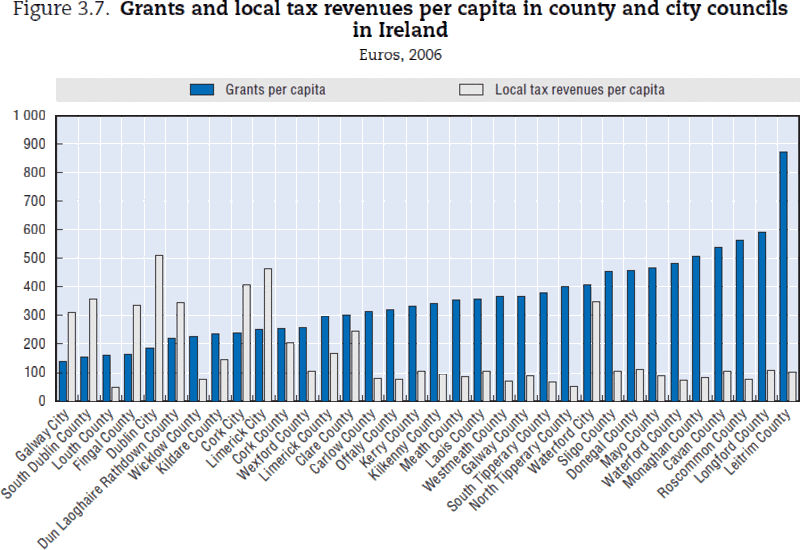
    Evidence of the subsidy of rural areas by urban:

    j8cz1v.gif

    The provision of Fire services isn't covered by the call out charges; Urban schools have lower pupil:staff ratios costing the state more to educate each child in attendance; ESB & Phone infrastructure was paid for by the taxpayer as it was put in place whilst those companies were in state control. A more recent example might be UPC: whilst far and away the best broadband service in the country, they don't provide services to anywhere outside of major urban centres as it's simply not economically viable for them to do so.

    Do you honestly think eircom would put in phone lines for remote rural dwellers now? How many decades of phone bills would it cost to recoup the investment in, and maintenance of, the network were they to do so?


  • Advertisement
  • Closed Accounts Posts: 211 ✭✭Maggie 2


    There are street lights in country areas, where there are number of houses together. Country folk also use libraries and public parks, almost as much as townies!


  • Closed Accounts Posts: 7,197 ✭✭✭daenerysstormborn3


    That table is from 2006 and the "evidence" is hardly conclusive.

    If you take Leitrim for example, population 31,000 approx., and Dublin for example, over 1,000,000 - obviously Dublin is going to generate more revenue than Leitrim to pay for the services required by the larger concentration of people.

    Eircom do install phone lines for remote dwellers, at a high cost.


  • Closed Accounts Posts: 7,197 ✭✭✭daenerysstormborn3


    Maggie 2 wrote: »
    There are street lights in country areas, where there are number of houses together. Country folk also use libraries and public parks, almost as much as townies!

    I don't know what "country areas" you're talking about Maggie but I have lived in 3 different parts of rural Ireland with no street lighting, no footpaths and no access to libraries or public parks, among other things.

    There is no library near where I live, nor is there a park.

    Where one might say urban dwellers subsidise rural dwellers, one could also say rural dwellers subsidise urban dwellers with funds going towards water and sewage provision.


  • Banned (with Prison Access) Posts: 690 ✭✭✭puffishoes


    If it's going to be based on the price of the house. How do they figure out the price when an EA can't?

    Is it the price when you bought it? the price it i will be next year?

    How do price a falling asset that has no market?


  • Registered Users, Registered Users 2 Posts: 2,557 ✭✭✭madalig12


    Maggie 2 wrote: »
    There are street lights in country areas, where there are number of houses together. Country folk also use libraries and public parks, almost as much as townies!

    Catch yourself on.


  • Registered Users, Registered Users 2 Posts: 1,185 ✭✭✭Flex


    That table is from 2006 and the "evidence" is hardly conclusive.

    If you take Leitrim for example, population 31,000 approx., and Dublin for example, over 1,000,000 - obviously Dublin is going to generate more revenue than Leitrim to pay for the services required by the larger concentration of people.

    Eircom do install phone lines for remote dwellers, at a high cost.

    Thats exactly the point thats being made


  • Registered Users, Registered Users 2 Posts: 2,557 ✭✭✭madalig12


    Eircom are not govt or council run.


  • Closed Accounts Posts: 7,197 ✭✭✭daenerysstormborn3


    Flex wrote: »
    Thats exactly the point thats being made

    :confused:


  • Closed Accounts Posts: 21,717 ✭✭✭✭Godge


    That table is from 2006 and the "evidence" is hardly conclusive.

    If you take Leitrim for example, population 31,000 approx., and Dublin for example, over 1,000,000 - obviously Dublin is going to generate more revenue than Leitrim to pay for the services required by the larger concentration of people.

    Eircom do install phone lines for remote dwellers, at a high cost.


    The table is based on revenue per capita meaning per person so it is unrelated to the number of people in the county.


  • Registered Users, Registered Users 2 Posts: 68,173 ✭✭✭✭seamus


    :confused:
    Your argument is that people in towns and cities should each have to pay more because they have access to services.

    However, because there are more people in towns and cities, it costs less per capita to fund their services. Therefore logically those in towns and cities should be paying less than those outside of them.

    Otherwise you're saying that people in cities should be required to subsidise the services of people outside cities.


  • Advertisement
  • Registered Users, Registered Users 2, Paid Member Posts: 24,808 ✭✭✭✭Sleepy


    Exactly. Per capita, or (more importantly imo) per taxpayer, the services are cheaper to provide to urban dwellers due to economies of scale and population density. As such, urban dwellers get more services. As it stands, the cost of the provision of the inferior services received by rural dwellers (and you have no argument that living in the country means you get less services) aren't covered by the tax they contribute.

    I include rural towns in this btw. So, whilst you might not have streetlights, libraries, parks or much in the way of public transport in Derrynagran, you'd find a certain level of all these in neighbouring Foxford and that level would be above what could be afforded by the taxpayers of Foxford and it's surrounding townlands. The shortfall of which, would be picked up by the taxpayers of, for example, Westport and Castlebar (which in turn are probably subsidised to some extent by the taxpayers of Galway, Cork, Dublin etc.)

    Cities are the engines of the modern economy. That's not to denigrate the rural way of life or the importance of maintaining a food supply but it gets galling for us taxpayers that moved to urban centres (or in my case the capital) in order to find work when we constantly hear those we subsidise demanding exemptions from taxes on the basis that the services which we subsidise for them aren't as good as the ones we pay for ourselves.


  • Registered Users, Registered Users 2 Posts: 68,173 ✭✭✭✭seamus


    Sleepy wrote: »
    Cities are the engines of the modern economy. That's not to denigrate the rural way of life or the importance of maintaining a food supply but it gets galling for us taxpayers that moved to urban centres (or in my case the capital) in order to find work when we constantly hear those we subsidise demanding exemptions from taxes on the basis that the services which we subsidise for them aren't as good as the ones we pay for ourselves.
    +1
    In general I don't have any major problem overpaying my way (as it were) for local services. I don't consider the rural way of life to be inherently inferior or to be abandoned, and I recognise that if rural dweller were required to pay the true cost of their services, it would very quickly lead to ruin, poverty and a massive social divide between urban and rural.
    We're a small nation, I see no reason to segregate communities or their money.

    But as Sleepy says, it's then galling to hear rural dwellers demand that city dwellers pay even more based on some misguided idea of how local costs and services are distributed.

    Be careful what you wish for - if the charge is truly applied "fairly" as so many people want, you will quickly find rural charges skyrocketing beyond affordability.


  • Closed Accounts Posts: 7,197 ✭✭✭daenerysstormborn3


    seamus wrote: »
    Your argument is that people in towns and cities should each have to pay more because they have access to services.

    However, because there are more people in towns and cities, it costs less per capita to fund their services. Therefore logically those in towns and cities should be paying less than those outside of them.

    Otherwise you're saying that people in cities should be required to subsidise the services of people outside cities.

    No, my argument is that the people who actually have access to services and can avail of them regularly should pay for them.
    Sleepy wrote: »
    Exactly. Per capita, or (more importantly imo) per taxpayer, the services are cheaper to provide to urban dwellers due to economies of scale and population density. As such, urban dwellers get more services. As it stands, the cost of the provision of the inferior services received by rural dwellers (and you have no argument that living in the country means you get less services) aren't covered by the tax they contribute.

    I include rural towns in this btw. So, whilst you might not have streetlights, libraries, parks or much in the way of public transport in Derrynagran, you'd find a certain level of all these in neighbouring Foxford and that level would be above what could be afforded by the taxpayers of Foxford and it's surrounding townlands. The shortfall of which, would be picked up by the taxpayers of, for example, Westport and Castlebar (which in turn are probably subsidised to some extent by the taxpayers of Galway, Cork, Dublin etc.)

    Cities are the engines of the modern economy. That's not to denigrate the rural way of life or the importance of maintaining a food supply but it gets galling for us taxpayers that moved to urban centres (or in my case the capital) in order to find work when we constantly hear those we subsidise demanding exemptions from taxes on the basis that the services which we subsidise for them aren't as good as the ones we pay for ourselves.

    What do you mean "you have no argument that living in the country means you get less services"? We do get less services:confused:

    So it's perfectly acceptable to expect rural dwellers to travel a substantial distance to avail of all these "local services" which they are expected to pay for but rarely, if ever, avail of.

    Nobody is demanding an exemption, well I'm certainly not, I am, however, suggesting that those that have access to services should pay more for them. Why is that so hard to understand? Why should I pay for footpaths and street lighting in the next town over when I don't have any where I live?


  • Closed Accounts Posts: 7,197 ✭✭✭daenerysstormborn3


    seamus wrote: »
    +1
    In general I don't have any major problem overpaying my way (as it were) for local services. I don't consider the rural way of life to be inherently inferior or to be abandoned, and I recognise that if rural dweller were required to pay the true cost of their services, it would very quickly lead to ruin, poverty and a massive social divide between urban and rural.
    We're a small nation, I see no reason to segregate communities or their money.

    But as Sleepy says, it's then galling to hear rural dwellers demand that city dwellers pay even more based on some misguided idea of how local costs and services are distributed.

    Be careful what you wish for - if the charge is truly applied "fairly" as so many people want, you will quickly find rural charges skyrocketing beyond affordability.

    What "misguided idea"? You get the services, you pay for them, I don't get the services but I still pay for them anyway.

    If rural charges "skyrocketed", I would expect then the level of services available to other areas.


  • Registered Users, Registered Users 2 Posts: 4,236 ✭✭✭Dannyboy83


    Having it deducted from wages seems by far the most sensible way to do it.

    Proof that unscrupulous methods work better when it comes to teaching Irish governments how to act.


  • Registered Users, Registered Users 2, Paid Member Posts: 24,808 ✭✭✭✭Sleepy


    No, my argument is that the people who actually have access to services and can avail of them regularly should pay for them.
    Those with the best access to services pay most towards them on a per-capita basis. In fact, they pay for more than they receive as they recognise that certains standards of services should be a universal right within their country: roads, gardai, fire services, access to health servics, access to education etc.

    What do you mean "you have no argument that living in the country means you get less services"? We do get less services:confused:
    And I'm not arguing with you on that fact. ;)
    So it's perfectly acceptable to expect rural dwellers to travel a substantial distance to avail of all these "local services" which they are expected to pay for but rarely, if ever, avail of.
    Yes. Unless you want to further reduce those services to just those that are affordable out of the tax revenue from each electoral district (or townland).

    Nobody is demanding an exemption, well I'm certainly not, I am, however, suggesting that those that have access to services should pay more for them. Why is that so hard to understand? Why should I pay for footpaths and street lighting in the next town over when I don't have any where I live?
    Because the people in that town helped contribute towards the road outside your house, the electricity and telephony infrastructure you're using to connect to this site etc. etc.

    Are you suggesting that we shouldn't collect taxes from anyone and not providd any public services? Or that taxes collected from an area should be the only money spent in that area? In each of these scenarios the urban dweller would be far, far worse off than they currently are.
    What "misguided idea"? You get the services, you pay for them, I don't get the services but I still pay for them anyway.

    If rural charges "skyrocketed", I would expect then the level of services available to other areas.
    You're working on the misguided idea that your taxes cover the cost of the services that you are currently provided with. In order to avail of the same services available to urbanites, you would need to be paying colossal taxes. I'd wager a guess that your entire income and that of your neighbours couldn't meet the cost of providing you with such tbh.


  • Registered Users, Registered Users 2 Posts: 1,547 ✭✭✭Fiery mutant


    When I built my house, I had to pay the council €8k to pay for the upkeep of footpaths in a town almost 50km away. I don't recall any of my friends having to do that when they purchased houses in the city.

    So if the property tax is going to pay for local services, I want my €8k back.

    We should defend our way of life to an extent that any attempt on it is crushed, so that any adversary will never make such an attempt in the future.


  • Registered Users, Registered Users 2 Posts: 5,112 ✭✭✭Blowfish


    No, my argument is that the people who actually have access to services and can avail of them regularly should pay for them.
    Indeed, but as the figures show, urban dwellers are paying for them, in fact they are actually overpaying for the services they get.

    The extra the urban tax payers are paying goes to fund the (expensive) few services there are in rural areas.
    Nobody is demanding an exemption, well I'm certainly not, I am, however, suggesting that those that have access to services should pay more for them. Why is that so hard to understand? Why should I pay for footpaths and street lighting in the next town over when I don't have any where I live?
    If you were to do that, rural dwellers would have to pay much more than they do now and urban dwellers would have to pay less.


  • Closed Accounts Posts: 7,197 ✭✭✭daenerysstormborn3


    Sleepy wrote: »
    Those with the best access to services pay most towards them on a per-capita basis. In fact, they pay for more than they receive as they recognise that certains standards of services should be a universal right within their country: roads, gardai, fire services, access to health servics, access to education etc.

    And I'm not arguing with you on that fact.

    Yes. Unless you want to further reduce those services to just those that are affordable out of the tax revenue from each electoral district (or townland).

    Because the people in that town helped contribute towards the road outside your house, the electricity and telephony infrastructure you're using to connect to this site etc. etc.

    Are you suggesting that we shouldn't collect taxes from anyone and not providd any public services? Or that taxes collected from an area should be the only money spent in that area? In each of these scenarios the urban dweller would be far, far worse off than they currently are.

    You're working on the misguided idea that your taxes cover the cost of the services that you are currently provided with. In order to avail of the same services available to urbanites, you would need to be paying colossal taxes. I'd wager a guess that your entire income and that of your neighbours couldn't meet the cost of providing you with such tbh.

    As did I contribute towards the road outside their house, the electricity and telephony infrastructure they're using to connect to this site etc. etc. but for my contribution they then get much more.

    "Are you suggesting that we shouldn't collect taxes from anyone and not providd any public services?" - did I say that?

    "Or that taxes collected from an area should be the only money spent in that area?" - yes, because if the household charge is going to be spent the way we're told it will (although that remains to be seen) then city councils will undoubtedly get more than county councils and my services will still remain the same regardless. Are they suddenly going to have the money to install footpaths and street lighting, among other things, where I live?

    "I'd wager a guess that your entire income and that of your neighbours couldn't meet the cost of providing you with such tbh." - nor am I suggesting that. I am suggesting that those who can actually avail of such services should pay for them. The same way I paid for the installation of my water and sewage system and the upkeep of same.


  • Advertisement
  • Closed Accounts Posts: 7,197 ✭✭✭daenerysstormborn3


    Blowfish wrote: »
    Indeed, but as the figures show, urban dwellers are paying for them, in fact they are actually overpaying for the services they get.

    The extra the urban tax payers are paying goes to fund the (expensive) few services there are in rural areas.
    If you were to do that, rural dwellers would have to pay much more than they do now and urban dwellers would have to pay less.

    How would they have to pay more for services they don't receive anyway?


This discussion has been closed.
Advertisement
Advertisement