Advertisement
Help Keep Boards Alive. Support us by going ad free today. See here: https://subscriptions.boards.ie/.
https://www.boards.ie/group/1878-subscribers-forum

Private Group for paid up members of Boards.ie. Join the club.
Hi all, please see this major site announcement: https://www.boards.ie/discussion/2058427594/boards-ie-2026

famine follys

  • 09-05-2012 05:41PM
    #1
    Registered Users, Registered Users 2 Posts: 27


    1)People on the left need to understand that spending borrowed money on infrastructural projects does not lead to growth and is no different to famine follys.In fact such spending is an impediment to real growth by increasing debt and prolonging the period under the cosh of the bond markets/troika.

    2)People also need to try and understand the difference between solvency and liquidity.Look the terms up in Wikipedia .
    Ireland is insolvent but liquid whereas the Irish banks are solvent(we think) but illiquid.

    3)Growth and austerity are not mutually exclusive and in fact growth is how austerity ends which proves that factors driving growth are a lot more complex than throwing liquid funds into the pot.Confidence in the future is a major driver of growth and we need to get to that point fast.

    4)The gov needs to come clean and balance the books by reducing soc welfare and public service pay.Only then when people know there is nothing worse to come will confidence in the future be restored.


Comments

  • Closed Accounts Posts: 5,451 ✭✭✭Delancey


    Interesting points , certainly the lack of confidence and uncertainty are a serious hindrance to growth - just look at how much is being saved rather than spent.

    Morgan Kelly of UCD did suggest a radical , almost overnight re-alignment of spending with income . This would have seen massive across the board cuts , including social welfare and PS pay . Kellys rationale was the pain would be severe but quick and thereafter confidence would return whereas we now have slow stagnation allied to high unemployment and confidence is constantly undermined by fear of new taxes.

    My own view is that Kellys plan while not without merit , would cause a total collapse of the domestic economy and serious public disorder. The ' shock ' would , I believe , be too much.


  • Registered Users, Registered Users 2 Posts: 4,132 ✭✭✭RichardAnd


    Delancey wrote: »
    My own view is that Kellys plan while not without merit , would cause a total collapse of the domestic economy and serious public disorder. The ' shock ' would , I believe , be too much.


    I would agree. However, I'm also of the understanding that a deficit isn't a problem by itself, it's simply that Ireland can't borrow money at an interest level that would allow her to continue paying back the debt it had already accumulated by borrowing in the past.

    That last sentence describes many of the problems of modern finance. :S


  • Registered Users, Registered Users 2, Paid Member Posts: 3,307 ✭✭✭Good loser


    I like your post.

    At the start of this recession people were saying we should not make the same mistake as made in the eighties. That is taking years and years to make the needed cutbacks.

    This seems now to have gone by the board. The time for balancing the budget is being postponed and postponed.

    On radio today the Sinn Fein guy thought 26 years was too quick!


  • Registered Users, Registered Users 2 Posts: 23,283 ✭✭✭✭Scofflaw


    1)People on the left need to understand that spending borrowed money on infrastructural projects does not lead to growth and is no different to famine follys.In fact such spending is an impediment to real growth by increasing debt and prolonging the period under the cosh of the bond markets/troika.

    This is not in fact accurate. All spending stimulates the economy, at a rate depending on what the spending is, but usually at a multiple of the spending somewhere between 0.5 and 2.5. Government borrowing for spending is money coming in from outside the economy, which makes it one of the few sources that really adds to the economy.

    The balance is whether the resulting growth is larger than the cost of borrowing the money. At the troika rates of 3.55% (EFSM 2.97%, EFSF 3.06%, IMF 4.79%), this isn't a problem, since all that's required is 1.5% of real growth plus 2% inflation. At the current market rates of 5.5%+, it would be a problem.

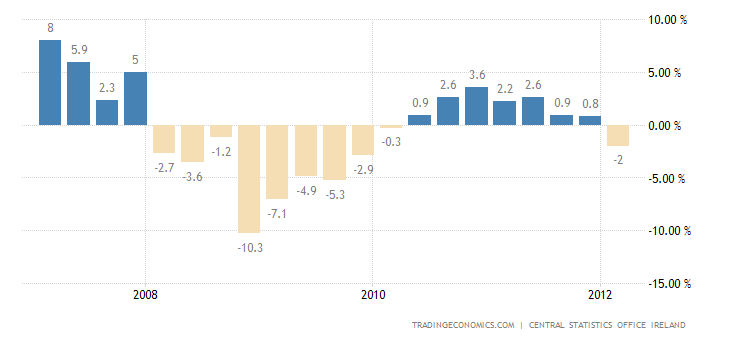
    And yes, obviously, we're in recession, so one can make the objection that we don't have 1.5% growth, but the point still applies, since the stimulus reduces the contraction. Also, we're not doing quite as badly as one might think:

    chart.png?s=iegrpyoy&d1=20070101&d2=20120510
    2)People also need to try and understand the difference between solvency and liquidity.Look the terms up in Wikipedia .
    Ireland is insolvent but liquid whereas the Irish banks are solvent(we think) but illiquid.

    Countries are never insolvent, because they have forever to pay their debts and never go out of business for economic reasons. On the other hand, we are illiquid in the usual meaning of the term, because we cannot afford to access any funding bar official sources. The Irish banks would be insolvent without State support, and are also illiquid because they're reliant on ECB funding.
    3)Growth and austerity are not mutually exclusive and in fact growth is how austerity ends which proves that factors driving growth are a lot more complex than throwing liquid funds into the pot.Confidence in the future is a major driver of growth and we need to get to that point fast.

    True.
    4)The gov needs to come clean and balance the books by reducing soc welfare and public service pay.Only then when people know there is nothing worse to come will confidence in the future be restored.

    It's one option, and certainly better than reducing the deficit by cutting back on capital spending, for reasons that contradict your first point - capital spending is investment which improves the growth prospects of the country, current spending is not. On top of that, the problem is that money being spent on wages and social transfers is going to people who are themselves in debt, and is being used by them to pay down their own debts rather than spent into the economy.

    cordially,
    Scofflaw


  • Registered Users, Registered Users 2 Posts: 27 Tess Tickle


    Can you think of one capital project that is home produced and would deliver a fast payback to the taxpayer and is not the state acting as a provider of risk capital?


  • Advertisement
  • Closed Accounts Posts: 5,451 ✭✭✭Delancey


    Can you think of one capital project that is home produced and would deliver a fast payback to the taxpayer and is not the state acting as a provider of risk capital?

    Fast Payback is the key phrase here , I cannot think of a public capital project that would provide a quick return but then that is not what such investment is about.
    It's all about improving the economic infrastructure for long-term gain , the reduction in such expenditure is particularly unfortunate for several reasons -
    1) With the collapse in construction the old bogey of '' construction inflation '' is no longer a serious isssue whereas in the past it drove many projects over budget.
    2) Irelands Infrastructural deficit has been identified many times - no sign of it improving now.
    3) Capital projects can be labour intensive and do a lot to help unemployment.

    New roads that are tolled do offer a quicker and measurable return though in my view this serves to make Ireland a more expensive place and undermines competitiveness.


Advertisement
Advertisement