Advertisement
Help Keep Boards Alive. Support us by going ad free today. See here: https://subscriptions.boards.ie/.
https://www.boards.ie/group/1878-subscribers-forum

Private Group for paid up members of Boards.ie. Join the club.
Hi all, please see this major site announcement: https://www.boards.ie/discussion/2058427594/boards-ie-2026

what do you know about quadratic equations?

  • 02-02-2010 12:57PM
    #1
    Closed Accounts Posts: 11,924 ✭✭✭✭


    me and two others have to do a mini-project about quadratic equations - what they are, how did mathematicians centuries ago solve them, etc - for about 10-15 minutes in a workshop.
    is there any other ways to solve them besides the -b formula, completing the square and letting alpha and beta equal the roots?

    any help would be much appreciated.
    thanks


Comments

  • Closed Accounts Posts: 6,081 ✭✭✭LeixlipRed


    There are loads of old methods for solving certain types of quadratics. Check this out, some historical stuff there.


  • Closed Accounts Posts: 6,081 ✭✭✭LeixlipRed


    Actually, I'm thinking of methods of solving cubics, which are the interesting ones. Tartaglia and that. The Babylonians were the first to play around with quadratics, have a google, that link I supplied is more relevant for cubics.


  • Registered Users, Registered Users 2 Posts: 2,481 ✭✭✭Fremen


    Look up the pythagorean brotherhood, too.
    They solved x^2 = 2 and got a nasty shock.

    It depends how deep you want to go.... the Princeton companion to mathematics has some *deep* stuff on algebraic geometry and arithmetic geometry, but you probably need to be in second year of a maths degree to follow it.

    Edit:
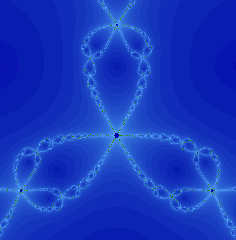
    Going into some detail on the Newton-raphson method might be good. You could do some stuff on Newton fractals if you know about complex numbers. would make for some interesting pictures in your presentation.


  • Closed Accounts Posts: 6,081 ✭✭✭LeixlipRed


    Yeh, the Newton-Rapshon method is a good idea actually. It's simple enough to explain and derive too.


  • Closed Accounts Posts: 11,924 ✭✭✭✭RolandIRL


    thanks for the replys. i'm only in first year science, not a dedicated maths degree course. don't need to go into too much depth. forgot about the whole newton-raphson method.


  • Advertisement
  • Registered Users, Registered Users 2 Posts: 2,481 ✭✭✭Fremen


    Definitely have a crack at newton fractals then. They're easy and they'll liven up what could otherwise be a slightly dull topic.

    Fractal_newton.png


  • Closed Accounts Posts: 11,924 ✭✭✭✭RolandIRL


    the pictures on wikipedia look so much like kaleidascopes. :)
    i'm going to have another look at my 2nd level maths book again.
    could you also use de moivre's theorem to solve quad. equations with complex roots? i think i remember doing that in 5th year of secondary school.


Advertisement
Advertisement