Advertisement
Help Keep Boards Alive. Support us by going ad free today. See here: https://subscriptions.boards.ie/.
https://www.boards.ie/group/1878-subscribers-forum

Private Group for paid up members of Boards.ie. Join the club.
Hi all, please see this major site announcement: https://www.boards.ie/discussion/2058427594/boards-ie-2026

Solar for Beginners [ask your questions here]

1150151152153154156»

Comments

  • Registered Users, Registered Users 2 Posts: 449 ✭✭Dozz


    Hi all. I have a solar setup at home. Standard Solis inverter and approx 6.6 Kwp. Panels all south facing.

    I have a good bit of West facing roof that I was thinking of putting panels on but unfortunately I have no spare strings on the inverter.

    I have access to a commercial grade inverter (see attached photos). Is it possible to use this in a domestic setup?

    Cheers


  • Registered Users, Registered Users 2, Paid Member Posts: 8,639 ✭✭✭deezell


    Off grid only, and its a three phase inverter. It may not be possible to energise individual phases without a reference 3 phase grid connection at the input, i.e, fully off grid. More tech reading required, but Cananda v Bosnia about to kick off, and I have a duty of care to watch the World Cup. All of it.


  • Registered Users, Registered Users 2, Paid Member Posts: 10,828 ✭✭✭✭893bet


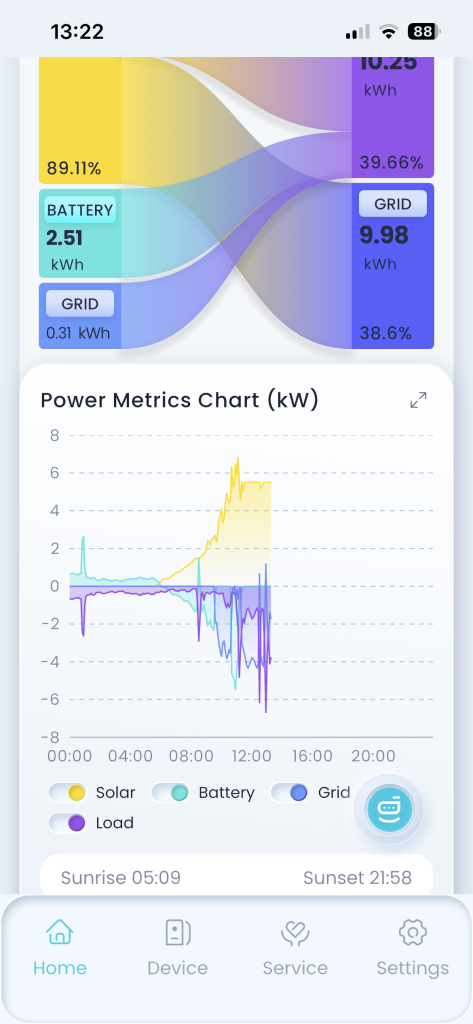
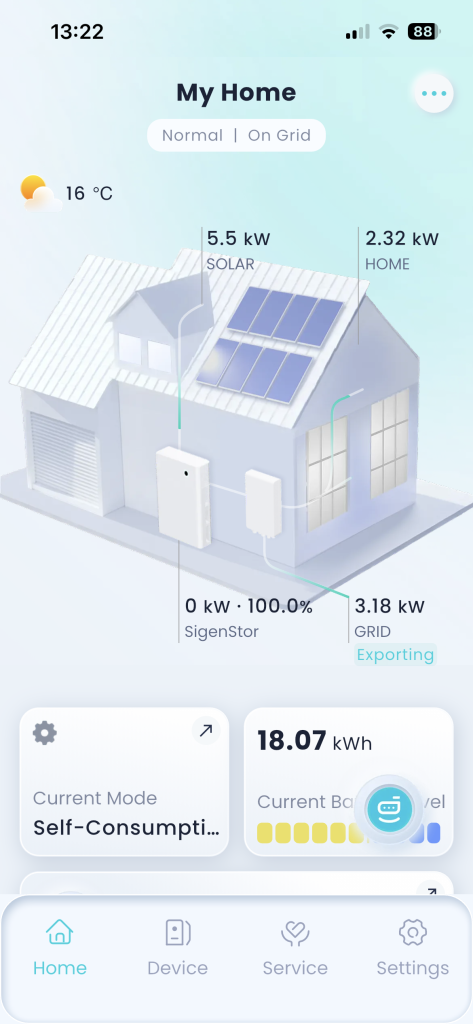
    only installed Friday.

    9.2kw perfect south pretty much.

    Assume I am being clipped below at 5.5. But why?

    When there is a load of 2-3 on the house I thought I could use the excel solar for the load and still send back 5.5?

    Only time I was above 5.5 was when the battery was charging and I was had a house load on that exceeded the 5.5 I think.


    IMG_2982.png IMG_2983.png


  • Registered Users, Registered Users 2 Posts: 1,092 ✭✭✭KAGY


    Unfortunately that's the way inverter works. The max it can convert from DC to AC is 5 kilowatts. When you're charging the battery it's not converting so it can supply more power in total.


  • Registered Users, Registered Users 2, Paid Member Posts: 10,828 ✭✭✭✭893bet


    yeah figured that out. Need to dump battery early in the morning if the weather is to be good


  • Advertisement
  • Registered Users, Registered Users 2, Paid Member Posts: 8,639 ✭✭✭deezell


    It can charge the battery with excess, but the max it can place on your grid is 5.5kw. it has no way of knowing if there's self consumption or if its all going to FIT. If your hybrid inverter has dynamic Export Power Management (EPM), and a CT clamp on the live cable from the meter, to measure reverse current back into the grid, then it will know how much is going to local load, and should be able to allocate the available solar output to fulfill the local load and send the max 5 5 to the grid.


  • Moderators, Home & Garden Moderators Posts: 7,738 Mod ✭✭✭✭graememk


    It's max that can leave the inverter, not export.

    (And all hybrids have a CT/meter otherwise it can't monitor the grid so it can charge and discharge the battery.)


  • Registered Users, Registered Users 2 Posts: 628 ✭✭✭white_westie


    Could you connect South-North panels in parallel to 1 MPPT?

    So basically question arises from option of connecting East-West panels in parallel to a single MPPT - could the same logic apply to a South-North orientation?
    ie: same number and type of panels installed on each aspect, connected in series to form a string on each aspect, then the 2 connected in parallel at the inverter.

    In a South-North situation, the south panels would have sun for most of the year, so they would set the voltage to start the MPPT up all of the time. During the winter months the North panels would not be generating much, but in the summer months they would.
    The parallel connection would mean the voltage would be fairly constant, but the current would fluctuate - would that upset the MPPT logic? Would it work?

    Am only talking about low number of panels (4) on each aspect.

    Am I understanding the theory correctly?
    If so, anyone ever seen anything like this being attempted? Cannot find anything myself.

    TIA
    WW


  • Registered Users, Registered Users 2 Posts: 1,027 ✭✭✭whosedaddy?


    Connecting panels in parallel means the current is additive. Based on data sheets Imp of most panels is between 10-14 Amp depending on make. And 5kw inverters have max Imp of 16A or less per string.

    But when one aspect hits Imp max, there is little headroom for the other aspect before you hit inverter max Imp.
    I presume inverter switch off when you hit Imp max - so it could end up toggling instead of producing anything.


  • Registered Users, Registered Users 2, Paid Member Posts: 8,639 ✭✭✭deezell


    Yes it will work. North facing will contribute little in winter, its potential output may not even reach the mppt voltage determined by the mppt string, i.e, the south panels will supply current to the inverter, but effectively reverse bias the north panels if their Open Circuit voltage does not reach the mppt setting when loading the panels. In most cases though they will contribute, and in summer, early morning and later in the evening, they will be on par, and north will briefly be dominant towards sunset or from sunrise.

    There is debate about reverse current through the weaker lit panels, but this will be very low and will only occur when their OC voltage can't make mppt voltage. In large parallel arrays some might fit reverse blocking diodes on the end of each parallel set, to avoid reverse currents, but this is generally only considered when paralleling uneven number sets of panels, or paralleling more than two sets. There is some debate on this in Reddit, also AI Google answers are substantially correct. It's probably not popular as users tend to just use two strings, but there was a query here a while back from a user who inquired about three string inverters, as he had a large south facing set, and wished to add equal E and W facing sets. Paralleling the latter offered a solution.


  • Advertisement
  • Registered Users, Registered Users 2 Posts: 897 ✭✭✭jams100


    Hi,

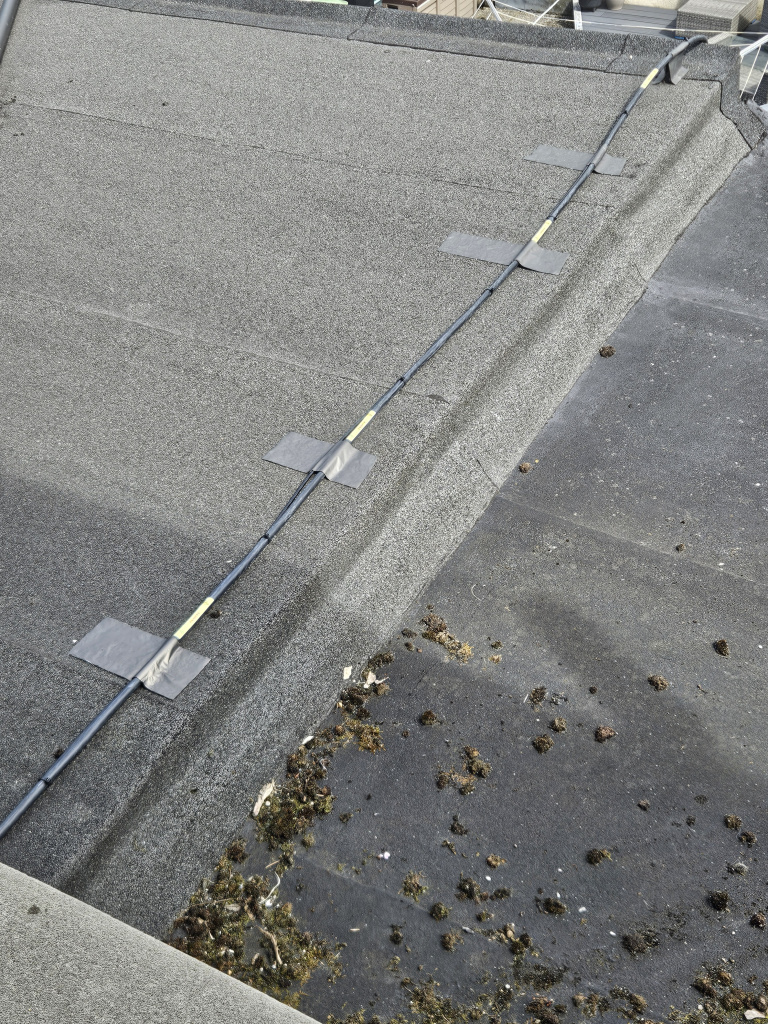
    My neighbour recently got solar panels installed which included running wires across a flat roof to a battery and this is how they left it. Is this standard / ok or what should they have done here? (To me it looks very tacky and that duck tape is going to fail when an Irish winter hits).

    1000062080.jpg


  • Registered Users, Registered Users 2 Posts: 2,856 ✭✭✭bullit_dodger


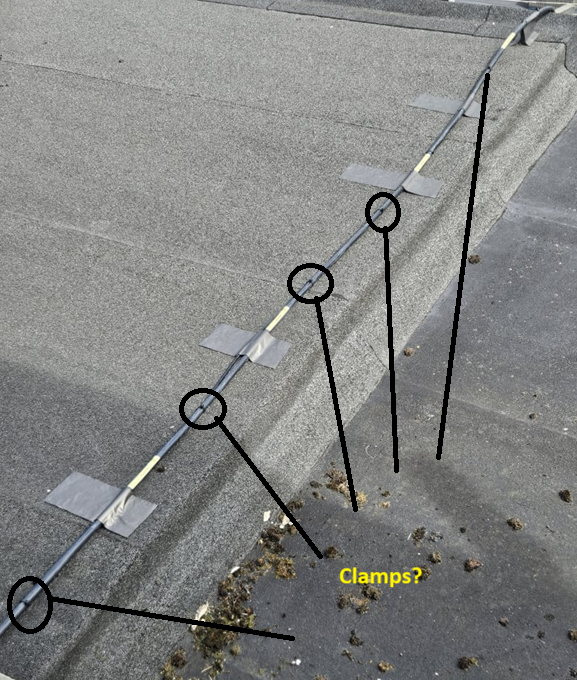
    It doesn't look great does it? That said, it does appear to be affixed by clamps every 18 inches or so, no? (It's kinda hard to see from the photo)

    Problem with those flat roofs is that any mounting is going to have to break the waterproof seal to affix the cable(s). I'd personally perfer if it was in a black/grey conduit, but yeah, that tape is probably going <somewhere> once it gets wet in a windy storm

    image.png


  • Moderators, Computer Games Moderators, Recreation & Hobbies Moderators Posts: 11,440 Mod ✭✭✭✭CatInABox


    Looks to me that those are cable ties, to hold together the two cables, so not clamps.

    Hard to see how you could clamp these down on a flat roof, as you pointed out, it'll pierce the waterproof seal.

    It's definitely something to monitor. Perhaps you could check that where the cable leaves the flat roof, the next clamp is as close as possible, and is heavy duty. A plastic clamp nailed into the wall will come loose as soon as the wind overcomes the tape.


  • Registered Users, Registered Users 2 Posts: 2,928 ✭✭✭ECO_Mental


    Looking at this closely I don't think that is regular old duct tape, but more a flat roof repair tape that is more substantial. You can see its a bit thicker and designed for outdoors. I would hope they didn't clamp it down to the roof, most equipment on flat roofs is held down using ballast, running cable I woudl assume be in maybe a metal duct to give it a bit of weight and protection. You can then also place some ballast on these metal ducts

    6.1kWp south facing, South of Cork City


  • Registered Users, Registered Users 2, Paid Member Posts: 8,639 ✭✭✭deezell


    The 'clamps' appear to be zip ties possibly threaded through small retainers. If these are attached to the roof by a screw through the felt into the ply, it's a leak risk. Otherwise there might be self adhesive retainers, but tiny, maybe 25mm, as you cant see them. These will have little purchase on the mineral felt, the mineral grit is not that well stuck to it.

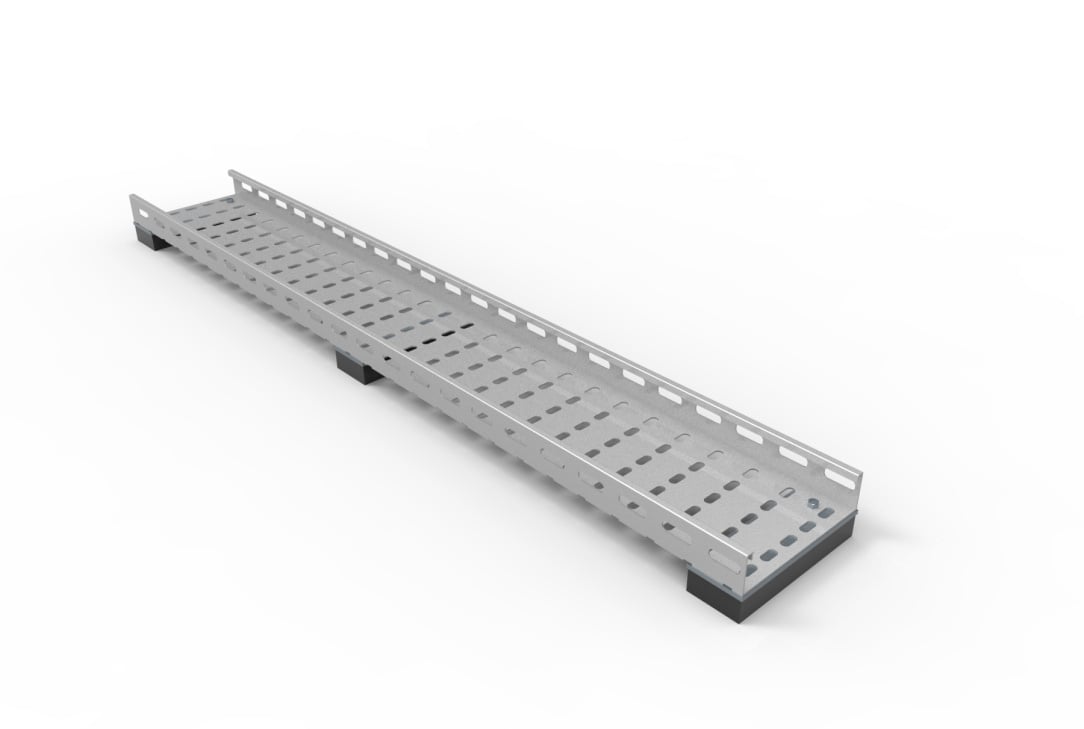
    Note there is another smaller cable attached to the outside of this larger tubing, you can see it over the tape. The zip ties in my opinion are doing no more than holding this cable to the thicker one, and only the gaffer/felt repair tape is keeping the lot on the roof. A small form cable tray adhered to the roof might sound like a more secure job, the existing arrangements are creating a flat roof water trap,especially as dirt and debris seal the cable to the roof. Nothing like a pool of water to accelerate flat roof felt integrity. Any cable carrier needs to be raised, and its mounts just glued down. The image is pure amateur hour installation, but I doubt they would shell out on a few metres of this type of tray.

    cable-tray.jpg


  • Registered Users, Registered Users 2 Posts: 807 ✭✭✭mr chips


    I've a noob question about bifacial panels. Presumably these are only effective if they're not actually fixed close to a roof, but rather are mounted with a sufficient gap such that the rear of the panel can catch reflected/ambient light. As in, close to zero usable extra light would be reflected even from a white surface, if it's as close as e.g. 8cm from the rear of the panels - correct?


  • Registered Users, Registered Users 2, Paid Member Posts: 16,062 ✭✭✭✭josip


    Bifacials are only of benefit in a ground mounted system.


  • Registered Users, Registered Users 2 Posts: 807 ✭✭✭mr chips


    As I thought in that case, cheers.


  • Registered Users, Registered Users 2 Posts: 5,463 ✭✭✭Deedsie


    Hi, considering getting solar panels fitted. Total newbie to this so don't really know what I need or should do. We have some complications.

    The house is slightly larger than your typical house but the south facing roof section is not very large. You would probably fit 4 panels at most.

    We have a combi boiler system so won't be able connect the solar panels to the current water tank.

    Is that a problem? When we change the boiler and install a solar compatibile hot water tank will we be able connect it retrospectively? Also would like to connect to an ev charger down the line. Can that connection be made retrospectively?

    With the grants that are available what can we expect to be spending? Would like a battery included.

    Would people expect an improved grant package in the budget? Should we wait for that?

    House was built in the late 90's. Based in North Tipperary.


  • Registered Users, Registered Users 2, Paid Member Posts: 8,639 ✭✭✭deezell


    I think you're confusing thermal solar panels with PV (photovoltaic). Thermal are filled with a fluid, heated by the sun. and the hot fluid pumped to your HW cylinder, (which you dont have). PV generate electricity during bright daylight which can be used to supplement your electricity consumption, fed back into the grid for a modest payment, or to charge a battery for later use. Car charging is nominally independent of solar. If you have some solar being generated, some charge in the solar battery also, this will reduce your electricity bills, the amount dependent on the number of panels and the time of year. Hot can also be heated by an electric immersion, which is not economical compared to combi on demand oil or gas heating, but could be heated by solar when available.

    Now cut to the chase. WIth room for 4 solar panels, you are not remotely in a position to heat water, charge cars, fill Batteries, install HW cylinder economically. 4 panels will run your fridge and background electronics. It won't boil a kettle. It certainly won't pay for and run the installation of a Hot water electrically heated storage cylinder. It will contribute almost nothing to charging an EV with average mileage (1600 km/month requires about10kwh per day, most of which will come from your supplier at flat rate or punitive day rate. Charging at night rate on a smart plan will reduce the costs somewhat, with the meagre solar available to supplement your household demand during day/peak rates

    Unless you can get ten south facing or maybe your four South panels plus another 10 or 12 EW panels, there is simply not the potential power incoming to pay back on PV heated HW cylinder installation or solar Battery installation.

    A 4 panel non hybrid installation might stil cost you €4000, none of these installers get out of bed for less. Fir that you can expect some reduction in bright daylight home consumption, plus a measure of feed in tariff rebate. A member of family with a basic builders 4 panels on his roof got about €500 FIT rebate after 5 years, and the rest is used running the fridge/freezer and other plugged devices in strong daylight. In winter it makes very little contribution.

    Post edited by deezell on


  • Advertisement
  • Registered Users, Registered Users 2 Posts: 5,463 ✭✭✭Deedsie


    Thank you very much for the detailed response. I may be entirely wrong about the number of panels that would fit on the South facing roof. We could also put a large number of panels on an East facing roof. The front of the house faces West and the roof would not look right with panels on it. The North would be the same Width as the South and obviously not much use panels wise.


  • Registered Users, Registered Users 2 Posts: 2,856 ✭✭✭bullit_dodger


    "roof would not look right with panels on it". I mean I can't say your wrong, but the general agreement is to fill your roofs with as many panels as you can to make it as worthwhile an investment on your home.

    When your sitting inside on a cold evening in November having a nice cup of tea watching the telly with credits that you obtained from feed-in-tariff over the summer months, do you really mind how the roof looks? With the adoption of panels in Ireland, I think most roofs look pretty slick with them on there, esp if it's done symetrical (nice grid etc and not slapped up willy-nilly, but again, that's a personal preference.


  • Registered Users, Registered Users 2, Paid Member Posts: 8,639 ✭✭✭deezell


    Alas some arrays look shyte on roofs, especially the smooth thin slate effect tiled roofs. Panels with a visible grid pattern, or big wide metal frame edges. Panels stood high off the roof tiles, with annoying gaps beteeen some rows, mixed horizontal and vertical. and the large uneven mandatory setback from gables or gutters can be very visually jarring. Panels inset as the actual roof are an extremely rare install. It's important to have a decent image generated by the satellite image software they use to get an idea how they will look, but casual observation will confirm some neat and pleasing layouts. and some slapped up looking ones.


  • Moderators, Home & Garden Moderators Posts: 7,738 Mod ✭✭✭✭graememk


    East west is a very viable option, peak power may not be as high but it starts early and stops late.


  • Registered Users, Registered Users 2 Posts: 2,856 ✭✭✭bullit_dodger


    Yeah that's true mate, esp ones where you have odd panels through at random filling spaces. That said, I've seen a couple of those flat thin slate roofs and a nice grid of black backed panels with the solid black (metal/plastic?) bird protectors skirting the panels tend to look pretty well and give the impression that the array is more apart of the roof.

    Aside: I don't think the bird protectors are generally needed, but they look well in that scenario. Worth considering if you haven't seen them (I guess that's directed to more to 'deesie' to consider)


  • Registered Users, Registered Users 2 Posts: 5,463 ✭✭✭Deedsie


    I looked again at the orientation of the house, thinking of the house as a rectangle, the front and back of the house are the longer parts. The right and left the narrower parts.

    So the Back is more ENE orientation, the front is WSW, one side is SE and the opposite end is NW.

    The roof is a slate roof.


  • Registered Users, Registered Users 2, Paid Member Posts: 16,062 ✭✭✭✭josip


    I'm with Guy de Maupassant as regards how the panels look on our roof.


  • Moderators, Category Moderators, Arts Moderators, Sports Moderators, Paid Member Posts: 56,323 CMod ✭✭✭✭magicbastarder


    thinking of getting solar? this in in your future.


Advertisement
Advertisement