Advertisement
Help Keep Boards Alive. Support us by going ad free today. See here: https://subscriptions.boards.ie/.
https://www.boards.ie/group/1878-subscribers-forum

Private Group for paid up members of Boards.ie. Join the club.
Hi all, please see this major site announcement: https://www.boards.ie/discussion/2058427594/boards-ie-2026

Is Irelands neutrality stance in WW2 unfairly criticized? (see Mod note 217)

19091939596109

Answers

  • Registered Users, Registered Users 2 Posts: 81,058 ✭✭✭✭FrancieBrady


    Hempel greatest use was as a useful tool for Francis’s crusade.

    The Allies knew he was no Nazi and was just doing what diplomats do. He returned to work as one - exonerated.


  • Registered Users, Registered Users 2 Posts: 6,540 ✭✭✭Francis McM


    Hempel was never "turned". If he was, he would have agreed to go to meet his otherwise handlers in western countries. Instead Dev told him he could stay here, at least for some years until the heat died down. And there were other radio transmissions from Ireland to Germany during the war, for example the weekly one from an agent who called to an IRA safe house to do so weekly.

    Anyway, none of that has anything to do with the fact

    "As noted already, during World War II, Nazi diplomats - old school, new school and any school - stationed in officially neutral countries that Germany subsequently invaded (such as Denmark, Norway, Belgium, the Netherlands, and Luxembourg) did transition from traditional diplomatic representatives into instruments of occupation, political subversion, and logistical control. People in those countries were selected and sent to Slave labour and extermination camps. Hempel ewould have known that. That was their job, same as he had a job working for Hitler during the war, and he had a private meeting with Hitler."


  • Registered Users, Registered Users 2 Posts: 6,540 ✭✭✭Francis McM


    Hempel lived here in relative luxury in Monkstown, Dublin for 4 years after the war having nothing to do with diplomatic or government work.

    His wife supported him by running a confectionery and bakery.

    The US wanted to see Hempel's records in very early May 1945 but the Irish government would not allow that, and instead allowed Hempel about a week to destroy all the records and evidence before allowing access to the embassy.


  • Registered Users, Registered Users 2 Posts: 81,058 ✭✭✭✭FrancieBrady


    You bullshitted about us refusing to ‘extradite Henpel until you changed tack on that, can you show one formal request for him to be handed over?

    Not anecdote, an actual source that shows a formal request?


  • Registered Users, Registered Users 2 Posts: 8,894 ✭✭✭jmcc


    Still the same debunked claim about radio transmissions. The transmitter in O'Donovan's home was seized and he was interned from 1941 to 1943.Transmitters tended to be detected quickly.

    Regards…jmcc


  • Advertisement
  • Registered Users, Registered Users 2 Posts: 6,540 ✭✭✭Francis McM


    On his wiki page it said, and it still says,

    "After his removal as the German head of mission, De Valera granted Hempel and other members of his staff asylum. He resisted requests from the Allies to extradite him, which would have led to a long internment in the Witness Prison of the Palace of Justice, Nuremberg.[6] Hempel was not allowed to work, but the family was able to go on living at the legation, Gortleitragh, in Monkstown, Dublin, and Hempel's wife then supported them by running a confectionery and bakery.[7"

    In that quote above, it says " He resisted requests from the Allies to extradite him".

    However, I knew there was no formal extradition in Ireland in the 1940s, the Allies requested him, to interview / question etc : they wanted to speak to Nazi diplomats for 3 reasons, which I went in to for you.

    The main point was:

    In other neutral countries that Germany invaded, Nazi party diplomats (like Hempel) in the countries before they were invaded became the one in charge of sending people to slave labour + extermination camps etc. Why would Hempel have behaved differently to other German diplomats - especially as Hempel was a Nazi Party member? That was his job.


  • Registered Users, Registered Users 2 Posts: 8,894 ✭✭✭jmcc


    For the early years of the war, telegraph cables to Germany were routed via the UK. The decision to block them was taken around 1943 (I think). That made communicating with Berlin a bit more difficult but not impossible.

    Regards…jmcc


  • Registered Users, Registered Users 2 Posts: 81,058 ✭✭✭✭FrancieBrady


    So no actual evidence just a wiki page. Wiki pages you accused someone else of editing? ?

    There is no extradition request and no formal request yet this was Hitler’s righthand man who the British couldn’t be bothered prosecuting coz they were tired or whatever ridiculous claim you made and then exonerated.

    Would you ever feck off with the nonsense


  • Registered Users, Registered Users 2 Posts: 5,122 ✭✭✭adaminho


    The irony of them accusing me of editing a Wiki page and then denying they edited a quote despite evidence. I stuck them on ignore.


  • Registered Users, Registered Users 2 Posts: 6,540 ✭✭✭Francis McM


    There always were other ways of communicating with Berlin. For example, as noted already:

    It is of course known that communications to Germany ( regarding Allied activity in N. Ireland etc) was not just sent from Hempel and his team during the war.

    For example, this is about Jim O'Donovan friend of Sean Russell and head of explosives in the IRA, and weekly radio information to Germany:

    Quote:

    "Yet despite all this, Jim O'Donovan was falling under Hitler's spell. In fact, during the early years of the war, he became increasingly interested in Nazi ideology and visited Germany three times.

    Speaking for the first time about his father's work with the Nazis, Gerard O'Donovan - who was a young boy during the conflict - told me how he still remembers one regular wartime visitor to their home in Dublin:

    "There was a room off the dining room where there was a radio transmitter. A man used to come every Saturday and send messages to Germany on that radio… and we children used to call (him) Mr Saturday Night."

    Jim O'Donovan died in 1979 without, according to those who knew him, any regrets about his involvement with the Nazis."

    Sean Russell's U-boat submarine did not attempt to come over and back without any communications ? ;)


  • Advertisement
  • Registered Users, Registered Users 2 Posts: 6,540 ✭✭✭Francis McM


    Little do you know that there was no extradition in Ireland in 1945. As I already pointed out to you:

    As noted already, if you research it, you will see many German and Axis diplomats were arrested, prosecuted by military tribunals, or tried for war crimes and "conspiring to wage aggressive war". Dev allowed Hempel remain here from 1945 until 1949. He stayed out near Dun Laoghaire as far as I remember."

    Extradition did not exist in Ireland in 1945. Quote:

    "FrancieBrady kept asking why was he not extradited, but if he knew anything about the era or Hempel, he would have known that extradition did not legally exist in Ireland in 1945. Although this State inherited British extradition laws, those laws broke down by the late 1920s. For decades, we relied on informal handovers - or not - instead of formal, court-backed procedures."


  • Registered Users, Registered Users 2 Posts: 81,058 ✭✭✭✭FrancieBrady


    You first claimed extradition was denied by Dev.

    I challenged you on it and you weaseled out of it and you think that is forgotten?
    You have done it several times now..

    Nobody is buying your drvel, nobody, not one other poster is riding to support your bitter crusade.
    You are a disgrace to reasonable debate.

    Once again Goodnight.


  • Registered Users, Registered Users 2 Posts: 6,540 ✭✭✭Francis McM


    Dev allowed Hempel to remain here for 4 years until the heat had died down, even though all Nazi diplomats were wanted in 1945 by the Allies for questioning. Hempel had destroyed all documentation and was allowed a week to do so by Dev and co, even though the Americans wanted immediate access.


  • Registered Users, Registered Users 2 Posts: 6,540 ✭✭✭Francis McM


    There were plenty of reasons the Allies wanted to interview Nazi diplomats like Hempel after the war. You may prefer to make personal attacks on me, but you should look at the facts, easily found online if you do not believe me:

    • War Crimes Trials: Diplomats and embassy staff were interrogated to build cases for the Nuremberg Trials, as they possessed firsthand knowledge of the regime's foreign policy and complicity in the Holocaust. [1, 2]
    • Asset Recovery: Interrogators questioned foreign service staff to track down stolen art, looted gold, and hidden funds as part of the Allied "Safehaven" project. Where did all the funds / loot from invaded countries, murdered jews etc go? How much did Hempel's office get, or how was it funded?


  • Registered Users, Registered Users 2 Posts: 81,058 ✭✭✭✭FrancieBrady


    Here's what you previously repeatedly claimed but sleeveenly rowed back from and tried another angle.

    After the war, the US and Allied forces requested that the Irish government extradite Hempel to stand trial. DeV once again resisted.

    Post 579

    They requested extradition TO STAND TRIAL?

    Not a shred of proof of either but that doesn't stop you making a false claim.

    Now, after repeated requests to back up your new claim we find you have no evidence of any formal requests for Hempel except the general request in 1945.


  • Registered Users, Registered Users 2 Posts: 8,894 ✭✭✭jmcc


    That is a fascinating article and points to Gray being little more than a messenger boy and not a professional diplomat. In itself, that is unsurprising as he was a nepo-crony appointment based on family connections. He seemed to be actively excluded from knowledge of intelligence operations. In context, feeding the German legation disinformation during the build-up to Overlord (the D-Day invasion) was extremely important and the American Note would have helped increase the confidence of the Germans in the material they were receiving via the German legation.

    The difference between Gray and Hempel is stark. Hempel was a professional diplomat and was not originally a member of the Nazi party. He also was aware of German intelligence attempts in Ireland.

    Hempel n

    had been aware of some German intelligence operations in Ireland (Abwehr and SD) but not of actual operational details unless the agents srewed up. Some of these agents seemed to cause problems for Hempel. Attempts to use the IRA as a German proxy to cause problems in Ireland and the UK did not work out well. The Irish government response of interning hundreds of IRA members caused serious problems for that strategy. German intelligence operations here shifted to intelligence gathering. Some of the Abwehr attempts and infiltrating agents became highly problematic for the German legation with the way that the agents seemed to get captured so quickly. With the way that agents often lost their transmitters, some of them contacted the legation directly if they were not already detected and arrested.

    The IRA was trying to get arms and finance from the Germans. This was not unusual and revisionist pro-British historians and opinionators in Ireland ahistorically try to depict this as collaboration, often mentioning Sean Russell and others, with the Germans. Ironically, the Unionists in 1914 illegally imported 25,000 weapons and perhaps over a million rounds of ammunition. This introduced the gun into Irish politics and made Irish Independence inevitable.The Irish Volunteers subsequently imported weapons and ammunition from Germany. There was large-scale democratic support for Home Rule in Ireland. After 1916, that changed and Irish Independence was voted for overwhelmingly by the Irish people in 1918. The voting franchise had been expanded and it was no longer just the comfortable Middle Class Catholic voters voting. The way that the UK tried and failed to suppress Irish independence created a bedrock for the policy of Irish neutrality in WW2.

    Churchill never seemed to have gotten over that and it seemed to colour his interactions with Ireland and the Irish government over Irish neutrality. Perhaps he even came to regret supporting the illegal and anti-democratic anti-Home Rule activities of the Unionists because appeasing them effectively made Ireland independent inevitable and that led directly to Ireland having a decision on its neutrality in WW2.

    Given the way that German encryption (both the manual ciphers and Enigma) was compromised, the German legation seems to have been a major asset for the Irish and Allied intelligence organisations. The compromise of German manual encryption was so complete that a German agent in captivity who thought he was communicating with Berlin was awarded the Iron Cross and promoted to major.

    Expulsion would have ended the German legation's use. Hemplel also knew the key players in Irish politics. In historical terms. he appears far more adroit than the bungling amateur Gray.

    Post edited by jmcc on

    Regards…jmcc


  • Registered Users, Registered Users 2 Posts: 81,058 ✭✭✭✭FrancieBrady


    Churchill never seemed to have gotten over that 

    He was by no means the only one, there are still those today who will spread mistruths and Britishcentric opinions on that period. That extends to criticism of Irish neutrality too.


  • Registered Users, Registered Users 2 Posts: 8,894 ✭✭✭jmcc


    There is another interesting parallel with how the voting electorate changed in 1918 and the current day politics in Ireland.

    The voting franchise was quite restricted in terms of who could vote prior to 1918. That meant that the Irish Home Rule vote was heavily Middle Class. Ignoring 1916. the extension of the franchise meant that the Irish electorate became far less Middle Class and more democratically representative of the population.

    In this respect, the collapse in support for FFG, two parties that once commanded over 80% of the vote in Irish GEs is similar to the way that support for the Irish Parliamentary Party collapsed in 1918. The CALPOL voters, the Comfortable, Affluent, Liberal, Property Owning, Lefties (according to the Irish Independent) almost economically resemble those who supported Home Rule. The pre-1918 Home Ruler voters were often benefitting economically from Ireland being part of the UK.

    Regards…jmcc


  • Registered Users, Registered Users 2 Posts: 6,540 ✭✭✭Francis McM


    You say Hempel "was not originally a member of the Nazi party". Hempel was a member of the Nazi party from 1938, before the war, and for the duration of the war. He was distraught at the suicide of his boss, the Fuhrer, and was wringing his hands etc when Dev called to offer condolences on behalf of the Irish people. The only P.M. in the world to to condolences to any Nazi official.

    Answer one question.

    In other neutral countries that Germany invaded, German diplomats (like Hempel) in the countries before they were invaded became the ones in charge of sending people to slave labour + extermination camps etc. Not all diplomats were Nazis but Hempel was. Why would Hempel have behaved differently to other German diplomats - especially as Hempel was a Nazi Party member? That was his job.

    Dev would have spared because he was the Nazi's useful fool,

    " nützlicher Idiot ",

    but what about the rest of use sent to slave labour Nazi concentration camps in the event of a German victory of these islands?

    You do realise there were 20 million slave labourers in Europe of the Nazis, many from neutral countries Germany invaded?

    In fact there were 50 captured Irish seamen among those slave labourers, 22 of who died in captivity in horrible conditions, so during the war Hitler or his followers like Dev's friend Hempel did not care where his slave labourers were from if they were not the master race.

    Untitled Image


  • Registered Users, Registered Users 2 Posts: 81,058 ✭✭✭✭FrancieBrady


    And around and around to previously debunked rants we go.


  • Advertisement
  • Registered Users, Registered Users 2 Posts: 8,894 ✭✭✭jmcc


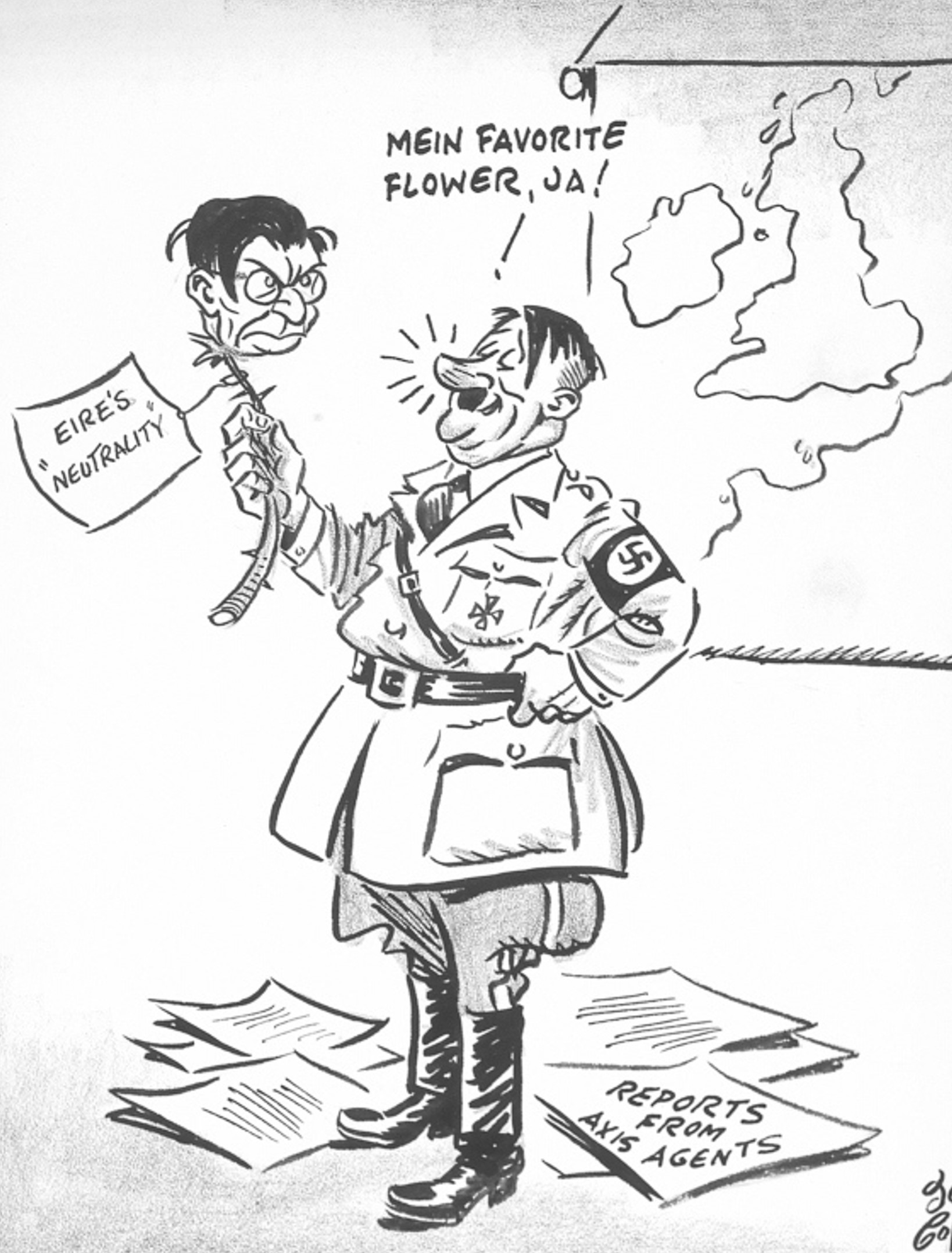
    Complete with the same cartoon being spammed on the thread multiple times.

    Regards…jmcc


  • Registered Users, Registered Users 2, Paid Member Posts: 4,303 ✭✭✭Cyclingtourist


    What change in the franchise has occurred in recent times to support your dodgy thesis about supposed similarities in the fortunes of the IPP and FF/FG? Even more dodgy given recent election results.

    FF during 'the Emergency' was largely made up of former anti-Treaty supporters who adopted repressive measures that were justified, in their estimation, to preserve the sovereignty of the state, exactly the same justification the pro-Treaty side gave for their policies in 1922-23.

    The unified position on neutrality can legitimately be viewed as the beginning of the end of Civil War politics in Ireland.


  • Registered Users, Registered Users 2 Posts: 81,058 ✭✭✭✭FrancieBrady


    The unified position on neutrality can legitimately be viewed as the beginning of the end of Civil War politics in Ireland.

    Not at all convinced there is any evidence for this ^^,

    IMO 'Civil War' politics ended when the vote-share collapse almost lost them them the power that had swapped between them. Remains to be seen if that is just a temporary truce too.

    Neutrality was just something they all thought was the correct direction to take.


  • Registered Users, Registered Users 2 Posts: 8,894 ✭✭✭jmcc


    The shift away from a largely property owning electorate to a more complex electorate with younger voters having to rent because the costs of buying a house increased massively. Many of these voters no longer vote for FFG or for the CALPOL parties. The shift away from the Irish Parliamentary Party was caused by 1916 and the 1918 GE. The collapse in support for FFG was caused by the bursting of the property bubble and the rise of a section of the electorate who were not comfortable property owners. More of them became eligible to vote and a similar shift to the collapse of the IPP happened in the GEs since 2011.

    Support for FFG has collapsed and it no longer has over 80% support. Irish GEs are STV rather than First Past The Post. That means that their decline was somewhat obscured due to the fragmented electorate. That younger renter element in the present day Irish electorate is growing. The WW2 FF was a catch-all party. The current FF has become more centre Right according to Wikipedia and others. In this respect, it is beginning to resemble the IPP. Would the current FF have been pro-neutrality? No. There is a distinct Redmondite hue to the current FF and its leader.

    Regards…jmcc


  • Registered Users, Registered Users 2 Posts: 8,894 ✭✭✭jmcc


    Apart from the pro and anti Treaty issues, FF and FG were both offshoots of the SF that had won the 1918 GE. It is no surprse that they broadly aligned on beutrality in WW2.

    GE

    Regards…jmcc


  • Registered Users, Registered Users 2, Paid Member Posts: 4,303 ✭✭✭Cyclingtourist


    The false narrative that there was a difference between FF & FG was exposed by the Emergency crisis and the retreat by FF from the radicalism of the 1930s. As the parties were still lead by first generation Civil War politicians the healing of the split wasn't at first evident.

    "Many of these voters no longer vote for FFG or for the CALPOL parties"

    Virtually all parties in the present Dáil could be described as 'CALPOL' parties. They're mostly populists who when in power moderate their policies.

    Anyway this is getting away from the subject of the thread.

    In 1939-45 there was political consensus on the major issue of the time. The divisions were mainly personality based or what such and such did in the WOI/1916. Partition had become meaningless as an issue and in fact aided Éire's ability to sustain sovereignty. Post-the Emergency it was a FG led government who took us out of the Commonwealth just as Dev's 1937 constitution had previously loosened the ties to the UK in the run-up to WW2. Everyone was headed in the same direction.


  • Registered Users, Registered Users 2 Posts: 81,058 ✭✭✭✭FrancieBrady


    The false narrative that there was a difference between FF & FG was exposed by the Emergency crisis and the retreat by FF from the radicalism of the 1930s. As the parties were still lead by first generation Civil War politicians the healing of the split wasn't at first evident.

    There was a difference with regard to the matter,

    DeValera and FF opposed the move because it had an impact on ending partition and other impacts.

    I agree it is off topic so will leave it there.


  • Registered Users, Registered Users 2 Posts: 8,244 ✭✭✭growleaves


    Yesterday you quoted a paragraph from Hempel's Wikipedia page which gave two linked sources. These sources were also included in your post.

    The second source was the following article written by Liv Hempel, his daughter:

    'Hitler's death didn't mean a damn thing to my father' – The Irish Times

    Liv Hempel was quoted as saying: “Hitler’s death didn’t mean a damn thing to my father; he was happy about it – like we are happy about Osama bin Laden.”

    You want people to think Hempel was "distraught" at Hitler's suicide, yet you're (unknowingly) linking to a first-person account that says he wasn't.

    You see Francis, this is what I was saying to you before: you are scanning Wikipedia summaries and AI blurbs and grabbing whatever snippets you think support your points, but you're not even reading or understanding your own sources! It is obvious that this is what you are doing.


  • Registered Users, Registered Users 2 Posts: 5,122 ✭✭✭adaminho


    I've linked to that article before and they dismissed it.

    Here is Dev in his own words.

    Though he never publicly commented on his reasons for visiting Hempel, de Valera privately defended his actions in a letter to Robert Brennan, the then Irish ambassador in Washington. “I have noted that my call on the German minister on the announcement of Hitler’s death was played to the utmost. I expected this. I could have had a diplomatic illness, but as you know, I would scorn that sort of thing. So long as we retained our diplomatic relations with Germany, to have failed to call upon the German representative would have been an act of unpardonable discourtesy to the German people and to Dr. Hempel himself. During the whole war, Dr. Hempel’s conduct was always irreproachable. I certainly was not going to add to his humiliation in his hour of defeat.” De Valera went on to say his actions should not have “special significance attached to it such as connoting approval or disapproval of the State in question, or of its head”.


  • Advertisement
  • Registered Users, Registered Users 2 Posts: 8,894 ✭✭✭jmcc


    The important point is why the electorate supports such policies and how the composition of the electorate itself plays such a strong role in that support. The latter is often overlooked when comparing the WW2 electorate with previous ones. If the same voting restrictions and requirements that had given the IPP such support (pre 1918) were in place for an Irish GE circa WW2, the elected TDs would probably have rejected neutrality and opted to join the Allies. This is because the restrictions (age, income, property, sex) on those eligible to vote were quite different. In terms of demographics, they were very different electorates. That meant that there was a natural trend towards neutrality because of the more representative electorate. It was not simply a government policy. FF and FG still had a lot of the same supporters who had fought in the WoI and also the Civil War. They had direct experience of dealing with the British hence the reluctance to join the UK (initially) in WW2.

    Regards…jmcc


Advertisement
Advertisement