Advertisement
Help Keep Boards Alive. Support us by going ad free today. See here: https://subscriptions.boards.ie/.
https://www.boards.ie/group/1878-subscribers-forum

Private Group for paid up members of Boards.ie. Join the club.
Hi all, please see this major site announcement: https://www.boards.ie/discussion/2058427594/boards-ie-2026

Is Irelands neutrality stance in WW2 unfairly criticized? (see Mod note 217)

18384868889109

Answers

  • Registered Users, Registered Users 2 Posts: 81,059 ✭✭✭✭FrancieBrady


    If you want to know more, buy the books yourself. I would not like to spoil them for you.

    You are a joke at this stage to be honest. Reduced to trolling.


  • Registered Users, Registered Users 2 Posts: 6,541 ✭✭✭Francis McM


    Rubbish. Read the books. Look up the many links on the web. You may not think the Irish seamen were abandoned but everyone else does.

    The facts are the facts as I always pointed out.

    When did the Irish govt know of Irish prisoners? 1941

    Who liberated the survivors of the men? British army

    When? in 1945, on their painful, slow push eastwards through Europe

    How many Irish merchant seamen died in captivity? 22

    How do you think the Irish government treated these men and other when they returned from the war? 

    Do you think Hempel, the distraught Nazi party diplomat who Dev sympathised to on the death of Hitler, deserved more respect - with Hitler - than the relatives of the 22 Irishmen who died in Hitler's Concentration camps?


  • Registered Users, Registered Users 2 Posts: 5,127 ✭✭✭adaminho


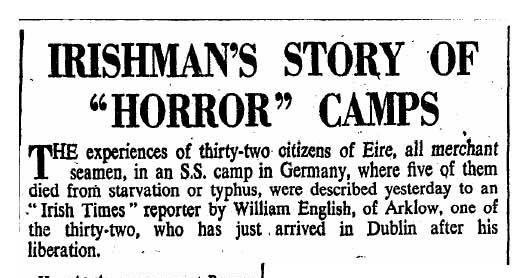
    billy english.jpg

    Irish Times 17 May 1945

    Newspaper coverage of Billy English. So It wasn;t ignored.

    The other examples are of Irish army deserters. That was covered earlier

    No proof of the men Farge being shunned by the Irish government like you claimed.

    Did Harry Callan mention it in his book?


  • Registered Users, Registered Users 2 Posts: 81,059 ✭✭✭✭FrancieBrady


    You posted links to deserters, not merchant seamen.

    Deserters in WW2 were lucky, they were shot in WW1. Nearly 400 of them by the British 266 shot in WW2

    WW1 deserters were only pardoned in 2006.

    Death Penalty for Desertion - Warfare History Network


  • Registered Users, Registered Users 2 Posts: 6,541 ✭✭✭Francis McM


    I gave you links in post 2551 to how many Irish were treated after they returned home from the war.

    For example "they came back to a country that was scornful of, ignorant of, and indifferent to what they had been through. In many cases, they faced open hostility."


  • Advertisement
  • Registered Users, Registered Users 2 Posts: 81,059 ✭✭✭✭FrancieBrady


  • Registered Users, Registered Users 2 Posts: 6,541 ✭✭✭Francis McM


    Wrong. Read this in the link. That gives a flavour of the times.

    "Of the 60,000 Irish men and women who joined the British Forces fighting against fascism, 9,000 died during the war while 12,000 returned to Ireland. The rest, wisely it appears, chose to stay in the UK.
    Returning Home explores in great detail the fate of thousands of Irish soldiers who returned home when the war ended only to find that they were not at all welcome. The book outlines the massive economic, social and psychological problems that these veterans faced for the rest of their lives."

    N.B you were asked already "

    Do you think Hempel, the distraught Nazi party diplomat who Dev sympathised to on the death of Hitler, deserved more respect - with Hitler - than the relatives of the 22 Irishmen who died in Hitler's Concentration camps?


  • Registered Users, Registered Users 2 Posts: 81,059 ✭✭✭✭FrancieBrady


    Are you blind?

    For the 5,000 men who deserted the Irish Defence Forces to join the British Army, poverty, joblessness and social exclusion were their reward (and that of their children as this reviewer can testify).


  • Registered Users, Registered Users 2 Posts: 5,127 ✭✭✭adaminho


    I see you left out the next lines again.

    By Paddy Reid
    16 September 2012
    Returning Home – Irish Servicemen after the Second World War by Bernard Kelly

    This timely book explores a largely forgotten period of Irish History. It tells the story of those thousands of Irish men and women who served in the British Armed Forces during 1939-1945. As such, this book is an important social document on Ireland’s often troubled, sometimes tormented, connection to World War Two. It is an excellent and quick read, aided greatly by the moving, personal stories of soldiers who returned to Ireland. Returning Home will appeal to the general reader as well as those who enjoy Irish historical writings. As such, this book would enhance the learning curriculum in school history courses.

    Of the 60,000 Irish men and women who joined the British Forces fighting against fascism, 9,000 died during the war while 12,000 returned to Ireland. The rest, wisely it appears, chose to stay in the UK.
    Returning Home explores in great detail the fate of thousands of Irish soldiers who returned home when the war ended only to find that they were not at all welcome. The book outlines the massive economic, social and psychological problems that these veterans faced for the rest of their lives.
    For the 5,000 men who deserted the Irish Defence Forces to join the British Army, poverty, joblessness and social exclusion were their reward (and that of their children as this reviewer can testify).


  • Registered Users, Registered Users 2 Posts: 6,541 ✭✭✭Francis McM


    What about the other 55,000 to 60,000? Just above your highlighted bit it says

    "Of the 60,000 Irish men and women who joined the British Forces fighting against fascism, 9,000 died during the war while 12,000 returned to Ireland. The rest, wisely it appears, chose to stay in the UK.
    Returning Home explores in great detail the fate of thousands of Irish soldiers who returned home when the war ended only to find that they were not at all welcome. The book outlines the massive economic, social and psychological problems that these veterans faced for the rest of their lives."

    N.B. some others would think up to 130,000 Irish people, from north and south, fought for British forces during WW2. Most from south of the border learnt to keep their mouths shut about it though if and when they returned home.


  • Advertisement
  • Registered Users, Registered Users 2 Posts: 5,127 ✭✭✭adaminho


    not at all welcome.

    So only the 5,000 weren't welcome. How were the rest shunned by the government. You have access to the government records there should be some mention of it. You read Harry Callan's book, what did he say about it?


  • Registered Users, Registered Users 2 Posts: 6,541 ✭✭✭Francis McM


    As the books say of Irish people who were in the war and returned "they came back to a country that was scornful of, ignorant of, and indifferent to what they had been through. In many cases, they faced open hostility."

    Read the book.

    "they came back to a country where their attitude to them was so poisonous that they quickly learned to keep their war service secret."


  • Registered Users, Registered Users 2 Posts: 5,127 ✭✭✭adaminho


    "When ex-servicemen returned their friends and family were delighted to see them, but they encountered indifference from the government and much of the population. There were no bands out to meet them because most people did not see the Second World War as Ireland's war; it wasn't something to be celebrated.

    What should the government have done for them? A pension? A medal for fighting in someone else's war? What?


  • Registered Users, Registered Users 2 Posts: 8,896 ✭✭✭jmcc


    More deflection to post-WW2 after yet another claim was debunked or shown to be economical with the facts that contradicted the claim.

    Regards…jmcc


  • Registered Users, Registered Users 2 Posts: 6,541 ✭✭✭Francis McM


    Quote from the book:

     In many cases, they faced open hostility."

    "they came back to a country where their attitude to them was so poisonous that they quickly learned to keep their war service secret."

    I think it was you who were one of the ones who asked what happened when they came home. The book gives a flavour of the time. ;)

    By the way, Do you think Hempel, the distraught Nazi party diplomat who Dev sympathised to on the death of Hitler, deserved more respect - with Hitler - than the relatives of the 22 Irishmen who died in Hitler's Concentration camps?


  • Registered Users, Registered Users 2 Posts: 81,059 ✭✭✭✭FrancieBrady


    You are not answering the question again.

    What did the government do (the thread subject) to discriminate against these men


  • Registered Users, Registered Users 2 Posts: 6,541 ✭✭✭Francis McM


    What are you on about "discriminated against"

    The book says

     In many cases, they faced open hostility."

    "they came back to a country where their attitude to them was so poisonous that they quickly learned to keep their war service secret."

    You have not answered the question:

    By the way, Do you think Hempel, the distraught Nazi party diplomat who Dev sympathised to on the death of Hitler, deserved more respect - with Hitler - than the relatives of the 22 Irishmen who died in Hitler's Concentration camps?


  • Registered Users, Registered Users 2 Posts: 5,127 ✭✭✭adaminho


    And the next line in the quote that you left out?

    Instead, they came back to a country that was scornful of, ignorant of, and indifferent to what they had been through. In many cases, they faced open hostility. Their service in the British forces was seen by many at home as anti-national, almost traitorous.

    So some people didn't like that they joined the British army. No mention of them being shunned by the government.

    You also started all this by claiming the government shunned the Merchant seamen. How? You have the books, what does Harry Callan's book say about it?


  • Registered Users, Registered Users 2 Posts: 6,541 ✭✭✭Francis McM


    Callan's book says they quickly learned to keep their mouths shut about their war experiences when they returned to Ireland.

    You have not answered the question Do you think Hempel, the distraught Nazi party diplomat who Dev sympathised to on the death of Hitler, deserved more respect - with Hitler - than the relatives of the 22 Irishmen who died in Hitler's Concentration camps?


  • Registered Users, Registered Users 2 Posts: 5,127 ✭✭✭adaminho


    All these things were from a previous time and I wanted to forget them — I wanted to get on with my life. I did not
    know what to say to my friend.
    Charlie Byrne lived across the road from Billy; Patrick Reilly and Patrick Kavanagh lived further up the road. I could understand why they were upset. It would be hard for them, knowing that their families and neighbours had read the newspaper; not many of the people I knew bought The Irish Times. I handed the article back to Billy. ‘Sorry, I just can’t talk about Farge.’
    ‘That's all right, Harry.’

    Harry Callan

    As for the government shunning them? From the Berard Kelly book you quoted.

    For example, based on their wartime service in
    the British armed forces, veterans were paid insurance benefit by the Irish state
    which was then refunded by Britain. As Kelly relates, de Valera tried unsuccessfully
    to use this arrangement to negotiate a more wide-ranging agreement whereby
    Britain would pay benefits to Irish workers who had returned home after working in
    British industry during the war


  • Advertisement
  • Registered Users, Registered Users 2 Posts: 81,059 ✭✭✭✭FrancieBrady


    What 'open hostility' from the government did they face?


  • Registered Users, Registered Users 2 Posts: 6,541 ✭✭✭Francis McM


    Read the book and find out. That is the purpose of the books. Because no matter what I or the people who survived the camps or the Irish Independent say, you do not accept it anyway, even when it it backed up by the books.


  • Registered Users, Registered Users 2 Posts: 81,059 ✭✭✭✭FrancieBrady


    Read the book and find out.

    Trolling again when in a corner. Quelle suprise.

    You cannot tell us what the government did = fact.


  • Registered Users, Registered Users 2 Posts: 6,541 ✭✭✭Francis McM


    The book also says those who came home especially struggled to find work. Not surprising considering these quotes from the book:

     In many cases, they faced open hostility."

    "they came back to a country where their attitude to them was so poisonous that they quickly learned to keep their war service secret."

    By the way, Do you think Hempel, the distraught Nazi party diplomat who Dev sympathised to on the death of Hitler, deserved more respect - with Hitler - than the relatives of the 22 Irishmen who died in Hitler's Concentration camps?


  • Registered Users, Registered Users 2 Posts: 5,127 ✭✭✭adaminho


    You were told previously that there were 70,000 unemployed in Ireland at the end of the war. Where were they going to get jobs?


  • Registered Users, Registered Users 2 Posts: 81,059 ✭✭✭✭FrancieBrady


    Struggling to find work was common in Ireland in the post war economy.

    Were they specifically discriminated against by any government measure? Did our neutrality affect their employment prospects?

    *I am not touching your 'have you stopped beating your wife' question. If you can't work out the difference between observing diplomatic protocols and individual condolences that's your problem.

    **Also, long ago when first asked I said I think DeValera made a mistake going to Hempel's house.
    I haven't pivoted, changed or backed away from that view.


  • Registered Users, Registered Users 2 Posts: 6,541 ✭✭✭Francis McM


    You asked what happened when they came home. I showed you links which you now seemingly accept.

     In many cases, they faced open hostility."

    "they came back to a country where their attitude to them was so poisonous that they quickly learned to keep their war service secret."

    By the way, Do you think Hempel, the distraught Nazi party diplomat who Dev sympathised to on the death of Hitler, deserved more respect - with Hitler - than the relatives of the 22 Irishmen who died in Hitler's Concentration camps?


  • Registered Users, Registered Users 2 Posts: 81,059 ✭✭✭✭FrancieBrady


    You asked what happened when they came home.

    So far you have FAILED to present anything that shows the subject of the thread, the government - did anything to discriminate against these men and women.

    Struggling again.


  • Registered Users, Registered Users 2 Posts: 6,541 ✭✭✭Francis McM


    After Defending Dev for many posts you finally accepted he "made a mistake" when it was pointed out to you he was the only P.M. in the world who sympathised on Hitler's death.

    Now, will you answer the question asked already : Do you think Hempel, the distraught Nazi party diplomat who Dev sympathised to on the death of Hitler, deserved more respect - with Hitler - than the relatives of the 22 Irishmen who died in Hitler's Concentration camps?


  • Advertisement
  • Registered Users, Registered Users 2 Posts: 6,541 ✭✭✭Francis McM


    That is not the subject of this thread. JMCC was complaining about "More deflection to post-WW2" 

    Now, will you answer the question asked already : Do you think Hempel, the distraught Nazi party diplomat who Dev sympathised to on the death of Hitler, deserved more respect - with Hitler - than the relatives of the 22 Irishmen who died in Hitler's Concentration camps?


Advertisement
Advertisement