Advertisement
Help Keep Boards Alive. Support us by going ad free today. See here: https://subscriptions.boards.ie/.
https://www.boards.ie/group/1878-subscribers-forum

Private Group for paid up members of Boards.ie. Join the club.
Hi all, please see this major site announcement: https://www.boards.ie/discussion/2058427594/boards-ie-2026

Is Irelands neutrality stance in WW2 unfairly criticized? (see Mod note 217)

14142444647109

Answers

  • Registered Users, Registered Users 2, Paid Member Posts: 4,303 ✭✭✭Cyclingtourist


    I remember on school trips in 1950s & 60s being surprised as a Dub hearing people in Dundalk refer to the country as the Free State, think it lingered longer in border counties. Éire was on our stamps and was both a correct and convenient name during WWII.

    We weren't at 'war' and references to individuals like Montgomery or Brendan Bracken (Minister for Information) as being Irish was banned but referring to the conflict we weren't in as 'war' was never banned.


  • Registered Users, Registered Users 2 Posts: 5,125 ✭✭✭adaminho


    In reply to your edit

    Do not forget many Canadians died crossing the Atlantic trying to come and fight ridding Europe of Nazism, when we looked on as the western most part of Europe and not allowing any Canadian planes or ships to be temporarily based here to defend those people.

    Did Canada request to base planes or ships here?


  • Registered Users, Registered Users 2 Posts: 6,540 ✭✭✭Francis McM


    You highlight the part of the quote and only remember the part you like. I look at the quote as a whole. The bit that includes for example how Canada "actively lobbied Dublin to abandon neutrality". Also "Canadian officials pushed strongly for Ireland to join the Allied cause, emphasizing the geopolitical and naval importance of the island to the survival of the United Kingdom."

    I also looked at the bit you highlighted in bold. Much fairer to quote the whole lot as I did, without editing any in bold.


  • Registered Users, Registered Users 2 Posts: 5,125 ✭✭✭adaminho


    I did not edit anything out. I just did not quote the whole article. If you want to read the whole article I provided the link.

    I'll just use your answer from yesterday shall I?

    Yes Canada lobbied us to join the war as did Britain and America. What did they do when we didn't? The answer was in the section I highlighted.

    Canada asked, we said no, Canada said okay. I wonder is there a Cartoon for that?


  • Registered Users, Registered Users 2 Posts: 81,059 ✭✭✭✭FrancieBrady


    US soldiers were forbidden to cross the border without permission. Of course this was ignored as there were attractions and things available that weren't in 'at war' NI..

    I was involved with an RTE programme here documenting people's stories of the time. One long believed story got debunked by one elderly man.
    A famous fire and brimstone RC priest used patrol the cinema here with a cane, ensuring no boys and girls sat 'dangerously' together. It attracted media interest etc and it was always assumed he was just a moral conservative.
    The elderly contributor however had a different story, he was protecting girls from wily American soldiers who had snook across the border seeking fun times with more innocent girls. 😁


  • Advertisement
  • Registered Users, Registered Users 2 Posts: 5,125 ✭✭✭adaminho


    I'd say there were a few neutralities breached alright😁


  • Registered Users, Registered Users 2 Posts: 81,059 ✭✭✭✭FrancieBrady


    Castle Archdale further into Fermanagh is good too, bigger display and closely connected to Lough Erne


  • Registered Users, Registered Users 2 Posts: 17,555 ✭✭✭✭Flinty997


    The cartoon illustrates that not every where at that time were ok with Irish Neutrality.


  • Registered Users, Registered Users 2 Posts: 5,125 ✭✭✭adaminho


    And was pointed out around the second or third time it was posted it was as a result of leaks from American ambassador David Gray to try pressure De Valera to close the German embassy. He was persuaded to drop this campaign by William Donovan, head of the OSS and founder of the CIA as it jeopardised US and British spy operations involving the Irish.

    The New York Times warned, the German legation might pass on information that would “endanger the lives of many thousands of Allied soldiers, including many of Irish descent”. Amidst this hysterical coverage, de Valera was depicted as indifferent to the Allies’ plight. Joe Walshe visited London and “protested vigorously” to J. Russell Forgan, who was acting head of European operations for the OSS in David Bruce’s temporary absence.

    “Although I agreed with him completely,” Forgan wrote to me in 1970, “I had to say that if we told the actual facts, all of the wonderful work that his intelligence services had been doing with the Allies would be ruined. He saw the point immediately.”

    The Irish had provided some “very useful” co-operation on intelligence matters, Forgan assured me. “In general, despite the American news media,” he emphasised, “the Irish worked with us on intelligence matters almost as if they were our allies. They have never received the credit due them.”

    Gray hated Dev and never missed an opportunity to try discredit the Irish.

    After retiring, Gray persisted with what had become an obsession to discredit de Valera, this time by writing his critical memoir. He spent years on it, but then he suddenly abandoned the project around 1960, because, he said, the ghost of Roosevelt had advised him to forget it.

    Not the first time he quoted ghosts either.

    Shortly after arriving in Dublin in Apr 1940, Gray wrote to US president Franklin D Roosevelt about “the memories and the ghosts” in his official residence in Phoenix Park, where the late British prime minister Arthur J Balfour had lived in the 1880s. Balfour had held seances with the famous medium Geraldine Cummins of Cork. She would go into a trance and write out supposed messages from ghosts. She began holding seances for Gray.

    On Nov 8, 1941, Balfour’s ghost supposedly warned Gray about Joe Walshe, secretary of the Department of External Affairs. “He, from what I can see, is hand and glove with the German Minister,” the message read.At a further seance on Dec 2, 1941, Cummins produced a message from the late US president Theodore Roosevelt. “I want to tell you,” Cummins wrote, “that I think Franklin will hold the Japs for a while; at any rate from our country’s point of view. I see no immediate Armageddon for young America, possibly not at all.”

    This was the Tuesday before the Japanese attacked Pearl Harbor, but Gray’s belief that he was in touch with ghosts was unshaken. “Four days after this communication,” Gray wrote to Franklin D. Roosevelt, “the Japs attacked Pearl Harbor. They had TR fooled. I suspect that if these communications come through pretty much as given our friends on the other side don’t know very much more than they did on this side.”


  • Registered Users, Registered Users 2 Posts: 17,555 ✭✭✭✭Flinty997


    There a lot inconsistency to Irish Neutrality at the time. The idea propagated here that any violation put neutrality at risk doesn't hold up looking at how inconsistent it was.


  • Advertisement
  • Registered Users, Registered Users 2 Posts: 17,555 ✭✭✭✭Flinty997


    These long winded political anecdotes about ghost and grudges with DeValera are not needed. Devs own actions condemned his own legacy and by association Irish Neutrality.


  • Registered Users, Registered Users 2 Posts: 81,059 ✭✭✭✭FrancieBrady


    There may have been, and I'd have no issue agreeing but we are are making a judgement using hindsight, that nobody had at the time. Dev etc had to play the war in real time, really difficult time and again, in hindsight, they got it right.

    That is important even if you can't see it.


  • Registered Users, Registered Users 2 Posts: 5,125 ✭✭✭adaminho


    Condemned by who? Most of it was during the war period when people only knew what was being leaked to the press. The people who really knew what was happening with Irish cooperation have been quoted here plenty of times. The whole point of this thread is to determine whether criticism was unfair. With everything that is known about Ireland's actions during the war do you think Dev was right or wrong with his stance on neutrality? It seems the only thing to hold against him personally is his visit to Hempel's house on Hitler's death, and for the avoidance of doubt here, even though his motives were meant to be sympathy to Hempel and not for Hitler I fully understand the backlash.


  • Registered Users, Registered Users 2 Posts: 17,555 ✭✭✭✭Flinty997


    Even if you can't see it, he brought the country to civil war, split the country as it is today, caused unnecessary economic hardship and stagnation of the economy, and associated himself and thus Ireland with Nazi Germany.

    This thread exists because that's the perception.

    Much of his reputation is fixing problems he instigated in the first place, or taking credit for things he didn't do on his own. Not that he's reputation is all bad or that he didn't do good things especially with regard to neutrality. But he forever tainted it with his hate for all things British.


  • Registered Users, Registered Users 2 Posts: 6,540 ✭✭✭Francis McM


    An estimated 70 to 85 million people died during World War II, including about 40 million civilians. It is also a fact, not an opinion, that World War II was initiated by Nazi Germany, led by Adolf Hitler, when it invaded Poland on September 1, 1939. This act of aggression prompted the UK and France to declare war on Germany on September 3, 1939. Fact.

    You may think we done the right, moral thing throughout the war, but many people died in the mid Atlantic gap who would disagree with you.

    You still have have clarified if you would have liked a German victory or not, like some other Republicans who you defended like Sean Russell.

    Would you have preferred if more of the map below was coloured blue (Axis) or grey (neutral like us)?


  • Registered Users, Registered Users 2 Posts: 17,555 ✭✭✭✭Flinty997


    There's good and bad to Irish Neutrality. It's not black and white. Both good and bad reberate to the today.


  • Registered Users, Registered Users 2 Posts: 81,059 ✭✭✭✭FrancieBrady


    You may think we done the right, moral thing throughout the war, 

    The goal was to protect Ireland and it's people.

    Yes. I think, all things considered, and without slanting, spinning, lying or misrepresenting the actual facts and realising that hindsight was not available to the decision makers, it was the 'right' thing to do and I support our neutrality.

    I understand that is not eveyone's view and you could if you want blame us for death's, but as has been pointed out you can go back further and blame those death's on others with equal cause.
    In any conflict situation, I will always put the primary blame on those who had the power to prevent that conflict in the first place.


  • Registered Users, Registered Users 2 Posts: 6,540 ✭✭✭Francis McM


    The world saw Dev as very morally questionable because he prioritized absolute national sovereignty and survival over the global fight against fascism. We were like the fellow at the free bar, drinking some free pints, while a fight was started by bullies and we done nothing to help except stand there. And then express condolences for the main bully and instigator of the fight when he died.

    Other people can put it better than me:

    • Denial of the "Treaty Ports": Ireland refused to allow the Royal Navy to use strategic deep-water ports (such as Berehaven, Cobh, and Lough Swilly). This forced British and American naval forces to take longer, more dangerous routes to protect Atlantic shipping convoys from German U-boats, significantly compounding Allied casualties.
    • Strict Censorship & "Moral Equivalence": The Irish government—referred to as "The Emergency" domestically—enforced heavy censorship. The local press was barred from explicitly condemning Nazi atrocities, and news of the Holocaust was frequently suppressed or written off as mere "British propaganda," creating a dangerous moral vacuum at home.
    • De Valera's Condolences to Germany: Taoiseach Éamon de Valera paid a formal visit to the German minister in Dublin to offer official condolences following Adolf Hitler's death in 1945. This act provoked massive global outrage and remains the most prominent symbol of perceived Irish moral insensitivity toward the war's victims.
    • Treatment of Allied Volunteers: While Ireland remained neutral, an estimated 70,000 Irish citizens quietly crossed the sea to volunteer in the British Armed Forces. Upon returning home, thousands of these veterans—and over 5,000 who had deserted the Irish Defence Forces to fight—faced severe state penalties, including the loss of pensions, unemployment benefits, and public sector employment.


  • Registered Users, Registered Users 2 Posts: 5,125 ✭✭✭adaminho


    AI is not the world! Use links to back your point up!


  • Registered Users, Registered Users 2 Posts: 17,555 ✭✭✭✭Flinty997


    This hindsight argument doesn't hold water. It's a false narrative..

    Irish people of the day did not volunteer en masse to fight with Germany.


  • Advertisement
  • Registered Users, Registered Users 2 Posts: 81,059 ✭✭✭✭FrancieBrady


    The world saw Dev as very morally questionable

    The 'world' saw many different people as 'morally questionable and changed their opinion;
    Gandhi, Mandela, Luther King spring to mind.

    I'm not giving Dev their stature, my point about him is the 'world' soon got over it, and in a few years too as shown by the facts.
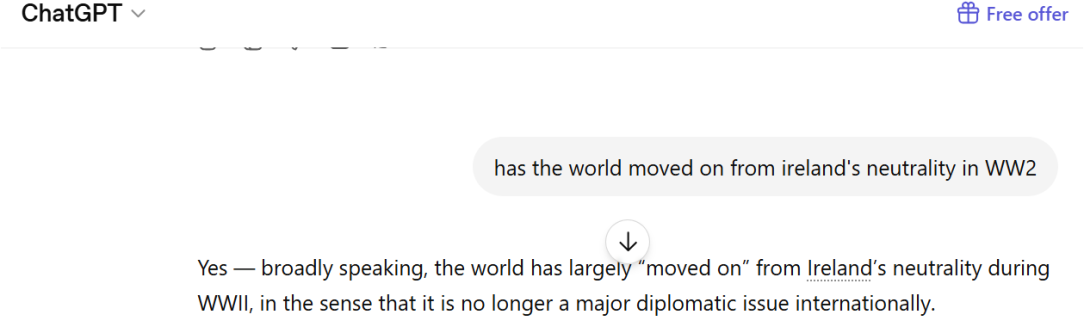
    The world has almost totally forgotten what happened here bar a few still bitter, frankly, under-researched people on the internet.
    Here's some AI Chat to prove it. 😁

    image.png


  • Registered Users, Registered Users 2 Posts: 81,059 ✭✭✭✭FrancieBrady


  • Registered Users, Registered Users 2 Posts: 6,244 ✭✭✭Sudden Valley


    The Irish contributed alot of men to the allied cause, that is not in question but the consequences in the country if the government had committed to ally with the British and allied forces is. We dont know what would have happened if De Valera had take the unpopular route of not being neutral. No political party at that time here supported that stance.


  • Registered Users, Registered Users 2 Posts: 81,059 ✭✭✭✭FrancieBrady


    Hugely important and completely ignored of course.
    Almost total political support across the House and when one deputy objected he was forced to resign by his party leaders in FG.

    But Dev this Aiken that…


  • Registered Users, Registered Users 2, Paid Member Posts: 4,303 ✭✭✭Cyclingtourist


    That map of the world with all the green is misleading to say the least.

    The light green represents all countries who after Pearl Harbour till the end of the war declared war on someone. This includes obviously the U.S. and a number of others but also countries like Uruguay (February 1945), Argentina (March 1945) and even Chile (April 1945) which specifically declared war on Japan and only participated on a diplomatic level. Peru declared 'a state of belligerency' against the Axis in February 1945 which allowed them join the UN even though their 'belligerency' was purely diplomatic.

    In Europe the Finnish participation is unique in a number of ways. It fought on the German side but managed to avoid the occupation of its capital by the Red Army. It was the only democracy fighting for the Axis. It, like Ireland, joined the UN in 1955.


  • Registered Users, Registered Users 2 Posts: 5,125 ✭✭✭adaminho


    Also Iceland while officially neutral is classed as Allied on that map due to being invaded by Britain.


  • Registered Users, Registered Users 2 Posts: 6,540 ✭✭✭Francis McM


    Stop diverting about Ghandi etc. Nobody has changed their views about Hitler. Hitler was no Ghandi. Hitler is still thought of as the most evil man in the world ever.

    And who in the world commiserated over him? Dev.


  • Registered Users, Registered Users 2 Posts: 81,059 ✭✭✭✭FrancieBrady


    Who mentioned Hitler? 😁

    Yes, Dev followed centyries established diplomatic protocol.

    Not his wisest decision, but again, forgotten about and the world got on with setting up the UN, etc. Are we excluded from any world bodies we wish to be members of? Nope.

    Did a single one of the Allies, break off diplomatic ties? Nope, Impose embargoes? Nope Impose Trade sanctions or restrictions? Nope

    Just some bitter folk who have to spin, lie, misrepresent and invent to make their case.


  • Registered Users, Registered Users 2 Posts: 5,125 ✭✭✭adaminho


    Okay, let's try this,

    How would Ireland have abandoned neutrality when there was no political party calling for it and the majority of the country were in favour of it?

    What do you think should have happened?

    I want your opinion and any ideas you have on how it would work and we can work out different scenarios.

    There are no right or wrong answers but, bear in mind,we are talking about the period during the early war so you only have access to information available at that time.

    Edit: Take your time, think it through I'm not expecting an answer straight away.


  • Advertisement
  • Registered Users, Registered Users 2, Paid Member Posts: 4,303 ✭✭✭Cyclingtourist


    Yes and the British also occupied the Faero Islands.

    Note also Denmark appears in dark green in the map. The Danish government and King remained in Copenhagen following the German invasion and cooperated with Germany. Relations with Germany remained calm until the summer of 1943 when an Allied victory was becoming increasingly obvious.

    Denmark was 'liberated' in May 1945 having never had a 'government in exile' or having declared war on either the Allies or the Axis.

    Hard to see why it's coloured green in the map.


Advertisement
Advertisement