Advertisement
Help Keep Boards Alive. Support us by going ad free today. See here: https://subscriptions.boards.ie/.
https://www.boards.ie/group/1878-subscribers-forum

Private Group for paid up members of Boards.ie. Join the club.
Hi all, please see this major site announcement: https://www.boards.ie/discussion/2058427594/boards-ie-2026

Is Irelands neutrality stance in WW2 unfairly criticized? (see Mod note 217)

13334363839109

Answers

  • Registered Users, Registered Users 2 Posts: 81,059 ✭✭✭✭FrancieBrady


    😁😁 use of the Azores didn’t make much difference to the people of Coventry or London or Pearl Harbour.

    An awful lot of lives and crucial battles would have been lost without access to our weather reports.

    We were neutral what we could do’ like Portugal, was limited.


  • Registered Users, Registered Users 2 Posts: 5,125 ✭✭✭adaminho


    The cartoon was printed around the time FDR demanded the expulsion of the German delegation.

    The note outlined help that the United States had given to Ireland over the decades and suggested that this was being repaid with an Irish policy that helped the Nazis. As "an absolute minimum", Roosevelt demanded that the Irish expel the Axis diplomats, because they afforded Germany an espionage advantage that was endangering "the lives of thousands" of American soldiers preparing for the Allied invasion of Europe. The note was worded to ensure de Valera's rejection.

    The story was leaked to the American press and a smear campaign was launched against de Valera in America, where the episode made front page news throughout the country during the week leading up to St Patrick's Day. Administration officials contended that the Irish should realise that diplomats were an espionage threat.

    De Valera saw red. Walshe went to London to warn Marlin that if the American divulged that Irish diplomats were being used as American spies, all co-operation would be cut off.

    We know the cartoon, there's no need to spam the thread with it everytime!


  • Registered Users, Registered Users 2 Posts: 6,540 ✭✭✭Francis McM


    There were ships relatively close to Belmullet and all over the place giving weather reports. Portugal giving the use of the Azores made a big difference in that part of the Atlantic.


  • Registered Users, Registered Users 2 Posts: 6,540 ✭✭✭Francis McM


    You miss the point. Look at the cartoon from Canada again. It had nothing to do with St. Patricks day etc. It is about Ireland, our neutrality and Hitler etc.


  • Registered Users, Registered Users 2 Posts: 81,059 ✭✭✭✭FrancieBrady


    Good for them.

    If your knowledge deficit includes not knowing how vital the weather reports where to Eisenhower and the Allies I wouldn’t be at all suprised. But I reckon you know only too well and will now try and obfuscate and spun again.


    It’s ineffably sad to see someone so full of self loathing that you feel the need to go on a crusade like this.


  • Advertisement
  • Registered Users, Registered Users 2, Paid Member Posts: 4,303 ✭✭✭Cyclingtourist


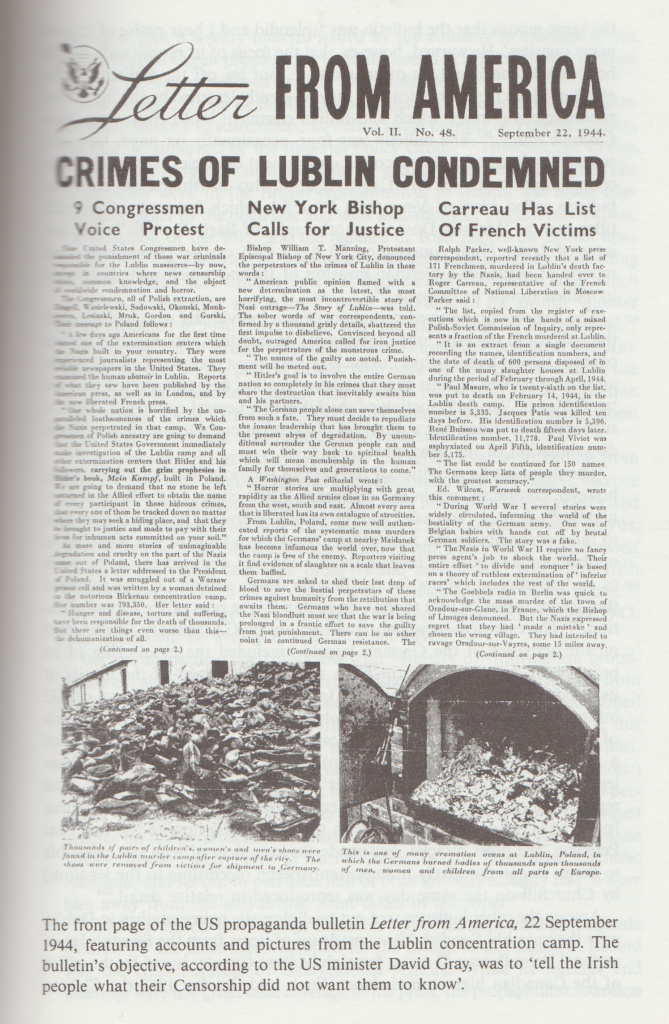
    Scan_20260525.jpg

    From 'Censorship in Ireland 1939-1945' by Donal O'Dridceoil (Cork University Press 1996).


  • Registered Users, Registered Users 2 Posts: 5,125 ✭✭✭adaminho


    It was published as a comment on the the US leaks about the Germans in Dublin. It wasn't know at the time that it was an MI5 operation feeding false info. Here is different account.

    When MI5 explained the situation, OSS leaders realised the Irish security situation was even better than they “had previously thought”. MI5, which was effectively using the German diplomats in Dublin as double agents, had serious reservations about the Americans demanding the expulsion of Axis diplomats from Dublin.
    If the German diplomats were expelled, MI5 warned that this would possibly endanger Allied security, because the Germans might infiltrate a useful spy. As it was, the British had broken the German codes and were reading all the messages from the legation in Dublin.

    The OSS knew Gray’s proposal was just a political ruse, so it did not involve itself in the American Note, which was delivered to de Valera on February 21, 1944. News of the note and de Valera’s refusal broke on March 10.
    As this was the week leading up to St Patrick’s Day, the news ignited a firestorm of criticism in the American press. Ireland was denounced as indifferent to the lives of American soldiers, even Irish-American boys. Some American journalists contended that the Irish should realise that diplomats were often used as spies.
    The press campaign against Ireland turned so nasty the Irish feared the Americans might even divulge how the Irish diplomats were being used on the continent.
    Carter Nicholas noted: “Walshe was very anxious about the point, particularly as the Irish could not publicly admit to having engaged in so unneutral an act as supplying us with anti-Axis intelligence.”

    Here is what the OSS actually thought

    All three OSS agents had been withdrawn from Ireland, but now, at the suggestion of the Irish, the OSS decided to station Ed Lawler in Dublin for the rest of the war. “The co-operation and information we received from the Irish was every bit as extensive and helpful as it would have been if Ireland had been a full partner with us in the war effort,” Lawler wrote.

    The Americans were leaking info to the press to pressure Dev. The head of the OSS himself Bill Donovan had to step in and warn FDR off.


  • Registered Users, Registered Users 2, Paid Member Posts: 4,303 ✭✭✭Cyclingtourist


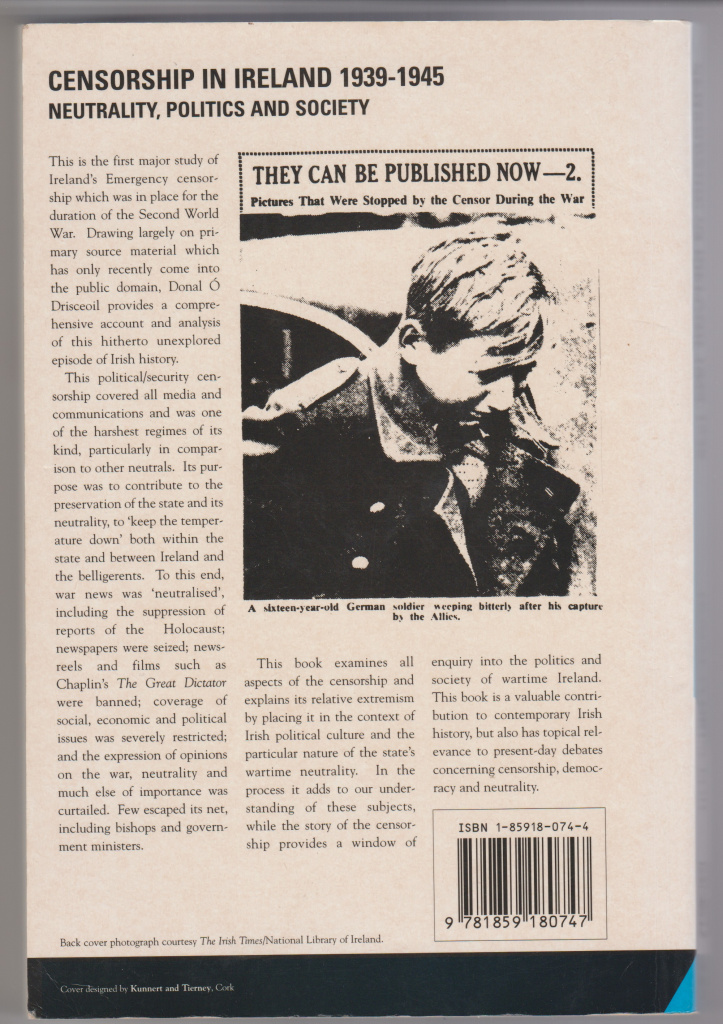
    Scan_20260525 (2).jpg

    Back cover of Censorship in Ireland 1939-1945.

    Recommended reading for those genuinely interested in Irish neutrality during WWII.


  • Registered Users, Registered Users 2 Posts: 6,540 ✭✭✭Francis McM


    I wonder was any other country in the world as heavily censored as Ireland? The state and media were even required to use the term "The Emergency" rather than "war". People were not allowed use the term " Nazi", and were not told anything of Axis atrocities.  Information about "the Nazis" was with held to such a degree people could not make an informed, educated opinion about neutrality, which suited Dev fine.


  • Registered Users, Registered Users 2 Posts: 81,059 ✭✭✭✭FrancieBrady


    Yes you can spin it as protecting the Nazis, the truth is more nuanced.
    The purpose of censorship was to preserve Neutrality and to not be seen taking either side.
    Therefore there was heavy censorship of both the Nazis and the Allies. Newspapers were warned not to praise Britain too much, not to encourage support for the Allied war effort or to publish British propaganda.
    On the Nazis it was similar.

    It should also be remembered that they were censored from reporting any information on Allied troop movements or shipping/submarine movement as well.


    Everywhere operated censorship.
    In Britain penalties for breaking the censorship code were severe - imprisonment, internment without trial and confiscation of assets being a few.


  • Advertisement
  • Registered Users, Registered Users 2 Posts: 6,244 ✭✭✭Sudden Valley


    Extreme hyperbole to suggest we were the most heavily censored country during a war involving the Soviet Union and nazi Germany. Very embarrassing to even suggest that.


  • Registered Users, Registered Users 2 Posts: 6,540 ✭✭✭Francis McM


    The Allies operated many thousands of temporary and permanent stations globally. They had 6,000 meteorologists and also some specially equipped aircraft and ships.

    Your idea that the best help we gave the Allies to free Europe from Nazism / end the war in Europe was a weather report from Belmullet is pretty pathetic if you think the Allies relied on that one report for the timing of the biggest invasion in history, D day.

    We actually helped the Allies in more important ways than that. Do you think that with all the planning that went in to D-day, and with literally the future of the free world at stake, the powers to be would trust and rely on one weather report. What if that person - who obviously did not know the importance of the task at the time - was sick, drunk, made a typo in the report, had a hangover and got someone else to make an educated guess or fill in last weeks figures?


  • Registered Users, Registered Users 2 Posts: 6,540 ✭✭✭Francis McM


    Those countries could at least call it a war. We could not. It was only an Emergency

    Other countries could refer to "the Nazis". We could not.

    Most other countries around the world got to hear of Axis atrocities. We did not.


  • Registered Users, Registered Users 2 Posts: 5,125 ✭✭✭adaminho


    The irony of you complaining about censorship when you edit out any quotes that don't suit your agenda!


  • Registered Users, Registered Users 2 Posts: 6,244 ✭✭✭Sudden Valley


    I just answered your question that would take a second of thought. Obviously those two countries were more heavily censored than us. Ridiculous your hatred for ireland.


  • Registered Users, Registered Users 2 Posts: 6,540 ✭✭✭Francis McM


    Someone else wrote that the average Dubliner, commenting on the revelations about the Nazi Holocaust at the end of the Second World War, ‘would not be persuaded even though all the hosts of Hitler’s victims were to rise from the dead; he would only pour himself another drink muttering “British Propaganda”’. Such scepticism in the face of the emerging evidence was common in Ireland.


  • Registered Users, Registered Users 2 Posts: 81,059 ✭✭✭✭FrancieBrady


    What did I say? There'd be spin and obfuscation.
    I did'nt predict that the word 'best' would be put in my mouth though. 2 outta 3 ain't bad.

    Not interested in discussing this with you, who cares at this stage what you believe.


  • Registered Users, Registered Users 2 Posts: 6,540 ✭✭✭Francis McM


    It is possible for a person to live in Ireland and love Ireland but still look at the facts of what happened in the past. The Irish people I spoke to 20, 30, 40 years ago and who told me their experiences deserve that.

    Another interesting little snippet: Back in that era,  Garda Commissioner Carroll stated that Gardaí were no longer to provide references for “local persons who are applicants for British Forces,” replying that Garda Regulations prevented it.

    No mention could be made in the press of the hundreds of thousands of Irish who helped the Allied war effort. Sometimes a newspaper like the Irish Times would try to get around the censors by saying something like "Paddy Murphy from Main st in the town had a boating accident in the Mediterranean last month but is believed to have survived".


  • Registered Users, Registered Users 2 Posts: 6,540 ✭✭✭Francis McM


    If using quotes I generally give the link so people can read the quote in context should they wish to do so. I do not edit quotes.

    As regards censorship, the population of Ireland was kept more in the dark about the holocaust in April 1945 than even the German civilian population were. For example, British forces liberated the Bergen-Belsen concentration camp in mid-April 1945. Graphic newsreel footage and press coverage began to emerge internationally, and German civilians were brought to the camps to see what had happened. Here within Ireland, the state censor suppressed and heavily downplayed the reports of the Nazi camps as "anti-national propaganda".

    No wonder Dev went and expressed his condolences on May 2nd. The rest of the world, those who had access to media, was generally much better informed.


  • Registered Users, Registered Users 2 Posts: 5,125 ✭✭✭adaminho


  • Advertisement
  • Registered Users, Registered Users 2 Posts: 6,540 ✭✭✭Francis McM


    Do you not know anything about the war period?

    2 seconds on google and I was able to verify that

    "The statement is historically accurate. Garda Commissioner Michael Carroll issued a directive that members of An Garda Síochána were forbidden from providing references for local applicants attempting to join the British Forces. [1]"

    Also, the Irish Times in those days was a lot different to the Irish Times since the 1980s. Google will tell you "The Irish Times reporting of the Allied cause in WWII reflected a delicate balancing act due to the Irish State's official policy of neutrality. Despite wartime censorship, the paper published extensive, sympathetic coverage of Allied operations, highlighted the bravery of tens of thousands of Irish volunteers". Journalists were prohibited from saying too much, taking sides, or printing death notices of Irish citizens serving in the British forces,


  • Registered Users, Registered Users 2 Posts: 81,059 ✭✭✭✭FrancieBrady


    An anonymous letter now, no supporting data for it's observation or your own addition 'was common in Ireland'.

    😁😁

    Sinking lower and lower.


  • Registered Users, Registered Users 2 Posts: 81,059 ✭✭✭✭FrancieBrady


    No mention could be made in the press of the hundreds of thousands of Irish who helped the Allied war effort.

    Wrong, mention could be made but were limited. It wasn't called 'censorship' for nothing!

    Censorship was prevalent everywhere during the war and the Emergency here.


  • Registered Users, Registered Users 2 Posts: 5,125 ✭✭✭adaminho


    I asked you earlier to clarify a quote and you ran away. Do you want to answer it now?


  • Registered Users, Registered Users 2 Posts: 6,540 ✭✭✭Francis McM


    Censorship was everywhere to a degree, even films are still censored now. However, my point was the population of Ireland was kept more in the dark about the holocaust in April 1945 than even the German civilian population were. For example, British forces liberated the Bergen-Belsen concentration camp in mid-April 1945. Graphic newsreel footage and press coverage began to emerge internationally, and German civilians were brought to the camps to see what had happened. Here within Ireland, the state censor suppressed and heavily downplayed the reports of the Nazi camps as "anti-national propaganda".


  • Registered Users, Registered Users 2 Posts: 81,059 ✭✭✭✭FrancieBrady


    Yeh, sill waiting on FDR telling Aiken he didn't trust him


  • Registered Users, Registered Users 2 Posts: 6,540 ✭✭✭Francis McM


    Not in those exact words but read the report in full and look at the reasons Aiken failed in his mission to get weapons and arms. Roosevelt was afraid they may be used against Britain. Nothing to do with Aiken "apparently involved in the reprisal killing of six people in his home area of Co Armagh in 1922."

    Aiken the gunman had the decency to be ashamed of the dirty stuff

    Quote from the meeting between Roosevelt and Aiken.

    "The President interrupted to say that he believed in being perfectly frank. He said 'you are reported as having said that the Irish had nothing to fear from a German victory'. Mr. Aiken said he had said nothing of the kind, and I backed him up in this, and further said that we had seen no report alleging any such statement.

    The President went on to talk of the dire consequences that would come to Ireland in the event of a German victory. On the question of supplies the difficulty was in not knowing how they would be used. The Rumanians, for instance, had asked for military equipment, and, when asked who they would use the equipment against, they had no reply. In our case there was no definite and explicit statement that they would be used against Germany in case of attack. "

    Because Roosevelt did not know how any weapons they would give to Ireland would be used, and because they did not give any to Aiken, that means they did not trust him.


  • Registered Users, Registered Users 2 Posts: 81,059 ✭✭✭✭FrancieBrady


    And we had spent the war suppressing stuff from and about the Allied side as well BECAUSE we were neutral.

    Will the penny ever drop?


  • Registered Users, Registered Users 2, Paid Member Posts: 4,303 ✭✭✭Cyclingtourist


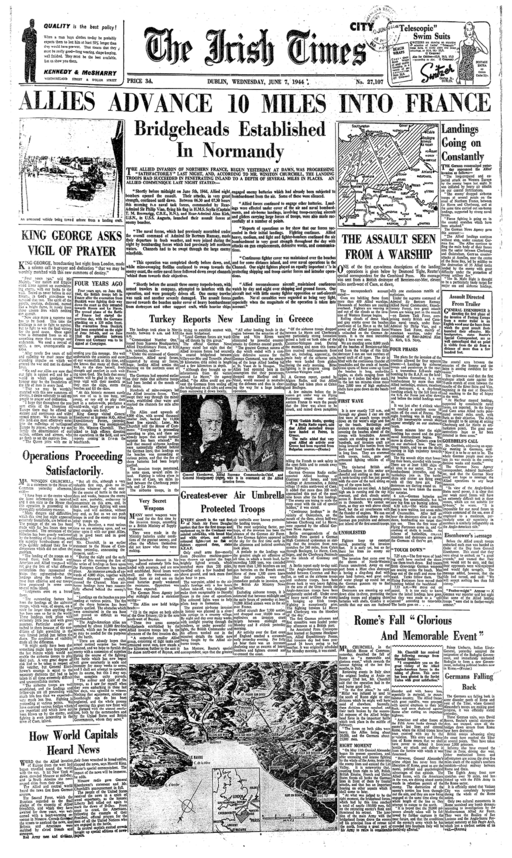
    WF7XL5VY25B7JB6PWUUQTM3RCI.png

    How the Irish Times reported the D-Day landings on Wednesday June 7th 1944, one day on from the landings.


  • Advertisement
  • Registered Users, Registered Users 2 Posts: 8,244 ✭✭✭growleaves


    Back on page 1 of this thread (now 36 pages long) I wrote this comment:

    "The historian Paul Fussell, who lived through WWII, said German atrocity stories were widely viewed with scepticism because of people's memory of fake propaganda atrocity stories during the First World War (tall tales of German soldiers bayoneting Belgian babies in 1914)."

    It's in his book The Great War and Modern Memory by Paul Fussell.

    Now you're saying that "Someone else" (who?) wrote that the 'average Dubliner' viewed the atrocity stories with scepticism. Well according to Fussell, who as I said lived through the war and wrote from experience, a lot of people took this view.


Advertisement
Advertisement