Advertisement
Help Keep Boards Alive. Support us by going ad free today. See here: https://subscriptions.boards.ie/.
https://www.boards.ie/group/1878-subscribers-forum

Private Group for paid up members of Boards.ie. Join the club.
Hi all, please see this major site announcement: https://www.boards.ie/discussion/2058427594/boards-ie-2026

Is Irelands neutrality stance in WW2 unfairly criticized? (see Mod note 217)

13132343637109

Answers

  • Registered Users, Registered Users 2 Posts: 6,540 ✭✭✭Francis McM


    Interestingly, during the war, about 20% of all personnel serving on Irish merchant ships were killed, by the Germans. Did you know that If an Irish ship was torpedoed, bombed, or lost at sea with all hands, Dev banned the Irish media from reporting it.

    If you research it, you will see that Irish sailors in our own merchant navy felt erased by their own government. When they died at sea, their families often received little information, and their deaths were largely hidden from the Irish public to prevent anti-German public outrage.


  • Registered Users, Registered Users 2 Posts: 81,058 ✭✭✭✭FrancieBrady


    Source your claims


  • Registered Users, Registered Users 2 Posts: 5,122 ✭✭✭adaminho


    You just don't like facts do you? Of all the buildings damaged you think the Synagogue was the first, all because you only want to believe that! I've given you loads of links yet you continue to spam the same link over and over despite the fact that it actually contradicted one of the points you were trying to make!


  • Registered Users, Registered Users 2 Posts: 81,058 ✭✭✭✭FrancieBrady


    By inventing, spinning, telling mistruths over and over again they have massively proved the point - criticism is unfair.


  • Registered Users, Registered Users 2 Posts: 26,361 ✭✭✭✭Kermit.de.frog


    Most countries in Europe imposed strict censorship during the war mainly to try and prevent espionage and maintain morale. Ireland was not unusual in that regard.


  • Advertisement
  • Registered Users, Registered Users 2 Posts: 9,184 ✭✭✭saabsaab


    Yes but 50 countries didn't join in the war against the Axis before they were attacked unless they were bound by treaties to do so or part of the British Empire. Even the US didn't until they were attacked by Japan.


  • Registered Users, Registered Users 2 Posts: 6,540 ✭✭✭Francis McM


    I know the Synagogue was the first public building in Dublin bombed by the Germans. Dev did not tell the nation that, just as he did not tell the nation when our ships were sunk by German subs.


  • Registered Users, Registered Users 2 Posts: 6,540 ✭✭✭Francis McM


    We were bombed on numerous occassions by the Germans during the war and our ships sunk. Because Dev or nobody told you our ships were sunk does not mean they were not targeted and sunk, with loss of life.

    After Pearl harbour, most countries in the world turned against the Axis powers. You were probably brought up to believe most countries were neutral. They were not.

    The blue are the axis countries. Light grey - if you can see them - are the neutral.


  • Registered Users, Registered Users 2 Posts: 5,122 ✭✭✭adaminho


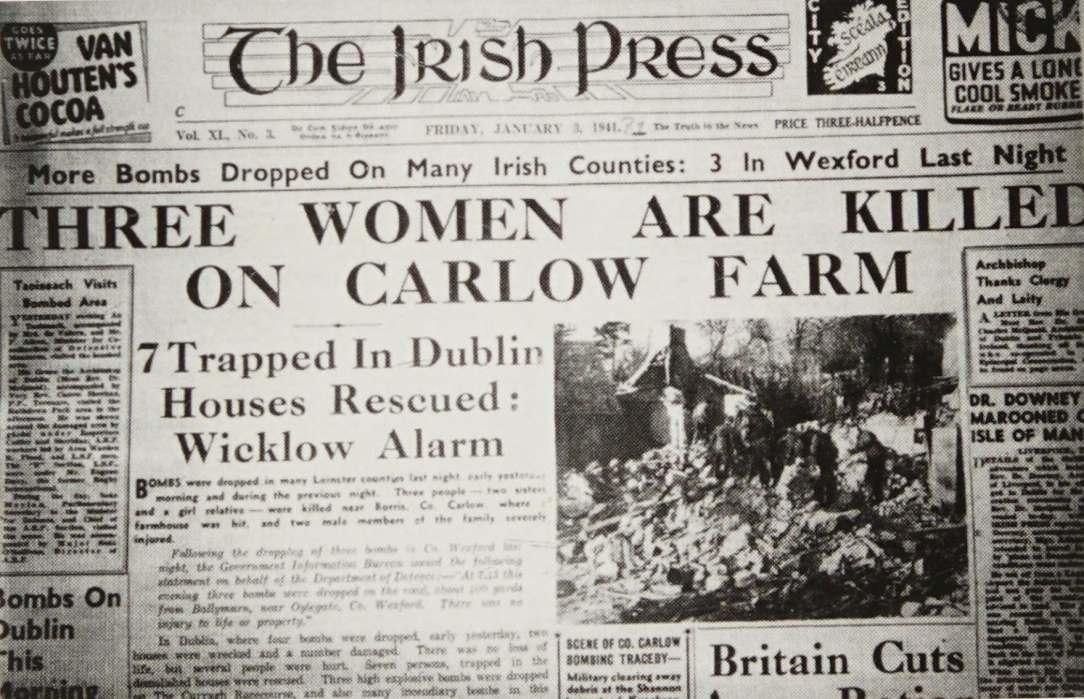
    How do you know? Because the one link you've shared over and over said so? Despite the School and Presbyterian church being hit by the same bomb? Despite it making the front page of the paper? Despite your own link saying that the government raised it in Berlin?

    irish press.jpg

    How did you make it to retirement age in the CS if this is the level of your reading comprehension?

    You're just embarrassing yourself now, all we are doing is waiting to see how far down the rabbit hole you actually go!


  • Registered Users, Registered Users 2 Posts: 6,540 ✭✭✭Francis McM


    Carlow is not in Dublin last time I looked etc. lol. The Synagogue was structurally damaged, the Presbyterian church was not, a few window were broken.

    Talking about censorship, did you know Dev forbidded media outlets from reporting on the many tens of thousands of Irish men who volunteered to fight in the British and Allied armies. Furthermore, stories detailing Nazi and Japanese atrocities in occupied territories were actively censored…because he was afraid they would provoke Ireland to abandon neutrality. People in the free State here were kept in the dark about what was really happening. No wonder so many left after the war.


  • Advertisement
  • Registered Users, Registered Users 2 Posts: 5,122 ✭✭✭adaminho


    What is the byline right under the headline?

    Presbyterian church, school and Synagogue were all hit by the same bomb, they were all the "first public buildings bombed in Dublin!"

    Pretty much every country had some form of Censorship during the war!

    Who left after the war?

    Do you even know what you're trying to argue?


  • Registered Users, Registered Users 2 Posts: 6,540 ✭✭✭Francis McM


    Underneath the headline it says "7 trapped in Dublin houses rescued". In this bombing of the Jewish quarter in Dublin, the Synagogue was damaged more than any other public building.

    Not much on the net about it but it did happen.

    In the link it says "there was an awful lot of anti-jewish policy in Dublin in them days" so no surprise Dev did not tell the country about it or meet the people who used to worship there.

    Dev did not even tell people when Irish flagged ships were sunk and ordinary Irish people were killed at sea by German submarines.

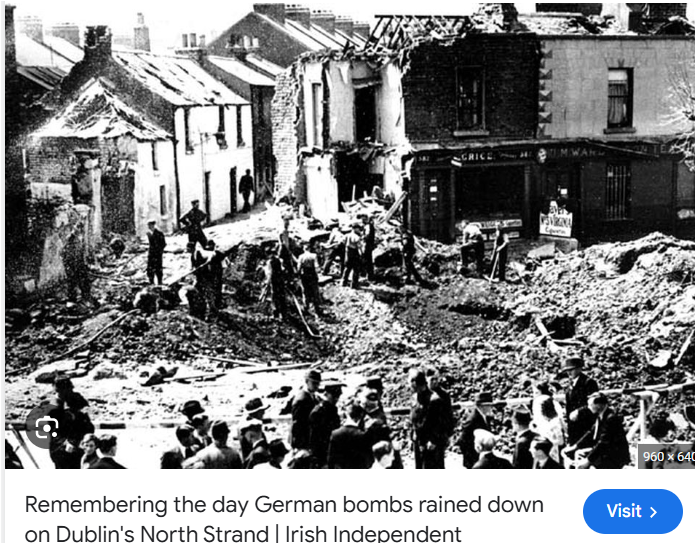
    It was suspected the reason Amiens st station or Eamon st or whatever you want to call it ( now Connolly Station) was bombed by the Germans was because Irish people were going up to Belfast in their thousands every month to join the British forces. Of course the bombs missed by 400 - 800 meters and became known as the North Strand bombings, which killed 34 and injured 100 or whatever. Lord Haw Haw told us it would happen and it did.


  • Registered Users, Registered Users 2 Posts: 5,122 ✭✭✭adaminho


    Do you seriously think a Synagogue being damaged should take priority in the headlines over 3 dead and 7 trapped! Think about it!

    They reckon — some say it was deliberate, some say it was accidental

    So some lad in Dublin doesn't know either!

    I've shown you actual quotes from the pilot apologising and saying it was accidental. I've shown you quotes from Winston Churchill admitting that he thought British jamming of the Y Beams screwed German navigation but you're going of the memories of some lad from 20 year odd years ago?


  • Registered Users, Registered Users 2 Posts: 6,540 ✭✭✭Francis McM


    The Synagogue on Dublin's Jewish quarter was not mentioned at all even though it was the first public building damaged in Dublin. Not saying it should be the main headline in the paper, but you brought up the paper - where is the mention.

    Of course nobody can prove it was deliberate. Nobody can prove the German sinking of the Irish Pine, an Irish flagged ship all painted up with large tricolours etc by a German submarine was deliberate, but it did happen.

    German planes may have been steered off course by British radio waves sometimes but German planes knew when they were over Irish cities because there was no blackout, unlike UK cities.

    An elderly German living in Canada and known only Heinrich did claim to have been one of the pilots who bombed Dublin and asked for forgiveness, but the ramblings of that elderly gentleman must be taken with a pinch of salt as it was a clear night over Dublin, the was no blackout over Dublin (unlike Belfast) and Dublin bay is very different to the coast near Belfast. Plus if he circled over Belfast rather than Dublin there would have been more flak, searchlights etc.

    Also, if you think the bombing of Dublin was an accident, why did Lord Haw Haw warn about it / predict it from Germany?

    Do not insult peoples intelligence.

    Post edited by Francis McM on


  • Registered Users, Registered Users 2 Posts: 6,540 ✭✭✭Francis McM


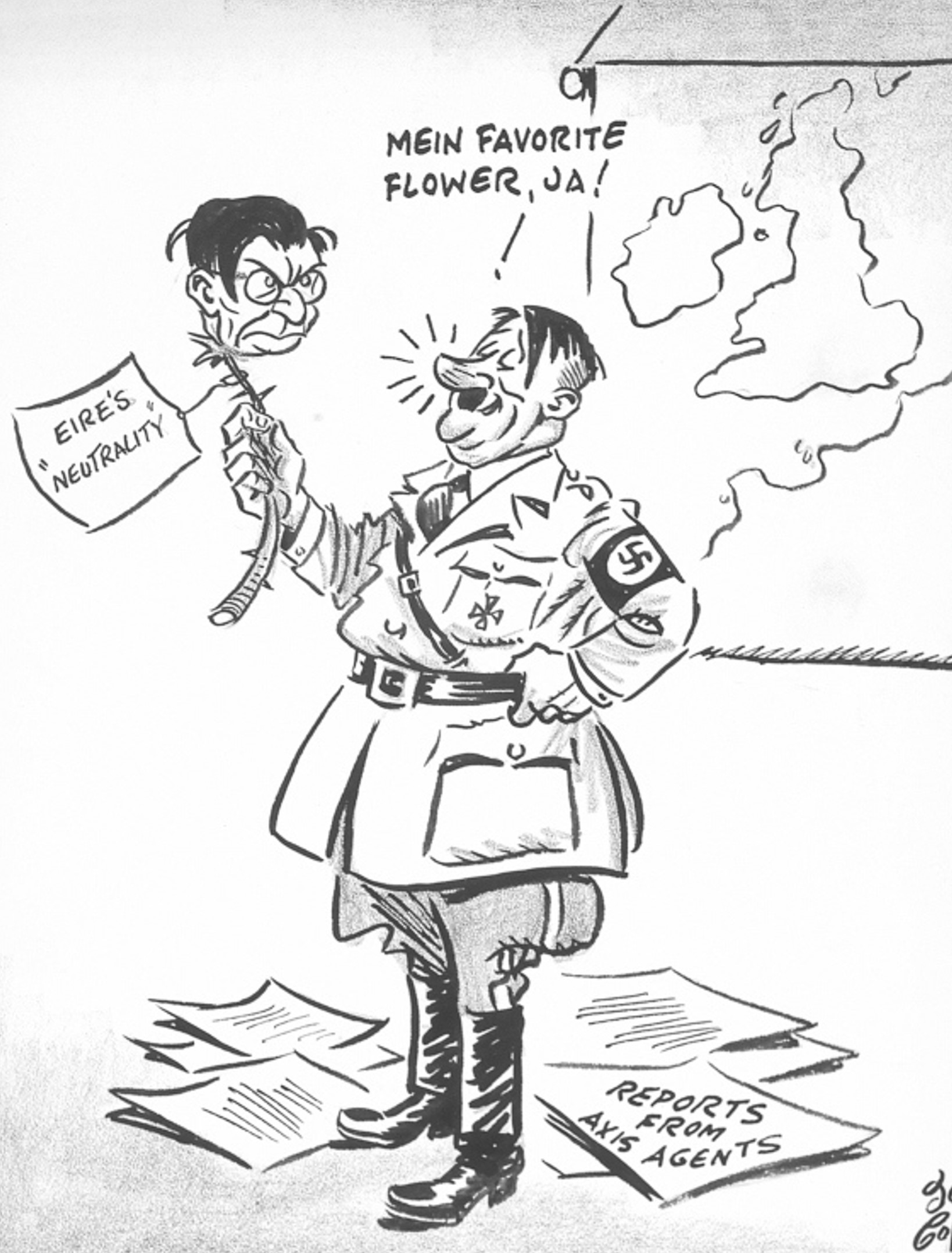
    How Ireland was viewed by Canada during the war, in which many Canadian men lost their lives in the Atlantic.

    .

    Untitled Image


  • Registered Users, Registered Users 2 Posts: 6,540 ✭✭✭Francis McM


    The German pilot ( or so he claimed he was ) who apologised on RTE in 1998 for bombing the North Strand / Connolly Station area in Dublin over 50 years previously muddied the moral waters by expressing admiration for Hitler. He thought Hitler " was a very kind man". He said "I say he was a weakling because he was too kind." And Heinrich did not express any sorrow for the people of Belfast, supposedly the real target that night, who endured two nights of Luftwaffe raids the previous month in which almost 1,000 civilians were slaughtered by many Luftwaffe bombers.

    So not sure I'd trust such a man who claimed he was a pilot over 50 years previously.

    Wonder if he was the same pilot who bombed the Synagogue in Dublin on a different mission?

    First Nazi Bomb Dropped on Dublin Wrecks Synagogue - Jewish Telegraphic Agency

    If so, not surprising he did not say sorry for that if he was such a great admirer of Hitler.

    There were plenty of other attacks predicted by Lord Haw Haw ( an Irishman called Joyce) from Germany. Someone recollects " "I also remember Joyce complaining that the Irish were shipping cattle to Britain from the docks at Dundalk and threatened that it would be bombed if this continued," Colonel Flynn said. "And my father and I were in Dundalk the night a German aircraft bombed the quayside there a few days later. It was a clear night and we actually saw the plane coming in from the north." Dundalk, a tiny port on the Irish east coast, was indeed shipping cattle to Britain during the war."


  • Moderators, Society & Culture Moderators Posts: 17,874 Mod ✭✭✭✭Manic Moran


    So I had a bit of a deeper dig into that last bit, and the timing is interesting. If the meeting between Aiken and FDR occurred on 07APR41, the US had already allocated weapons to Ireland about a half-year previous, courtesy presumably of some advocation earlier by someone else. These would be the rifles and cannon which ended up in Irish service, the rifles starting to be issued by October 1940 to the LDF, photos do show them. The cannon showed up in 1941.


  • Registered Users, Registered Users 2 Posts: 81,058 ✭✭✭✭FrancieBrady


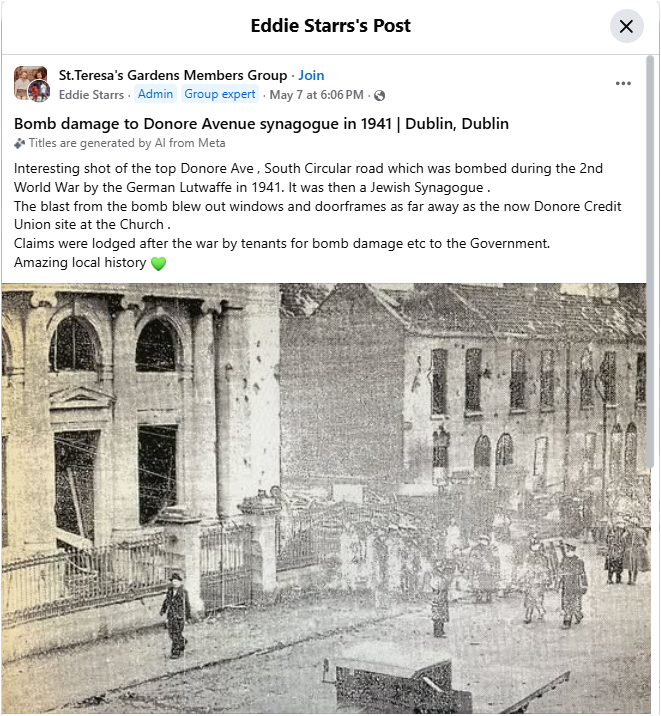
    image.png

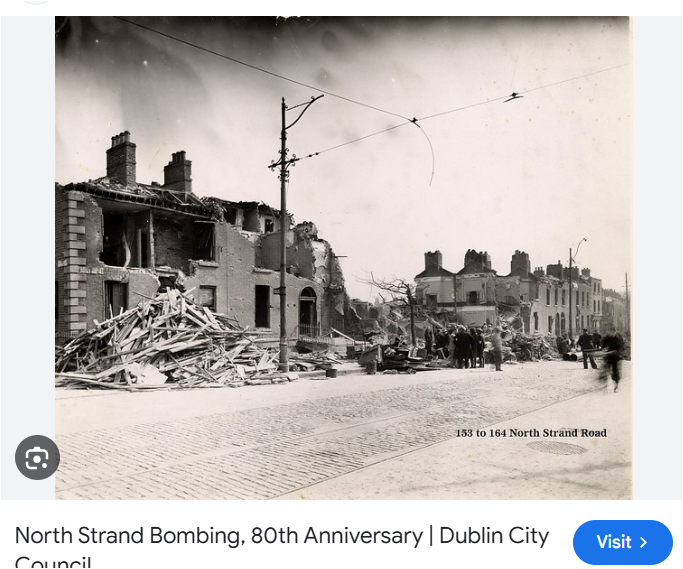
    image.png

    image.png

    Top pic shows the 'blast damage' to the Synagogue, while the others show the much more extensive damage to other buildings that took 'direct' hits.

    The Synagogue was NOT the first building 'HIT' because it WAS NOT hit, it was damaged like other buildings by the 'blast' of bombs.

    Exploiting the victims for a pathetic agenda never gets old for some.


  • Registered Users, Registered Users 2 Posts: 6,540 ✭✭✭Francis McM


    The Synagogue suffered structural damage from the bomb, the first public building in Dublin to do so. Whither you say it was hit by a bomb or not is up to you. Bomb aiming in those days was not precise, there were no guided bombs or anything. The bomb was dropped by a moving aircraft, and was subject to whatever crosswinds there may have been before it hit the ground.


  • Registered Users, Registered Users 2 Posts: 81,058 ✭✭✭✭FrancieBrady


    So you don't know the difference between blast damage and a direct hit from a bomb.

    Just shocking stubbornness to admit you have not a single shred of evidence for your claims not to mention a brass neck.

    And even if you were totally correct none of it brought us into the war because we were neutral and remained so and remain so until this day.


  • Advertisement
  • Registered Users, Registered Users 2 Posts: 6,540 ✭✭✭Francis McM


    Of course I know the difference: I never claimed it was a direct hit. It was bad enough to damage it structurally.


  • Registered Users, Registered Users 2 Posts: 81,058 ✭✭✭✭FrancieBrady


    And whole swathes of buildings were damaged to varying degrees. Some destroyed. Both the Synagogue and Pres church buildings still stand today.


  • Registered Users, Registered Users 2 Posts: 6,540 ✭✭✭Francis McM


    Interesting. The meeting between Aiken and Roosevelt was on 7th April 1941, but Aiken was unexpectantly kept waiting for someweeks for the meeting after he first arrived in the States. Here is a summary from the Examiner and I quote: "

    "Aiken arrived in Washington on Mar 18, 1941, but was kept waiting for almost three full weeks before he got to meet the president, who treated him dismissively. He accused Aiken of being anti-British.

    Shortly after the meeting began an aide entered the Oval Office and put a tablecloth and arranged cutlery on the president’s desk, but Aiken refused to take the none-too-subtle hint to leave. He had come too far and waited too long to be brushed off that easily. Aiken denied he was pro-Nazi, and the president suddenly jerked the tablecloth from the desk, sending the cutlery flying, and ending the meeting."

    The purpose of the trip to America by Aiken was to get arms. He failed. In all of the other more detailed reports of the meeting, there was no mention that America had supplied arms already. Could the arms have come via the UK at some stage, possibly in 1938 in a secret deal with the British, that the British could use the Treaty ports it had just handed back in case of war? Or maybe Dev got the old arms at some stage in exchange for use of the Donegal corridor, being able to base its armed (but disguised) trawler semi-secretly at Killibegs for air-sea rescue etc. Whatever, the Allies surely were in no mood to give further arms to Ireland if they had done so already. A lot of bad blood.


  • Registered Users, Registered Users 2 Posts: 81,058 ✭✭✭✭FrancieBrady


    So they refused to be bullied or bought by US or British pressure and maintained our policy of neutrality which pertains to this day.


  • Registered Users, Registered Users 2 Posts: 6,540 ✭✭✭Francis McM


    Rebuilding work had to be carried out on part of the Synagogue and it is no longer in use as a Synagogue.


  • Registered Users, Registered Users 2 Posts: 81,058 ✭✭✭✭FrancieBrady


    And the Presbyterian church is now a Mosque, the Barracks is now a College, cities change, what is your point?


  • Registered Users, Registered Users 2 Posts: 5,122 ✭✭✭adaminho


    Back to this again I see! I see you've switched to the summary that omits all the relevant details after being challenged on the contents of the official report you posted earlier!

    You say the meeting failed, but where did the Irish Pine and the Irish Oak come from? Could it be they are the two ships mentioned in the official report?

    Any source for your Canadian cartoon? It lacks and details such as when it was published or where. A link would be the polite thing.

    You've posted several different claims about Lord Haw Haw and the bombing of Dublin spread out over several posts. Can you put them into one clear post so I can address them properly together, please include any links you wish to rely on.

    Finally you can stop posting the article about the Synagogue now, we can pretty much recite it by heart. The Synagogue was one of many public buildings hit by the same bomb. For avoidance of doubt here is the link I posted Saturday from the National Museum of Ireland showing the actual bomb itself.

    https://www.museum.ie/collections/collection/object-180375/?return=%2Fcollections%2Fcollection%2F%3Fterm%3D%252A%26media%3Dyes%26subject%255B%255D%3DThe%2BEmergency%252C%2B1939-1946

    Bomb Fragment, 1941.

    A German bomb fell at the rear of the houses located at 91 and 93 Donore Terrace in the South Circular Road area of Dublin in January 1941. Three houses were destroyed and approximately fifty others damaged. Donore Presbyterian Church, the attached school and the Jewish Synagogue in Donore were also damaged. 20 people were injured, but there was no loss of life.

    This fragment of bomb shrapnel was recovered from Donore Terrace.

    The shrapnel shows that despite Ireland being neutral in World War II it was not immune to the destruction of the war.


  • Moderators, Society & Culture Moderators, Paid Member Posts: 9,903 Mod ✭✭✭✭Manach


    Mod Note: Re-iterating point from previous post (217), please avoid personal abuse. As well, the minutae of specific incidents might be served better in a separate thread. Hence, keep on topic on the main point of this: Irish Neutrality per se.


  • Registered Users, Registered Users 2, Paid Member Posts: 4,303 ✭✭✭Cyclingtourist


    'The Emergency, neutral Ireland, 1939-1945' by Paul Girvin (McMillan 2006) is probably the history that's most critical of Ireland's and in particular Dev's strict adherence to a policy of neutrality. He makes a convincing case that we could have gone further particularly after the U.S. joined the Allies. He suggests dropping strict neutrality for a status of 'non-belligerent' would have benefited us post-war. He argues that from 1943 onwards there was no doubt as to which side was going to win and I agree.

    On Dev's visit to Hempel to offer condolences he claims Dev would have had access to information from late 1944 from U.S. disseminated material of the nature of Germany's extermination policy against Jews. Whether he actually saw such material or what value he put on it is not known.

    BTW Hyde didn't visit Hempel, he sent his secretary instead.

    While Girvin's bias is obvious I tend to agree with his general conclusions.


  • Advertisement
  • Registered Users, Registered Users 2 Posts: 6,540 ✭✭✭Francis McM


    The other reports about the meeting betwen Aiken and Roosevelt are consistent with the summary of the report in the Examiner. Nobody else ever questioned the Examiner on that afaik.

    The cartoon was from Montreal. It is mentioned in more than one place online eg https://www.reddit.com/r/PropagandaPosters/comments/wm90dj/1944_cartoon_by_john_collins_editorial_cartoonist/


Advertisement
Advertisement