Advertisement
Help Keep Boards Alive. Support us by going ad free today. See here: https://subscriptions.boards.ie/.
https://www.boards.ie/group/1878-subscribers-forum

Private Group for paid up members of Boards.ie. Join the club.
Hi all, please see this major site announcement: https://www.boards.ie/discussion/2058427594/boards-ie-2026

Victron

124»

Comments

  • Registered Users, Registered Users 2 Posts: 2,925 ✭✭✭ECO_Mental


    Victron do videos every week or so showing installs, this is the first time Ive seen one based in Ireland. Interesting video and location on Bere Island in Cork. Serious setup this dude has and it shows how scalable Victron can be.

    6.1kWp south facing, South of Cork City


  • Registered Users, Registered Users 2 Posts: 467 ✭✭random.stranger


    I've done a lot of lurking around here & dug deep into researching. I'm leaning towards a Quattro II system, not sure if I can afford it. This is the brief I'm going to approach solar companies with, any feedback on it would be appreciated.

    Needs:
    1. Maximised PV array size to get more power during Winter months (up to limit of inverter capacity).
    2. Compliance with NC6 & qualifies for grant
    3. Bird proofing
    4. 10kW Battery (minimum)
    5. Continue to provide power to the house during blackout
    6. Divert excess energy to heat water
    7. Load shifting (dynamic pricing management)
    8. Configurable by user (manage load shifting etc.)
    9. Access to chimney

    Wants:
    1. EV Charger (don't currently have an EV, may get one 4+ years into the future)
    2. Support for adding a backup generator (outdoor connection)
    3. Uninterrupted power to important circuits during blackout
    4. Boost power in case of brownout (like Victron Quattro II or Multiplus II)
    5. Victron Cerbo GX
    6. Dynamic pricing management not dependent on cloud computing
    7. Screen
    8. European inverter company
    9. 20kW Battery (ideally)


  • Registered Users, Registered Users 2 Posts: 61,076 ✭✭✭✭unkel


    A few comments, first of all try not to confuse your units. The power of an inverter is in kW. The capacity of a battery is in kWh

    Needs: yes maximise your PV arrays, it is relatively cheap to add more at the start when they are doing the work anyway. NC6 is required unless your entire setup is off grid. I wouldn't worry about birds personally. Victron Quattro by design runs your house, it doesn't care if power comes from AC input (grid or genny) or from battery, so that is covered automatically. Water diverter is waste of money, better to sell to the grid. Victron are not the easiest to configure and manage export, but it is doable, you will have to dive in deep and take ownership

    Wants: don't get an EV charger if you don't need it for another 4 years. Do look into getting an EV much earlier though, it will pay for itself much quicker than any of this solar PV / battery stuff. Genny is standard input on a Victron Quattro. EPS is standard on the Quattro too with a switch over of 20ms from memory. No need for any transfer switch setup. Not sure how you would have dynamic pricing programmed in without being able to look up via an API what the actual dynamic prices are 😂

    And of course realise that a Victron system will never be the cheapest / fastest paying back solution. Unless you buy all hardware at less than half retail prices. Try not to buy a system that will never pay for itself….

    "Make no mistake. The days of the internal combustion engine are definitely numbered" - Quentin Willson, 1997


  • Registered Users, Registered Users 2 Posts: 2,925 ✭✭✭ECO_Mental


    This ended up a big ramble, I had to put it into Gemini to tidy it up to make sense of my stream of consciousness so apologies if it reads too AI like and goes off on a tangent in places😋

    A couple of things before we get into spec'ing out a system: what is your annual electricity bill at the moment? Do you have a heat pump, and do you cook with electricity? I ask because that dictates how much you could or should invest.

    I’m in an all-electric house (including an EV) and consume about 16,000 kWh a year. Before I got my Quattro and battery, my bill was about €2,300 a year, but I’ve also had solar PV for about five years. The way I looked at it, if you spec your system big enough, you can realistically achieve a zero electricity bill and easily make a couple of hundred euros a year back from the grid.

    If it pays for itself over 5 to 6 years, then €2,300 x 5 years is an €11,500 return—this is a very good payback, it could even cover a loan if you dont have the cash available.

    At the moment in Ireland, we have a few very good smart meter tariffs with excellent feed-in rates. One is head and shoulders above everyone else (raise a glass to Mr. Pinergy!), and you can make decent money if you get a big enough battery to cover your daily needs during the winter months first. For the other 8 months of the year, you are basically making gravy. I have a 30 kWh battery, and during the winter, it covers an average of 90–95% of my consumption. Right now, my bills are actually €100+ in credit per month; this is my first summer on the gravy train.

    Enjoy it while it lasts, though. As more people get solar PV, EirGrid isn't going to like us exporting back. We will eventually end up like parts of Europe where they charge you to export in the middle of the day or only give you 1 or 2 cents. Future systems will be all about storing and using your own PV later. I think we are a few years off from that, but the gravy train of the 25-cent feed-in tariff will definitely go.

    I suppose what I am saying is that you might be better off going big. Looking at your questions, the blackout transfer function is high on your list. I can confirm that with the Quattro, you don't even notice when the power goes out—the lights and even the internet don't drop for a second. I do also a have an additional Anti-Islanding unit as back up and ESBN will want this to be grid compliant.

    This is another reason to go big, perhaps into the 15 kVA range. If you just want backup on certain critical circuits, it can actually be more work trying to isolate them on your consumer board. Having a big-ass inverter-charger means you can back up the entire house its actually a bit simpler. I can be cooking with the heat pump running and everything else on without any issues.

    As Unkel said, the EV charger is like a separate project and doesn't really have anything to do with what you are trying to achieve here. I actually moved my EV charger to the grid side of my system so that if the utility power goes down, the charger goes down too. I didn't want a scenario where the power cuts out in the middle of the night and the car starts sucking 7 kW straight out of my domestic battery. I can still charge the car from the battery if I really want to by forcing an export to the grid, but that is highly inefficient. That said, the faster you move to an EV, the quicker your overall payback will improve—saving maybe €300–400/pm compared to diesel?

    As Victron's chief brand ambassador on boards.ie 😉, they are a Dutch company that has been making inverters for 50 years. They specialize in off-grid work, so they are built to be incredibly reliable. All of their control is handled locally on the Cerbo GX rather than relying on the cloud, and they update their VRM software regularly with new features.

    They do have an official software called Dynamic ESS (DESS) for dynamic tariff control, which is designed to take advantage of day-ahead smart pricing. Some people complain about it, but it’s a fairly complicated setup because it has to predict both your solar generation and energy consumption per half-hour for the day ahead. I don't use it myself—I use Node-RED and developed my own management system instead. Having Node-RED running directly and locally on the Cerbo GX with active support from Victron is fantastic. If you can dream it, you can program it with AI these days.

    When it comes to battery size, my mantra has always been: better off looking at it than looking for it. I have 30 kWh, and while I sometimes think I’d like more, I physically cannot put any more charge into it during the cheap three-hour night window I use. My system can go from 10% to 100% state-of-charge in three hours at a 10 kW charging rate, so there is no practical point in me getting more capacity. The 30 kWh setup is perfect for me. Ultimately, your battery size might depend on the inverter size you choose. But with 20kW that will cover more than enough if you dont have a heat pump.

    One final note: since you don't have an existing PV inverter, you will need a Victron solar charge controller (MPPT) to get that power into your battery, so budget for that extra cost.

    And don’t worry about birds nesting under the panels! That’s a UK thing for some reason—they seem to have a bird problem over there that we just don't experience here. I have yet to see a single post on Boards about birds nesting or unplugging MC4 connectors.

    You might have more questions after all this, so fire away!

    6.1kWp south facing, South of Cork City


  • Registered Users, Registered Users 2 Posts: 467 ✭✭random.stranger


    Thank you @ECO_Mental & @unkel

    Current annual usage: 4500 kWh
    Average daily usage: 12.2 kWh

    I would love to oversize it as much as possible for future proofing, but I think a 15kVA quattro setup is out of my price range.

    No heat pump or EV currently and a lot of other work would need to be done before putting in a heat pump. We do have an electric hob, oven & shower. I assume we'd have to avoid using these in case of power loss with a 5kVA inverter and 10-20 kWh battery (shower is 7.5kW afaik).

    I'm happy to dig into the technical side of Victron to configure it, I'm sure it will be a learning experience, but I enjoy that type of thing. Love the idea of the Cerbo GX being able to manage things locally with Node-RED.

    Can I add a second MPPT to the same battery to increase solar generation in Winter, without needing to go down the NC7 route?

    If we could add a second MPPT to the system, swap the Quattro for a MultiPlus II and avoid using the electric hob, oven & shower in case of power loss. I'm thinking of having 9.2kW of solar facing West (slightly South) & 4.6kW facing East (slightly North). Do you think we could be self-sustaining in the event of an extended power outage in December with that sort of setup when only powering the basics, [edit:] kerosene central heating boiler & pump, fridge/freezer, lights, tv, internet & computer?

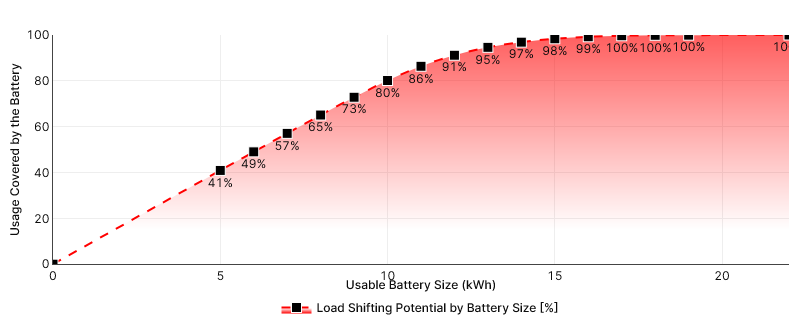
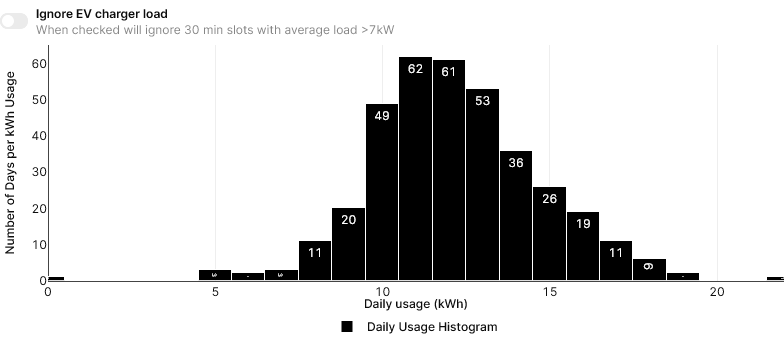
    I've attached images from energypal

    LoadShiftingPotentialBatterySize_EnergyPal.png NumberOfDaysPer_kWhUsage.ie.png


  • Advertisement
  • Registered Users, Registered Users 2 Posts: 61,076 ✭✭✭✭unkel


    No need for a 15kVA inverter at all, do what both @ECO_Mental and myself have done and keep any future EV charge point outside of the loop. Then 10kVA is more than enough. It will probably make you sick that I sold a great condition 10kVA Quattro for €1350 last year 😂 Was gonna use it myself, but with my battery in my shed it was just not practical

    That said, a 5kVA Multiplus is a bit mickey mouse for a full house. More suitable for low use on a camper or boat. I told you to get good value, but not to cheapen the whole setup!

    "Make no mistake. The days of the internal combustion engine are definitely numbered" - Quentin Willson, 1997


  • Registered Users, Registered Users 2 Posts: 467 ✭✭random.stranger


    When our neighbours were building next to us the ESB needed to bring in a separate supply line and transformer to them, I don't think we would qualify for NC7. Shame the Quattro didn't work out for you, I'd be looking for a 48V system anyways.


  • Registered Users, Registered Users 2 Posts: 61,076 ✭✭✭✭unkel


    It was a 48V, 10kVA. I sold another Quattro, a 24V 8kVA, last week

    Who says anything about an NC7? You would need to have a huge system to need one of those. On an NC6 you can export more that 120kWh per day. Or do you mean for NC6 sign off a 10kVA Quattro wouldn't qualify? Yeah well it looks like you are getting a very friendly sparks to do the sign off for you anyway? 😂 But if that is an issue, get one that falls within the NC6 limit. Not many households use more than 5.5kW often and for long durations, outside of the night rate slot

    "Make no mistake. The days of the internal combustion engine are definitely numbered" - Quentin Willson, 1997


  • Registered Users, Registered Users 2 Posts: 467 ✭✭random.stranger


    Oh, nice, I got it confused with the 8kVA you posted!

    I'm not doing anything creative with the sparks, everything above board.

    I thought a 5kVA was the largest Victron that falls within NC6, am I wrong?


  • Registered Users, Registered Users 2 Posts: 61,076 ✭✭✭✭unkel


    You are allowed 25A, which is 5.5kW. So could well be that only a Multiplus 5kVA could fall below that. There are far better options out there though for that limit. A 5.5kW Deye springs to mind (or any of its clones like Sunsynk or the latest Solis)

    I wouldn't just go Victron because you like the colour and think they are the best. They have generally good hardware but at full retail all their stuff is grossly overpriced. Says I - looking at a wall of light blue Victron hardware 😂

    "Make no mistake. The days of the internal combustion engine are definitely numbered" - Quentin Willson, 1997


  • Advertisement
  • Registered Users, Registered Users 2 Posts: 2,925 ✭✭✭ECO_Mental


    @random.stranger Looking at your usage you are really an average user and wouldnt need the 15kVA and not worth the while to get an NC7. What you could do maybe is for now get maybe a Multiplus II 5000 for for now get your NC6. The MPII should cover nearly 100% of your consumption as I am assuming you dont have any big loads biggest is probably the dryer or washing machine. Then have MPPTs solar charge controllers to manage you PV and pump additonal charge into the battery.

    What you can do then into the future when you start your trasition into an electric house (getting a HP etc) is just add more Multiplus IIs in parallel to up your capaicity. You can do this very easily with Victron, the Mulitplus II 5000 is one of thier cheapest inverters as its one of their biggest sellers.

    Downsides…yeah its a small bit weaker than some other inveter chargers that are setup to meet exactley the 25Amp limit, also it charges at most 3.5kW off the grid. But in reality you are an average user and the 5000 should meet neary 100% of your needs for now

    Its a pity they have a new MP 6K5 which has an output of 6000Watts so its about 1 or 2 Amps too much to be ok for an NC6. Also if you want to go NC7 later it might be more difficult as they have other strict requirments. That saying I hear some people dont say anything to ESBN when they add an additional inveters they just keep their export below 25Amps, who is to know….

    6.1kWp south facing, South of Cork City


  • Registered Users, Registered Users 2 Posts: 467 ✭✭random.stranger


    That MultiPluss ii 6K5 is painfully close!

    Thank you @ECO_Mental & @unkel , you've been really helpful.


Advertisement
Advertisement