Advertisement
Help Keep Boards Alive. Support us by going ad free today. See here: https://subscriptions.boards.ie/.
https://www.boards.ie/group/1878-subscribers-forum

Private Group for paid up members of Boards.ie. Join the club.
Hi all, please see this major site announcement: https://www.boards.ie/discussion/2058427594/boards-ie-2026

Is Irelands neutrality stance in WW2 unfairly criticized? (see Mod note 217)

11314161819109

Answers

  • Registered Users, Registered Users 2 Posts: 17,555 ✭✭✭✭Flinty997


    Who is asking the Ireland to declare war on anyone?Use of the ports and an airfield or two was all that was suggested here.

    You might argue that's contravention of Neutrality. But Ireland was doing that anyway.

    All it achieved was damaging international and Anglo arrangements that ultimately Ireland needed to prosper economically.

    You might argue it would have destroyed Irelands hard won independence. But that's a reach. After WW2 the empire slowly disintegrated as countries mostly gained their independence or autonomy.


  • Registered Users, Registered Users 2 Posts: 17,555 ✭✭✭✭Flinty997


    There was also catapult air cover, escort carriers. Wasn't just the long range bombers that closed the cap.

    Seems like a lot of omissions.


  • Registered Users, Registered Users 2 Posts: 81,058 ✭✭✭✭FrancieBrady


    In hindsight it might be a reach but they didn’t have the benefit of that.


  • Registered Users, Registered Users 2 Posts: 145 ✭✭casey jones


    Agreed, as was the tactical deployment of the destroyer escorts, the development of sonar and how they broke away to attack u boats once engaged.

    It was a battle that saw technology developments, counter measures etc. The Germans invented a torpedo that homed in on the sound of a ships propellor, the allies deployed noisy decoys called foxers towed to ships to attract these torpedos.

    Getting back to the Irish neutrality question the Treaty ports were of little or no value especially as the war developed. Somewhat ironically had the 32 counties been fully independent we may have been under more pressure to abandon neutrality given the need to guard the NW approaches plus the risk of German invasion might have been greater.


  • Registered Users, Registered Users 2, Paid Member Posts: 716 ✭✭✭myfreespirit


    Called a war crime by whom? It certainly had moral implications which is why acts like the Dresden or Tokyo Firebombings were made war crimes in the post-war era

    The Allied air raid attacks on Hamburg in 1943 and Dresden in 1945 have been called war crimes by a German historian, Prof Dr Sönke Neitzel, University of Potsdam. TV history programmes containing interviews with Prof. Neitzel about those attacks have been broadcast by the national German broadcaster ZDF recently, where he characterised the raids as war crimes.


  • Advertisement
  • Registered Users, Registered Users 2 Posts: 6,540 ✭✭✭Francis McM


    So a German calls something the Allies did in WW2 a war crime? I would tend to agree he has a point but being devils advocate

    (a) the Nazis bombed London, Coventry, Poland etc first. Live by the sword, die by the sword

    (b) the USAF and RAF chose Dresdem because it was home to 100 factories for the German war machine, plus it was a transport hub with railway marshalling yards etc

    (c) there is no question it demoralised the German nation and shortened the war

    (d) more people died in Nagasaki and Hiroshema - did he condemn them too

    (e) at the risk of whataboutery, the allies treated the Germans much better overall than the Germans treated those in extermination camps, on the eastern front etc.


  • Registered Users, Registered Users 2 Posts: 81,058 ✭✭✭✭FrancieBrady


    Not how it works If it’s a war crime then that’s what it is.


  • Registered Users, Registered Users 2 Posts: 6,540 ✭✭✭Francis McM


    It was not classified a war crime at the time.


  • Registered Users, Registered Users 2 Posts: 81,058 ✭✭✭✭FrancieBrady


    You are excusing a potential war crime by detailing what the other side did.

    That is no excuse and is not how it works.


  • Registered Users, Registered Users 2 Posts: 6,540 ✭✭✭Francis McM


    Portugal - which was neutral but allowed the use of air bases in the Azores, and co-operated with Britain - could have been bombed from the same place we would have been bombed from?

    Portugal was not bombed.


  • Advertisement
  • Registered Users, Registered Users 2 Posts: 6,540 ✭✭✭Francis McM


    Where is your poll to show the Irish feared an invasion by Britain during WW2? Britain had enough to do during WW2 without invading us.

    Dev's rep. Aiken went to Roosevelt to ask for arms. Aiken got thrown out after Roosevelt had a fit at the cheek of Aiken and threw knives and cutlery in the air.

    We only got crumbs from the Marshall plan and were shunned by everyone from the US, UK and Russians for a decade or two after the war, so paid for our selfish stance during the war.


  • Registered Users, Registered Users 2 Posts: 5,122 ✭✭✭adaminho


    Portugal is more than twice the distance from Northern France than Cork.


  • Registered Users, Registered Users 2 Posts: 81,058 ✭✭✭✭FrancieBrady


    Why would I need a poll? The government believed the threat of invasion was real.

    You need to get over the fact they made a decision in Ireland's interest not Britain’s and not the US’s.


    And you still haven’t backed up the Aiken stuff.


  • Registered Users, Registered Users 2 Posts: 6,244 ✭✭✭Sudden Valley


    We actually got more money in the Marshall plan than Portugal. And that story of FDR and Aiken does not need to be repeated ad nauseum.


  • Registered Users, Registered Users 2 Posts: 81,058 ✭✭✭✭FrancieBrady


    I think Portugal only got admitted to the UN at the same time as us too.


  • Registered Users, Registered Users 2, Paid Member Posts: 4,303 ✭✭✭Cyclingtourist


    Portugal was a special case being tied to Spain by pre-war treaties. It played an important role in keeping Spain neutral. Traditional ally of Britain.


  • Registered Users, Registered Users 2 Posts: 17,555 ✭✭✭✭Flinty997


    Strategic bombing - Germans really opened that can of worms with bombing Belgian cities in WW1 and then London with Zeppelins etc. Then bombing of Guernica in Spain. Their opponents then retaliated. But it was the Germans who kept starting that line of attack.

    The Germans propaganda really talked up Dresden and much of that false narrative persists to day. Exaggerated casualties etc. not that wasn't a horrible lost of life because obviously there was. But it wasn't a watershed in allied tactics they kept strategic and firebombing up till the end of the war in Japan.

    Politicians might have distanced themselves afterwards with some distortion of their involvement.

    It was some time after the fact that it known that area bombing was not accurate and indiscriminate and fire bombing even less accurate and more indiscriminate. The whole saga around Norden bomb site poor real-world performance with accuracy of around 30% for example.


  • Registered Users, Registered Users 2 Posts: 17,555 ✭✭✭✭Flinty997


    Of course none of that has anything to do with Irish Neutrality.


  • Registered Users, Registered Users 2 Posts: 6,540 ✭✭✭Francis McM


    France to Portugal by air is about the same distance as France to Ireland by air.

    Even though Portugal allowed the Americans to use part of its territory, the Azores, during the war, as a military base, neither Portugal or the Azores were bombed.

    It would have been more dangerous or riskier for the Germans to bomb Ireland rather than Portugal too, due to the proximity of Britain to any France-Ireland air route.


  • Registered Users, Registered Users 2, Paid Member Posts: 4,303 ✭✭✭Cyclingtourist


    The Americans didn't use the Azores till 1943 and Germany was never going to attack the Portuguese mainland for that, it would have affected German-Spanish relations adversely.


  • Advertisement
  • Registered Users, Registered Users 2 Posts: 6,540 ✭✭✭Francis McM


    Despite Irish-America, which was as disgusted at Dev as the rest of America, the US government did illustrate its disapproval of Ireland after the war by awarding Ireland only $128.2 million in loan aid ( which had to be repaid) and $18 million in grant aid.


  • Registered Users, Registered Users 2, Paid Member Posts: 4,303 ✭✭✭Cyclingtourist


    Ireland was never going to go commie so why waste money


  • Registered Users, Registered Users 2 Posts: 6,540 ✭✭✭Francis McM


    So Portugal could - and did - let the Allies use part of their territory to operate from, and not get attacked by Germany.

    But you think we here in Ireland would have been bombed if we allowed the Allies use say part of Achill Island as an airfield?

    Even though the airspace between France and Ireland was much riskier for Germany than the airspace from France to Portugal, around the bay of Biscay?

    You forget range of the Heinkel He 177 Greif, the World War II Luftwaffe heavy bomber, had a maximum range of approximately 5,000 to 5,600 km, depending on the variant and payload, so could easily have bombed Portugal, which is only 1140 km from France. So its range would have been enough to fly over the sea to Portugal and back. Besides, the Germans did not care for the sensitivities of neutral countries when it suited Germany, it invaded 7 of them ( Norway, the Netherlands etc ). But the point is, Germany did not bomb Portugal, even though it was "neutral" but had an allied airbase.


  • Registered Users, Registered Users 2 Posts: 6,540 ✭✭✭Francis McM


    The Marshall aid plan was more than preventing communism. It was to rebuild Europe, to prevent the economic collapse of Western Europe, and secure long-term trading partners for American goods.


  • Registered Users, Registered Users 2 Posts: 6,540 ✭✭✭Francis McM


    The Irish government did not believe the threat of invasion was real. After Dunkirk, the British had more than enough to do elsewhere, and were stretched thin enough already. If it invaded there would have been fiece guerilla resistance. It invading a neutral country would have been an international public relations disaster for the Allies, potentially alienating the United States, which was providing the UK with crucial supplies.

    The British preferred the carrot rather than the stick. The UK offered Ireland unity in June 1940 in exchange for abandoning its neutrality and joining the Allies. Dev obviously did not want unity bad enough. If Dev had been smart he would have taken unity but said no British forces in Ireland to protect us, only Canadians or Kiwis for example.


  • Registered Users, Registered Users 2 Posts: 6,244 ✭✭✭Sudden Valley


    The offer of unity was never going to happen. Churchill was never going to give Northern Ireland to the South, and De Valera knew it. Its a bit much to use this as a reason for Ireland to join the allies in WW2. It could never be a genuine proposal without the Unionists on board.

    The proposal even said they would need to obtain the assent of the Government of Northern Ireland which made it obviously unworkable and disingenuous, as is your framing of the proposal.


  • Registered Users, Registered Users 2 Posts: 6,540 ✭✭✭Francis McM


    Of course Britain would have given N. Ireland to the South in return for the island joining the Allies in WW2. It would have been in their interests to do so.

    German U-boats were sinking British supply ships at a devastating rate.

    Dev missed a great opportunity if he wanted a U.I.


  • Registered Users, Registered Users 2 Posts: 6,244 ✭✭✭Sudden Valley


    Complete nonsense. Ir needed the assent of the Northern Irish government. It was never a genuine offer and was unworkable.


  • Registered Users, Registered Users 2 Posts: 6,540 ✭✭✭Francis McM


    Countries do what is in their best interests, especially if they think it is also in the interests of the free world. In 1940, the British were up to their necks in water that was rising fast. Over 750 British-flagged merchant ships and fishing vessels were sunk by enemy action. Additionally, the Royal Navy lost dozens of warships, including 1 aircraft carrier, 2 cruisers, and over 20 destroyers.

    Germany conquered Denmark, Norway, the Netherlands, Belgium, and France in just six weeks.

    Churchill said the only thing that really scared him in the war was the u boat threat. Much of British food, raw materials, all its oil etc was imported.

    In 1940, German U-boats sank over 470 Allied merchant ships, totalling more than 2.4 million gross register tons.

    The turning point in the war for the British and their allies, to give the some hope, was not until Oct / Nov 42, north Africa. The British will dump when it suits them. Ask the Rhodesians.

    Dev missed a great opportunity if he wanted a U.I.


  • Advertisement
  • Moderators, Society & Culture Moderators Posts: 17,874 Mod ✭✭✭✭Manic Moran


    He may be being a bit inconsistent.

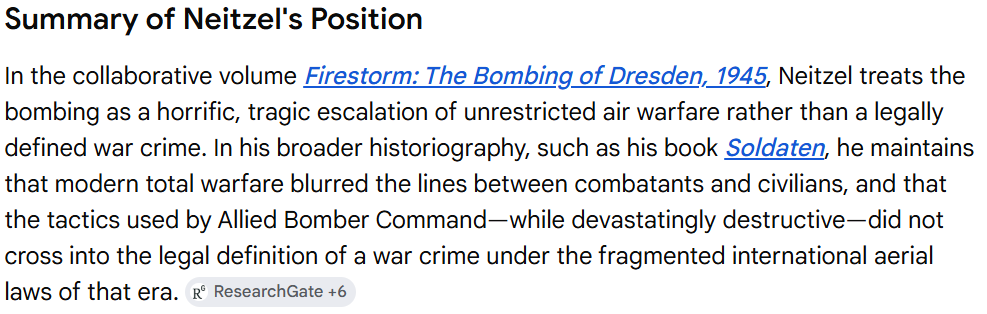
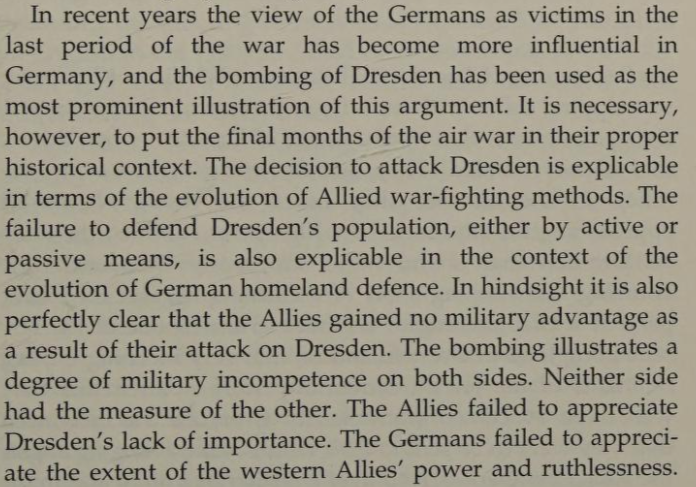
    image.png

    So I looked up his arguments (including checking out e-library for the Firestorm book above, which is where I snipped his writing below from), and they are…. a bit open to interpretation. All parties are agreed that there is no positive illegality: "Thou shalt not firebomb cities" was not a law until over three decades later. It's worth pointing out, I think, that modern thinking about war crimes came after reflection of WW2, which is partially why a bunch of new conventions were agreed.

    There are to caveats to the below: The first is that Nuremberg did establish the precedent of "post facto" laws, things which were not written as unlawful at the time but deemed so later. However, the Nuremberg trials' Count 3 (war crimes) did rely on the law as understood at the time, the post facto charges were larger in scale. It is worth observing that only one aerial city bombing of the war was considered a war crime and anyone charged for it: The bombing of Belgrade, which unlike Dresden was a clear violation of the laws which existed at the time (The city had been surrendered and the stated rationale was punishment of the civilian population). The other is that the morals and ethics of the bombing campaign can be argued for more validly than the legalities (though these also are a bit open to subjectivity by their very nature).

    His claims are:

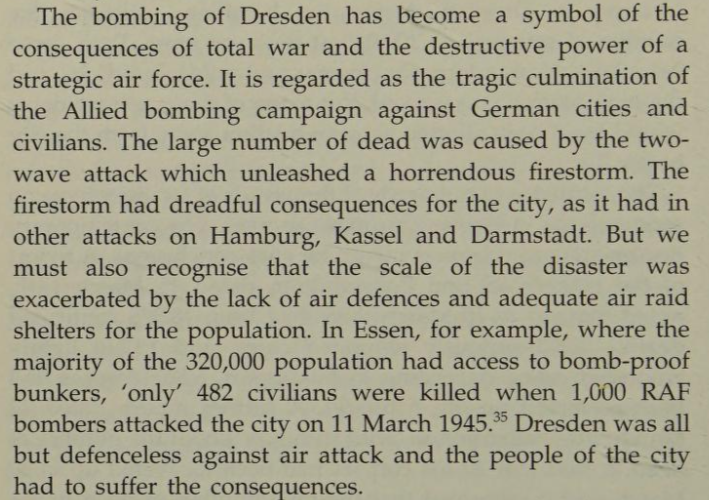
    Proportionality: That the destruction wrought was in excess of that which was necessary. Given it was total war and was after a substantial city bombing campaign by both sides, the question of 'what was necessary' to achieve the goal with relation to the proportionality is at the least debatable. Both sides had been dropping incendiaries on cities for years, there seems little difference in intent between them. Everyone was trying to burn everyone else. The main difference between Dresden and most of the other raids was that Harris basically got lucky and got the firestorm.

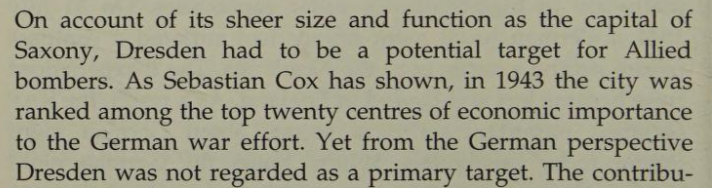
    Lack of concern for civilian casualties: The city didn't have the ability to respond to the fire, and lacked sufficient bomb shelters. Sounds like a German problem to the British. They had several years of war (and city bombing) to get used to the idea. Britain wasn't in the mood to be charitable at the time. Neitzel observes that the lack of defenses and lack of shelters was because the Germans didn't consider Dresden much of a target, despite it being in the top twenty places for the German war effort.

    image.png image.png

    Benefit gained was not sufficient to justify the destruction: See (1). He believes that the benefit gained by the destruction of Dresden just wasn't worth it given how late in the war it was and how much advantage it gave to the Allies as a result. The RAF apparently disagreed at the time. I would observe that the idea that something is should be illegal just because you are going to win anyway is daft on a couple of levels. If the outcome was pre-determined, the Germans could have surrendered and saved far more lives than just the citizens of Dresden. He also observes that the Allies may not have been aware of this.

    image.png

    Also worth noting that about six weeks earlier, Dresden had been declared a "Verteidigungsbereich" or military defense point, so not all the Germans were apparently talking to each other.

    The one thing he doesn't write in this is that was a war crime. (The book was published 2006, for context for 'in recent years'). I have not seen his ZDF interviews (And I probably couldn't understand them anyway), so I am not sure about the precision of his wording in those.

    See also discussion over on AskHistorians subreddit, which gives a pretty strong consensus.

    https://www.reddit.com/r/AskHistorians/comments/20zi27/was_the_bombing_of_dresden_in_ww2_a_war_crime_or/

    Post edited by Manic Moran on


Advertisement
Advertisement