Advertisement
Help Keep Boards Alive. Support us by going ad free today. See here: https://subscriptions.boards.ie/.
https://www.boards.ie/group/1878-subscribers-forum

Private Group for paid up members of Boards.ie. Join the club.
Hi all, please see this major site announcement: https://www.boards.ie/discussion/2058427594/boards-ie-2026

Solar for Beginners [ask your questions here]

1150151153155156

Comments

  • Registered Users, Registered Users 2 Posts: 2,616 ✭✭✭Vizzy


    Newbie question( probably been asked loads of times but here goes anyway)

    I have a 5.56kw system with a Solis inverter and 10kw battery.

    I have changed over to Energia in the last few days to avail of the cheap night rate.

    What I intend to do is "dump" my surplus SOC between 12 midnight and 1 50am. Then charge my battery at the cheap rate from 2am to 6am( I know that it wont take the full 4 hours to do it)

    Also, I will be charging my PHEV at the cheap rate on a granny charger( wont charge completely, but hopefully over a couple of nights I will get up to full charge in the car)

    I have asked the installer to set up the battery to force discharge and then recharge as above and he is to revert to me tomorrow.

    However, I charged the car last night and it basically emptied my battery. I would expect this as I want the battery to cater for as much of my demand as possible.

    When the installer changes the battery/inverter settings will the car and battery charge together from the grid so that I have a charged car and a fully charged battery at 6am every morning, or will the battery, as it charges then start to charge the car.


  • Registered Users, Registered Users 2 Posts: 1,159 ✭✭✭Rulmeq


    The battery is being discharged when you're charging the car because you're using the "granny charger". You should really bite the bullet and get a proper one, that way it doesn't touch the battery at all (it's inefficient to convert your AC mains to DC to store in the battery, only to then take it out of the battery convert it back to AC to convert back to DC to store in the car battery)

    Having said that, there should be an option to set the battery to "charge only" during the EV rate so that anything looking for power during that time should take it from the grid.

    See what your installer says when they get back to you about it (let them know what you saw happening)


  • Registered Users, Registered Users 2, Paid Member Posts: 16,043 ✭✭✭✭josip


    Wouldn't Vizzy have the same issue with a normal EV charger? Most EV chargers are AC like a granny charger, just 3 times the power.


  • Registered Users, Registered Users 2 Posts: 3,943 ✭✭✭dubmick


    anyone know of any Solar panel company that would do a call out? I have a GiveEnergy Hybrid Inverter that is offline since last night and both the seller and manufacturer are out of business.


  • Registered Users, Registered Users 2, Paid Member Posts: 867 ✭✭✭ricimaki


    Boards rules mean we can't publicly name any companies. You might get a few PM's (I don't know anyone for you)

    "Irish Solar Owners Group" on Facebook is worth a shout - very helpful for things like this


  • Advertisement
  • Registered Users, Registered Users 2 Posts: 3,009 ✭✭✭Dr Robert


    Typically the ones to ignore are the ones that pm you.

    Good advice on the Facebook group. Between it and this forum it's the two best places for information.


  • Registered Users Posts: 525 ✭✭✭septicsac


    Just a quick followup on the malfunctioning Puredrive Battery. Day 4 and still no reply from Puredrive. In that time Solis have been in contact every day, they have updated everything they can from their end, but with no success. They have stated it is as they suspected originally a BMS issue, with not enough current going to the battery when required despite all firmware being up-to-date and all settings being correct. Have sent further email to installer asking them to make contact with Puredrive themselves. Ultimately they were the seller, so the responsiblilty lies with them, but lets see how the softly softly approach goes before having to turn the screw.


  • Registered Users, Registered Users 2 Posts: 2,849 ✭✭✭bullit_dodger


    When you say "offline since last night", can you clarify what that means? Is it that you can't connect to the cloud? The inverter is showing no lights? The inverter is working, but you can't change settings? etc.

    (I have a Givenergy box myself)


  • Registered Users, Registered Users 2, Paid Member Posts: 3,634 ✭✭✭Ryath


    Looking at options to add battery storage to existing system. Have 8x300w panels SSE/150 degrees facing and a Solis-mini-2000-4G since 2018. Fitted under the Superhomes retrofit scheme so no grant available to us. Cheapest option would be to simply replace the inverter with a Hybrid one and DIY or get off the shelf battery. Would mean putting the battery in attic to keep installation straight forward as that is where current inverter is. Hoping to go for at least 16kw option.

    We are heavy users, heat pump and 1 ev. 19mwh hours last year 10.5 at night rate. There is always someone at home and my wife keeps the house very warm. With increased rates it really seems to make sense to add battery storage and try and shift as much load as possible of the day rates. Have just switched to Electric Ireland Day 34.34c Night 16.93c EV 9.94c 2-4am. Those day rates are going to be a killer with the heat pump next winter

    Does make sense I'd say to add more panels while I'm at it unless I can get the inverter swapped out cheaply. Can probably fit another 8 below existing panels and I'm hoping maybe another 8 on WSW facing side roof. Space is tighter the way that roof runs and there is a chimney and sky light to work around. Is there any point keeping existing panels if going all out and maximising the number of panels we can put on the roof? Consumer unit was moved to utility during extension and if doing a full new installation would have room for 1 or 2 16 kwh batteries there. Still probably looking at the guts of 8 to 10k though I know it will pay for itself quickly enough.

    Don't have data for the last couple of years as I could never get it to pair when I changed broadband last. Did get logger paired again over weekend though so will have proper data going forward. Was getting ~1.7mkw per year 2019-2023. Only have smart metre last 18 months. Only exported 230 kWh in the last 12 months according to ESB network data. Though I had no solar for April/May last year as I didn't know electrician had knocked of panels when he was working that I didn't spot until I got a bill.🤬 Should see if he would swap the inverter on the cheap for me! He said he does install solar but don't think he would be as up to date with options as the crowds doing it the whole time.

    So swap inverter and maximise battery storage or go all out and get as many solar panels on the roof as possible?

    North↑

    image.png


  • Registered Users, Registered Users 2 Posts: 2,849 ✭✭✭bullit_dodger


    Personally, due to your consumption, I feel your a good example of someone who should "go large". With a use case of 19,000kWh, I'd be seriously looking at filling all your roofs. It would seem a no brainer to get at least another 8 panels on that south east roof and yeah, I'd be looking at that west south west one too for another half dozen. You'll hit some limits of inverters though. Most of them with 2 strings max out at 22 or 24 panels, with 12 panels max on a single string.

    That north side roof though looks like it could hold 20 by itself. North facing roofs do about 60% of south facing, so while they aren't ideal, they ABSOLUTELY will pay for themselves over time.

    You'd have to run the numbers, but I'd be at least jumping the roof up to 22-24 panels from your 8 or so you have. Might even make sense to replace the existing 8 you have with larger ones (flog them on ebay etc)

    Batteries are also a great runner, although the plan you've picked which only has 2 hrs of Cheap rate means that you can't get enough into them to really make a dent. Energia has a 4 hr window of €0.10c/kWh (roughly) and that could mean that you might squeeze in 15-20kwh into a battery. usually you'll be limited to 3kw/hr or perhaps 5kw/hr for changing a battery.

    I'm sure you'd also get a few quid on ebay for your existing kit, so it would part fund the upgrade.


  • Advertisement
  • Registered Users, Registered Users 2 Posts: 7,582 ✭✭✭witnessmenow


    If you have the funds, I would fill the roof with panel as your first step. I would replace your existing panels and just go for a full new install, trying to keep them included will be more hassle than their worth as your new panels will be different wattage and sizes.

    Installing panels should make the inverter and battery upgrade vat free, so almost certainly be worth it.

    Even if you don't have the funds, I would consider borrowing to pay for this. Your electricity bill must be €4/5k a year? I'd imagine even without the grant you'd get a full roof with 20kWh of batteries for less than €15k off some crowds. If you got your bill down by €3k a year, it would have a pay off of 5 years.

    I would go to kilowatt.ie and put in your smart meter data. And then configure some hypothetical solar and battery systems to see the impact on your bill. (If you fill the roof it would be a 10kW solar system, but since some is North facing it might be a bit lower than that in reality). The yearly bill that this comes back with should give you a good idea of how long it would take to pay back. Just one thing to note that your existing system will throw off the hypothetical a bit. It might make more sense to configure it as the net new solar , like a 8kW system, as your smart meter data already has the ~2kW system accounted for.

    If your electrician does solar, I'm assuming he'd do a competent job from a safety and standards point of view, you could just spec what you want from suggestions here and see would he be interested. I don't have a clue so maybe wait for someone with more experience to suggest, but It probably makes sense to go with a solis s6 as the inverter as Solis stuff is relatively well regarded and it's compatible with cheaper batteries. You could probably save a lot on the batteries by going for the cheaper ones that get mentioned on here too.

    One issue with tonnes of battery storage is starts to become a challenge to charge them during the cheap window. You can only charge roughly 5kWh of battery every hour with a standard setup. Some lads here use external chargers to help increase that. But depending on what your ESB supply is limited to, you might not really have capacity to do that. Some houses only have a 12kW supply (63 amp fuse), your car charger and standsrd wat for charging the house battery alone would max this out, so there wouldn't be room for anything else

    The export is low, but your day rate usage is very high so presumably you self consumed a lot.


  • Registered Users, Registered Users 2 Posts: 205 ✭✭lamaq


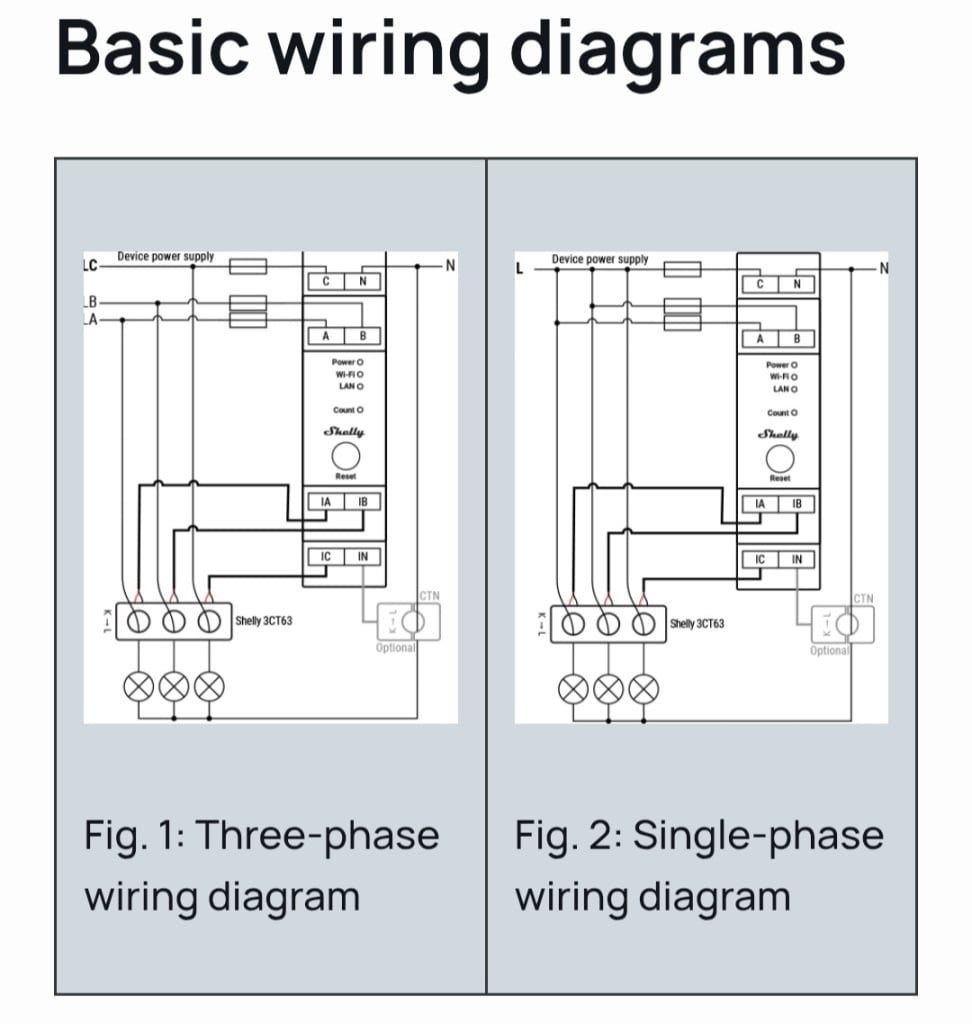
    I'm looking at getting an energy meter installed on my fuseboard (by an electrician), but they all seem to be for 3 phase connections, which I assume I don't have. My fuseboard is rated for 63 amps, but would this work with it?


  • Registered Users, Registered Users 2, Paid Member Posts: 8,632 ✭✭✭deezell


    That appears to be a three phase device also, just optinally wired with single phase split to each input and through what I assume is the current sensor. See the wiring diagrams. Ask the sparks also. Functional wiring diagram is as clear as mud.


  • Registered Users, Registered Users 2 Posts: 321 ✭✭ptogher14


    Shelly also do a single phase version. It may come with a 50A CT but you can get a 120 CT for it. Plenty of stuff out there, emporia is worth looking at for a full install. FYI if you have solar already installed, you more than likely have a CT installed on the main comer if you can extract the data from it.


  • Registered Users, Registered Users 2 Posts: 205 ✭✭lamaq


    It says the Shelly Pro 3EM can also do single-phase. I guess what I'm wondering is does that cover all 63 amps? Is there any way to know without getting an electrician to look at the fuseboard?

    The Shelly Pro 3EM 120A seems like it would work, but costs a good bit more.


  • Registered Users, Registered Users 2 Posts: 321 ✭✭ptogher14


    They are 63A CTs, so they'll cover 63A. The shelly EM gen 3 will work. Its comes standard with 50A CT but larger CTs can be bought separately. Its not din rail mounted, which the pro range are. Have an electrician look at your DB but that 3 phase CT could be awkward to get in if the DB is anyway tight


  • Registered Users, Registered Users 2 Posts: 205 ✭✭lamaq


    Should have mentioned that part of the reason I want an energy meter is for future compatibility with a solar battery. The Pro 3EM works with EcoFlow and Anker Solix, but I don't think the EM gen 3 is compatible, unfortunately.

    My other option is just to pick a battery brand now and use their energy meter -

    Sounds like I'll have to get an electrician to look either way.


  • Registered Users, Registered Users 2 Posts: 321 ✭✭ptogher14


    How do my mean it is compatible with the battery? What do you want it to do? Have you solar installed at the moment?


  • Registered Users, Registered Users 2 Posts: 1,389 ✭✭✭Exiled Rebel


    My parents and brother have separately installed Sungrow SH5.0RS inverters as part of their solar setups. It was a DIY job with the help of a electrician. The systems are up and running and working well, especially my brother's who has 12kWp of panels feeding into the 5kW inverter (they can be impressively oversized).

    The plan is to possibly add batteries in a year or so however during my research for them I noticed that the inverter is designed for HV batteries which are astronomical in price.

    From what I can see their only options are to a) pony up and add HV batteries from the likes of Sungrow or b) install an AC coupled battery.

    The second option looks to be far cheaper even if from a technical and efficiency standpoint not ideal.

    Are there any other options?


  • Moderators, Home & Garden Moderators Posts: 7,732 Mod ✭✭✭✭graememk


    C) swap out the sun grow for a solis/Sunsynk/deye that supports the "48v" batteries

    It would likely be the same price as an AC coupled system. (Also keeps you inline with the nc6 with max inverter limits).


  • Advertisement
  • Registered Users, Registered Users 2 Posts: 1,389 ✭✭✭Exiled Rebel


    Thanks.

    Option C would mean the brother having to reduce the number of panels he has from 24 to 20 (10kWp) if he was to put in a Solis Hybrid inverter for example. Be a bit of shame to do that.


  • Registered Users, Registered Users 2, Paid Member Posts: 16,043 ✭✭✭✭josip


    An S6 can take up to 16 kWp I think?


  • Registered Users, Registered Users 2, Paid Member Posts: 8,632 ✭✭✭deezell


    It looks like the way the Shelley is wired for single phase is that there are three paralell splits to the load(s) through the current sensors. Is it possible that these can read up to 63A on each pickup? They should. Maybe configuration and installation instructions will explain. In three phase mode it should be possible, as a three phased connected home or business will have plenty of single phase loads off each branch, not just exclusively 3 phase loads. The device doesn't carry any current through it, it merely measures source voltage per phase and current per phase, and the phase differences between the voltage and current on any phase if there are inductive loads. It has full 4 quadrant measuring, so it can measure reverse or feed in current. It looks from the wiring sketch that you should be able to monitor three seperate loads, even with a common single phase source, one of which can be an inverter, positive if charging from the grid, negative if feeding in. A second could be an EV outlet, the third would be the household load. You can sit up all night watching the current run in one way and out the other.

    Screenshot_20260508_093531_Samsung Browser.jpg

    On the Solis limit of 10 panels per string you infer, have you checked that the solis string voltage is exceeded by 12 panel no load voltage in series?. If this is the case, it should be possible to connect 8 on one string and 8+8 in parallel on the other, or 10 and 7+7, giving you one string with greater current range, effectively oversized by current capacity rather than voltage. The MPPT will optimise such a string.


  • Registered Users, Registered Users 2 Posts: 1,389 ✭✭✭Exiled Rebel


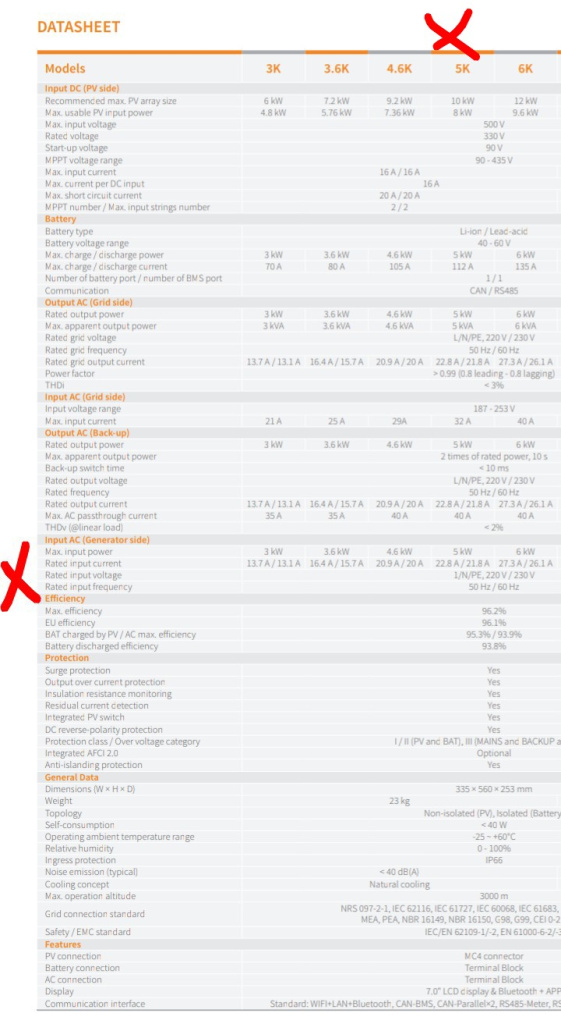
    20kWp but that version is way over the 25A NC6 limit, he'd have to settle for the 5kW inverter model to stay within the rules. The 5kW version has max DC array input of 10kWp.


  • Registered Users, Registered Users 2, Paid Member Posts: 16,043 ✭✭✭✭josip


    Does the 5kW version have the additional generator port?
    I've heard of people using that to connect up micro-invertered panels on a 3rd aspect.


  • Registered Users, Registered Users 2 Posts: 1,389 ✭✭✭Exiled Rebel


  • Registered Users, Registered Users 2 Posts: 205 ✭✭lamaq


    It can communicate with the battery in real time, so the battery knows exactly how much to output. I don't have solar at the moment, this is really for if/when plug-in solar ever becomes legal in Ireland.


  • Moderators, Home & Garden Moderators Posts: 7,732 Mod ✭✭✭✭graememk


    Ah the Anker battery/inverter. That makes more sense


  • Moderators, Science, Health & Environment Moderators Posts: 4,894 Mod ✭✭✭✭Tree


    Any of the shelly EMs can connect to a CT at the right spot. You only need a pro if you want the unit in the consumer box, but you can install the CT anywhere and wire it back. Mine is a regular EM in a plug socket that's close to the CU and the CT is just run over to the incoming wire from the smart meter


  • Advertisement
  • Registered Users, Registered Users 2 Posts: 205 ✭✭lamaq


    I need a Pro if I want to communicate with either an EcoFlow or Anker battery system. The other Shelly devices may work, but they're not listed as compatible on the EcoFlow or Anker sites.


Advertisement
Advertisement