Advertisement
Help Keep Boards Alive. Support us by going ad free today. See here: https://subscriptions.boards.ie/.
https://www.boards.ie/group/1878-subscribers-forum

Private Group for paid up members of Boards.ie. Join the club.
Hi all, please see this major site announcement: https://www.boards.ie/discussion/2058427594/boards-ie-2026

John Collison on why Ireland can't do infrastructure

1457910

Comments

  • Moderators, Sports Moderators, Paid Member Posts: 33,942 Mod ✭✭✭✭Podge_irl


    I strongly question the motivation, and indeed competency, of anyone who proclaims Ireland ranks below Bulgaria in terms of infrastructure and public services no matter what metrics are chosen.

    Extreme claims require extreme evidence and all that. The idea we are such a massive outlier is farcical.

    I’ll grant her health

    I won't grant her health. Our life expectancy and health outcomes are good. The health service has problems but again the idea it is the worst in Europe is silly.

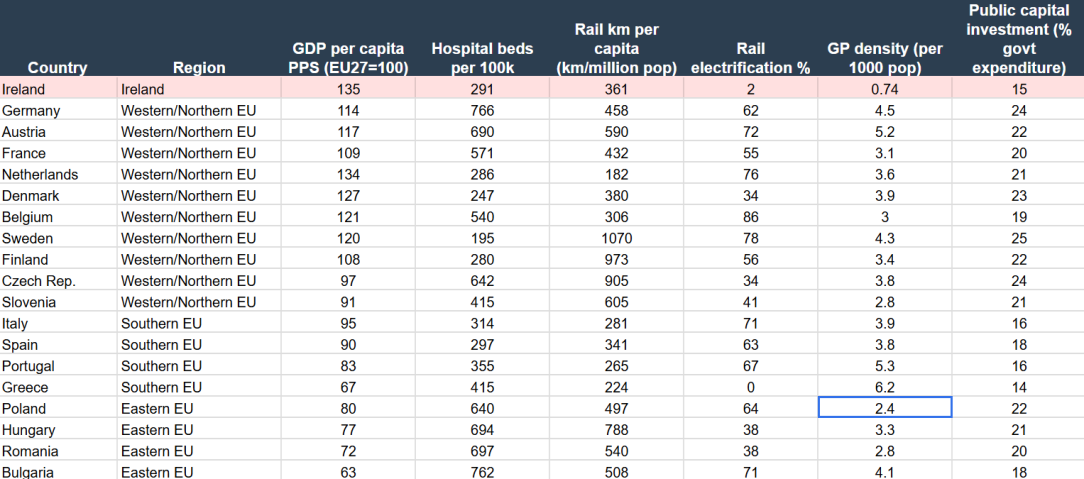
    This is apparently her data set. I don't even remotely need to check up stats to know that data showing we have a third as many GPs as the next lowest country in Europe is clearly incorrect.

    1000041931.jpg

    Using two rail metrics for her graph is absolutely bonkers. We are a small island uniquely unsuited to rail in Europe (not least because, as mentioned above, we have an unusually dense motorway network).


  • Moderators, Category Moderators, Arts Moderators, Sports Moderators, Paid Member Posts: 56,277 CMod ✭✭✭✭magicbastarder


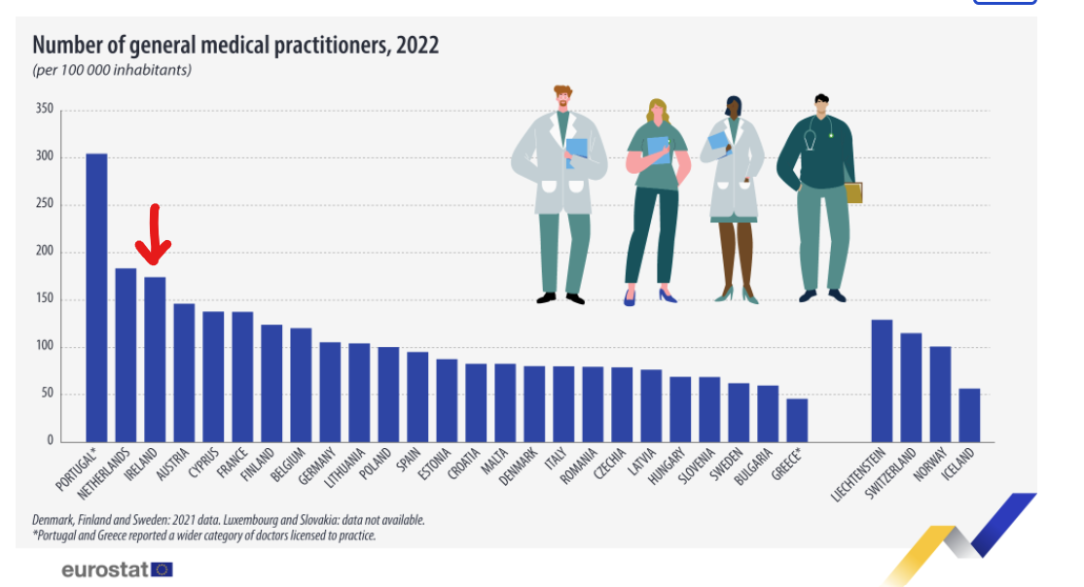
    that's a strange error to make in relation to the number of GPs; according to this, we're second highest per capita in the EU (excluding portugal as they used a different definition)

    https://ec.europa.eu/eurostat/web/products-eurostat-news/w/ddn-20250116-2


  • Moderators, Sports Moderators, Paid Member Posts: 33,942 Mod ✭✭✭✭Podge_irl


    Fair disclosure, that table is from Dan O'Brien. I looked for it from her substack and couldn't find it but I'm on a phone so can't dig too deep. But even the metrics she chose are weird and her "trust me if you pick anything else we do just as bad" argument is weak.

    Like if that graph was true we would be the outstandingly worst country in Europe by orders of magnitude. And that is a fairly silly concept.


  • Registered Users, Registered Users 2 Posts: 312 ✭✭Bsharp


    km of roads per capita and km of fibre broadband per capita are two examples which we'd perform well on as the counter factuals to start


  • Registered Users, Registered Users 2 Posts: 883 ✭✭✭spuddy


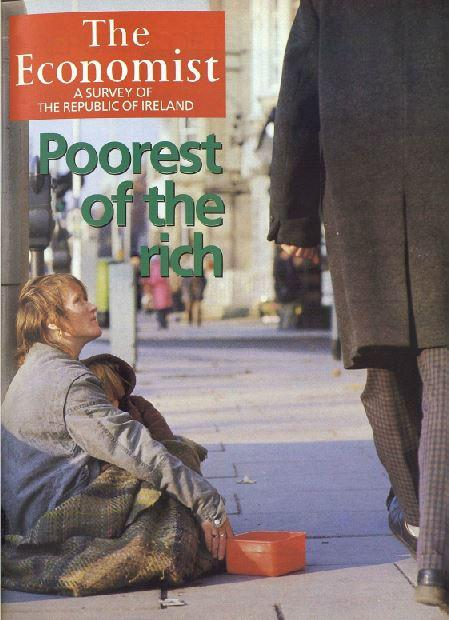
    1988 folks, these were the headlines.

    Are we as developed as other European countries? No. Have Governments (and the Civil Service who advise them) been too cautious with investment since the GFC? Yes.

    However some perspective, in just over one generation the change this country has undergone is remarkable.

    That's not an excuse for the problems the country has, which the State doesn't seem to have sufficiently competent people in place to properly address (yet), but today's issues are 'better' than what we had to deal with in the past, and therefore I remain optimistic that they too will be solved in time, because the population will demand it.

    image.png


  • Advertisement
  • Moderators, Category Moderators, Arts Moderators, Sports Moderators, Paid Member Posts: 56,277 CMod ✭✭✭✭magicbastarder


    a simple km of roads per capita just reflects a highly rural population; more is not necessarily better with that. in fact, you could argue it's a bad thing.

    similar with km of fibre.


  • Registered Users, Registered Users 2, Paid Member Posts: 3,517 ✭✭✭KrisW1001


    I suspect it was put together quickly, and then went viral, and with that, she no longer had full control over it. In fairness, though, she owes nobody any obligation to correct anything. It's an opinion piece, and as a way of starting a debate it has done its job. I happen to disagree with the angle she’s taking, but I definitely agree with her that there’s a fundamental problem with how this country delivers infrastructure, and it is being masked by a “we’re rich” narrative based mainly on windfall income from corporation tax - much like our fundamental problems were masked by windfall income from residential stamp duty back in the late 2000s. It's like we just don't learn. I have my own opinions on the reasons for this, but they’re off topic.

    My only complaint was that I’d like to have been told the how the vertical axis of that graph was calculated.


  • Registered Users, Registered Users 2 Posts: 2,691 ✭✭✭MayoSalmon


    One thing that article gets right is how she presented the fact that all the wealth we have just arrived..

    A lot of the mindset in this country stems from this situation whereby we were basically been gifted all this cash and hence have no obligation to invest it meaningfully for wealth to continue.

    That only reason you ever hear of the need to build infrastructure of any sort is because the government get spooked that multinationals will pass on Ireland because of the lack of infrastructure investment...housing, traffic etc..


  • Registered Users, Registered Users 2 Posts: 1,611 ✭✭✭JohnDoe2025


    I've seen this said before that we don't need FDI incentives.

    Could you explain to me why big pharma and tech would stay in Ireland without the incentives?

    Furthermore, without them, where would we get the money for investment in key infrastructure projects?


  • Posts: 0 [Deleted User]


    These companies have already invested untold billions and time into the economy, education and other sectors to ensure their products are of the highest quality. As part of OECD rules we are already taxing larger firms 15% instead of the base 12.5% ( https://www.revenue.ie/en/companies-and-charities/pillar-two/what-is/pillar-two-rules.aspx ) without any noticeable impact. I'm not saying to not provide incentives at all, but it certainly shouldn't be a cornerstone of our economic policies at this point. In the 90's we were a young and growing economy and FDI incentives was the foundation for that, but we're now a mature economy with a highly skilled workforce. I simply do not think that FDI incentives do a whole lot for us any more, especially when we should be putting more effort into encouraging local SMEs, especially non-profit companies where employees see a larger portion of annual earnings.

    We're reaching a point in society where there is an increasing wealth gap and consolidation with every economic shock (which are becoming more regular), so handing out incentives to companies who only exacerbate this issue is not in the public interest.


  • Advertisement
  • Registered Users, Registered Users 2 Posts: 1,611 ✭✭✭JohnDoe2025


    We have to keep the investment here, which requires continued incentives.

    Look at Intel, we keep needing them to upgrade their plants to build the more advanced chips, that is if they don't lose out and we have to replace those jobs.

    For a country like ours (or Singapore or Luxembourg) the economy is too small to rely on indigineous or SMEs, we would be more like the Faroes Islands in economic terms if we did.

    In relation to education, have a look at the work permit statistics. If our education system was producing the workers FDI needs, we wouldn't have so many work permits being issued to them.

    We are far from a mature economy as we don't have the infrastructure of a mature economy, housing, public transport, water, health and education all lag behind. We need FDI profits to pay for this.


  • Posts: 0 [Deleted User]


    Look at Intel, we keep needing them to upgrade their plants to build the more advanced chips, that is if they don't lose out and we have to replace those jobs.

    Upgrades and continued investment are decided upon by a number of factors like workforce skillset, supply chains, political/social stability and not simply tax incentives.

    we would be more like the Faroes Islands in economic terms if we did.

    that's an exaggeration, they have a population of around 55,000. Ireland has a diverse and highly skilled workforce. I agree that without FDI we wouldn't be where we are today but again, I don't think it is the be all and end all of our economy.


    If our education system was producing the workers FDI needs, we wouldn't have so many work permits being issued to them.
    I don't think this is the case. I believe it shows strong demand for skilled workers where growth outpaces our ability to create the talent ourselves. We also have some highly specialised sectors where some roles are difficult to fill, which would be the case anywhere in the world.

    We are far from a mature economy as we don't have the infrastructure of a mature economy, housing, public transport, water, health and education all lag behind. We need FDI profits to pay for this.

    In my opinion, decades of reliance on FDI focused growth without parallel public investment is exactly why infrastructure is lagging. As for relying on FDI, we're currently in a risky position where in 2024 three companies paid 46% of corporation tax ( https://www.rte.ie/news/business/2026/0219/1559232-ifac-corporation-tax/ ). This results in potential huge tax swings where one year is a boom and the next a bust, the knock on effect of this volatility is seen in lack of long term or start/stop investment in infrastructure and social services.

    This is why I think we need to rebalance our corporation tax with less focus on FDI incentives, with the goal to create a more predictable stream of corporation tax would allow the country to create feasible long term infrastructure plans.


  • Moderators, Social & Fun Moderators Posts: 4,692 Mod ✭✭✭✭Ozymandius2011


    It's ridiculous the Galway Ring road has been held up for nearly 30 years.

    The only defence I would make at our objection culture compared to other countries is that land has always been more emotional here because of memories of landlordism.

    I think as an island we are uniquely vulnerable to interruptions in supply chains due to war, pandemics like Covid etc. So the more production occurs here the better for that.

    We dont have oil (though the last government effectively banned drilling). We need a national rollout of renewables.

    Post edited by Ozymandius2011 on


  • Registered Users, Registered Users 2 Posts: 1,611 ✭✭✭JohnDoe2025


    It isn't possible to create a more predicatable stream of corporation tax, unless you accept that it will run at around 10% of its current level. Income tax would have to make up the difference.

    Much better as the current government is doing is to put as much as possible of the excess corporation tax aside for infrastructure and future shocks to the economy.

    Moving away from the current incentives will lower living standards across the economy.

    I am always curious about which industries people expect us to build up as part of the growth of SMEs.


  • Registered Users, Registered Users 2, Paid Member Posts: 9,858 ✭✭✭Gloomtastic!


    The Premature State: Why Ireland Can’t Build Itself

    David McWilliams interviews Sinead O’Sullivan here about her recent SubStack. He also mentions about the ‘nitpickers’ who try to detract from her argument by nitpicking over data points etc. He claims those nitpickers are employed here in government, tax-funded roles and to agree with her points would undermine their very comfortable positions.

    So, in the interests of transparency, @KrisW1001 you were nitpicking over her data points. Are you paid by the state in a role that would be undermined if her argument was correct?


  • Registered Users, Registered Users 2 Posts: 7,418 ✭✭✭Charles Babbage


    Most of these criticisms of public policy fail because they start from the premise that "they are all a shower of wasters" and any defence is "mere detail". In reality, the situation is more nuanced. From the Shannon scheme in the 1920s to Albery Reynold's telecoms 60 years later, progress was often made. More recently we build shed load of motorways in the 00s. Not all government is inefficient, the Revenue Commissioners do their job, the education system is as good as most. So the question is not why we do not build infrastructure, but what has changed since the 00s, but that is nuanced question and people prefer lazy generalisations.


  • Registered Users, Registered Users 2 Posts: 1,611 ✭✭✭JohnDoe2025


  • Registered Users, Registered Users 2 Posts: 4,286 ✭✭✭Ardillaun


    There’s an inertia over reasonable legislative reform. We seem to leave it until either a crisis or Europe force our hand. The problem with the land was complicated by the fact that so many without it had to leave the state entirely which meant that landowners have had a disproportionate political footprint up to the present day. Many of our smaller country roads are a trial to drive on with the traffic they now bear and putting a coat of paint on them doesn’t make them any bigger. I presume the cost of land makes reasonable widening and the provision of passing lanes more difficult?


  • Registered Users, Registered Users 2, Paid Member Posts: 3,517 ✭✭✭KrisW1001


    I was not "nitpicking". I was asking the most basic question anyone should ask whenever they see a graph or other "numbers" being used to advance an argument: "where are these numbers from, and how have they been calculated?" Unsourced data is indistinguishable from lies, and anyone can insert a chart into an article.

    I won't accept bogus data in support of any argument, even one I might believe in: facts are not optional. I'd advise you to take the same line, and question even those whose opinions you share. A strong argument will survive it.

    Regarding my personal life, I debated just telling you to go f off for yourself , but that might have left you thinking you'd been "right". No, sadly for the conspiracy narrative, I work in private industry, in a field unconnected with civil infrastructure or any Government-funded activities. My interest here is as a citizen. When I did work in an infrastructure-related field, years ago, none of it was in this country.

    So now, tell us all where your living comes from…


  • Registered Users, Registered Users 2, Paid Member Posts: 9,858 ✭✭✭Gloomtastic!


    Ok. Thanks for answering.
    Me? I’m currently living off a private pension.


  • Advertisement
  • Moderators, Category Moderators, Arts Moderators, Sports Moderators, Paid Member Posts: 56,277 CMod ✭✭✭✭magicbastarder


    I had assumed the question was a humorous one...


  • Moderators, Society & Culture Moderators Posts: 12,622 Mod ✭✭✭✭Amirani


    I listened to this and found it all pretty silly. It's good that Sinead O'Sullivan decided to start a debate and to add to the discourse - she made some strong arguments that are worthy of discussion. However, her approach to data is quite obviously flawed at best, and has very little statistical rigour. Attempting to reduce things down to a set of biased variables, particularly ones with high levels of multicollinearity, just undermines the argument she's making. She clearly just chose a set of data points that would support her hypothesis (pretty obvious when you use multiple rail-related metrics as the only transport ones) rather than a principal components/factor analysis type approach that seriously tried to create a set of explanatory variables.

    McWilliams trying to portray any criticism of this as 'nitpicking' by the deep state is pretty poor form for him, but he's not really a serious commentator most of the time, and is just a media personality. It's literally part of the scientific method to attempt to challenge/falsify a hypothesis, his response to this is unscientific nonsense.


  • Registered Users, Registered Users 2, Paid Member Posts: 3,517 ✭✭✭KrisW1001


    @Podge_irl The GPs figure is wrong, but not significantly wrong. There are 5200 GPs in Ireland, based on figures from the Irish College of GPs (their membership of 4400 is 85% of all practicing GPs). Against that, we have a population of around 5.58 million, so it’s about 0.9 GPs per thousand persons.

    It wasn’t always this way, which is why I suspect you reacted the way you did to the figures.. I was the same, which is why I dug into it. The low number today is due to two factors: first is rapid population growth, and the second is the erosion of pay and conditions for GPs. It’s great that you don’t have to pay for kids to go to the doctor anymore, but it’s not so great that the GPs get a pittance for it: Children are paid at a flat-rate per year that (if I remember right) is about double the rate for the 18-60 cohort on the medical card scheme. Now anyone with a kid can tell you that a child needs to the doctor far more often than an adult, and far more than twice as often. When you add the induced demand factor of making kids’ GP visits free, GPs have had a massive drop in both available capacity and in income. General Practice is a self-employment in Ireland, so a good income is essential for the survival of a practice, but these cuts have forced many young GPs to leave, or just not set up practice here at all after graduation. It took my own doctor nearly a year to find a junior GP to work with them, and that’s in a well-resourced, progressive urban practice.

    Just to be clear, I’m not defending the idea that everyone should have to pay €70 (€56 after tax rebate) to go to the doctor with a sick child, but this was a change that dramatically increased demand while also dramatically cutting remuneration. For a better idea of how to do it, I once had to visit the doctor in the Czech Republic, and there the system works on a nominal fee basis (equivalent to around a fiver here) per visit, a fee that the doctor can waive for patients that they know can’t pay. The fee doesn’t make much difference to the practice revenue, but it does deter the people who will march their kid to the surgery every time they sneeze or scrape their knee - my GP reckons that if they could get just ten patients on their GMS list to cop on a bit, they’d have at least an extra two appointment slots a week for other patients.


  • Moderators, Sports Moderators, Paid Member Posts: 33,942 Mod ✭✭✭✭Podge_irl


    Thanks for digging into that.

    But it is only one half of the equation. I don't so much question the stat for Ireland (though as you say it is wrong), but I question that it is possible we are that much of an outlier.

    Our total number of physicians per capita according to the OECD is broadly the same as Finland, Estonia, France, Hungary, Latvia, Poland and Slovenia.

    On a quick google and from Statista (so unsure of the provenance ultimately) Austria has 6,690 GPs for a population of 9.22 millions or 0.7 per 1,000. If that table is correct, she is using slightly incorrect figures for GPs in Ireland vs all doctors in every other country.

    That the data is wrong should be blindingly obvious to anyone. Again, she is either arguing in poor faith or just terrible at this.


  • Registered Users, Registered Users 2, Paid Member Posts: 3,517 ✭✭✭KrisW1001


    I think there’s a miscount between countries, and that some figures could be counting all generalist medical doctors, which would include non-consultant hospital doctors, Emergency Department Doctors and suchlike, but for Ireland the narrower definition of a generalist who runs public surgeries (“a GP”) was used.

    Eurostat appears to be using the broader definition, and it results in this chart:

    image.png

    (From this 2025 publication - Medical workforce in the EU: an ageing profession - News articles - Eurostat )

    That’s not to say we don’t have a dysfunctional health service. We definitely do. It’s something of a surprise to learn that we have the same number of medical staff give or take as countries with far better service provision. For me, the private/public split in specialist care is messing with wait times and quality of service. It’s not right either to say it’s the private model that messes things up, given that all GP primary care is private in Ireland, with the State directly reimbursing doctors for handling medical card patients, and we have historically had a very good GP system (as good as countries where it’s all public). Hospital care is neither fish nor fowl here, and that’s why it’s so badly broken: there are two parallel accounting and auditing processes within hospitals - one for the government, one for the insurers, and it’s a total waste of effort.


  • Moderators, Sports Moderators, Paid Member Posts: 33,942 Mod ✭✭✭✭Podge_irl


    One could spend a long time delving into the issues with the healthcare system (and I would argue it has elements of dysfunction, but is not in of and itself dysfunctional - health outcomes are still good), but the point is that the starting point for this person's thesis was bogus and would have been evidently so to anyone who spent more than 10 seconds googling some basic data or having some base common sense. She simply wants to believe or portray that we are uniquely awful in Europe and by an order of magnitude.

    I think we are bad at infrastructure for a number of reasons. Some of them aren't really are fault - no matter how rich we are now, we are broke as all else for much of the first century of our existence - some of them are experienced by other countries e.g. the planning morass, and some of them are undoubtedly unique to Ireland. But a discussion on this that starts with either wilful misleading graphs or just utter incompetence is not a good start point.


  • Moderators, Category Moderators, Arts Moderators, Sports Moderators, Paid Member Posts: 56,277 CMod ✭✭✭✭magicbastarder


    She has an article in the IT today now on the topic.

    https://www.irishtimes.com/opinion/2026/04/25/sinead-osullivan-irelands-population-is-told-it-has-never-been-richer-yet-it-has-never-felt-poorer/

    Paywalled, but a sample (talking about Varadkar's recent utterings)

    In the narrowest fiscal framing he has a point – on paper, a single Apple subsidiary in Cork books more profit than the entire Irish agricultural sector produces in output. But while his comments feel measured, it is easily mistaken for a strategy. However, this is not a strategy; it is the absence of one.


  • Registered Users, Registered Users 2 Posts: 14,299 ✭✭✭✭Zebra3


    Wouldn’t argue with much of that article.

    Politicians picking a couple of data points and thumping their chests.

    We’re back to where we were in the 80s.


    Educating our young to emigrate.


  • Moderators, Sports Moderators, Paid Member Posts: 33,942 Mod ✭✭✭✭Podge_irl


    We absolutely are not back to where we were in the 80s. In the year to April '25 a net 3,500 Irish citizens left for god's sake. It is utterly incomparable.

    Young people will always leave small countries with larger, same-language opportunities available and global travel so much easier. A great number of them come back.

    Meaning that while corporation tax has quintupled in a decade, our rail network has halved in a century.

    I see she is continuing with using utterly meaningless statistics to make her point.

    The 35,000 graduates who left last year because they could not afford to live here are not evidence of the system working

    35,000 graduates didn't leave. 35,000 Irish people left and 31,500 returned.

    Grass-fed beef and dairy produced in a temperate Atlantic climate and on land that has supported pastoral farming for 4,000 years is the textbook case of comparative advantage. The structural edge that countries spend fortunes and decades trying to manufacture is what Ireland possesses for free. And the orthodox economic advice is to protect it, invest in it, and build around it relentlessly.

    There is nothing to say about this other than she is an absolute hack.

    Collison's piece was about a million times more measured, sensible and factual then this garbage.


  • Advertisement
  • Registered Users, Registered Users 2, Paid Member Posts: 3,517 ✭✭✭KrisW1001


    Is she seriously suggesting in that last excerpt that we don't invest heavily in beef production in this country? Wow.

    However, there is a limit to that. Our ability to command higher prices for our beef comes from the customers' knowledge that Irish beef is not intensively farmed. The moment we try to adopt an industrial-scale raising system, we lose the main advantage that our global competitors cannot match us on.

    The rail one is bizarre... under any economic situation, our rail network would always have shrunk over the last century, as it served a population that has massively urbanised since it was built - rural local rail networks really cannot compete with road traffic in sparsely populated areas. Rail excels at moving large numbers of people at once, but if the entire population for 10 km around wouldn't fill one train, you're on a hiding to nothing with rail.

    The valid metric to pull up would be around new rail investment, but once you realise that Luas is rail investment (Green Line unquestionably so), you would see a pattern of investment following tax receipts, often by too long, but it's there nonetheless.

    But the point she keeps skipping over is that this is not a failure to build any transport infrastructure, but rather a political choice to prioritise a massive improvment to road infrastructure above rail. Given the comparative state of both networks in 1990, that was the right choice.


Advertisement
Advertisement