Advertisement
Help Keep Boards Alive. Support us by going ad free today. See here: https://subscriptions.boards.ie/.
https://www.boards.ie/group/1878-subscribers-forum

Private Group for paid up members of Boards.ie. Join the club.
Hi all, please see this major site announcement: https://www.boards.ie/discussion/2058427594/boards-ie-2026

Nuclear - future for Ireland?

1101102104106107142

Comments

  • Registered Users, Registered Users 2 Posts: 16,965 ✭✭✭✭charlie14


    The concise version of your post is “I haven’t a clue what the official current plan is, but I’m hoping you will dig me out of a hole of my own making and explain it to me”

    Not how it works. Nobody is here dó do your research for you. It’s solely up to you to do your own.


  • Registered Users, Registered Users 2 Posts: 24,493 ✭✭✭✭ted1


    You are such a spoofer, you have no idea what plan you are talking about. You keep referring to a plan but can't name it.

    The Climate Action plan, is the one that drives policy but doesn't support any of your posts, so if you can't name the plan i assume you are just making your own one up.

    The national Hydrogen strategy (not plan) has a 50/20 split, far from 50/50


  • Registered Users, Registered Users 2 Posts: 16,965 ✭✭✭✭charlie14


    The more you post the more it becomes obvious that you do not have a scooby as to what the current official government plan is.

    If this plan according to you is for 50% of generation for domestic use and 20% for hydrogen production, what is the remaining 30% of generation going towards ??


    The current plan is for 4GW of installed offshore capacity to be operational by 2030. This is not going to happen by 2030, but let’s pretend that it is. This is to be achieved by Codling Bank, Arklow, Shelmalere and Dublin Array. 50% of that 4GW installed capacity is under the present government National Hydrogen Strategy earmarked for hydrogen production. Not the 20% you are claiming.


    Your claims on hydrogen also raise the question that if hydrogen is not going to be used to fill the generating gaps due to unreliable and intermittent wind then what according to your perceived plan will. A sprinkling of magic powder paid for by magic money ?


  • Registered Users, Registered Users 2 Posts: 24,493 ✭✭✭✭ted1


    once again you can’t name your plan.
    its 5GW and 2GW. But the push is on for the 5GW the 2GW is secondary


    what clean on hydrogen?


  • Registered Users, Registered Users 2 Posts: 16,965 ✭✭✭✭charlie14


    Absolute and utter nonsense.

    The installed capacity of the 4 offshore wind farms that it is hoped will provide generation by 2030, which btw they will not, is 4 GW not 5 GW as you believe, and 50% (2GW) is for hydrogen production under the present official government National Hydrogen Strategy.

    Still waiting to hear how this plan, so far exclusive to your own head, is going to fill the generating gaps of unreliable intermittent wind if it is not going to be hydrogen ?


  • Advertisement
  • Registered Users, Registered Users 2 Posts: 24,493 ✭✭✭✭ted1


    it may eventually be hydrogen. But it’s still a good bit away. We will continue with gas for the foreseeable future. Maybe with a 20% mix but that only has 1/3 of the calorific value as gas. So it’s lit as simple as saying 80/20. Batteries are developing into 12 values but we’ll never have enough to run the grid.


  • Registered Users, Registered Users 2 Posts: 16,965 ✭✭✭✭charlie14


    Not only do you not know what the current official National Hydrogen Strategy is you cannot provide anything for this imaginary plan of your own other than burning ever increasing volumes of gas as our demand keeps rising. A strategy that has failed on all levels from electricity charges too reducing our emissions to anywhere close to the 51% level required for 2030 which will see us paying out billions annually on fines up to and beyond 2050.


    It’s a plan that would see us also tearing down wind turbines every 20 years to be replaced by other wind turbines at greater capital costs and higher strike prices until the end of time when nuclear with it’s once off capital cost and greater capacity factor over a comparative lifespan of 60 years would provide the same electricity per GW for as little as half the cost.

    You do not need to tell me about batteries. I pointed out recently in this thread that based on ESB costs they would require a capital spend of €10.8 billion to provide an average hourly grid demand of 3.6 GW for a single day before being drained


  • Registered Users, Registered Users 2 Posts: 24,493 ✭✭✭✭ted1


    so you think Over night we are going to switch to Hydrogen. not a chance its 20 way down the road.

    the strategy is still 5 GW and 2 GW.

    I'd be happy with a very turbine that installed in the last 20 years lasting 30 years, maintenance costs increase significantly after 20 years, and then you struggle to get support. e.g Vestas won't support sub 2 MW turbines.

    Newer turbines get less support, many of the new wind farms entre straight into a PPA with a data centre.

    Nuclear is expansive to build, and very expensive to decommission. Yes its once off. But the simple fact you keep ignoring is that it we started today, it would take 50 years before its commissioned.

    what do we do between now and 2076?


  • Registered Users, Registered Users 2 Posts: 17,427 ✭✭✭✭markodaly


  • Registered Users, Registered Users 2 Posts: 17,427 ✭✭✭✭markodaly


    Something which due to their relative lifespans will occur at least three times during the lifespan of a nuclear plant,

    The windfarm in the article mentioned a lifespan of approx 32 years.
    Would a nuclear power station get a life span of approx 100 years?

    According to the IAEA, nuclear plants have a lifespan of approx 40 years, and may be extended depending on upgrade works, maintenance, etc..
    So no, a Nuclear power plant doesn't have a life span of 100 years .


  • Advertisement
  • Registered Users, Registered Users 2 Posts: 1,799 ✭✭✭bored65


    The same Spain that also has 7-8GW nuclear?

    And been buying Russian gas to backup their unreliable renewables (that so infamously brought down their grid) as the Russians keep boasting about

    https://tass.com/economy/2118049


  • Registered Users, Registered Users 2 Posts: 17,427 ✭✭✭✭markodaly


    I am enjoying this debate, but…


    For the pro Nuclear folks, how do you make a business case to build a Nuclear power plant in Ireland, a plant that will cost anything from €40Billion to €60 Billion

    This may have been talked about before, but in Australia, nuclear was a big talking point in the last election. It was put forward by the Liberal Party who had an anti-renewable streak in them.
    Anyway, the analysis came back, and for the 7 nuclear plants they wanted to build, it would cost them from $116 - $600 Billion.

    https://smartenergy.org.au/nuclear-fallout-116-600-billion-to-build-7-nuclear-reactors/


    The electorate looked at the argument from both sides and roundly rejected the Liberals, ushering them to their 2nd biggest electoral defeat since WWII. Nuclear in that country is now dead, given it was examined and roundly rejected due to costs.

    Nuclear may have been a good deal in the 60's right up to the 90's, but costs, regulations, and a boom in wind/solar/batteries have put a death knell to the idea. SMSRs may be a game changer, but it's entirely unproven yet if they can be delivered as cheaply as some think. We have to wait a decade or two to see that come to the fore.


  • Registered Users, Registered Users 2 Posts: 1,799 ✭✭✭bored65


    The one and only and now gone offshore wind farm in Ireland lasted 20 years, sea is a harsh environment

    Nuclear plants last 60+ years without issues


  • Registered Users, Registered Users 2 Posts: 17,427 ✭✭✭✭markodaly


    You didn't read the article, did you?

    In 2022, they suffered a price shock just like everyone else, and they had Nuclear then.
    What has changed was that they doubled down on renewables, thus nuttering the latest shock. They didnt build any new nuclear plants.

    Are you proposing Ireland build one, for at least €40 Billion, and we would wait, about 20 years before we can use any of the power it would generate?

    That isnt the smart play here.


  • Registered Users, Registered Users 2 Posts: 17,427 ✭✭✭✭markodaly


    So, you picked the wind farm that suited your argument, an offshore wind farm, that was more experimental than anything. The windfarm I was referencing was the one that was repowered and it lasted 32 years, without issue.

    No nuclear power plant has been continuously running without issue for 60 years, and has not had any rigorous upgrade works carried out. Most get to a point after approx 40 years, where the cost of upgrades outweighs the benefit, so they are shut down.

    Now, if you can point out a Nuclear Plant that has been running fine for the last 60 years without any upgrades work carried out, I am all ears.


  • Registered Users, Registered Users 2 Posts: 16,965 ✭✭✭✭charlie14


    The live span of nuclear reactors have a lifespan of 60 years with even older nuclear power plants now having their lifespans extended by 20 years.

    The data from our close neighbours in the U.K. shows that wind turbines lose 1.6% of their capacity year on year. So do you somehow believe that the owners of offshore wind farms who have a 20 year strike prices are going to happily continue supplying electricity for one third less of the price than they were getting 20 years earlier, where they can scrap those wind farm after fulfilling these 20 year contracts and apply for a new 20 year contracts with a better strike ?

    If you do I have a lovely second hand bridge that has only suffered one major collapse I can let you have at a bargain price.


  • Registered Users, Registered Users 2 Posts: 17,427 ✭✭✭✭markodaly


    The live span of nuclear reactors have a lifespan of 60 years with even older nuclear power plants now having their lifespans extended by 20 years.

    I asked for examples.


    The data from our close neighbours in the U.K. shows that wind turbines lose 1.6% of their capacity year on year. So do you somehow believe that the owners of offshore wind farms who have a 20 year strike prices are going to happily continue supplying electricity for one third less of the price than they were getting 20 years earlier, where they can scrap those wind farm after fulfilling these 20 year contracts and apply for a new 20 year contracts with a better strike ?

    Again, you are dishing out misinformation.
    Newer turbines show significantly lower degradation, of about 0.17%

    https://www.sciencedirect.com/science/article/abs/pii/S0360544225017840


    But anyway, you always seem to be telling us what you are against. What are you FOR?

    How can Ireland get cheap energy for its people over the next few years..


  • Moderators, Recreation & Hobbies Moderators, Science, Health & Environment Moderators, Technology & Internet Moderators Posts: 99,487 Mod ✭✭✭✭Capt'n Midnight


    Name a nuclear plant that's produced power for 60 years without issues.

    Actually name a nuclear plant that's been operating for 60 years.

    Our first wind farm was opened in 1992 and the turbines are being replaced with much bigger ones. How long ago was that ?

    They are replacing those 21 turbines with 18 larger ones. Each of the news can provide more power than all of the 21 old ones.

    Post edited by Capt'n Midnight on


  • Moderators, Recreation & Hobbies Moderators, Science, Health & Environment Moderators, Technology & Internet Moderators Posts: 99,487 Mod ✭✭✭✭Capt'n Midnight


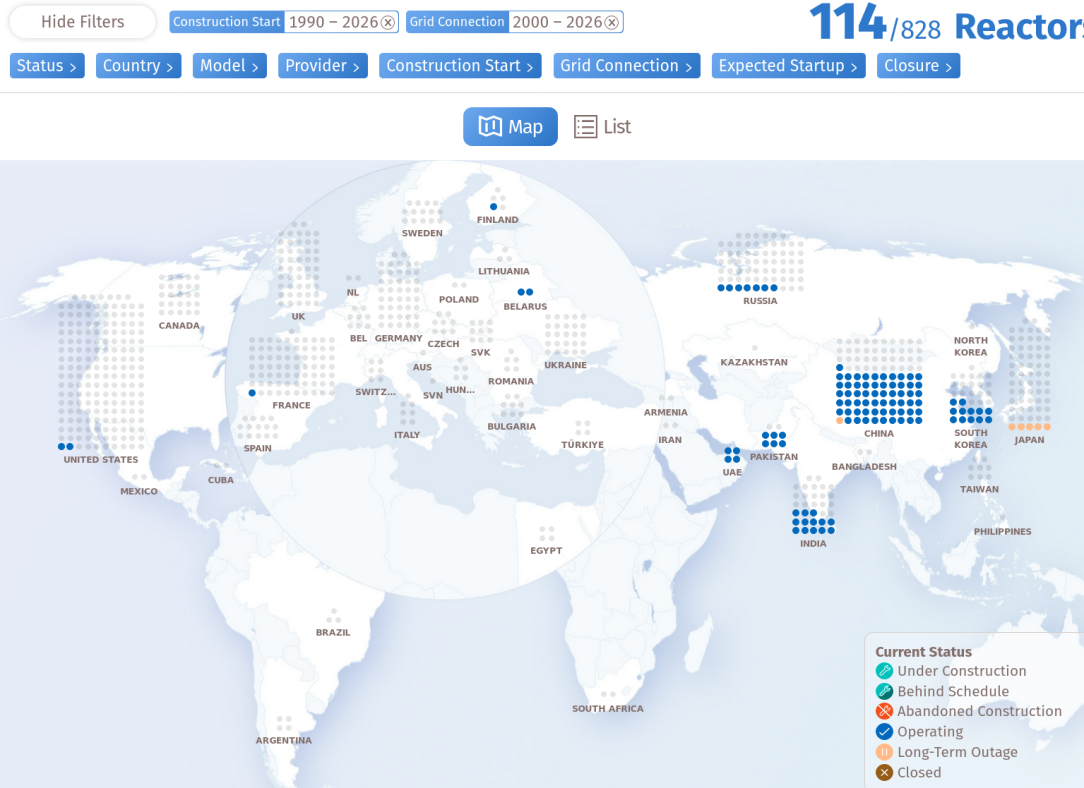
    image.png

    Only six nuclear reactors outside Asia were first connected to the gird this millennium.

    And that's not counting the four abandoned ones in the US, Brazil and Argentina.

    (Excluding ones that started construction before 1990 like Watts Bar)

    We'd have to do better than what's been done over the last 36 years across four continents. Not going to happen.

    Post edited by Capt'n Midnight on


  • Registered Users, Registered Users 2 Posts: 16,965 ✭✭✭✭charlie14


    My data is based on the peer review findings of Dr.Ian Staffell and Professor Richard Green of Imperial College London based on their 10 year study of 300 U.K. wind farms.

    Not that scientific or economics analysis has every mattered to anyone that supports this present plan where both are looked upon by them as two distant planets in some far of galaxy, but seeing as I have give my analysis, with verifiable data provided, on where this present policy is taking us in comparison to nuclear financially on many occasions, perhaps you would be good enough to be the first to give us the long requested and ignored financial breakdown of this present policy you appear to favour. Yes or no ?


  • Advertisement
  • Registered Users, Registered Users 2 Posts: 24,493 ✭✭✭✭ted1


    The oldest nuclear plant was built in 1969, less than 60 years ago…….


    the arklow bank WF. Was an early adopter there’s 24 years worth of development we’ve gone from 3MW turbines to 15 MW


  • Registered Users, Registered Users 2 Posts: 1,799 ✭✭✭bored65


    And the only offshore farm we build couldn’t last 20 years without burning down … at sea

    Lol


  • Registered Users, Registered Users 2 Posts: 24,493 ✭✭✭✭ted1


    wind turbines have no fuel costs.. they have service contracts that gurantee availability and a power curve. If these aren’t achieve the manufacturers pay. Any degradation is built into the financial model from

    Day 1.


  • Registered Users, Registered Users 2 Posts: 1,799 ✭✭✭bored65


    They also have no predictability of production with a crappy 30% capacity factor pushing the country to rely on gas leading to worlds most expensive electricity while still producing 6x co2 compared to countries with mostly nuclear

    Would you buy a car that randomly slow down on motorway to walking speed and last 5 years instead of 15?

    Wind has a fuel cost, the cost of gas most of the time wind is not blowing and needs backup, which is why we have such expensive electricity


  • Registered Users, Registered Users 2 Posts: 24,493 ✭✭✭✭ted1


    If you are going to argue like a child I’ll throw out Chernobyl , 3 mile island and Fukushima.

    But as an an engineer I realise that these things happen, and how they happened.

    I take it you not an actual engineer…


  • Registered Users, Registered Users 2 Posts: 24,493 ✭✭✭✭ted1


    What’s your plan for a low carbon grid that can meet our energy needs for the next 5@ years.


  • Registered Users, Registered Users 2 Posts: 1,799 ✭✭✭bored65


    you now claiming wind is gonna meet our energy needs in next 5 years?

    The 9GW of renewables can’t even meet our 6.5GW of needs on an average day without expensive gas as backup


  • Registered Users, Registered Users 2 Posts: 24,493 ✭✭✭✭ted1


    what’s the alternive toner the country. Keep burning fossil fuel For 50’ years till We build nuclear. ?

    I’ve no issue with nuclear other than the cost and duration. It would take to build.

    Offshore is 50%, and its is actually predictable


    we are an expensive country. Compare out welfare to other counties , our minimum wage.

    If we didn’t care about health and safety, pad our employees less etc. we’d be cheaper


  • Registered Users, Registered Users 2 Posts: 24,493 ✭✭✭✭ted1


    where did say that. I said low carbon which implies a mix of gas and wind.
    it makes up about 40%, but faces curtailments. It’ll be higher over the next few years as the SNSP rises.

    If you think gas is expensive, remove the 40% RES and watch that gas price increase


    so we decide to build a nuclear plant. It’ll be ready in 2076. What’s your plan , how do we meet demand with a low carbon ?


  • Advertisement
  • Registered Users, Registered Users 2 Posts: 1,799 ✭✭✭bored65


    wind is just a smokescreen and a distraction for burning gas back here in the real world for producers who needed to greenwash coal with something more palatable

    Result is 5x more co2 produced at 2x the prices to consumers and grid instability compared to nuclear


Advertisement
Advertisement