Advertisement
Help Keep Boards Alive. Support us by going ad free today. See here: https://subscriptions.boards.ie/.
https://www.boards.ie/group/1878-subscribers-forum

Private Group for paid up members of Boards.ie. Join the club.
Hi all, please see this major site announcement: https://www.boards.ie/discussion/2058427594/boards-ie-2026

Nuclear - future for Ireland?

1919294969799

Comments

  • Registered Users, Registered Users 2 Posts: 927 ✭✭✭bored65


    French nuclear has 77% capacity factor, right here on Wikipedia

    https://en.wikipedia.org/wiki/Nuclear_power_in_France

    and that’s on the lower end out of all the nuclear powered countries

    Now on the other hand your solar in Ireland is 10% and wind is 33%

    Needless to say 77 is a much larger number than 33 or 10 🤣


  • Registered Users, Registered Users 2, Paid Member Posts: 9,942 ✭✭✭SeanW


    "Intermittent sources don't all fail at once" … how many lives are you willing to bet on that statement? Because they can, and they do, fail simultaneously. Take for example Christmas 2010. I don't know if you were in Ireland back then, but it had the makings of a serious tragedy. A severe anti-cyclone settled all over Ireland around Xmas eve. Temperatures plummeted to -17C. Winds: dead calm for the entire event. Heating systems not designed for these temperatures failed all over the country, leading to many (myself included) putting on everything electric - and I mean this literally - everything, just to stay alive.

    The Captain has already admitted that no matter how much money we spend on intermittent renewables, we're still going to need many gigawatts of something else to back it up.

    Post edited by SeanW on

    https://u24.gov.ua/
    Join NAFO today:

    Help us in helping Ukraine.


  • Registered Users, Registered Users 2, Paid Member Posts: 9,942 ✭✭✭SeanW


    Your idea that we have to spend money on renewables while waiting for nuclear reactors to come online is entirely novel, and I think that is being generous. Finland didn't do any of this. When the OL3 reactor ran late, they just kept on using whatever they had until it was ready. I know because I was watching CO2/kwh stats on sites like electricity map during the time in question. Finland went from having CO2/kwh figures in 'yellow' (e.g. 100-150g/kwh) to more 'green' figures around 50g/kwh.

    Finland | Electricity Maps

    Not as good as France with ~25g/kwh but still a clear sign of good decisions being made. Compare countries like Finland and France to countries like Germany and Ireland that have followed the renewables path. Actually don't bother, because there is no comparison.

    https://u24.gov.ua/
    Join NAFO today:

    Help us in helping Ukraine.


  • Registered Users, Registered Users 2, Paid Member Posts: 3,299 ✭✭✭KrisW1001


    All at once is what I said, and it’s what I meant: the rate matters as much as, or more than, the amount. At the onset of a still period, you lose wind power one site at a time over a period of maybe 48 hours. An emergency shutdown of a single very large generator over a 2 hour period is a high risk to network stability, but a 24 to 72 hour tapering off of multiple generation sources is much, much easier to deal with.


  • Registered Users, Registered Users 2 Posts: 21,873 ✭✭✭✭cnocbui


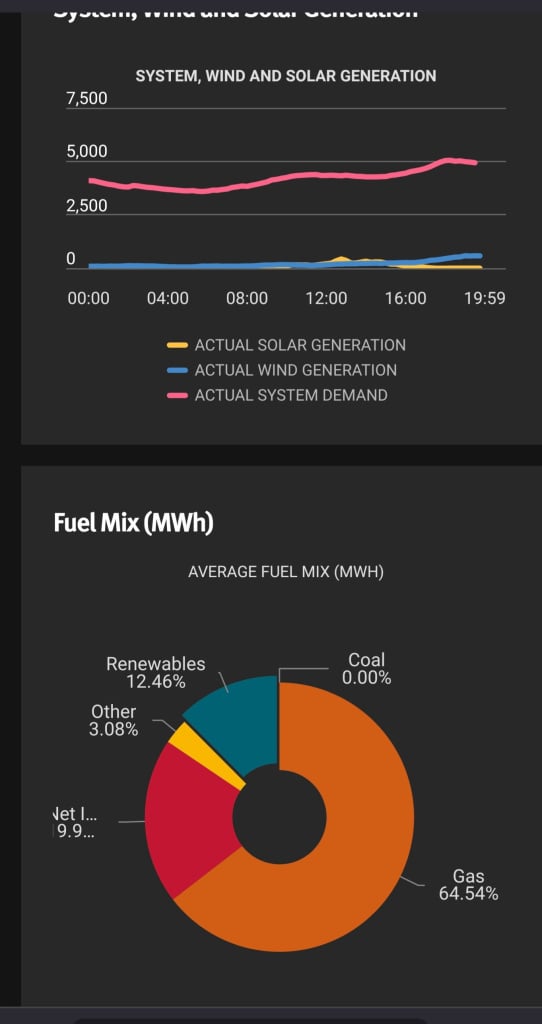
    Intermittents do fail all at once, it's in their very nature, it's the very reason we burn so much gas. Intermittents are by far the most unreliable source of energy regularly used. Burning gas = intermittent fail.

    Screenshot_20260208-195657_Firefox.jpg

    Can you seriously not comprehend that the vast gap between the pink and other lines is intermittents failing, because that's what that is, and it's frequent.

    France has 62.9 GW of nuclear capacity. I make that 551 TWh of annual generation capacity if they were all available simultaneously.

    In 2025, electricity consumption amounted to 451 TWh

    "As has been repeatedly pointed out, France didn’t build nuclear over-capacity, they added renewables to an existing Nuclear capability, which has resulted in overcapacity."

    Oops.

    Talking about something repeatedly pointed out: how many bloody times does it have to be pointed out that our future energy requirements are going to be significantly higher than at present? It's not going to be a 10 GW grid in 2050, FFS!

    image.png

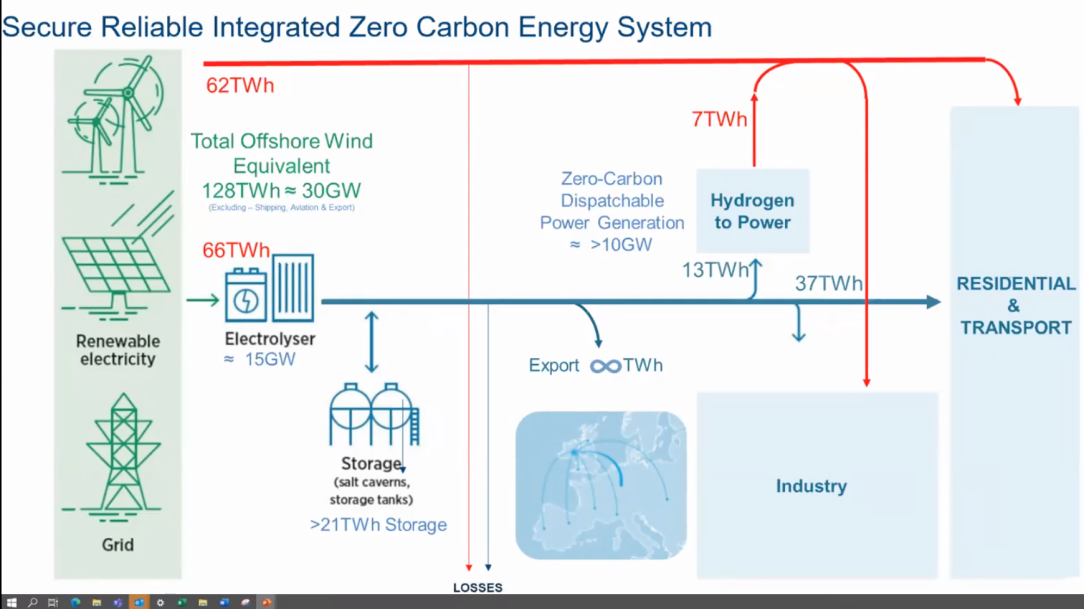
    It's going to require 15 GW, at least. That projection from the ESB was before data centres for AI were a thing. They would easily need to generate several GW more unless they are banned.

    Spitting chips at my 4-6 1.5 GW reactor proposal when the ESB is calling for 30 GW of far more expensive OSW is funny. OSW has atrocious maintenance costs. That 30 GW of offshore wind is a mirage in terms of a cost comparison with nuclear. The O&M costs of OSW are at least 25% of the initial capital cost. The longevity of the turbines is a third that of nuclear, but probably less given Irish sea states and wind strengths, so in terms of cost, It's more like 113 GW of OSW vs say 9 GW of Nuclear. (30*3*1.25)

    Accusing me of being 'conservative' for proposing the greenest, most reliable, cheapest, lowest CO2 emitting source to power Irelands future grid is an accusation I'm happy to admit to. It's an ironic accusation; being a proponent of nuclear in Ireland is actually being a radical.


  • Advertisement
  • Registered Users, Registered Users 2, Paid Member Posts: 3,299 ✭✭✭KrisW1001


    My last time explaining this:

    Current nuclear power options will not work in our grid, because each unit is too big a percentage of total grid demand.

    Resilience isn’t about how much you can lose, it’s about how long you are given to recover when it goes. No critical system is designed with the belief that it won’t break. The lack of understanding around this point is what makes the pro-nuclear stuff here so irritating: yes, nuclear has a high capacity factor, but that doesn’t actually matter - you don’t plan for normal running, you plan for outages. Have you ever even spoken to someone who works in critical infrastructure? Whether it’s water, telecoms, power, gas, nobody gives a shiny **** about the happy path when everything is running: running infrastructure is about planning for, and mitigating, failures - that’s 99% of the job.

    In a complex system it is much better to have multiple independent points of failure than one large one. If you do have loss of services, it’s preferable to have that sweep across the entire system one node at a time rather than to go in one big drop. The first case gives you more time to get your backup systems online, the second does not.

    Having a single 1.5 GW point of failure in our grid creates far more problems than having ten 150 MW points. If 1.5 GW drops over an hour (I’m being generous here - the worst case can be as short as 20 minutes), then you have to scramble to meet demand. If you lose the same absolute amount, but it happens as ten losses of 150 MW, each 30 minutes apart, then you can keep ahead of the failure, even though the overall time from “all” to “nothing” is comparable.

    Basically, just one NPP needs a resource to back it up that can jump from zero to at least 1 GW in less than 10 minutes. Another NPP can’t do that.

    Throwing two or three such generators onto the grid creates other problems: electricity, as we’ve heard so often, is really hard to store. What do we do with 3.0 GW of nuclear plus 5 GW of wind overnight when demand is just 2 GW? Can’t turn off any of it, so down the drain it goes - something that it also costs money to provide for. Every solution that makes nuclear work on our small grid requires so much storage or interconnection that it removes the need to use nuclear, and it’s all because the reactors are so big in comparison to our grid.

    France and Ireland aren’t comparable. France is one part of an enormous grid that stretches across Europe. A larger grid can take a larger single failure. (I don’t know why you think my comment about France’s surplus being from adding renewable energy to a nuclear base is some kind of flaw in my argument - it’s not; it’s what every nation that can use nuclear is doing, it’s what they should do, to eliminate gas peaking; but it is not a reason why we could do the same)

    Until there’s a viable nuclear generator that can be built in multiples of less than 500 MW, nuclear is just not going to work here. I’m not against nuclear at all: I’ve previously said we should look at co-funding nuclear in France or the UK and import that power over interconnects. The problem here is that we cannot use enough power to make nuclear viable ourselves — even when looking at future energy use projections.


  • Registered Users, Registered Users 2 Posts: 8,968 ✭✭✭Trampas


    One thing for sure I wouldn’t trust the builders here to build it. Sure what could possibly go wrong


  • Registered Users, Registered Users 2 Posts: 16,598 ✭✭✭✭charlie14


    Our grid demand according to Eirgrid will be ~15GW by 2050 and that was without any allowance for the likely extra generation required for AI. The accepted best practice is that one single generating plant should not exceed 10% -15% of grid demand. For a 15GW grid that is 1.5GW - 2.25 GW. per plant, not per source of generation. You can have as many plants generating from the same source as you wish as long as each does not exceed that 10% - 15% limit.

    I have spent time on here attempting to explain to some that in design you design on the basis that a chain is only as strong as its weakest link. Essentially what you are saying, that you design electricity generation based on when that source of generation is at its weakest so it can still provide the demand required. I get what the 2050 37GW+ Hydrogen offshore plan is. It`s to ensure that when renewables are at their weakest you can still provide the demand.

    Three problems with that plan.

    1 It will not provide 15 GW and will have us using as much if not more gas in 2050 as we are now'

    2 It requires, because of the capacity factor of wind, a huge level of over provision of installed capacity at unsustainable expense

    3 it will increase the strike price to the consumer by 2x - 4x what it presently is and we already have one of the highest charges for electricity in Europe.


  • Registered Users, Registered Users 2, Paid Member Posts: 1,513 ✭✭✭riddlinrussell


    4. It doesn't account for the absolute leaps and bounds Solar Capacity is making and has been for years

    Boards is in danger of closing very soon, if it's yer thing, go here (use your boards.ie email!)

    👇️ 👇️


  • Registered Users, Registered Users 2 Posts: 16,598 ✭✭✭✭charlie14


    When wind drops to 6% or less for long periods during Winter, which we have seen it do, how much installed capacity of solar would you need to make up the 94% required, and what are you going to use for the morning high demand of 6am - 10am and the primary demand time of 5pm - 7pm in Winter ?


  • Advertisement
  • Registered Users, Registered Users 2, Paid Member Posts: 1,513 ✭✭✭riddlinrussell


    Ah here, you sold me on nuclear ages ago, how many TDs have you successfully lobbied so far? When is the legislation due?

    Boards is in danger of closing very soon, if it's yer thing, go here (use your boards.ie email!)

    👇️ 👇️


  • Registered Users, Registered Users 2 Posts: 21,873 ✭✭✭✭cnocbui


    The 'capacity' might look impressive but the capacity factor isn't, so solar is near pointless in Ireland and isn't going to budge the needle much.


  • Registered Users, Registered Users 2 Posts: 16,598 ✭✭✭✭charlie14


    No need to lobby any TDs.

    The present government knows the 37GW/Hydrogen plan is a none runner and are just kicking the can down the road importing ever increasing levels of nuclear from the U.K. via interconnectors and hoping to import even more nuclear via the Celtic Interconnector from France.

    We were going to at best reach 23% of the 51% of reduced emissions required by 2030, and that included having Sceirde Rocks up and running. This government is not looking at 2050. They are looking at the fines that will become more evident and the questions that are going to be asked the closer we get to 2030 where the next general election has to take place before Jan 7th 2030.

    They are hoping to mitigate the damage by reducing those fines by importing nuclear. We imported 14.6% of our electricity from the U.K. last year, but I cannot see that continuing. There were rumbling from the U.K. last year on it being a one way street, and with the U.K. being a major net importer itself, and a possibility that their imports from Norway may be curtailed by Norway. Or completely cut. I can see that 14.6% only going one way. And it`s not upwards. That leaves the Celtic Interconnector with France, but it has only a 700MW capacity.

    This government`s only plan is to get through the 2030 general election and hold on to office. They played along with the Green Party in the last government to stop the Green Party throwing a hissy fit and walking, but don`t make the mistake of believing they do not know that this 37GW/Hydrogen plan is not totally financially unfeasible. If I can do the relatively simple mathematics off the costs, then Eirgrid has also done the same long ago and let them know.

    As to those interconnectors, do you remember how the greens were telling us we would be exporting that goldmine of wind power from our West Coast offshore floating wind turbines ? Yeah, that was a big fat lie. Where we are concerned, they are only going to be flowing in one direction.


  • Registered Users, Registered Users 2 Posts: 927 ✭✭✭bored65


    https://www.welt.de/wirtschaft/article69bd41f6cb1f9a070e403b8b/franzoesische-atomkraftwerke-werden-wichtiger-fuer-deutsche-stromnetz-stabilitaet.html

    TLDR: French nuclear is becoming ever increasing keystone of German energy grid

    Same Germany that prematurely shutdown nuclear plants to burn more coal and gas while spending trillions of failed Energiewende policies

    import French and Finns and Koreans to do it?

    Not like we have an any offshore industry or even port infrastructure to begin with for all that offshore wind that is being dreamed about either and have to get UK and Danes to do it


  • Registered Users, Registered Users 2 Posts: 16,598 ✭✭✭✭charlie14


    It`s ironic that Germany for years had been telling France how misguided they were using nuclear and also spent years attempting to block nuclear as an E.U. transition source of electricity while encouraging E.U. countries to use Putin`s gas.

    It`s not been just French nuclear they have become dependent on, it`s also Swedish nuclear. Sweden has become very annoyed at Germany draining their nuclear generation resulting in high prices for consumers in Sweden. They are especially ticked off that when Germany`s support of Putin`s gas bit them and the rest of the E.U in the ass, Germany shut down their own remaining nuclear plants.

    June 2024 Sweden rejected the Hansa PowerBridge. A proposed 700MW subsea power cable to Germany based on concerns that connecting to Germany`s "ineffective" market would add further high prices for Swedish consumers. Sweden has also threatened this month to restrict electricity exports to Germany over the E.U. congested revenues policy where 25% of Swedish internal congested revenue would go towards providing such power cables.

    Not long ago the E.U. were attempting to kill off nuclear generation and Germany was being held up to us by green as the example we needed to follow. But as the old saying goes, when money talks, bullshine walks.


  • Registered Users, Registered Users 2 Posts: 927 ✭✭✭bored65


    Norwegians too, they been extremely unhappy for years about their prices rising because of Germany, Denmark and UK interconnection

    https://www.sciencedirect.com/science/article/pii/S0301421525005191

    https://www.ft.com/content/f0b621a1-54f2-49fc-acc1-a660e9131740?sharetype=blocked&syn-25a6b1a6=1

    Our own interconnection to France (if it’s ever build and on this side of children’s hospital scale of cost overruns) could be met with hostility if the far left or far right ever takes power in France and they become populist as no one likes subsidising other countries and their banana policies


  • Moderators, Recreation & Hobbies Moderators, Science, Health & Environment Moderators, Technology & Internet Moderators Posts: 98,142 Mod ✭✭✭✭Capt'n Midnight


    With nuclear the deeper you look the worse it gets. Looking at over 20 year of operation -

    No EPR has hit the 90% capacity factor figure of merit in any year. Ever.

    The Swedish EPR's schedule suggests 86% is max possible in a year that has refuelling.

    No EPR has hit 75% capacity factor two years in a row.

    No EPR has hit 70% capacity factor three years in a row.

    In 2023 the three EPR's online had an average capacity factor of under 60%

    In 2022 the two EPR's online had an average capacity factor of 42.7%

    This means a LOT of backup would be needed to support nuclear at a time when we've no emissions to spare.

    The most optimistic roll out of nuclear here would take 20 years for the first reactor to be complete and 18 months for each one after that. By 2046 emissions should be down to 4% without nuclear.

    Add in another year for nuclear to go from criticality to full power and we'd only have 3% emissions (10 days) to spare to cover nuclear outages like going offline for 50 days to refuel or systemic failures.

    And there's the need for spinning reserve too.

    Numbers

    A 1660 MWe EPR should put out 14T.5 Wh per year. 90% of that would be 13TWh.

    In June 2018, Taishan 1 achieved criticality ... 29 June 2018 … connected to the grid.

    2018 42.1% - (3TWh in half a year) Note: only entered commercial operation in December

    2019 82.2%

    2020 62.9%

    2021 52.4%

    2022 28.2%

    2023 14.2%

    2024 87.2%

    In May 2019, Taishan 2 achieved criticality ... June 2019 … connected to the grid.

    2019 73.8% Note: only entered commercial operation in September ( 5.356 TWh in half a year)

    2020 85.4%

    2021 74.8%

    2022 57.1%

    2023 88.6%

    2024 68.9%

    Olkiluoto 3 - Criticality Dec 2021 , grid connection March 2022 - 1600MWe (Note 3.5% less output than the Chinese ones)

    2022 18% (1.9TWh over 3/4 of a year)

    2023 74% Note: only entered commercial operation in April but Just 0.01 TWh off best year ever. 10.37 vs 10.38 in 2025

    2024 69%

    2025 74%

    2026 86% Max possible due to scheduled shut down from 9/9/2026 to 29/10/2026

    2027 ??

    2028 85% Max possible due to scheduled shut down from 3/8/2028 to 02/5/2028

    Flamanville 3 - Criticality Sept 2024 , Grid connection Dec 2024, first time at 100% power 14th Dec 2025

    2025 ?? it took a full year to achieve full power

    2026 73% Max possible as will shutdown for 350 days on 26th September ( excludes this year's outages so already lower)

    2027 30% Max possible as will be shut down until 11th September.

    Dates from - https://en.wikipedia.org/wiki/EPR_%28nuclear_reactor%29

    https://www.tvo.fi/en/index/production/plantunits/ol3/ol3productionchart.html - there's recent dips down to 1.3TWh so that 86% is optimistic.


  • Registered Users, Registered Users 2 Posts: 16,598 ✭✭✭✭charlie14


    Norway isn`t a member state of the E.U. It has twice rejected membership and can stop supplying those interconnectors wherever it wishes. The U.K. is a net importer of electricity from both French nuclear and Norwegian hydro. If Norway cuts or curtails those exports to the U.K., I cannot see them being net importers, continuing to export the levels they are to us. It has been rising year on year and last year made up 14.6% of our supply.

    On the face of it the Celtic Interconnector, and us eager to have further connectors to France, may look a good idea, but we would need to pray that the French build those planned nuclear plants. As it is they have long established customers for their excess nuclear generation so we would most likely end up last in line with little or no idea what they could supply when we needed it.


  • Registered Users, Registered Users 2 Posts: 16,598 ✭✭✭✭charlie14


    Post upon post upon post of stats and speculation of how nuclear is no way comparable to whatever it is you are proposing and still nothing on what it is you are actually proposing or at what cost.

    Could that be because you know whatever it is you favor is neither feasible or financially affordable ?


  • Moderators, Recreation & Hobbies Moderators, Science, Health & Environment Moderators, Technology & Internet Moderators Posts: 98,142 Mod ✭✭✭✭Capt'n Midnight


    I don't need to provide costs. Only when nuclear shows up can the path diverge from the one we are on.

    To have nuclear you need to keep the lights on while reducing emissions for the next 20+ years. Still waiting to see how you can do that.

    Since what's left of the emissions by the time nuclear is up and running would get us through a Dunkelflaute , nuclear would have to have it's own zero carbon way of providing backup and spinning reserve.

    And a way to pay for itself when almost all demand is being met by renewables / storage / interconnectors which are paid for and out of contract or nearly so.

    Hywind , an offshore windfarm averaged 54% over it's first five years of operation.

    FLAMANVILLE-3 will be below 50% average capacity factor between this year and next year.

    Taishan 1's lifetime capacity factor is 55% with a low of 14.2%

    Taishan 2's is 76% with a low of 57.1%

    OLKILUOTO-3 77.6% with a low of 70%

    In 2023 the three EPR's online had an average capacity factor of under 60%. So it's doubtful that having an extra plant idling and only used for spinning reserve would be enough. Nuclear can't reliably backup nuclear. See also systemic failures in fleets.


  • Advertisement
  • Registered Users, Registered Users 2, Paid Member Posts: 9,942 ✭✭✭SeanW


    Yes, indeed, and I remember some absolutely boneheaded posts on this forum talking about how gas would be great as a transition fuel and a backup for weather dependent renewables. Since then we've had two major energy shocks: the Russian invasion of Ukraine and Iran closing the Straits of Hormuz while systematically destroying the oil and gas infrastructure of their neighbours.

    As for us, all we have to show for the last 40 years of being governed by boneheaded, ideologically driven, is absurd electricity costs and CO2/kwh emissions an order of magnitude higher than they need to be.

    We should have focused on removing gas from our energy system, starting no later than late 2021 when it was clear that the Russkies were up to something. Instead we've done the exact opposite.

    https://u24.gov.ua/
    Join NAFO today:

    Help us in helping Ukraine.


  • Registered Users, Registered Users 2 Posts: 16,598 ✭✭✭✭charlie14


    Well at least we now know what you are looking for.

    Continuing with this current 2050 plan of 37GW offshore + hydrogen that has been shown to you time and time, and time again, that not only has it been a failure to date with us importing almost 15% of our electricity, it will not even achieve half the emissions levels required by 2030 which will see us paying billions yearly in fines, that continuing with will not provide our 2050 requirements where we will still be burning the same if not more fossil fuel than now, while paying two to four times the present strike price when we are now consistently in the top three in Europe for electricity charges.

    All that for a cost you keep running away from because you know we will be flat broke before it is even close to being carried out and would still leave future generations up to their eyeballs in debt.

    What you favor is as close to the definition of insanity as it is possible to get. Rather than following the path of France, Finland and Sweden we followed Germany. Much, if not all, of that down to an airy fairy green ideology that somehow got the idea that money grew on trees or floating windmill in the Atlantic.

    In any line of business when a venture has been shown to be a failure you don`t keep throwing good money after bad because it is the guaranteed road to bankruptcy. You look at alternatives that are financially feasible.


  • Registered Users, Registered Users 2 Posts: 1,671 ✭✭✭Busman Paddy Lasty


    Wrong again. We know you hate the sun, we got the memo years ago. Don't lie though that solar is near pointless.

    Industry, retail and domestic are doing solar or solar plus batteries and getting results. My small system has generated 8.3 MWh in 3 years. I regularly take little or no day rate because battery. I could automate it to avoid peak usage too, peak that would be gas generated even if we had baseline nuclear already.

    What I've described is customer side too. No additional ESB or Eirgrid infrastructure required.

    It is high time you got a solar install at your house so you can see for yourself.


  • Moderators, Recreation & Hobbies Moderators, Science, Health & Environment Moderators, Technology & Internet Moderators Posts: 98,142 Mod ✭✭✭✭Capt'n Midnight


    The first problem is timescale. Nuclear missed the boat. It has next to no role in emissions reduction.

    The minimum realistic time for nuclear here is 20 years to complete the first reactor, and a year to go from completion to commercial operation by which time emissions will be down to 3%. Besides nuclear has no role in peaking and one reactor won't solve a Dunkelflaute so it's not going have much of a role in reducing that 3%

    It would be a minimum of 18 months per subsequent reactor. So a second reactor would be arriving when emissions are down to 1.5% and still wouldn't be able to offset peak demand.

    Please explain how to provide peaking power without fossil fuel ?

    The second problem, and it's a doozie, is the need for spinning reserve and backup for nuclear.

    No EPR has hit 70% three years in a row. No EPR has hit 70% in the third full year of operation.

    In 2023 the three EPR's averaged less than 60% , ie. they didn't generate two reactors worth of 90% capacity factor.

    One EPR in it's fifth full year of operation dropped to 14.2% capacity factor.

    Please explain how you propose to prop up nuclear without using fossil fuel ?

    Like I keep saying until 2048 we'll till have the fallback of being able to use a weeks worth of fossil fuel emissions to ride through a Dunkelflaute even if everything on the grid is unavailable and there's no better storage solution. There is no role for nuclear.

    The third problem is how to pay for it

    Nuclear power would only be needed to fill in the gaps in renewables, interconnectors and storage.

    There is no economic sense in curtailing other suppliers that are out of contract and operating on O&M costs to subsidise 100% of nuclear's output at price indexed for half a century after the contract has been signed.


  • Registered Users, Registered Users 2 Posts: 21,873 ✭✭✭✭cnocbui


    Congrats on your solar made with Uyghur slave labour.


  • Registered Users, Registered Users 2 Posts: 1,671 ✭✭✭Busman Paddy Lasty


    Resorting to childish comments when you have no argument.


  • Registered Users, Registered Users 2 Posts: 21,873 ✭✭✭✭cnocbui


    How is a comment about slavery childish?

    https://www.bbc.com/news/world-asia-china-57124636

    You don't want to be confronted with the unpleasant truth and are lashing out with the first facile retort that pops into your head.


  • Registered Users, Registered Users 2 Posts: 1,671 ✭✭✭Busman Paddy Lasty


    The motive rather than the content of your comment. Going on a whataboutery tangent. Then accusing me of doing the very thing you have just done.


  • Registered Users, Registered Users 2 Posts: 16,598 ✭✭✭✭charlie14


    Your first and third "problems" are essentially the same in that you have provided nothing as to how much this 37GW/Hydrogen plan would cost to implement. Or how much the consumer would end up paying for electricity for a plan that would not even fulfill our 2050 requirements on any level. Yet this is the plan you want to keep throwing money at based on nothing other than blind faith in an Irish Green Party ideology where you have been shown time upon time that nuclear would do the job for half the cost or less.

    Not surprising economically where you think that not having an indexed linked contract for electricity over the lifespan of a nuclear plant is sound business sense compared to three such contracts over the same period for what you favor. Any business would take your arm off for an indexed linked contract that guarantees them a fixed price for the materials they need to operate for 60 years.

    Your second "problem" is a doozie alright. Especially when you keep blather on about nuclear capacity factors when you have been shown that half U.K. offshore wind farms could not make it past 35% and your bogeyman nuclear Hinkley C at 50% capacity would generate cheaper electricity than Empire 1 or indeed the Hai-Long wind farm without including inflation for their relative capital costs.

    Nuclear can provide it`s own spinning reserves, and can ramp up or down by 5% a minute. You cannot ramp up renewables and they cannot provide a dependable baseload due to them being intermittent. Why do you think French renewable companies look to buy 130+ TWh French nuclear each year ?

    I`ll give you a hint. It`s not to export.


  • Advertisement
  • Registered Users, Registered Users 2, Paid Member Posts: 9,942 ✭✭✭SeanW


    Given that we've had two energy crises in the last five years, and Europe is hopelessly dependent on gas/oil imports, can any of the anti-nuclear posters explain:

    1. Whether it is (or was) a good idea to continue relying on gas as a backup for unreliable renewables?
    2. If No: then what actions should we now take to limit or eliminate our reliance on gas for electricity?

    https://u24.gov.ua/
    Join NAFO today:

    Help us in helping Ukraine.


Advertisement
Advertisement