Advertisement
Help Keep Boards Alive. Support us by going ad free today. See here: https://subscriptions.boards.ie/.
https://www.boards.ie/group/1878-subscribers-forum

Private Group for paid up members of Boards.ie. Join the club.
Hi all, please see this major site announcement: https://www.boards.ie/discussion/2058427594/boards-ie-2026

Nuclear - future for Ireland?

1909193959699

Comments

  • Moderators, Recreation & Hobbies Moderators, Science, Health & Environment Moderators, Technology & Internet Moderators Posts: 98,142 Mod ✭✭✭✭Capt'n Midnight


    I was being generous with the ~80% average for nuclear. It's based on EVERY NPP on the planet , except those with construction delays, extended shutdowns, early life shutdowns and abandoned constructions.

    Which new reactors have 94% or greater capacity factor for an average year ?

    And remember for Ireland construction delays count as capacity factor hits because we'd have to get power from somewhere and we won't be able to rely on fossil fuel to replace nuclear for more than a few weeks a year.


  • Registered Users, Registered Users 2 Posts: 16,598 ✭✭✭✭charlie14


    You know as we as everyone else that new reactors have a capacity factor greater than 90%, but if you want to go with the global weighted average capacity factor of 84% I have no problem with that and I will do the same for fixed bottom offshore wind turbines where the global weighted average capacity factor is 34%.

    Not that it would make a blind bit of difference. I have already shown you that if the most expensive nuclear plant you could find was operating at a capacity factor of 50% it would still generate every GW of electricity for less than Empire 1 at a capacity factor of 42% because of the capital cost required for offshore wind.

    Best case scenario for reduction in our greenhouse gas emissions is 23% rather than the 51% required by 2030. Nobody that can add 2 + 2 and come up with 4 as the answer believes we will have zero emission by 2050 without bankrupting the state and everyone in it. We will be paying fines from 2030 and well after 2050 because this current plan - even if it was financially feasible - would have us still burning gas in 2050, at the very least at the same volume we are now.


  • Registered Users, Registered Users 2, Paid Member Posts: 9,942 ✭✭✭SeanW


    The idea that "In order to prepare for nuclear you have to prove you don't need it" is certainly a new one. But at least we agree that no matter how much money we spend on windmills and solar panels, we will need 5+GW of something else anyway, and also that we will be burning fossil fuels for decades regardless.

    Because that's exactly what Finland did while it waited for its most recent nuclear plant to come online - they just waited for the problems to be worked out and used it to reduce emissions when it started operations.

    It should be noted also that investments in renewables are not eternal, wind mills and solar panels have limited lifespans and need to replaced, even faster than nuclear power plants do, for example Sizewell B in the UK may run until 2055 - 60 years. Can any wind mill, solar panel or battery claim the same?

    Sizewell nuclear power stations - Wikipedia

    As for Ireland having hydro, not really, this isn't Scandinavia. Biogas and Biomethane also misdirect farmland and possibly other resources. Geothermal in Ireland is not a serious runner as (thankfully) Ireland is volcanically not active. Again, we're not Iceland. Incinerators … maybe but they carry problems of their own, as for "Fuel to energy" I presume you mean "Energy to fuel" (i.e. capturing energy in liquid fuels, gases etc that can be burned later when needed) that would be great but the tech isn't in widespread use yet, and there's no evidence it will be for the foreseeable future.

    https://u24.gov.ua/
    Join NAFO today:

    Help us in helping Ukraine.


  • Moderators, Recreation & Hobbies Moderators, Science, Health & Environment Moderators, Technology & Internet Moderators Posts: 98,142 Mod ✭✭✭✭Capt'n Midnight


    Tashian-1 hit 13.8 TWH which is 98% of one year's critical factor . for the combined total outputs of 2020 , 2021 and 2022. Nuclear is nowhere near as dependable as you would suggest.

    Tashian-1 hit 91% in 2024 and Tashian-2 got to 92% in 2023. That's Years 7 and Years 5 of operation. That's not every year, that in a particularly good year , downhill with the wind behind you sort of stuff.

    Investing in renewables now means avoiding fines. Nuclear will play no role in reducing emissions here in the next 20 years.


  • Moderators, Recreation & Hobbies Moderators, Science, Health & Environment Moderators, Technology & Internet Moderators Posts: 98,142 Mod ✭✭✭✭Capt'n Midnight


    It's not a new one. I've been explaining for a while now that nuclear will take so long that to keep the lights on until it arrives you could invest in renewables and have them installed and paid for by the time nuclear showed up.

    By 2045 we should be using 5% of current emissions and dropping 1% a year after that. And then nuclear shows like a blister when most of the work's done ?

    Finland gets more energy from the wind installed during OL-3 delays than from OL-3. In 2024 Finland got 20TWh from wind which is about the same as OL-3 provided in 2024 combined with 2025.

    Edit - Link for the 20 TWh

    Post edited by Capt'n Midnight on


  • Advertisement
  • Registered Users, Registered Users 2 Posts: 16,598 ✭✭✭✭charlie14


    For 20222 of the 42 U.K. fixed bottom offshore wind farms 20 had a capacity factor of less than 35%, with 10 0f that 20 being less than 30% and 6 struggling to make 25%.

    We can all nit pick numbers, but it doesn`t change the facts. The most expensive nuclear plant you could find, Hinkley C, when capacity factor and lifespan are taken into account will generate a GW of electricity for less than half the price of Empire 1. And that does not even include inflation for the further capital expenditure Empire 1 will require to bring it up to the lifespan of Hinkley.

    By 2030 at very best our emissions under the current wind plan will be 23%. Miles off the 51% required so from 2030 we will be paying fines. That is where putting all our eggs in the renewable basket has got us. It has certainly done nothing to lower charges with us year on year in the top three most expensive countries in Europe, and it has definitely done nothing for our energy security where last year we imported 14.6% of our requirements. A % that has been rising year on year.

    It`s not even the case that if we found a forest of money trees that would pay for this current 2050 plan it would prevent us being fined. We would be burning as much, if not more, gas in 2050 as we are now. Sticking with this plan is just throwing good money after bad until we go bankrupt and would achieve nothing other than increasing our strike price by between 2 and 4 times what it currently is, and you have not shown a single figure that it will do otherwise.


  • Registered Users, Registered Users 2, Paid Member Posts: 15,603 ✭✭✭✭josip


    This is where NOT putting all our eggs in the renewable basket has gotten us. If we had been even half mature as a country and developed the bottom fixed Irish Sea Offshore Wind sites at the same time as UK, Germany, Netherlands, Denmark were developing theirs we would already have met our 2030 targets. But instead we chose parish pump politics and built housing estates in the countryside which resulted in a lost decade of proper infrastructure development.


  • Registered Users, Registered Users 2 Posts: 16,598 ✭✭✭✭charlie14


    Alternatively had we gone with the wishes of the ESB in the 70s and not chosen parish pump politics, we could now be like the French. No problem with emissions and earning billions annually from exporting electricity.

    Both scenarios are off the your aunt being your uncle if she grew testicles variety, whereas reality now is what it is.


  • Registered Users, Registered Users 2, Paid Member Posts: 3,299 ✭✭✭KrisW1001


    You don’t know what “Parish Pump” politics means if you think it applies to a nationwide, grass-roots campaign against building a nuclear power plant at Carnsore Point. Not one poll through the 1970s ever gave a majority in favour of the project, but the Government pressed on. It wasn’t public pressure that killed the project, but the meltdown at Three Mile Island in 1979. After that, even the most pro-Nuclear politicians knew it was dead.

    Three Mile Island was the beginning of the end for nuclear power in the west. Most of what was built in the 1980s were projects that were too late to stop, and then Chernobyl came along and killed the idea of any future expansion.


  • Registered Users, Registered Users 2 Posts: 16,598 ✭✭✭✭charlie14


    There are times when the government for the overall national good of a country`s future needs to make unpopular decisions and stick with them. The French 1974 Messmer Plan was highly unpopular but the French government pressed ahead and are where they are now as opposed to where we are.


  • Advertisement
  • Registered Users, Registered Users 2, Paid Member Posts: 3,299 ✭✭✭KrisW1001


    It wasn't public opinion that killed the project, though... Nuclear suddenly lost it's "safe" image once people in power started to look into what had actually happened at Three Mile Island, and how close it came to a meltdown.

    At the sane time, "natural" gas had arrived as a generation source: highly flexible, visually clean, cheap to build out and cheap to run off North Sea gas, and in our case, Kinsale gas.

    Really, it was the politicians who lost faith in nuclear over the 1980s... the public had never liked it at all.


  • Moderators, Recreation & Hobbies Moderators, Science, Health & Environment Moderators, Technology & Internet Moderators Posts: 98,142 Mod ✭✭✭✭Capt'n Midnight


    ESB International wanted nuclear so they could sell consultancy abroad based on us being a neutral country (cf. our beef exports) It wasn't for the domestic market.

    It didn't have public support.


  • Registered Users, Registered Users 2 Posts: 16,598 ✭✭✭✭charlie14


    The French government at the time decided after the oil crisis not to get caught out again and went with nuclear. Many like us went with gas and ended up being caught out by Putin`s gas. In hindsight France got it right.

    I haven`t seen anything on it for a while, but a few years ago an Ireland Thinks survey showed that there was a 50/50 split here for nuclear with larger numbers in the 18 - 25 group favoring than disfavoring nuclear AFAIR.


  • Moderators, Recreation & Hobbies Moderators, Science, Health & Environment Moderators, Technology & Internet Moderators Posts: 98,142 Mod ✭✭✭✭Capt'n Midnight


    They've added just 225MW of nuclear capacity since 1997 and the next new plants are three years late and 40% over budget , which is impressive since they won't start construction for years.

    Good thing they've lots of hydro and have been rolling out wind and solar for years and making lots of money exporting renewables.


  • Registered Users, Registered Users 2 Posts: 16,598 ✭✭✭✭charlie14


    Nuclear provided 70% of their electricity in 2025, and as the largest net exporters of electricity in Europe year on year it has profited them by over €5 Bn. a year for each the last three years.

    If I was you I would not be holding my breath waiting on France to shut down their nuclear fleet or cancel any of their new plants. Just keep looking in the mirror telling yourself that French electricity exports have nothing to do with nuclear and one day you may even convince yourself


  • Moderators, Recreation & Hobbies Moderators, Science, Health & Environment Moderators, Technology & Internet Moderators Posts: 98,142 Mod ✭✭✭✭Capt'n Midnight


    France had half it's nuclear fleet offline during the last gas embargo. And had to import gas to power up fossil fuel plants to keep the lights on as the interconnectors were maxed out.

    If Nuclear was as dependable as claimed then it would have had it's chance to shine. It didn't.


  • Moderators, Recreation & Hobbies Moderators, Science, Health & Environment Moderators, Technology & Internet Moderators Posts: 98,142 Mod ✭✭✭✭Capt'n Midnight


    image.png

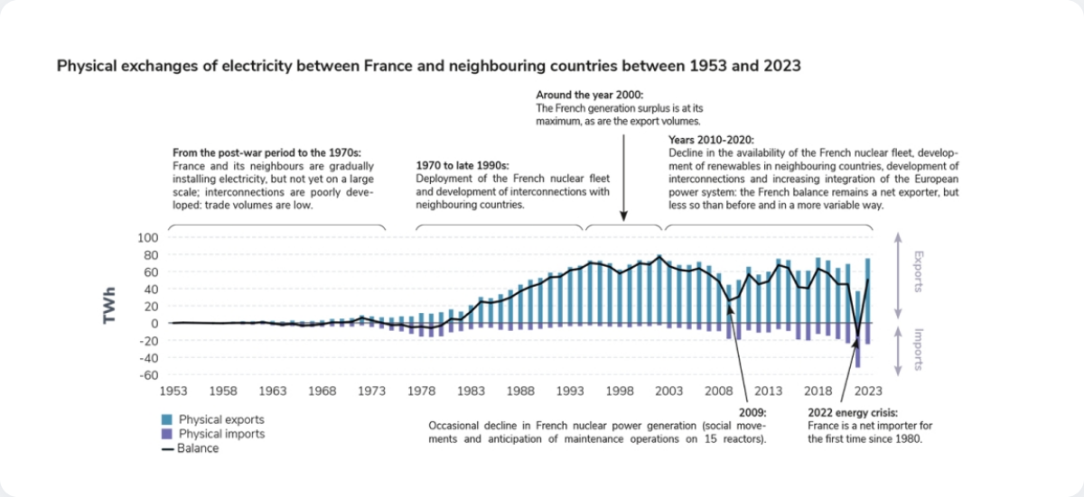
    https://analysesetdonnees.rte-france.com/en/annual-review-2023/keyfindings You can see why exports won't be like they used to be.

    Oh look they had 15 reactors needing maintenance in 2009. That means 2022 is indefensible. (With nuclear the more you dig the worse it gets) I can't recommend a power source that will have systemic failures ever decade or so.

    image.png

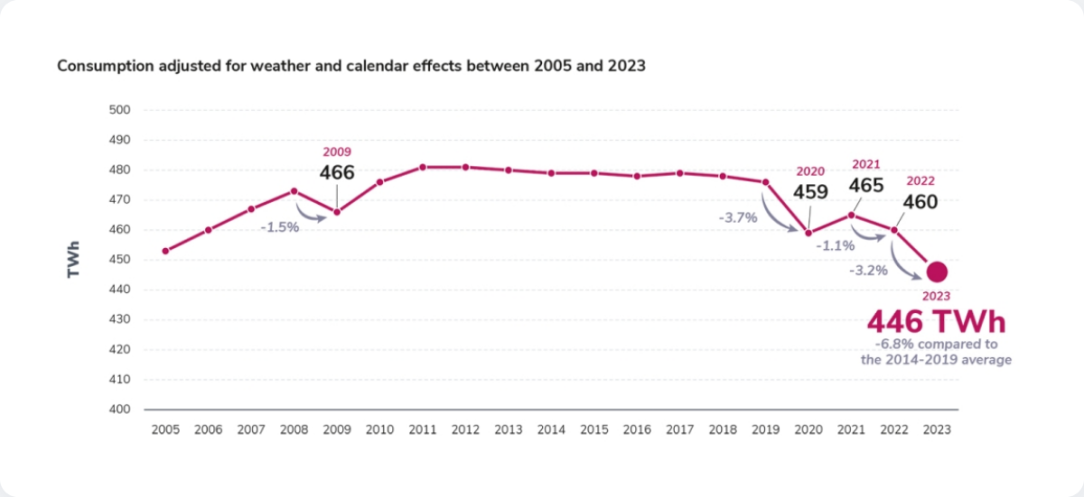
    Domestic consumption had dropped so more available for export. That has nothing to do with nuclear improving.


  • Registered Users, Registered Users 2 Posts: 16,598 ✭✭✭✭charlie14


    You are getting either forgetful or confused. I have already explained this to you.

    From 2010 until this year EDF have had to supply their renewable competitors with up to 100 TWh @ a bargain basement price of €42 per MWh under ARENH to keep them in business. 2022 this was increased by 20% to 120 TWh at that bargain basement price. That is over 25% of the electricity Frances consumes annually.

    What failed to shine in France in 2022 was renewables when getting a virtual handout of cheap electricity to supply over 25% of the market, it still resulted in an increased use of fossil fuels. Since then the French government have revisited the ARENH and from this year the price will be €70 per MWh which will most likely result in an increase in EDF bottom line larger than even than that of 2025.


  • Registered Users, Registered Users 2 Posts: 16,598 ✭✭✭✭charlie14


    Oh look, France made €16 Bn. from exporting nuclear generated electricity for the last 3 years, - 1.5 times the cost of Finland`s OL3 -, and did it while keeping renewable companies in business supplying them with up to 100TWh each year for a rock bottom price of €42 per MWh.


  • Registered Users, Registered Users 2 Posts: 1,151 ✭✭✭323


    Good to see a bit of common sense. Floating Offshore Wind in the West coast is a fantasy.

    The few test bed SPAR systems off Aberdeen you mentioned has been a failure, remember, that region of the north sea is a mill pond in comparison to our Atlantic conditions, seabed conditions/geology for mooring & cable trenching also very different. The semi-sub ones off Portugal, like the one in the gulf of Leon cannot survive west coast wave heights.

    The Coreo Generation one off Carna is a perfect example of sustaining the fantasy. The most basic of desktop studies years before, with open source data, would have shown it to be technically unfeasible. Gravity Base Foundations on a reef area that's breaking white water well over 300 days a year, FFS.

    The current proposed fixed bottom OSW on the South coast are little better, sure we'll just go deeper than any others (deeper than what is considered feasible), in sea conditions many orders of magnitude worse than has ever been attempted to build in, on crap geology, by developers with no experience in offshore construction. Gonna be interesting.

    State is betting our future on a fantasy.

    “Follow the trend lines, not the headlines,”


  • Advertisement
  • Registered Users, Registered Users 2 Posts: 21,873 ✭✭✭✭cnocbui


    Irelands tranchent anti nuclear attitude, clearly evident in this thread, is to Ireland what Brexit has been to the UK. Illogicalty and lies used to sell extremely bad policy with severe negative future consequences.


  • Registered Users, Registered Users 2, Paid Member Posts: 3,299 ✭✭✭KrisW1001


    Oh don’t be a total dope. I’m not anti-nuclear. Never have been. The glory days for Nuclear power ended in the 1970s - after that, everyone has become more sceptical - and for good reasons too. But the problem specifically for Ireland, is that what’s on offer in terms of nuclear power right now, in the real world, does not work for a small isolated grid like Ireland’s, even if we could guarantee that the generation capacity would come in on time and on budget.

    Any modern reactor is going to be 1200~1500 MW. Adding something this size to our small grid (about 8000 MW, excluding renewables) would require about 600~1000 MW of standby generation on top of that, because nuclear reactors do go offline, and when this one does, we need to come up with the power to make up the shortfall, and quickly.

    Small Modular Reactors were to have a 300~600 MW output, and this is actually the ideal size for our grid, as it wouldn’t require much additional backup. If there were an SMR available, I’d be in favour of at least trying to build one here, in addition to scaling up renewable energy (this is what all the “nuclear success” countries have been doing). Unfortunately the problem with SMRs, is that they don’t exist outside of computer renders, and honestly are unlikely to exist when the price of energy storage is declining so quickly that renewables plus storage will displace gas on its own. That said, Trump’s latest adventure’s outcome of raising world gas prices (and, once again mysteriously end up doing something that helps Vladimir Putin) may put nuclear back into the picture economically and spur some proper development of SMRs.

    Honestly, though, I think the time has passed for nuclear fission - the promised economies of scale from scaling up to 1500 MW per reactor never came about. The only reason SMRs were floated as an option is because of the rampant construction inflation of the current generation of plants has made them look cheap by comparison.


  • Registered Users, Registered Users 2 Posts: 21,873 ✭✭✭✭cnocbui


    The core fantasy, which absolutely no one can address, is grid scale energy storage. There is literally no remotely affordable solution in existence. Ireland's entire energy policy is based on the hope that something practical and affordable will come galloping in across the wave tops off the west coast, on a great white horse, to solve the insoluble, by 2050.

    Nuclear energy doesn't have this problem of relying on religious faith to provide a solution, is well and truly proven and is considerably cheaper than intermittents.

    Post edited by cnocbui on


  • Registered Users, Registered Users 2 Posts: 21,873 ✭✭✭✭cnocbui


    Stop with the pejoratives. I know you seemingly can't help it as your acerbic personal put downs are a characteristic of your nasty style, but still, knock it off.

    Sceptical? World wide their are 75 nuclear reactors under construction and 120 planned. Ursulla von der Leyen just admitted that Germany and European opposition to nuclear was wrong-headed; it signals a massive shift in the EU stance to nuclear and is a clear signal that the EU apparatus now realises intermittents are not the solution they thought they were. which is no surprise as the grid scale storage problem is insoluble.

    This small grid large reactor misfit argument is a sick joke. Intermittent sources require hundreds of grid connections, and they are very, very expensive. There are 300 or so wind farms, all of which have required grid connections/enhancements.

    Given the grand plan of all transport and all domestic heating and most industrial energy requirements all being made electricity dependent before 2050, the 'small grid' is going to have to grow up fast anyway. The grid can't handle any of the multitude of intermittents plonked down on every hill top and farm either, but it's modified every time to cope. The same can be done if you go for two nuclear power stations, one on the Shannon estuary and one on the east coast. Two to three 1.5+ GW reactors each, 600 acres of land, instead of the hundreds of thousands intermittents gobble; upgrade the grid to fit - duh.

    You can back up nuclear with nuclear and solve the downtime problem with simple over capacity, which is what France has essentially done, which is why they can export so much. When a reactor needs to be off lined, you just export less. Alternatively to export, it might more likely be the case that excess capacity would be used to generate fossil fuel replacements for transport and industry. This is probably a better strategy as you don't have to waste huge sums on interconnectors.


  • Registered Users, Registered Users 2, Paid Member Posts: 3,299 ✭✭✭KrisW1001


    Intermittent sources don’t all fail at once, leaving a massive hole in generation capacity. This shouldn’t be hard to understand, but I guess you formed your opinion once and won’t ever challenge it. Good for you, but it’s pretty tiresome to hear the same backward-looking, hidebound, defeatest answers to what is a genuine problem.

    Multiple 1500 MW reactors, on multiple sites, for a 10,000 MW grid? This is insanity. The greenfield costs of nuclear are horrendous: the “cheap” reactors we keep hearing about are 3x per site in order to share that high overhead, but in Europe the massive cost overruns have been at sites that were supposed to leverage existing facilities (nuclear fuel has its own complex and expensive support chain).

    As has been repeatedly pointed out, France didn’t build nuclear over-capacity, they added renewables to an existing Nuclear capability, which has resulted in overcapacity. If we were the size of France, interconnected into the world’s largest synchronous area, we should have done the same, but we aren’t and we aren’t.

    Acerbic? Yes, sometimes, but just tired of the same lazy arguments claiming to be “for nuclear” when they’re just conservative anti-renewables politics dressed up. If that characterisation offends you, I’m sorry you don’t see what you’re writing. If there were no renewable energy projects at all, nuclear wouldn’t be spoken about at all because we should just be using gas… that’s the real angle.


  • Moderators, Recreation & Hobbies Moderators, Science, Health & Environment Moderators, Technology & Internet Moderators Posts: 98,142 Mod ✭✭✭✭Capt'n Midnight


    "You can back up nuclear with nuclear" that failed in France when they lost half their plants. Also Japan where they lost 100% of their reactors for a decade.

    I keep pointing out that on our grid you have to replace 75% of the missing power within 5 seconds. You can't ramp up nuclear to offset a SCRAM elsewhere.

    Nuclear backup failed when France was putting two reactors per site on the basis that the other one would keep working. They got lucky during some floods that could easily have taken out the other reactor too. No leccy , no cooling and tick tick tick Kaboom!

    They were spending about ~100m per reactor on retro fitting backup.


  • Moderators, Recreation & Hobbies Moderators, Science, Health & Environment Moderators, Technology & Internet Moderators Posts: 98,142 Mod ✭✭✭✭Capt'n Midnight


    France is able to export more electricity because they have more renewables and because domestic demand has dropped.

    It's not because they've installed 225MW more since 1997. They've now got 63GW installed. However, since the next reactor isn't due till at least 2038 it's an average of 0.0087% a year. Assuming no reactor shuts down in the meantime.

    EDF lost €18 Bn in 2022 when debt increased to €65 , last year they spent €3.4 Bn on "Cost of gross financial debt" it was €4.1Bn in 2024.

    So making €16Bn over three years is as impressive as Tashian-2 taking three years to get 98% of one year's capacity factor.


  • Registered Users, Registered Users 2 Posts: 16,598 ✭✭✭✭charlie14


    2025 France consumed 451TWh. French nuclear provided 69% = 311TWh. Their net export was 92TWh and they provide renewable companies with 100TWh to keep them in business at a rock bottom price of €42 per MW. That is a total of 503TWh. That was 52TWh (11.5%) greater than the total French domestic demand.

    Now seeing as according to you, all this electricity France exported in 2025 (92TWh) was all from renewable companies, the only way they could have done that is by exporting the cheap ARENH electricity they got from nuclear, which I doubt they were allowed to do under the terms of ARENH. Or if they did it was nuclear anyway. What makes your exports all being from renewables even more ridiculous is that the €5.4 Bn. for that electricity went into EDFs account.

    Did you miss the part of my post that from a total of 42 U.K. offshore wind farms 20 failed to reach a capacity factor of 35%, 10 of which didn`t reach 30% with 6 struggling to make 25% because you were off again, similar to Hinkley C, searching for the worst possible capacity factor you could find on nuclear. As I said to you already, two can play that game.

    2022 France consumed 464TWh of electricity of which nuclear provided 63%. Your figured pulled out of very thin air was that it would be in the low 40% range was it not ??😅

    63% of 494 = 292TWh. 2022 French nuclear was compelled to provide renewable companies with 120 TWh at a rock bottom price of €42 per MW. A 20% increase on the previous, and since, maximum threshold. That it has now been changed from €42 per MWh to €70 per MWh, a 66% increase, shows just how rock bottom that €42 per MWh was.

    Without being compelled to keep renewable companies in business, French nuclear would have provide domestic demand with 292TWh + 120TWh = 412 TWh in 2022. 83.5% of total French domestic demand.

    It wasn`t nuclear that caused EDF to make a loss in 2022. It was keeping renewables in business.


  • Moderators, Recreation & Hobbies Moderators, Science, Health & Environment Moderators, Technology & Internet Moderators Posts: 98,142 Mod ✭✭✭✭Capt'n Midnight


    "It wasn`t nuclear that caused EDF to make a loss in 2022."

    Half the reactors were offline. Nuclear is simply not as reliable as suggested. It's not worth waiting for.

    The proposed six new reactors will not be on line before 2038 and the price has already increased by 40%

    Then again a few posts back I showed the woeful capacity factor for EPRs even though they are only an incremental evolution of 50+ reactors already built in France. I used to argue that reactors usually take six months from connection to full power, but the evidence suggests it may be closer to six years before you can get reliability.

    Which means there is no role for nuclear in Ireland's emission reduction.


  • Advertisement
  • Registered Users, Registered Users 2 Posts: 16,598 ✭✭✭✭charlie14


    Do you ever actually read posts or do you just ignore them and reply with what suits you ?

    I just showed you that in 2022 French nuclear provide 63% of domestic demand. Not the low 40% you were predicting at the time. Had they not been compelled to sell to renewable companies 120Twh, at a ridiculous price that has since been increased by 66%, That 63% + the 120TWh would have supplied 83.5% of total French domestic supply in 2022.

    Again with the picky capacity factors and reliability when I have shown you half the U.K. offshore wind farms could not reach a 35% capacity factor, 25% did not reach a 30% capacity factor, with 17% struggling to make 25%.

    I have also shown you where even compared to the most expensive nuclear plant you could find that the U.S. Empire 1 offshore fixed bottom wind farm will cost over twice as much to generate a GW. And that was without including inflation where if applied relative to their lifespans, for Empire 1 it will cost at least three times more.

    Instead of wasting both our times, post what you believe will see us achieving zero emissions by 2050 and at what financial cost. Heaven knows it`s not as if you haven`t been asked for that enough times already, but rather than answer you have just ignored and gone off on another of your nuclear rants.


Advertisement
Advertisement