Advertisement
Help Keep Boards Alive. Support us by going ad free today. See here: https://subscriptions.boards.ie/.
https://www.boards.ie/group/1878-subscribers-forum

Private Group for paid up members of Boards.ie. Join the club.
Hi all, please see this major site announcement: https://www.boards.ie/discussion/2058427594/boards-ie-2026

People discussing their illnesses on RTE Radio One and Newstalk

  • 10-03-2026 02:08PM
    #1
    Registered Users, Registered Users 2 Posts: 5,900 ✭✭✭


    I notice there seems to be a big increase in people being brought on to discuss their illnesses on a daily basis on both RTE Radio One and Newstalk.

    This morning already Claire Byrne had a lady on discussing her fatal fetal abnormality and subsequent pregnancy loss and simultaneously David McCullogh over on RTE Radio One had a man on whose son was diagnosed with muscular dystrophy.

    Now it's not lunchtime yet I'm listening to Andrea Gilligan who is interviewing a lady about an ADHD diagnosis.

    While I have every sympathy with anyone suffering from serious or life-threatening illness, I'm getting tired of the radio stations going all-out on serious and terminal illness, even more-so in recent times.

    I don't think we need it on a daily basis? I thought when Tubridy was finished with the Late Late, that the airwaves might lighten up a bit. Not so. It's now a daily routine of illness misery and suffering.

    It's fine and indeed educational in small doses, but please, not every day.

    Most of us have suffered or had family suffer serious illness at some stage and we don't want daily reminders of same every time we listen to the radio.


«1

Comments

  • Registered Users, Registered Users 2 Posts: 34,103 ✭✭✭✭zell12


    Yes, we all need to know that Mary in Ballydehob has obscure disease #392007. A certain Mister Duffy used to excel in the pleasure of subjecting the listeners to same


  • Registered Users, Registered Users 2 Posts: 6,817 ✭✭✭touts


    There's money in misery.

    People tune in to hear other people describe the misery. For RTE that helps advertising revenue. For the people describing the misery there is usually some charity or go fund me campaign looking for donations.


  • Registered Users, Registered Users 2 Posts: 1,195 ✭✭✭techman1


    The germans have a word for it

    Schadenfreude.


  • Registered Users, Registered Users 2 Posts: 2,457 ✭✭✭GSF


    that’s more enjoyment of arrogant people getting their comeuppance.


  • Registered Users, Registered Users 2 Posts: 37,070 ✭✭✭✭NIMAN


    It has always been a thing on Irish radio as long as I can remember.

    We do appear to love a bit of misery.


  • Advertisement
  • Registered Users, Registered Users 2 Posts: 4,181 ✭✭✭ford fiesta


    Personal illness stories were not a discussion topic on Irish radio and TV up to until the mid 2000s….it has increased each year since.


  • Registered Users, Registered Users 2 Posts: 2,457 ✭✭✭GSF


    I’m sure Gay Byrne liked a lot of tragedy every now and then


  • Registered Users, Registered Users 2 Posts: 7,689 ✭✭✭yagan


    Get used to it. We're an aging society and no doubt the radio advertisements in between will increasingly offer medical solutions.

    LyricFM is about the only radio station I can stomach these days but even their Spry finance ads have reaching for the mute button.


  • Registered Users, Registered Users 2 Posts: 18,636 ✭✭✭✭RobbingBandit


    Does anyone realise how many illnesses and disabilities are invisible or hard to notice currently and have you any idea how valuable raising awareness of such things can prove to be. I'm autistic multiple complications from dual medical problems and anyone could pass me by on the street without a second glance.

    I know it is tough being reminded of personal experiences like this but honestly in this day and age the more these things are talked about the better things can get for people whose lives are a horror show.


  • Registered Users, Registered Users 2, Paid Member Posts: 1,484 ✭✭✭z80CPU
    Darth 8-bit


    but not more than half the time on a talk radio show


  • Advertisement
  • Registered Users, Registered Users 2 Posts: 2,457 ✭✭✭GSF


    a lot of the religious guff that used to fill the airwaves in days gone by is replaced by personal life stories about illness and adversity I suppose. Its the new religion


  • Registered Users, Registered Users 2, Paid Member Posts: 19,329 ✭✭✭✭elperello


    Illness does not necessarily result in "misery" these days.

    Early diagnosis and effective treatments are improving outcomes in more cases than previously.

    It's helpful to both the patient and family/friends to have open discussion.

    True there may be occasions when due to schedule clashes you may get a day with too much emphasis on the subject.

    Anyone who is upset by such a discussion literally has the answer at their fingertips and an alternative is readily available.


  • Registered Users, Registered Users 2 Posts: 7,689 ✭✭✭yagan


    On the other hand too much, as the original poster opined, can actually have you reaching for the off switch.

    BTW, I'd imagine the internet is route 1 for answers these days and social media, despite all its faults, has been great for support groups for particular needs.


  • Moderators, Social & Fun Moderators, Paid Member Posts: 4,744 Mod ✭✭✭✭TherapyBoy


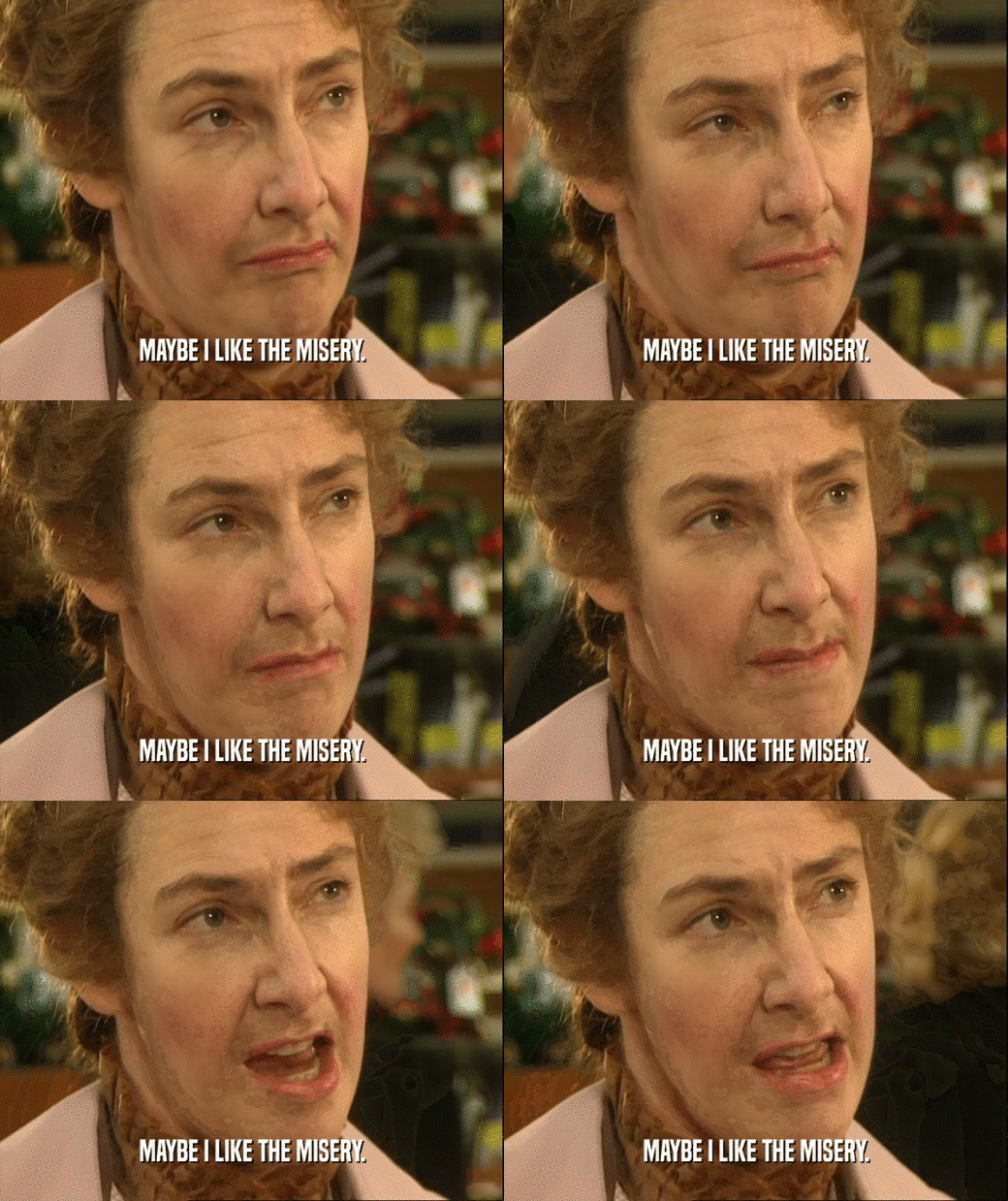
    Are you right there Mrs Doyle..


    IMG_1242.gif


  • Registered Users, Registered Users 2, Paid Member Posts: 24,334 ✭✭✭✭Tell me how


    Behind every such story, there is usually a family that has been carrying the burden of the illness for an extended period. They have had to deal with the strain, the effort, the worry and the horrible reality of the hand that life has dealt them. And often, they are doing so with admirable dignity and fortitude.

    I heard the man speaking about his son with muscular dystrophy, and for me, what struck me was how calm and measured the man sounded given the words that he was saying. I don't know how I would look at my child if they were sick with a likely terminal condition and not want to scream my head off at the difficulty and pain of it all.

    And outside of the studio for these people, there is often poor supports and the message that the lack of funding either for research or services or medications means that the people suffering will continue to do so. And so these individuals, and their families, are doing everything they can to raise awareness hoping that in doing so, their suffering may someday be reduced. Or that the next person who is diagnosed will have an easier path.

    You're right there may be more of these stories on the radio now, but people know that public commentary can very much influence where funds ends up and so people must to use a horrible analogy "sing for their supper". Behind every one of this 6 minute pieces is months/years or a life time of pain and in front of them is more of the same or a shorter life expectancy than they could have hoped for. Time and again I hear these people and it makes me stop and think how small my problems are by comparison.

    There is way more variety and content available on the airways today than at any point in history so I'm sure the OP will find something to their liking. Or, I've heard some mention on the wireless myself of this fancy new fandangle called podcasts I think it is that I understand allows you to listen to exactly what you want :).


  • Registered Users, Registered Users 2 Posts: 181 ✭✭amovingstatue


    Ah there she is, she leapt to mind as I read this thread


  • Registered Users, Registered Users 2, Paid Member Posts: 8,825 ✭✭✭plodder


    Now it's not lunchtime yet I'm listening to Andrea Gilligan who is interviewing a lady about an ADHD diagnosis.

    It must have been around that time I heard an ad on either RTE or Newstalk, for ADHD diagnoses for around 900 quid from a private psychiatry operation.

    “The opposite of 'good' is 'good intentions'”


  • Registered Users, Registered Users 2 Posts: 2,146 ✭✭✭Radio5


    There's also the benefit of highlighting the shortcomings with our medical professionals and the systems they have set up. For a long time they were another hierarchy to be deferred to and obeyed and couldn't be criticised.


  • Registered Users, Registered Users 2 Posts: 7,689 ✭✭✭yagan


    I think the point of the original poster is making is that too much misery turns people off turning on such radio segments entirely.

    I only ever bother turning on the radio to hear music on LyricFM, whereas I can read all the news I want via subscriptions and forums.

    Some people love "MiseryFM", I had a neighbour whose highlight of the day used to be listening to da poor craters on Joe Duffy. It made her feel more content in her own life knowing the misery others were in.

    BTW, I'm not downplaying what positives can be gained by one individual highlighting their plight, but as standard programing it can lose impact.

    Over the last five years we've been caring for elderlies with various complaints (overall it's simply aging), but all the supports we've needed have been easily found via the internet or our local healthcare centre. I acknowledge that not everyone who needs can actually use the internet, but still that's where the action now is at, so radio is becoming despite all good intentions something of a backwater.

    Post edited by yagan on


  • Advertisement
  • Registered Users, Registered Users 2 Posts: 255 ✭✭Tacitus Kilgore DCLXVI


    I think raising awareness is another important part of these pieces. Whatever about the motivations of the producers/researchers/hosts wanting to talk about them at least it makes people aware of what others are going through. It can also help people who are going through things themselves know that they aren't alone.

    Given the history of how we've dealt with all sorts of matters in this country, letting vulnerable people know that they aren't doing this alone isn't a bad thing. I hate to do the 'telling it like it is hardman' routine but if someone doesn't want to listen to or watch this stuff just switch it off. I do the same thing with anything sports-related as I have zero interest in any of them. It's quite easy to do.


  • Registered Users, Registered Users 2, Paid Member Posts: 24,508 ✭✭✭✭dxhound2005


    Their point is that they have noticed a big increase in it. Or as they put it, there seems to be a big increase.

    "I notice there seems to be a big increase in people being brought on to discuss their illnesses on a daily basis on both RTE Radio One and Newstalk."

    Unless they can present evidence to that effect, it is just their opinion. It would take a lot of research to prove or disprove. If it is true, it will take some time to see if people change their listening habits in response. Four quarterly JNLR's would be fair.


  • Registered Users, Registered Users 2, Paid Member Posts: 24,334 ✭✭✭✭Tell me how


    I think the point of the original poster is making is that too much misery turns people off turning on such radio segments entirely.

    Yeah, I get that, and I'm not saying the OP is wrong, what they're giving is a subjective opinion obviously. I don't necessarily agree, but that is also just an opinion.

    I remember as a child, there was no shortage of very difficult topics discussed on Gay Byrne show for example. And there was much less alternative options back then.

    Some people love "MiseryFM", I had a neighbour whose highlight of the day used to be listening to da poor craters on Joe Duffy. It made her feel more content in her own life knowing the misery others were in.

    This has always been the case for some reason with some people, as you say. And in the same way, people always love complaining about something instead of making choices to get their needs met elsewhere. Read any of the threads about various shows (TV and Radio) and 50% of the posts will be people complaining about the content that they still listen to or watch.

    BTW, I'm not downplaying what positives can be gained by one individual highlighting their plight, but as standard programing it can lose impact.

    Not sure what to say about that, who decides which cases make it to Radio to highlight their plight before everyone has switched off?

    Over the last five years we've been caring for elderlies with various complaints (overall it's simply aging), but all the supports we've needed have been easily found via the internet or our local healthcare centre. I acknowledge that not everyone who needs can actually use the internet, but still that's where the action now is at, so radio is becoming despite all good intentions something of a backwater.

    A concept worthy of a thread in it's own right possibly. Remember "Video Killed the Radio Star". Guess what closed down at the end of last year? MTV. There's still something about the radio I think that makes people feel they are part of a community in a way that not even podcasts do. Not sure how to describe it. And with the way the internet has gone, I think people are turning away (to some degree) or at least growing suspicious of manipulated or very conditioned content.


  • Registered Users, Registered Users 2 Posts: 17,239 ✭✭✭✭whisky_galore


    There must be a demographic out there who loves the "rare disease of the week" slot, but I'm not it.

    Perhaps if our healthcare system actually fcuking worked as intended, we would have less of these but here we are.


  • Registered Users, Registered Users 2, Paid Member Posts: 24,508 ✭✭✭✭dxhound2005


    There was a good one on BBC Radio 4 today, The Curse. They do plenty of medical stuff, and disability issues. Always have, so there has been no increase recently.

    https://www.bbc.co.uk/programmes/m002sf5r

    That won't play on my computer, but this is the blurb below. The programme mentions that NF is the same size as England, but with only 1% of the population size. The curse in part derives from the limited gene pool in the past.

    "For generations, young, seemingly healthy men were mysteriously dying on the Canadian island of Newfoundland. They dropped dead doing normal everyday things like eating dinner, walking across the beach or shovelling snow. Locally, it became known as The Newfoundland Curse and it has been terrorising families for centuries. It turns out that these families have a rare genetic heart condition called Arrhythmogenic Cardiomyopathy, or ACM for short. If left untreated, ACM will kill 80% of the men who have it by the time they are 50 and, until recently, it was practically undetectable. In 1995, genetic counselor Dr Kathy Hodgkinson was introduced to The Curse. Determined to understand why this was happening, she made it her mission to uncover the truth with the goal of ending it once and for all."


  • Registered Users, Registered Users 2, Paid Member Posts: 24,334 ✭✭✭✭Tell me how


    There must be a demographic out there who loves the "rare disease of the week" slot, but I'm not it.

    Why must there be?


  • Registered Users, Registered Users 2 Posts: 5,900 ✭✭✭Comhrá


    It's St Patrick's Day. 2pm. and Newstalk has a documentry on eating disorders in men. Well done Newstalk!


  • Registered Users, Registered Users 2 Posts: 1,596 ✭✭✭AyeGer


    Ray D’arcy was a big man for interviewing people with illnesses on his RTE show.


  • Registered Users, Registered Users 2 Posts: 37,070 ✭✭✭✭NIMAN


  • Advertisement
  • Registered Users, Registered Users 2, Paid Member Posts: 24,334 ✭✭✭✭Tell me how


    Are we complaining because they're discussing the topic, or complaining because they're doing it at this particular time on this particular day?

    It's hard to know these days.


Advertisement
Advertisement