Advertisement
Help Keep Boards Alive. Support us by going ad free today. See here: https://subscriptions.boards.ie/.
https://www.boards.ie/group/1878-subscribers-forum

Private Group for paid up members of Boards.ie. Join the club.
Hi all, please see this major site announcement: https://www.boards.ie/discussion/2058427594/boards-ie-2026

Solar for Beginners [ask your questions here]

1141142144146147

Comments

  • Registered Users, Registered Users 2, Paid Member Posts: 10,141 ✭✭✭✭10-10-20


  • Moderators, Home & Garden Moderators Posts: 7,614 Mod ✭✭✭✭graememk


    And inverters only really come in round numbers, a 5.5 or 5.75 would be ok, or even a 5kW inverter and a 750w micro inverter would sneak in under the limit.

    My 6kW (grandfathered into the new limits) is rated for 27.5 amps afaik but never actually passes 25 amps as when I'm producing 6kW the grid voltage is at least 245v


  • Registered Users, Registered Users 2, Paid Member Posts: 22,126 ✭✭✭✭Bass Reeves


    On an east west orientation how would you split your panel stsllation on the roof east/west, 50/50 ....60/40.

    This is for a holiday home no battery exporting excess.

    Slava Ukrainii


  • Registered Users, Registered Users 2, Paid Member Posts: 15,613 ✭✭✭✭josip


    With no battery and if it's truly due east/west, then 50/50.


  • Registered Users, Registered Users 2, Paid Member Posts: 10,141 ✭✭✭✭10-10-20


    Well… I'd say that you're more likely to be consuming power in the evening rather than the morning, so logic would dictate that a 60% W and 40% E split would make better use of any light that there is in the evening. But that's just my 2c.


  • Advertisement
  • Moderators, Home & Garden Moderators Posts: 7,614 Mod ✭✭✭✭graememk


    Is filling both roofs full an option?


  • Registered Users, Registered Users 2, Paid Member Posts: 15,613 ✭✭✭✭josip


  • Registered Users, Registered Users 2, Paid Member Posts: 10,141 ✭✭✭✭10-10-20


  • Moderators, Home & Garden Moderators Posts: 7,614 Mod ✭✭✭✭graememk


    Need to watch the P levels and have your soil tests done 😂


  • Registered Users, Registered Users 2, Paid Member Posts: 10,141 ✭✭✭✭10-10-20


  • Advertisement
  • Registered Users, Registered Users 2, Paid Member Posts: 22,126 ✭✭✭✭Bass Reeves


    not necessaryits a holiday home we yse ourselves. Its will be empty for 70% of the winter from mid September to late April. Duringbthe summer at present its used 50-60% of the time. System will have a surplus all summer long.

    Its.more about maximising power. I alwaysctaught East had a higher gain in that the pannels wete cooler in the morning and generated more power because of that.

    Slava Ukrainii


  • Moderators, Home & Garden Moderators Posts: 7,614 Mod ✭✭✭✭graememk


    Well still fill the roof, anything you dont use will be exported and you'll get paid for it.


  • Registered Users, Registered Users 2, Paid Member Posts: 15,613 ✭✭✭✭josip


  • Registered Users, Registered Users 2, Paid Member Posts: 10,141 ✭✭✭✭10-10-20


    Hold on a moment - where's the original post gone from this thread anyhow? There's a gap back to the 13th.


  • Moderators, Home & Garden Moderators Posts: 7,614 Mod ✭✭✭✭graememk


  • Registered Users, Registered Users 2, Paid Member Posts: 10,141 ✭✭✭✭10-10-20


    Hmm, must have been a browser issue, I see it now.


  • Moderators, Home & Garden Moderators Posts: 7,614 Mod ✭✭✭✭graememk


  • Registered Users, Registered Users 2 Posts: 22 smithymk11


    How do you find this system and what was the over all cost if u don't mind me asking feel free to mail me privately.


  • Moderators, Category Moderators, Arts Moderators, Sports Moderators, Paid Member Posts: 55,579 CMod ✭✭✭✭magicbastarder


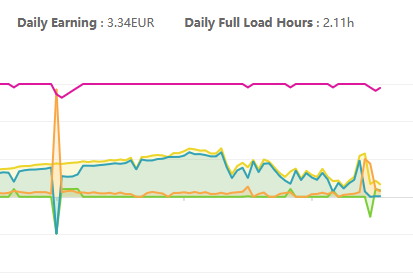
    solis system. reddish purple line is battery charge. is that periodic dip in battery charge an artefact of the way the solis system works, or a fridge or freezer occasionally kicking in? if it was the fridge, say, i'd have assumed it'd be doing that all day long.

    image.png


  • Registered Users, Registered Users 2, Paid Member Posts: 10,141 ✭✭✭✭10-10-20


    Go on and give us a scale - or even an indication how long a 20 min snooze would look like. 🤣

    And what W is the inverter?


  • Advertisement
  • Registered Users, Registered Users 2 Posts: 8 Alzerland


    Hi everyone,

    I’m a qualified automation engineer with extensive experience in controls, wiring, and automation systems, and I’m planning a DIY solar PV + battery system for my small office in Cork, hoping to do the house roof in the future all going well. My goal is to power the office as off-grid as possible, using a 3.5–4 kWp AIKO Neostar panel array with battery storage, and eventually, I would like to have the system connected to the grid for microgeneration.

    From a practical perspective I can safely handle panel mounting, wiring, battery setup, and inverter configuration.

    However, I cannot legally perform the grid connection myself, as I’m not registered under SEAI / RACI.

    I’m comfortable with DC/AC wiring, MPPT controllers, and general electrical safety, just not appropriately certified.

    I’m looking for advice and/or a qualified person who could:

    Connect the system safely to the grid.

    Provide guidance on grid-tie inverter setup and any necessary inspections or paperwork.

    I’d also welcome general advice if anyone has done something similar in the past, or has any general advice.

    My rationale for trying to DIY is to reduce costs, our house was built after 2021, so it doesn’t qualify for SEAI microgeneration grants, meaning a fully installed system would be prohibitively expensive if done entirely by a contractor, making the ROI impractically long.

    Any advice, references, or contacts would be hugely appreciated!

    Thanks in advance,


  • Registered Users, Registered Users 2 Posts: 303 ✭✭ptogher14


    Hi Alzerland,

    A REC (Registered Electrical Contractor) needs to sign off the NC6 form to allow you to export legitimately. Unless you know someone who is comfortable with your competencies and willing to do so, it may prove difficult.


  • Registered Users, Registered Users 2, Paid Member Posts: 8,455 ✭✭✭deezell


    If you just physically install an inverter and batteries initially off grid, then hire an electrician to make the relatively simple grid mains connection back to your consumer unit. It's just a run of cable from a specific consumer RCBO to the inverter isolator and from there to the inverter and battery stack. That constitutes a FIT or nightrate timeshift system, and would immediately give some (poor) return on Investment. It shouldn't require much time or cost the get it on grid and get the form signed.

    You can add DC panels later, doing all that work yourself, as thats off grid side of the inverter. Maybe I'm wrong and theres a big checklist of items and components to submit? The conumdrum of grid tied firemans relay to disconnect the panels is still a mystery, as this technically prevents auromatic panel supported battery backup to an isolated off grid set of essential circuits. but thats another active thread.

    I'd always imagined that a static properly mounted and located 5kw inverter is the only item that needs the NC nod, its the only component that can interact with the live grid. With that in you should be free to continue with your DC inputs, battery or panels, and of course implement a switched off grid backup plan that is isolated from the mains during a power cut, or permanently off grid like a UPS. Maybe there are few electricians able to do this willingly, like there are few heating installers/plumbers who have a clue about smart heating controls and thermostat configuration. At least you can DIY those.


  • Registered Users, Registered Users 2 Posts: 3 jamespipe


    Here in Australia, our regulators (Clean Energy Council/Solar Accreditation Australia) are much stricter. You can't "DIY the DC side" here. The wiring must be done by a licensed electrical contractor.


  • Registered Users, Registered Users 2, Paid Member Posts: 1,618 ✭✭✭JohnySwan


    You need to be very careful here. The DC side of the system requires testing and records too. You also require appropriate insurance. My advice would be to get a proper installer, with the grant and vat free installs, I'm not sure the savings are as great as people think.


  • Registered Users, Registered Users 2, Paid Member Posts: 15,613 ✭✭✭✭josip


    Agree, my brother has been a fully qualified sparks for 30 years. He sourced his own panels and batteries (trade price and could escape the VAT) but he got an SEAI registered installer to do all the installing.


  • Registered Users, Registered Users 2, Paid Member Posts: 8,455 ✭✭✭deezell


    That's the thing, even when someone is qualified in a field, it's subdivided into specialities, a sparks may have no experience of inverter installation, and in particular, the soft configuration of the devices to the panels, batteries etc

    I suppose this discussion of self lnstall is as a result of the perception that labour charges for the hardware installation have in many cases been many multiples of the hardware cost, gobbling up the grant of course. Like if a tyre fitter asked for €200 to fit your new €100 Goodyear, or if Power city asked for two grand to swap in your new €1000 double oven (I think they charge €60-80).

    The Australian comment is interesting. Their model is based on selling transferable credits for your system capacity to meet the energy companies solar source obligations. This results in significant discounts, like a grant. Check out this current Oz Aldi Package, installed with STC rebates presold and deducted.

    Key Details of the Aldi Solar Offer (as of late 2025):

    Package 1 ($6,999): Includes 6.6kW of solar panels (15 x 440W), 5.5kW hybrid inverter, and 10kWh lithium-ion battery storage.

    That's about €4250. No one's going to self install at that price for that amount of kit.


  • Registered Users, Registered Users 2 Posts: 1,057 ✭✭✭Peppa Cig


    Hello folks,

    As a newbie, Just working my way through the extensive information and knowledge on boards regarding Solar PV. A great resource - thanks.

    Thought I would share my scenario to see want ye think. I’m unsure about the feasibility/payback on Solar PV for our case when I consider that 68% of consumption is at cheaper night rate. Also regarding optimum number panels and battery storage.


    Annual Electricity = 30,000 kWh (yes 30k 😭)

    68% of electricity consumption at night rate

    Day/Night Rate Plan = 0.31/0.15

    Will be ground mount for panels. Flexible on orientation. I read south facing best. Might be a 30-50m run for cable back to invertor.

    EV charging at night but chargeback to company. (Accounts for estimated 5000 kWh of the 30k total).

    Domestic grant eligible.


    Thanks!


  • Moderators, Category Moderators, Arts Moderators, Sports Moderators, Paid Member Posts: 55,579 CMod ✭✭✭✭magicbastarder


    25K non-EV kwH a year ? Oof.


  • Advertisement
  • Registered Users, Registered Users 2 Posts: 184 ✭✭randomcorkman


Advertisement
Advertisement