Advertisement
Help Keep Boards Alive. Support us by going ad free today. See here: https://subscriptions.boards.ie/.
https://www.boards.ie/group/1878-subscribers-forum

Private Group for paid up members of Boards.ie. Join the club.
Hi all, please see this major site announcement: https://www.boards.ie/discussion/2058427594/boards-ie-2026

Irish Property Market chat II - *read mod note post #1 before posting*

1938939940941943

Comments

  • Registered Users, Registered Users 2 Posts: 15,040 ✭✭✭✭Red Silurian


    No but caps will only apply from March for 6 years, after which a landlord doesn't have to apply the 2% rule


  • Registered Users, Registered Users 2 Posts: 5,878 ✭✭✭BlueSkyDreams


    Not being able to raise the rent by more than 2% for the next 6 years is a cap.

    The 6 year rule could easily turn into a 10 year rule down the line.


  • Registered Users, Registered Users 2 Posts: 15,040 ✭✭✭✭Red Silurian


    Yeah but more likely the 6 year limit was chosen because the current govt will be gone by then and won't have to deal with any fallout. I'd say the only way the rule would be extended is if we get a proper govt


  • Registered Users, Registered Users 2 Posts: 325 ✭✭MadeInKerry


    As I said on another thread. A 2% per year cap is totally uninvestable. Doesnt take a genius to work that one out either to be fair.


  • Registered Users, Registered Users 2 Posts: 2,473 ✭✭✭mrslancaster


    Afaik, sitting tenants who rollover into a further 6 year term will continue with the max 2% rent cap so I don’t see how there will be any doubling of the rent. Also, if a new tenant moves into a property after the previous tenant left voluntarily, a landlord can charge market rate but that will be based on comparisons from the new register, not from daft or out of the landlords head. The register will have all rents, RPZ, capped, discounted AHB, cost rentals etc and the rate will refer to size, bedrooms, location, BER etc.

    Any rent, whether it’s a first time rent or a renewal, is to be submitted to the RTB and any landlord who breaks the rules could get a criminal charge along with huge fines. It sounds very draconian to criminalise a landlord who makes an error on paperwork but I’m sure there’s many will be delighted to see that. To me that’s just another thing that scares landlords out of the market.

    Agree that housing is a need but landlords or developers are not obliged to supply housing, they can enter and exit that market the same as any business investor can participate in other sectors. If citizens are unable to buy or rent due to lack of availability, it falls on the state to create conditions where investors are willing to take a risk to meet the demand.


  • Advertisement
  • Registered Users, Registered Users 2 Posts: 2,098 ✭✭✭PeadarCo


    2% a year, there are deposit accounts that give you the same return or better return. Especially after tax plenty give a better return (DIRT is 33% v the marginal tax rate at the higher tax bracket of 50% ish). If an investment option can't beat or is worse than what is effectively the risk free option, it is the text book definition of a bad investment opportunity.

    Not to say it makes it easy for tenants, but if the service provider can get a better return investing in a different asset class, it just means long term less and worse options (ie people who don't follow the rules). At some point tax breaks or something along those lines will need to be given. Ideally you want to increase the return for landlords without driving rental costs for tenants sky high in the short to medium term/however long it takes the supply of new units to come on stream.


  • Registered Users, Registered Users 2 Posts: 7,788 ✭✭✭timmyntc


    2% a year is not the ROI but the increase in ROI.

    And you do not pay marginal rate on rental income if you hold the property in a fund or business structure,so you can compound your rental gains almost tax free.

    You cannot achieve that with deposit savings accounts.


  • Registered Users, Registered Users 2 Posts: 2,098 ✭✭✭PeadarCo


    You can get 2% every year from the bank essentially risk free ( or as close you will get to that). You are correct that for pension funds etc marginal rate versus DIRT is irrelevant. But for a lot of small landlords selling it is relevant.

    Also the 2% is not the increase in ROI. If inflation is 3% in real terms the ROI has decreased even though in nominal terms the amount received has increased. Might be acceptable for a risk free investment but not one with substantial risk.

    Remember a big factor when looking at ROI is risk. If a bad tenant means you get no income for a year or two plus have to pay legal fees. That negatively impacts the ROI calculation. Also the fact that landlords will no longer be able to get vacant possession to sell also decreases the ROI of the investment as vacant properties sell at a premium compared to tenant occupied ones.

    My point is for a lot of small landlords its better to sell up and get the 2% on their investment in the bank or pension instead of having of having to bother with all the awkward ROI calculations made worse by political uncertainty around tenancy laws.

    Just to be clear tenants still need support but encouraging landlords to leave the rental market doesn't help things. Even under the new rules once a tenant leaves the property, it can be sold with vacant possession. Without new investors the private rental market could still shrink abet at a slower pace. That benefits no one.


  • Registered Users, Registered Users 2, Paid Member Posts: 22,107 ✭✭✭✭Bass Reeves


    Another factor with the inflation or 2% is that its general inflation. Costs associated with houses and housing maintenance are running at 5%+ yearly increases. Takes some utilites at present they increase by inflation+5% yearly

    Slava Ukrainii


  • Registered Users, Registered Users 2 Posts: 7,788 ✭✭✭timmyntc


    If inflation is 3%, your money in the bank is worth 3% less and your rate of return is down and you are losing money.

    Cash in bank is the worst inflation hedge, property is one of the best


  • Advertisement
  • Registered Users, Registered Users 2 Posts: 15,040 ✭✭✭✭Red Silurian


    My understanding was that after 6 years the rent can be reset to market rent for sitting tenants. If a tenant voluntarily leaves within the 6 year timeframe the market rent can be reset for the new tenant.

    You're confusing rental increases with deposit interest. The interest is accrued on your deposit. The money you spend buying the home is more akin to your initial investment.

    Say for example I bought this apartment for €350k (I'm aware that asking is 295 but let's assume it goes up by 55k)

    https://www.daft.ie/for-sale/property-apartment-131-the-matthew-the-strand-ennis-road-co-limerick/6485565

    and I rent it out for €2k a month, below is a bigger apartment in the same complex for €2.5k/month so I'd be fairly confident of getting €2k

    https://www.daft.ie/for-rent/apartment-the-strand-apartments-ocallaghan-strand-limerick-city-centre/6493636

    After one year the 350k investment has netted 24k. But also the latest residential property price index from the CSO shows that property prices have increased by 7.9% outside of Dublin, meaning your 350k investment after one year has given you €24k in rent and €27.65k in property price inflation.

    https://www.cso.ie/en/releasesandpublications/ep/p-rppi/residentialpropertypriceindexnovember2025/

    This gives a total return, should the landlord sell up after 1 year of €51.65k on a €350k investment or the equivalent of 14.75%.

    Let's say 50% of it goes on tax (likely a lot less but for example)

    Your return on the investment is still way in excess of 7%. Before you raise your rent by another €480 a year

    Do you know of any bank offering these returns?


  • Registered Users, Registered Users 2, Paid Member Posts: 22,107 ✭✭✭✭Bass Reeves


    First off you have buying and selling costs. The property tax is 333 per year or 666 after tax. Service charge is 1800 a year. Not sure an one bed in Limerick will net 2k a month. After that you have maintenance. In general apartments do not inctease in value at the same rate as houses and one beds are generally slowest of all.

    70% mortgage repayments of 17k per year for 20 years. Interest will be about 10k for the first year so gross first year costs, 10k+1.8+1k in modest maintenance costs allowable directly agaist rent, 7k+ 333 paidvout of after tax income wich translates to 14.7k in taxed income.

    Fitting out cost fridge freezer 750 euro, washing machine and dryer 800 euro. Furnitre 2.5k. Bed 1200 euro, oven microwave ( presume seller will leave hob) 750 euro, small electric and utensils 750 euro. 7kish total

    Rent I expect its more in the line 1.8k a month. Or 21.6k per year. So net loss fist year 21k.6 k - 27.5k cost -1k is in depreciation and 0.5k electrician or a 7.5k net loss.

    Initial investment 355k +4k( legal and ⁹professional eg engineers etc) and 7k in fit out costs total 366k. Personal investment 117.5 k

    We will give the apartment is rising by 4%a year in value or 14.2k.so you net.increase in wealth is approx 7k or about 6% but that 6%is not gauranteed

    However property is an active investment you have to manage it. You will have accountancy and other costs out of that. An investment fund will gennerally return you that. You fund manager will not be ringingnyou on Sunday morning as you head to a GAA match and say the water is off or the washing machine is not working.

    At present I am not selling. However I will have to consider my options if a tenant moves ot.

    Take an older person who bought a house 20years ago. It cost 250k at height of boom now its worth 400k. Rent is 50-70% of market rent.They are after a problem tenant or two, one during COVID where they recieved no rent for 18 months and could not evict. They paid 8-9% in interest during 2010/11. Initially they invested 105k and borrowed 150k

    Now they have a choice property market is strong, they can sell pay 50k in gains tax, maybe less if they have unused depreciation as well as legal.and professional fees for sale.

    Some will stay some will exit. Some are exiting at present some will wait until present tenant leaves.

    If they invested the orginal 105k in an investment fund it would have returned 292 @ a 5% rate of annual return. If they had trickled it into a pension investment took tax relief etc add about another 100k.

    Property is a long term active investment. Its not free money. LL have other choices and its not as attractive as it once was

    Slava Ukrainii


  • Registered Users, Registered Users 2 Posts: 5,046 ✭✭✭Villa05


    My home has been making more than me on median(ish) income over the past 3 years

    Irish deposit accounts are loss making in real terms. Homes with no rental return have a far better ROI, comparing deposit accounts interest rates to property is just plain daft


  • Registered Users, Registered Users 2 Posts: 7,788 ✭✭✭timmyntc


    what other choices do LLs have that give a better return than letting?


  • Registered Users, Registered Users 2 Posts: 2,098 ✭✭✭PeadarCo


    It's not daft. When looking at ROI you have to look at the Risk Free rate. Deposit accounts are the closest the average person gets to that. In real terms deposit accounts do lose money. But all investments have the potential to lose money.

    When looking at any investment you need to look at potential return and RISK. Generally the higher risk an investment the higher return that people demand.

    Saying that getting 2% extra every year is a good investment is meaningless without looking at risk.

    A landlord can continue to rent and face the risk of getting 0 income and a negative return if they get a bad tenant. Or sell and put the money on deposit. I could have picked other investment options(with higher returns) but deposit accounts are less risky. My point is saying 2% is great doesn't make sense when a significant amount of landlords are selling. They have other investment options starting with deposit accounts.


  • Registered Users, Registered Users 2 Posts: 7,788 ✭✭✭timmyntc


    but rental return is not 2%, its x% yield + 2% per year. Actually more than that, x% + 2% pa and y% increase on property values.

    Deposit accounts are cash based and eroded by inflation, whereas property prices tend to beat cash inflation.


  • Registered Users, Registered Users 2 Posts: 2,098 ✭✭✭PeadarCo


    But you are completely ignoring risk. Of course deposit accounts are not a good investment but they represent the risk free rate.

    If a tenant doesn't pay and takes 2 years to get out you have a negative ROI for that period. You don't have that issue with deposit accounts. For small landlords this risk is made worse by having only a few properties.

    Any half decent ROI calculation that is done will factor in the 2%. So the expected ROI is the expected ROI not ROI plus 2%. The ROI for any new tenancies also has to allow for they cannot sell with vacant possession (unless tenants leave of their own accord) and with that the negative hit to the ROI.

    Private property is a less attractive investment option. We can see that with landlords selling. Depending on the nature of a tenancy a deposit account can provide a better return than purely renting. Yes long term you can sell but an investor needs to be able to afford the long term is months and potentially years of no income.

    ROI varies for every property and the investment time horizon and should be compared to the risk free rate ie deposit accounts.


  • Registered Users, Registered Users 2 Posts: 15,040 ✭✭✭✭Red Silurian


    Obviously when you make up your own unrealistic figures it's not going to look as good


  • Registered Users, Registered Users 2 Posts: 7,788 ✭✭✭timmyntc


    Private property is a less attractive investment option. We can see that with landlords selling

    But we aren't actually seeing this - yes landlords are selling, but many more are buying and entering the market. Total rental supply is increasing not shrinking, so the investment opportunity clearly is still attractive


  • Registered Users, Registered Users 2 Posts: 2,473 ✭✭✭mrslancaster


    @Red Silurian

    My understanding was that after 6 years the rent can be reset to market rent for sitting tenants. If a tenant voluntarily leaves within the 6 year timeframe the market rent can be reset for the new tenant.”

    There’s so many new rules and I’m probably reading it incorrectly but I thought market rate was only allowed when a new tenant moved in for the first time. So not for a sitting tenant who renews for another six years.

    To me it doesn’t make sense that the rent for a sitting tenant can be increased after six years, but if a landlord issues notice for no fault he can’t charge market rate so any new incoming tenant gets the benefit of a lower rent? Crazy rule. Why would a landlord not just keep the sitting tenant and increase the rent if that’s allowed.


  • Advertisement
  • Registered Users, Registered Users 2 Posts: 15,040 ✭✭✭✭Red Silurian


    To be fair to you there's a good few new rules and getting the head around them isn't easy. Below is an explainer from the citizens information website that might help. Basically the tenancy is ended after 6 years and the rent can be re-set to market rates with the tenant still in situ. Re-setting is different to increasing in this way

    https://www.citizensinformation.ie/en/housing/renting-a-home/changes-to-the-rules-for-renting-from-march-2026/

    From 1 March 2026, if a new tenancy is being created a landlord will be able to re-set the rent to market value, if the previous rent was below market value and:

    • The tenant leaves the tenancy voluntarily
    • The tenant breaks their obligations
    • The home no longer meets the tenant's needs, for example, because it is too small
    • The 6-year tenancy of minimum duration ends for a private rented tenancy
    • 3-years has passed for tenancies in student-specific accommodation


  • Registered Users, Registered Users 2 Posts: 325 ✭✭MadeInKerry


    I recently helped my brother decide whether to sell his house or not with the new rules coming in. He has sold.

    In the end he made the decision based on.

    His rent was far below market rent.

    Almost no mortgage left on the house.

    After CGT he is going to pocket a few hundred thousand euros.

    No more worrying about the house or getting calls or complaints at inconvenient times.

    No more chasing people for rent and being made to feel like scum for doing it.

    No more risk of tenants deciding not to hand hm back his house when he wants to sell it.

    No more risk of tenants not paying rent.

    No more new rules every year and trying to figure them out.

    Now his only worry is where to put a few hundred thousand and how to spend it.

    Talking to him and his wife the other day they are 110% happy they cashed in and let it go.


  • Registered Users, Registered Users 2, Paid Member Posts: 22,107 ✭✭✭✭Bass Reeves


    You always have choices if you have money. What you are forgetting is where a LL has a property below market rent the return may be little better than than having money on deposit when you take costs into account. For those that are trying to become a LL.for the first time the costs are much more significant than ten years ago with added risk. As well some entrants into the rentals market were parents who expected there children to go to college in a certain area. The changes in legislation, the inability to get vacant possession and the new 6 year rule are all added risk.

    For any LL with 3 properties you would be crazy to buy another one and have the added risk of being a large LL.

    Traditionally property was a consideration for a way to add to retirement funds if you were hitting pension investment ceilings. Deemed disposals mitigated against investment funds. However demmed disposal will be gone within 7 years so putting money into such a fund retuning 4-6% is much more attractive than property

    Its your opinion that my figues are unrealistic. Just taking your rental assumption you assumed beace a 2 bed was put up at 2.5k that a one bed would make 2k in same area. Normally its a 65-75% ratio. Thats a projected rent of 1625-1850 and my rental figure was at the upper end of the projection.

    Even to achieve such acrztion on a one bed you.need a young couple andnin this case ones with substantial earning pay such a rent. These couples have other choices and can easily buy a property

    Slava Ukrainii


  • Registered Users, Registered Users 2 Posts: 15,040 ✭✭✭✭Red Silurian


    His rent was far below market rent.

    Can you explain further? Was he jealous because somebody else was getting more than him? Not sure how that's an issue really. He was getting essentially free money.

    Almost no mortgage left on the house.

    So the house was mortgaged at one point meaning he didn't buy it with his own money? Litterally investing the banks money and got a return for himself. Sweet

    After CGT he is going to pocket a few hundred thousand euros.

    And he will be forgoing a few grand a month in rent in place of a lump sum. Some would say it's not much of a benefit

    No more worrying about the house or getting calls or complaints at inconvenient times.

    No more chasing people for rent and being made to feel like scum for doing it.

    How often did this happen, honestly?

    No more risk of tenants deciding not to hand hm back his house when he wants to sell it.

    There's no laws against selling with tenants in situ, quite the opposite in fact

    No more risk of tenants not paying rent.

    You mentioned this already? How often did this realistically happen?

    No more new rules every year and trying to figure them out.

    Perhaps confirm which juristiction your brother is selling his house in? The same rules have applied for the last number of years here in Ireland

    Now his only worry is where to put a few hundred thousand and how to spend it.

    My heart bleeds for him, no bank will give a return like the one he's gotten though. Perhaps he needs something more risky like the stock market

    Talking to him and his wife the other day they are 110% happy they cashed in and let it go.

    It's good that they are happy as they could have cashed in next year and made on average 9% more while at the same time making easy money from the rent now that the mortgage is paid off


  • Registered Users, Registered Users 2 Posts: 15,040 ✭✭✭✭Red Silurian


    Most 2 bed apartments in limerick city go for 2k-2.3k The complex I listed has a number of benefits over others, hence the higher rent, the higher price and the higher return on investment. The average rent difference between a 1 and 2 bed apartment in Limerick is about €300 so I was being very conservative by knocking €500 off the price of a 2 bed to come to the one bed price


  • Registered Users, Registered Users 2 Posts: 325 ✭✭MadeInKerry


    You arent very bright are you? If you cant figure it out from what I posted, you just dont want to figure it out. ITs clear enough from my post. Get someone else to explain it to you if they have the patience.


  • Registered Users, Registered Users 2 Posts: 102 ✭✭agoodusername


    I'm not going to get into too much detail on the intricacies of the housing crisis here, I made a post on this thread a couple of years ago speaking about generating supply to make some sort of dent and I don't fancy repeating myself.

    I will say that I am against the notion that this is an issue that'll be resolved if the state stops interfering in the market. This isn't an Irish issue at all, far from it, but the reality is that too many are being left behind by the price increases not matching wages for decades.

    Let's be real, we do need some sort of state involvement. You can give me exceptions and convoluted ways to get around this, but there are hundreds of thousands of dedicated workers making very ordinary salaries in valuable jobs who will never be able to rent alone or purchase a modest property near their employer.

    With this in mind, I don't have an issue with some state involvement, private developers will never be able to price their offerings to suit the admin support worker in central Dublin making 37k a year. How exactly we go about this is a different question, aside from my hope that we see the minimum wage climbing. I'd hope that with radical increases in supply and council lists focusing on employment needs, those making below the median salary will see some sort of future. (yes I am the optimist)


  • Registered Users, Registered Users 2 Posts: 5,555 ✭✭✭PokeHerKing


    Wage increases wouldnt solve the supply side and realistically would inflate prices more.

    The answer is the government building huge amounts of affordable housing for the part of the population working jobs vital to a society and economy but realitively low paying.

    While theyre at that they should build retirement villages as well.

    But wish in one hand and $hit in the other and see which fills up faster.


  • Registered Users, Registered Users 2 Posts: 730 ✭✭✭soirish


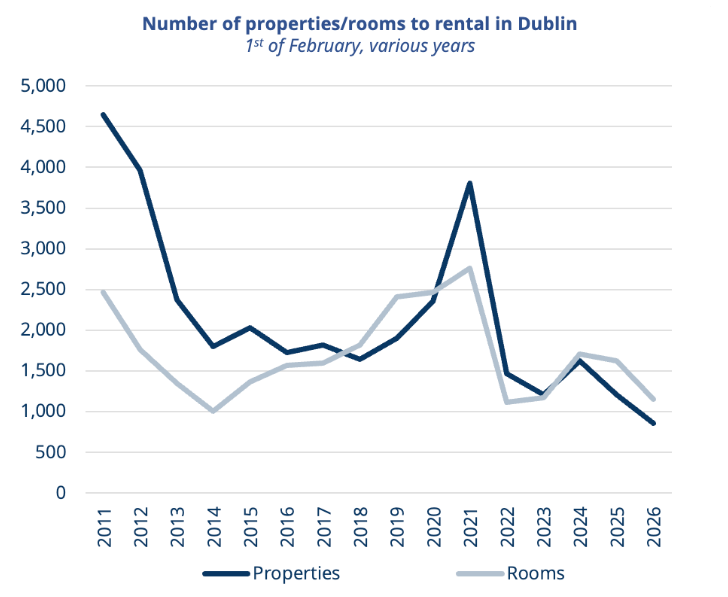
    Screenshot 2026-03-22 at 08.55.06.png

    The latest Daft report


  • Advertisement
  • Registered Users, Registered Users 2 Posts: 325 ✭✭MadeInKerry


    Im seeing rise ion the number of properties coming on to the market where I am. They all look like ex rentals from the photos. At least there is one silver lining to landlords selling up.


Advertisement
Advertisement