Advertisement
Help Keep Boards Alive. Support us by going ad free today. See here: https://subscriptions.boards.ie/.
https://www.boards.ie/group/1878-subscribers-forum

Private Group for paid up members of Boards.ie. Join the club.
Hi all, please see this major site announcement: https://www.boards.ie/discussion/2058427594/boards-ie-2026

Adding panels to a system

  • 11-02-2026 08:59PM
    #1
    Registered Users, Registered Users 2 Posts: 49


    Hi all,

    Looking to run an idea past ye;

    I have a 15 panel system installed on my roof. I have a large shed app. 7m away on the same orientation/pitch that I am looking to add 5 panels to.

    I will be going with the same panel model and putting it in series with the rest. I have the 15 as two strings currently split 8:7 so will jig it around a bit to have 10:10 or thereabouts.

    My question is regarding isolator / fireman switch. My current system has the auto fireman switch up at the cable entry point under the roof tiles as per regs.

    Do I need to look at having another one at the shed array? Or a DC isolator at the shed? Or no switch at all and just cable direct from new mini array broken into the existing?

    Any other considerations on such a job?
    Thanks


Comments

  • Moderators, Home & Garden Moderators Posts: 7,609 Mod ✭✭✭✭graememk


    At the most basic level all you need is a wire coming from one of the strings to the shed and a wire coming back. (From the roof)

    Consideration to be taken for cable route and protection. Isolator on the shed may help with that too. But that is also another point of failure!


  • Registered Users, Registered Users 2 Posts: 49 dessertspoon


    Thanks for the reply.

    I will be putting the cable in conduit and burying 500mm deep.

    I can see the isolator being another failure point. It also could be a useless isolator in the sense it will actually open the entire circuit for that string, rather than the implied usage of isolating just the shed array.


  • Moderators, Sports Moderators Posts: 18,873 Mod ✭✭✭✭slave1


    Have you checked the inverter can "take" the additional 5 panels, there is a maximum voltage rating on every inverter


  • Registered Users, Registered Users 2 Posts: 3,431 ✭✭✭Buffman


    As mentioned above first check to see can your inverter handle it?

    Does the shed have it's own consumer unit?

    It will be a lot less hassle to have separate system in the shed with a simple grid-tie inverter if you have the spare capacity on your grid connection. Saves running the DC cables between the buildings and removing your existing panels to rearrange the string wiring.

    The below is a general 'signature' and not part of any post:

    FYI, if you move to a 'smart' meter electricity plan, you CAN'T move back to a non-smart plan.

    You don't have to take a 'smart' meter if you don't want one, opt-out is available.

    Buy drinks in 3L or bigger plastic bottles or glass bottles or cartons to avoid the DRS fee.

    Public transport user? If you're sick of phantom ghost services on the 'official' RTI sources, check bustimes.org for actual 'real' RTI, if it's on their map it actually exists.


  • Registered Users, Registered Users 2 Posts: 49 dessertspoon


    Yes indeed, rated for a max input of 10kwp, I currently have 6.7 so this would bring it to ~9kwp.

    It is also rated for 900V max. and 20 panels at ~40V VOC are within that.


  • Advertisement
  • Registered Users, Registered Users 2 Posts: 49 dessertspoon


    Yes the shed has its own sub consumer unit.

    But isn’t the ESB micro generation scheme limiting my inverter size? My installer specifically went for a 5kw rated output model instead of 6kw due to this. If I put another inverter in I would burst this limit.


  • Registered Users, Registered Users 2 Posts: 3,431 ✭✭✭Buffman


    Ye, you're almost on the NC6 limits.

    Are you planning on DIYing it or getting an installer to do it? If it's the latter do your sums as the payback period might be so long as to not make it worth it.

    Yes, by going from 6.7kW to 9kW pv into the 5kW inverter you'll be getting a bit more on cloudy days and will be maxing out the inverter more but on the flip side that will lead to lots more inverter clipping which is just wasted energy not earning you any money.

    The below is a general 'signature' and not part of any post:

    FYI, if you move to a 'smart' meter electricity plan, you CAN'T move back to a non-smart plan.

    You don't have to take a 'smart' meter if you don't want one, opt-out is available.

    Buy drinks in 3L or bigger plastic bottles or glass bottles or cartons to avoid the DRS fee.

    Public transport user? If you're sick of phantom ghost services on the 'official' RTI sources, check bustimes.org for actual 'real' RTI, if it's on their map it actually exists.


  • Registered Users, Registered Users 2 Posts: 49 dessertspoon


    Thanks.


    Likely going to DIY.

    I checked the last year’s of meter export data and I only reaching >99% power less than 1% of the time. I am confident that the extra panels will be able to get close to being fully utilised rather than being clipped by the inverter.


  • Moderators, Sports Moderators Posts: 18,873 Mod ✭✭✭✭slave1


    Clipping can be avoided/minimised by charging batteries or heating water, timing appliances etc or charging the car


  • Registered Users, Registered Users 2 Posts: 3,431 ✭✭✭Buffman


    Ye, sounds good, if you're DIYing I wouldn't be too worried about isolators or fireman switches at the shed, you can leave the last MC4 connectors handy for yourself to get at to disconnect if you need to do any work in future.

    Hopefully you know your current string layout so you can plan your new strings beforehand without any unnecessary messing around on the roof. If you have someone to help you up there it will make life a lot easier.

    If your inverter is able for it with the specs and you've room on the shed roof you might as well max it out as close to the full 10kW as possible.

    The below is a general 'signature' and not part of any post:

    FYI, if you move to a 'smart' meter electricity plan, you CAN'T move back to a non-smart plan.

    You don't have to take a 'smart' meter if you don't want one, opt-out is available.

    Buy drinks in 3L or bigger plastic bottles or glass bottles or cartons to avoid the DRS fee.

    Public transport user? If you're sick of phantom ghost services on the 'official' RTI sources, check bustimes.org for actual 'real' RTI, if it's on their map it actually exists.


  • Advertisement
  • Registered Users, Registered Users 2 Posts: 14,470 ✭✭✭✭SteelyDanJalapeno


    How would you avoid clipping by heating water, charging the car or timing appliances?


  • Registered Users, Registered Users 2 Posts: 864 ✭✭✭RCSATELLITES


    Charging a battery that's DC is the only way to avoid clipping (I think) all those mentioned still need to go through the inverter.


  • Registered Users, Registered Users 2 Posts: 864 ✭✭✭RCSATELLITES


    Are you going to add optimisers for the 5 you are adding or you think they are ok. Orientation, angle the same as existing roof no shading?


  • Registered Users, Registered Users 2 Posts: 49 dessertspoon


    Wasn’t planning to add optimisers. Orientation is the exact same. Pitch slope is about ~8 deg shallower. No risk of shading.


  • Registered Users, Registered Users 2, Paid Member Posts: 5,881 ✭✭✭...Ghost...


    If there is a delta in pitch, the lowest performing panels on the string will drag the others down, same as shading.

    Stay Free


  • Registered Users, Registered Users 2 Posts: 49 dessertspoon


    That is true. But how much that would impact the net output (33% more panels offsetting a drag-down) I am not too sure?


  • Registered Users, Registered Users 2 Posts: 7,545 ✭✭✭witnessmenow


    i think you'll have to do a bit of homework on this!

    You could use this site to get the power a panel on each roof will generate:

    https://re.jrc.ec.europa.eu/pvg_tools/en/#PVP

    And figure out the difference between a panel on your roof and your shed And apply to your whole array on the better performing roof. Try get as accurate as you can with the orientation and the angle of the roof.

    For example (I'm making up numbers):

    • A panel on your house roof generates 1000kWh according to that site
    • A panel on your shed generates 900kWh
    • 900/1000 gives you 0.9. Your panels on your house would be generating 90% of what they were before.
    • Use the tool again with your full array value on your roof, and multiply the number is brings back by 0.9
    • Then figure out if the cost of optimisers on the worse performing roof is worth the loss.

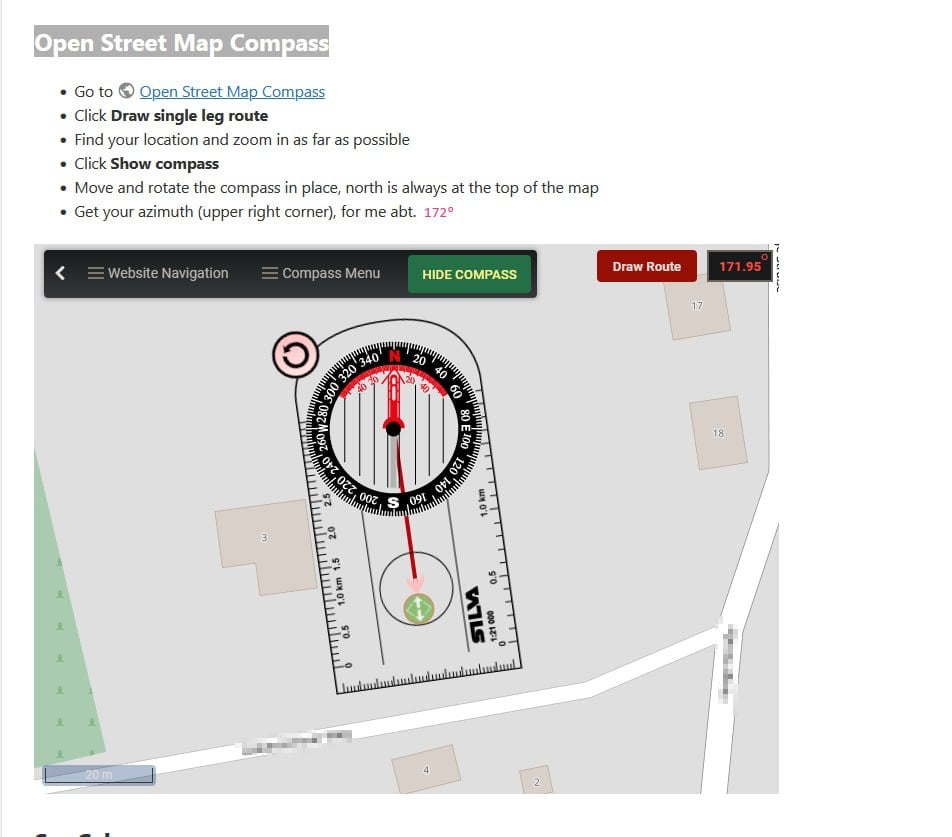
    To get your azimuth:

    In this picture they are getting the azimuth of the roof facing the road at the bottom.

    You will also need to take the figure it returns and take -180 from it. So in the picture example the figure you'd put into the above website would by -8 (172-180)

    IMG_20260403_072849_046.jpg


  • Registered Users, Registered Users 2 Posts: 49 dessertspoon


    Thanks for your help.

    I ran the analysis. The PV GIS tool estimates a 3% loss due to the slope. If I assume I have to absorb that full 3% loss across the other 15 panels then my net increase by adding 5 panels is still 1713 kWh per year. That is a 29% increase as opposed to an ideal 33% increase. Still worth doing!


  • Registered Users, Registered Users 2 Posts: 4 dingbat69


    Hey,

    I'm not an electrician, or a vaunted solar electrician ;-) So no advise, just my own experiences.

    I have been messing about with adding various sets of panels to my setup.

    Out of the box, 6KW ground mounted array to a 5KW dual mppt inverter, any sunshine, even in Feb and the inverter maxes out, I can change the GM panel slope up to 56 degrees, this is why the are so performant.

    I have added two other 2nd hand arrays to my Inverter, using a Vevour PV joining box and the spare MPPT.

    8 X 275W Gable wall mounted 90 Degrees ESE panels. 2KW

    8 X 290W on a shed 5 @ 12degrees ESE, 3 @ 12 degrees WNW. 2.2KW

    The two strings joined together run at about 250V, with the ESE morning string kicking in before the GM array and the shed mounted array ticks along nicely during the day & picks up a bit of extra electricity in the evening, I expect this to increase a little as the sun moves higher and sets more to the north.

    From my limited knowledge, its mostly based on connecting the arrays & disconnecting the arrays in various sunshine states, all my mppt seems to care about is that the string voltages from the two arrays are the same, disconnecting the Gable Array in the late afternoon when the sun has moved off that wall, has no effect on the production of the shed mounted array, I have to conclude that either the tracking mppt in the inverter can just ignore that string, or the shaded array provides its required 250V with no backfeed and the amps generated just go to the inverter.

    I tried temu blocking diodes, the just got hot and I did not see any difference anyway.

    The current regs state that the fireman switch should be within 1.2M of the array, as technically you are going to wire the new array into the old array, I think you are meeting this requirement.

    Not sure if this helps any!


  • Registered Users, Registered Users 2 Posts: 7,545 ✭✭✭witnessmenow


    That sounds right to me anyways. I can't help with any of the other questions though!


  • Advertisement
  • Registered Users, Registered Users 2 Posts: 49 dessertspoon


    Many thanks for sharing your experience! Your setup is very tolerant of the very different azimuth angles indeed.


Advertisement
Advertisement