Advertisement
Help Keep Boards Alive. Support us by going ad free today. See here: https://subscriptions.boards.ie/.
https://www.boards.ie/group/1878-subscribers-forum

Private Group for paid up members of Boards.ie. Join the club.
Hi all, please see this major site announcement: https://www.boards.ie/discussion/2058427594/boards-ie-2026

BusConnects Dublin - Bus Network Changes Discussion

1583584586588589592

Comments

  • Registered Users, Registered Users 2 Posts: 16 senorsmoke


    so €270 million to implement the new contactless payments on public transport.


  • Registered Users, Registered Users 2, Paid Member Posts: 19,628 ✭✭✭✭LXFlyer


    There is a lot more to this than just enabling contactless payments.

    It’s far more complex than that.

    The cost is estimated to be up to €270m, and that is to implement a completely new national back end system for processing payments of all types, including a new account based payment system, together with new validators and ticket machines, for the entire country’s PSO bus, train and tram network.

    https://www.irishtimes.com/ireland/2026/02/03/new-contactless-payment-system-for-public-transport-may-cost-up-to-270m/


  • Moderators, Recreation & Hobbies Moderators Posts: 12,192 Mod ✭✭✭✭BeerNut


    I get really annoyed by headlines like this. Are we supposed to be enraged by that number? Are we invited to come up with our own estimate of what would be reasonable?


  • Moderators, Motoring & Transport Moderators, Technology & Internet Moderators Posts: 24,122 Mod ✭✭✭✭bk


    The contract is also to maintain the entire system, including all validators, gates and ticket machines for 20 years. So it works out at about 13.5 million per year.


  • Registered Users, Registered Users 2 Posts: 16 senorsmoke


    I wasn’t saying it was too expensive but that at least a figure was there. Over the lifetime of the contract it is reasonable for what will be covered by the contract.


  • Advertisement
  • Moderators, Motoring & Transport Moderators, Technology & Internet Moderators Posts: 24,122 Mod ✭✭✭✭bk


    To put some context to this, London is also looking to upgrade to the same type of next gen ticketing system and the contract is looking to be £1.5 Billion over 12 years.


  • Registered Users, Registered Users 2, Paid Member Posts: 19,628 ✭✭✭✭LXFlyer


    A further explainer article - but leaves the important multi-annual support contract element.

    https://www.irishtimes.com/ireland/2026/02/03/whats-so-complex-about-introducing-contactless-payment-for-public-transport-in-ireland/


  • Moderators, Motoring & Transport Moderators, Technology & Internet Moderators Posts: 24,122 Mod ✭✭✭✭bk


    There is one element to the next gen ticketing that I think they have maybe gotten wrong and I suspect is badly delaying the rollout.

    That is the decision that the new validators and infrastructure should work with the old Leap cards and free travel cards and all that goes with that. I suspect this means that rather then just using an off the shelf system, they have had to code and test all the old 20 years worth of old Leap card technology and ticketing on the new systems and validators.

    I suspect we could have had at least contactless tap to pay one to two years earlier if they didn't do this!

    The alternative approach would have been to keep the old Leap card system in parallel, with it's own separate validators, etc. until the new system phased it out and completely replaced it. That is what was done when Leap cards was first introduced, we had two validators side by side until the old tickets were completely phased out. Other cities take this approach too with EMV contactless.

    This is why we will only start getting new validators next year and they will initially only work with Leap cards and we won't get the tap to pay until 2028.

    Had they taken the alternative approach we could have gotten contactless tap to pay straight away and then over time they could added new functionality to it until it completely replaced the old leap cards. I would have preferred that approach.


  • Registered Users, Registered Users 2 Posts: 1,037 ✭✭✭BP_RS3813


    Was only discussing this with friends the other day. Contactless readers are not hard to come by, set up or link up with systems - practically every single shop in Dublin and a lot of European transport systems have them.

    It would not be hard to outfit every bus with them.

    Interfacing it with our dinosaur leap card system however is another thing entirely.

    Add to that how will things like the 90 min fare/student/young adult cards work with a generic bank card?


  • Moderators, Motoring & Transport Moderators, Technology & Internet Moderators Posts: 24,122 Mod ✭✭✭✭bk


    The way it works on buses is completely different from shops and a lot more complicated.

    The ones in shops need an internet connection and take a few seconds to process the transaction, talking to a payment processor etc. over an internet connection. This isn’t possible on buses as it would be too slow (goal is 500 milliseconds) and buses don’t always have reliable internet connections everywhere.

    Thus a special mode was created specifically for public transport in the cEMV standard called model 2 payments (model 1 being the simple shop example).

    The way it works on buses, etc. is that when you use your debit card, it doesn’t charge you at that point like it would in a shop. Instead it simply records your card details in the validator. At a later point the card info is transferred to the backend systems and then overnight they figure out what you owe, taking into account 90 minute tickets and daily and weekly capping and only then do they charge your bank account.

    Not just anyone can use this special mode, it requires lots of security and special agreements with various financial institutions, to make sure fraud doesn’t happen.

    Now this isn’t exactly new, it has been implemented in other cities too, but it is more complicated then how it works in shops.

    Having said all that, I suspect adding old leap card support to it has slowed down the rollout of what would otherwise be a somewhat more straightforward project.


  • Advertisement
  • Registered Users, Registered Users 2, Paid Member Posts: 94 ✭✭DrivingSouth


    Do we know or expect that there will be a leap 2.0 card or will we have to use our phone or bank card?


  • Registered Users, Registered Users 2, Paid Member Posts: 9,443 ✭✭✭dublinman1990


    I suspect the security firms & the banks setting up these special security arrangements are getting a payment in lieu from the NTA every time a leap card transaction is being put through these enhanced security channels to prevent fraud when it is being processed from the old leap card machines & validators in the PSO bus fleet.


  • Moderators, Motoring & Transport Moderators, Technology & Internet Moderators Posts: 24,122 Mod ✭✭✭✭bk


    Apparently it will support existing leap cards from day one, actually it will launch with this functionality first on the new validators next year, with the bank card/phone payments not coming until the year after!

    It isn’t clear if there will eventually be a leap card 2.0 or not, they haven’t said. It is definitely possible and in Amsterdam which has a similar modern ticketing system, they have introduced a new card to replace the old one. From a passenger perspective it shouldn’t really matter as either way it should l work the same way for them.


  • Registered Users, Registered Users 2 Posts: 6,336 ✭✭✭trellheim


    I did really like the new paris system it just loads as a smartcard in your phone wallet and is designed to work in low battery situations , all you need is the phone and you never need go near an actual machine to set it up , metro or rer


  • Moderators, Motoring & Transport Moderators, Technology & Internet Moderators Posts: 24,122 Mod ✭✭✭✭bk


    I found it very buggy, in particular on Android phones.

    We couldn't get it to work at all the first night as it seems their backend systems were down! On Android it is weird that you need to install two separate apps to get it working and have to give the second one dozens of weird permissions which are pretty bad for privacy!

    You need an internet connection to actually buy a ticket.

    It did work better on iPhone as you don't need the app and can buy a ticket directly in Apple Wallet. But no such support for Google Wallet on Android. Also the ticket working in low battery mode only applies to iPhons, not Android phones!

    I suppose it isn't so bad if you bought a weekly ticket, but it was all a bit of a fap to buy single tickets.

    Then there is all the weirdness of bus/tram tickets being separate and not integrated with metro/rer tickets. No daily/weekly capping and awkward weekly ticket. Though non of these issues are specific to the tech, same of paper tickets.

    There is also the extra layer of complexity if you are travelling with kids without a phone!

    I suppose it is okay, better then queueing up at ticket machines. The treatment of Android as very much second class citizen was bizarre!

    Of course it is better then what we currently have with Leap cards, but I do think the approach we are going to take of just using your debit/credit card will be FAR easier.


  • Registered Users, Registered Users 2 Posts: 102 ✭✭hfjm20


    I was in Paris less than a month ago for only a few hours. Maybe I was doing it wrong but it seemed very expensive to just buy one ticket for every single metro journey, no matter the distance. Also it wasn’t made clear that there was a separate ticket you needed for the airport so when I went out there that was a whole mess trying to get out. Don’t think it’s a system I’d like replicated here, from my experience anyway


  • Registered Users, Registered Users 2 Posts: 6,336 ✭✭✭trellheim


    I did have an iphone and it all worked excellently I thought


  • Registered Users, Registered Users 2 Posts: 3,672 ✭✭✭VG31


    While they would never do it here, the best system from a user perspective is the Germany/Switzerland system. Just buy a ticket in an app and then forget about it. There are no ticket barriers and validation isn't required. You only have to show your ticket if there are ticket inspectors and they are generally rare enough in urban areas.

    The second easiest system is contactless flat fare like in London. Having to also tap-off like in the Netherlands is a bit more cumbersome.


  • Registered Users, Registered Users 2 Posts: 1,037 ✭✭✭BP_RS3813


    We don't need any more forced apps.

    London rules is fine


  • Moderators, Motoring & Transport Moderators, Technology & Internet Moderators Posts: 24,122 Mod ✭✭✭✭bk


    There is no forced apps, they usually have other alternative ways to pay too. There are usually ticket validator machines on the bus/train that you can buy tickets from or validate some Leap type card on. Just like how in Cork you can pay using the TFI Go app or Leap card or cash.

    In some cities you don't even need to do anything with the app, if you allow it GPS access it can automatically tag you in and out when you get on and off.

    This sort of thing could work very well for Luas and Metrolink and even DART if they got rid of the silly gates. Our issue is the buses, you would need to hire lots of ticket inspectors like the Luas has. I'd love to see us move to this model, but with us struggling to hire bus drivers, it might not be the best time to do it for buses, but hopefully something for the future.

    One cool future technology is Ultrawide Band (UWB), it is built into iPhones and high end Android phones. It allows for very precise location (it is how Apple airtags work).

    You don't even need to take your phone out of your pocket, just step through the door of the bus and you would be tagged on, which the driver could see and then when you exit the back door, automatically tag you off.

    Also the gates at DART stations could swish open without you even breaking stride or taking your phone out of your pocket.

    It could give you an experience similar to Germany, but still having the driver do the ticket checking.

    I expect UWB to be the next next gen of ticketing.


  • Advertisement
  • Registered Users, Registered Users 2 Posts: 3,672 ✭✭✭VG31


    In some cities you don't even need to do anything with the app, if you allow it GPS access it can automatically tag you in and out when you get on and off.

    SBB have that for trains in Switzerland. I haven't tried it myself though as I usually have some sort of pass there.


  • Registered Users, Registered Users 2 Posts: 1,890 ✭✭✭john boye


    Speaking of ticket inspectors, I saw them out bright and early on the 41 at 6am recently.


  • Registered Users, Registered Users 2 Posts: 1,890 ✭✭✭john boye


    There's hoarding up outside Tesco in Liffey Valley with Bus Connects logos all around it. I know they're changing that roundabout to a signal junction but it seems like quite a big site just for that, is there something else going in there?


  • Registered Users, Registered Users 2 Posts: 1,554 ✭✭✭StreetLight


    Probably just a storage base for machinery and construction equipment.

    Post edited by StreetLight on


  • Moderators, Motoring & Transport Moderators, Technology & Internet Moderators Posts: 24,122 Mod ✭✭✭✭bk


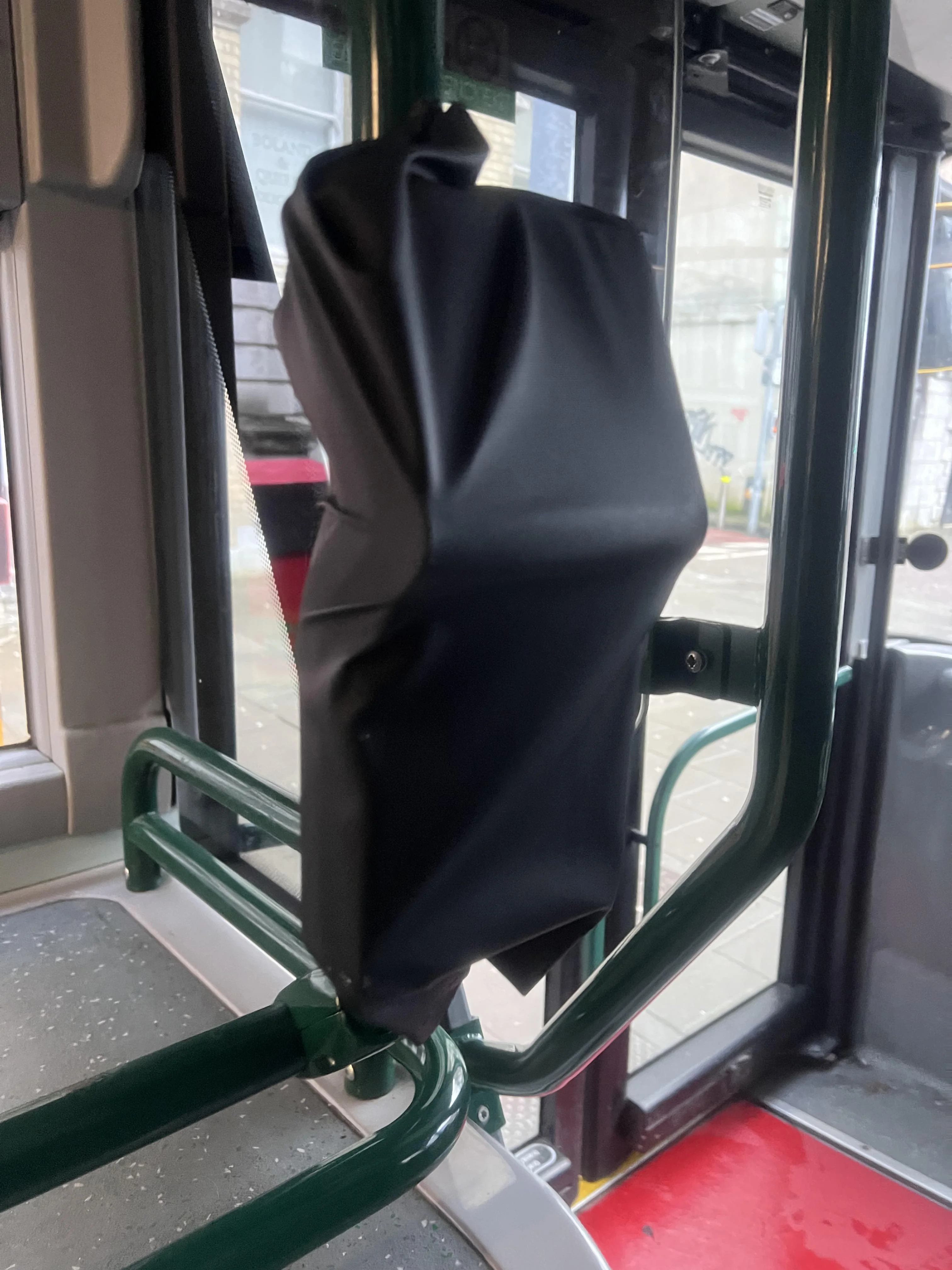
    Interesting to note that right hand validators have started to appear on buses in Cork. They are currently covered over, but the shape of them looks very different to the current Dublin right hand validators.

    So it will be interesting to see if these show and indication of what the new validators for Dublin under the next gen ticketing will look like.


  • Registered Users, Registered Users 2, Paid Member Posts: 9,443 ✭✭✭dublinman1990


    Are these new right hand validators appearing on a single bus route in Cork to use it a trial period or are they appearing across the entire BÉ fleet? It would be nice to see some photos to have a look at their appearance.


  • Registered Users, Registered Users 2, Paid Member Posts: 9,443 ✭✭✭dublinman1990


    The 23, 24 & 80 have their routes changes implemented in DCC yesterday.

    Has anyone here used these buses on their revised routes yesterday for 1st impressions on traffic levels & their ability to maintain their reliability on their timetables?


  • Registered Users, Registered Users 2 Posts: 30 transfer90


    It would be useful if the 23 and 24 had a stop on Bachelors Walk to allow easier access to Henry Street and O'Connell Street.


  • Moderators, Motoring & Transport Moderators, Technology & Internet Moderators Posts: 24,122 Mod ✭✭✭✭bk


    They seem to be appearing across multiple routes in Cork. Picture here from the Cork BusConnects thread:

    Untitled Image


  • Advertisement
  • Registered Users, Registered Users 2 Posts: 101 ✭✭AdmiralHip


    I saw a comment from the NTA that the merge of the 80 and 130 is now happening in 2027 in an Irish Times article today on the adjustments to the routes for the 80, 23, and 24. Was there an announcement that this was pushed back somewhere?


Advertisement
Advertisement