Advertisement
Help Keep Boards Alive. Support us by going ad free today. See here: https://subscriptions.boards.ie/.
https://www.boards.ie/group/1878-subscribers-forum

Private Group for paid up members of Boards.ie. Join the club.
Hi all, please see this major site announcement: https://www.boards.ie/discussion/2058427594/boards-ie-2026

"Expect more extreme weather" says Met Éireann

Comments

  • Registered Users, Registered Users 2, Paid Member Posts: 14,456 ✭✭✭✭sryanbruen


    There is no fixed numerical threshold for what constitutes as a warm night unlike other definitions such as "heatwave" or a "tropical night" where the same threshold is across the board.

    Met Éireann defines a warm night based on the 90th percentile of average minimum temperature over a 5-day period against 1961-1990. So a "warm night" in winter will be a different threshold to a warm night in summer or even variation in a month as a warm night in early April will be somewhat different to a warm night in late April due to thermal lag or seasonal variation. This also applies on a station by station basis with varying 1961-1990 averages.

    The Met have their definitions on different terms such as a warm night in the link below. This is also the only part of met.ie you will be able to access 09-09 data for synoptic stations and even then only in month, annual or seasonal form so no daily 09-09 data whereas the normal historical database has synoptic stations from 00-00 which makes no sense and at the same time climate station data are 09-09.

    Photography site - https://sryanbruenphoto.com/


  • Registered Users, Registered Users 2 Posts: 15,941 ✭✭✭✭Supercell


    Thanks Sryan, interesting stuff.


  • Registered Users, Registered Users 2 Posts: 27,865 ✭✭✭✭Larbre34


    Storm Éowyn certainly became a landmark event for impact on the electricity grid, but its important to note that it exceeded the gust records by just 1 km/h over a storm previously seen in 1945, and definitely did not exceed the storm of January 1839, in terms of records or impact, though records from that time remain unofficial.

    The electricity damage from Éowyn was as much to do with a lack of resilience and preventative maintenance in the system and weakening caused by high winds in November and December of 2024, than of the weather impact itself.

    The rest of the Met É commentary really feels like its trying to make something out of what is mostly nothing.

    Rainfall 104% of a 30 yr average? So, utterly average then!

    Yes, the increasing trend in average air temps over 70 years by about 1.5C is scientifically notable, but it hasn't contributed to a proportionate increase or decrease in rainfall or storm events over that time either. Just 4 named storms in 2025, after all.

    And yet the government persists in putting almost all its eggs in the climate mitigation basket rather than climate adaption, when we know what we do to mitigate against things in Ireland is completely ineffectual on a global scale and has no science behind where it will actually leave us in 100 to 200 years, versus hard adaption and resilience investment.

    To be clear, I do accept anthropogenic climate change, but I believe it is blended heavily with longer term natural pattern changes, both from within the planet and in our orbital relationship with an ever changing star.

    And I believe we should deal with the practical challenges in front of our faces, rather than laying long-odds bets on very, very costly mitigations.

    To that point, commentary like this from Met É, though I accept they are fulfilling a statutory mandate by doing so, are entirely useless to everybody.


  • Registered Users, Registered Users 2, Paid Member Posts: 14,456 ✭✭✭✭sryanbruen


    The number of named storms should never be used to show an objective trend because there's a high degree of subjectivity in them.

    Photography site - https://sryanbruenphoto.com/


  • Registered Users, Registered Users 2 Posts: 364 ✭✭ClimateObserver


    Quite right, and regarding modern-day weather measurements there are a fair few things to consider. You rightly point out that 1 km/h was the difference between 1945 and 2025 in terms of the strongest ever gust. Now, how much of that 1 kmh can be down to better quality equipment being just simply more accurate? Secondly, Mace Head station wasn't recording windspeeds in 1945. So, it's a new station in that regard.

    When it comes to temperature recording, alot if not all has moved over to digital sensors - particularly following the EU wide ban on mercury thermometers. These digital sensors are more sensitive to temperature spikes - so is it then fair to compare new records against old records? If digital thermometers were in existence in 1887, would it have recorded higher than 33.3°C in Kilkenny?

    Yes, there are human induced 'climate change' effects happening - particularly around change of land use, urbanisation and pollution emissions and these coupled with natural climate variability and fluxing solar activity all combine to change or amplify existing patterns.

    However, there is also little mention of the Hunga Tonga eruption in the factors leading to the recent global temperature increase 2022-2025 (so far) - and there is none in the IT article linked above. Post eruption it was reported that global temperatures would spike owing to the vast amounts of water vapor from the eruption with a lag print of 5-7 years before this exits the atmosphere. Water vapor is the biggest 'greenhouse gas' there is.

    Ireland is sensitive to a moisture laden atmosphere and it's little surprise to see four of the last five years in the warmest of modern-day records as a result. Night time humidity certainly is up and this IMHO is a leading factor in pushing overall Irish temperatures high recently.


  • Advertisement
  • Registered Users, Registered Users 2 Posts: 1,937 ✭✭✭Billcarson


    It is now thought that the Hunga Tonga eruption if anything had a slight net cooling effect and was not responsible for the recent surge in warmth.

    https://phys.org/news/2025-12-international-reveals-atmospheric-impact-hunga.html


  • Registered Users, Registered Users 2 Posts: 1,121 ✭✭✭Robwindstorm


    What a brilliant oneliner Sryan. It wraps it all up. The 2023/2024 storm season is a prime example. In The so called 'busy storm season ' half the storms recorded don't even reach Met Eireann's own criteria, one even recorded as a ' strong breeze'.


  • Registered Users, Registered Users 2 Posts: 364 ✭✭ClimateObserver


    https://phys.org/news/2023-01-tonga-eruption-chances-global-temperature.html

    I was working off that which was published a year after the eruption. I'd be interested to see more research overall as the nature of the eruption (underwater → atmosphere) is unprecedented.

    The newest study is a little wishy-washy about 'net cooling' - for instance if it covers the Mesosphere right down to the Troposphere?

    It could be years before we know definitively if the HTHH eruption is responsible for the 2022-2025 spike, at the moment it certainly is a suspect in the cause of the sudden spike.


  • Registered Users, Registered Users 2 Posts: 3,764 ✭✭✭.Donegal.


    I don’t understand how some people argue that humans pumping enormous amounts of gases into the atmosphere has little or no effect on climate, while simultaneously blaming the Tonga volcanic eruption which also injected massive amounts of material into the atmosphere for global warming.

    Either putting large amounts of crap into the atmosphere affects the climate, or it doesn’t. You can’t logically argue that human emissions are insignificant while claiming a single volcanic eruption caused global warming.


  • Registered Users, Registered Users 2 Posts: 364 ✭✭ClimateObserver


    Humans pumping gasses into the atmosphere isn't the only game in town - having a broad mind and looking also at other sources is a reasonable approach to the topic. Otherwise people just become polarised on the topic and when that happens, this is usually one of the end results:

    Berlin power outage for 45,000 homes blamed on ‘politically motivated’ attack | The Independent


  • Advertisement
  • Registered Users, Registered Users 2, Paid Member Posts: 14,456 ✭✭✭✭sryanbruen


    Precisely, 2023-24 was a key example where this is skewed whereas other seasons like 2022-23 have very little - in fact, our first named storm that season was in August the following year! Some years they seemingly love to go to town with naming depressions then others they tend to be more reserved. It's far too subjective to use this in an objective way to see the change in frequency of storms. Met Éireann I feel have been more consistent in naming than the UK Met Office who are wildly unpredictable sometimes whether they would name or not. They seem to have swung more towards the naming pendulum in recent winters than the reserved camp.

    As is well documented by now, average winter wind speeds in the 21st century have decreased significantly though the slow down has reduced and flatlined in the past decade with no real trend of late. But wind speeds are only part of the game. 2013-14 for instance whilst not the windiest winter on record was I believe the most cyclonic winter on record with exceptionally low mean sea level pressure which is another parameter that goes into the naming of storms.

    Photography site - https://sryanbruenphoto.com/


  • Registered Users, Registered Users 2 Posts: 1,937 ✭✭✭Billcarson


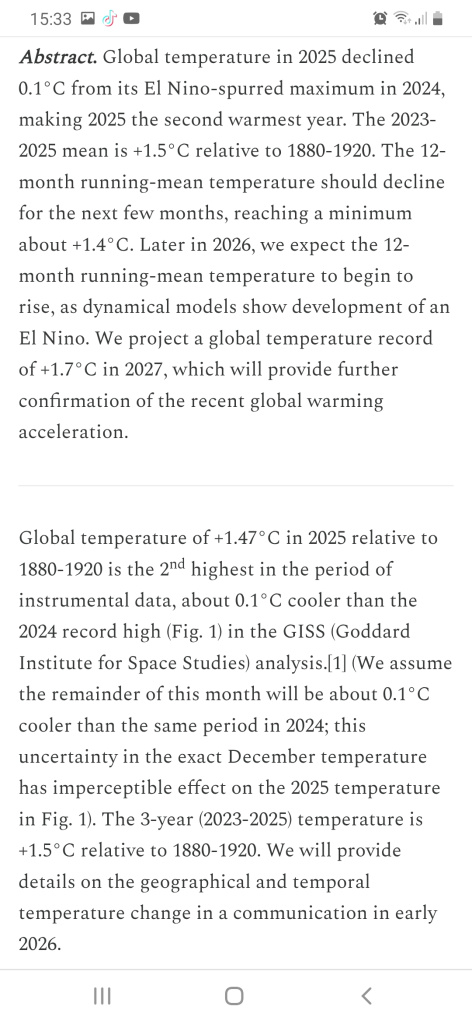
    James Hansen believes that the reduction in sulphur in shipping fuel is the reason behind the recent accelerating warming = less aerosols in the atmosphere. He thinks these aerosols previously released by ships were masking the true extent of the warming. His temperature predictions have been very accurate the last few yrs. He predictioned only a very slight reduction in temperatures for 2025 after 2024 the warmest yr on record globally when 2025 should have been normally expected to be lower then what it was after the last El Nino in 2023/24 and 2025 being a La Nina yr.


  • Registered Users, Registered Users 2 Posts: 1,937 ✭✭✭Billcarson


    2024 fossil fuel emissions released 37 billion tonnes of co2 into the atmosphere. On average worldwide altogether volcanoes release around 300/350 million tonnes of co2 per year.


  • Registered Users, Registered Users 2 Posts: 27,865 ✭✭✭✭Larbre34


    James Hansen is an extremist living in a completely impractical mindset.

    No one doubts his expertise, but his crusades that demand the perfect at the expense of the good are just not serious efforts.

    People who are ostensibly in his camp have been very critical of him for 20 years now, because he simply will not recognise what is politically possible versus scientifically ideal. And the climate change deniers on the right love him for it, because his sort of attitude contributes to paralysis and nothing ends up changing.


  • Registered Users, Registered Users 2 Posts: 15,547 ✭✭✭✭M.T. Cranium


    So, the 00z run of the GFS ends on 23rd Jan (at 00z) with a setup that would likely produce a severe windstorm in some part of western Europe on the anniversary of storm Eowyn. Something to monitor in coming days. Right now, there's quite a disagreement between GFS and ECM on pattern evolution. That's probably the main item of interest as GFS calls for cold zonal flow and ECM up until this morning had more of a cold blocking pattern developing.

    It would be nasty business indeed if the anniversary of Eowyn were to be marked by another named storm. Too far out to be a reliable forecast by any means, but cold zonal patterns often facilitate storm development since the jet stream is depressed to lower latitudes than average and there is bound to be an air mass clash taking place any time there is a strong trough forming in the central longitudes of the Atlantic. As I mentioned the model run ended with an ominous look, and we will see within 12-24 hours if this signal persists how it might develop closer to Ireland within 24-36 hours of the end of the guidance.


  • Registered Users, Registered Users 2 Posts: 1,937 ✭✭✭Billcarson


    He is one of the more alarmist types of scientists but with the recent surge in temperatures time will tell that maybe he is right to be......or not.

    Nothing much is changing anyway. Climate change should be bringing people more together in mitigating and adapting to the problem. It seems these days people are more polarised then ever on the issue and much of it down to misinformation etc


  • Registered Users, Registered Users 2 Posts: 27,865 ✭✭✭✭Larbre34


    Honestly Bill, I think that a policy of mitigation and adaption together is doomed.

    The unprecedented expense and resource requirement of the former would completely starve the latter. Without any guarantee of efficacy.

    I know adaption sounds like whackamole, but at least a mole is both visible and tangible. Mitigation, without any scientific basis, is like taking your whacking mallet and tossing it down a bottomless dark well. You don't know what will happen to it, but you do know that you won't have a mallet anymore.

    And what I mean by the lack of science around mitigation is, we have no idea, nor can we ever have any idea, whether the temperature rise is arrestable, or reversible, or whether it is locked into a cycle that might take five or ten centuries of zero greenhouse gas emissions to begin to ease.

    Like really, the mitigation argument is just about as conceited as unchecked industrial pollution by humans was in the first place.


  • Registered Users, Registered Users 2 Posts: 1,937 ✭✭✭Billcarson


    But we cant keep emitting tens of billions of tonnes of co2 into the atmosphere every year. There is no easy way out if it. We can try adapt as best we can but just digging a hole for future generations who no doubt will condemn us.…id rather that not be our legacy. Adaptation will just get more and more difficult. Remember not just for humans but most life on earth .....domino effect.....One thing I suppose though is who knows what type of technology will be around in one or two hundred yrs time, or even in the next few decades....


  • Registered Users, Registered Users 2 Posts: 1,937 ✭✭✭Billcarson


    James Hansen from Dec 18 2025

    Screenshot_20260107-153310_Chrome.jpg


  • Registered Users, Registered Users 2 Posts: 15,547 ✭✭✭✭M.T. Cranium


    (posted forecast in wrong thread, interesting to see a well-developed low moving at right angles to the track of Eowyn a year and a day later. Much different results)


  • Advertisement
Advertisement
Advertisement