Advertisement
Help Keep Boards Alive. Support us by going ad free today. See here: https://subscriptions.boards.ie/.
https://www.boards.ie/group/1878-subscribers-forum

Private Group for paid up members of Boards.ie. Join the club.
Hi all, please see this major site announcement: https://www.boards.ie/discussion/2058427594/boards-ie-2026

Nuclear - future for Ireland?

1888991939499

Comments

  • Moderators, Recreation & Hobbies Moderators, Science, Health & Environment Moderators, Technology & Internet Moderators Posts: 98,124 Mod ✭✭✭✭Capt'n Midnight


    https://web.archive.org/web/20251113225302/https%3A//www.edfenergy.com/energy/power-station/daily-statuses

    Today in the UK only four out of ten nuclear generators are at Nominal full load, in the middle of November.

    Two others are at reduced load. Heysham 2 Reactor 7 and Heysham 1 Reactor 1

    Four are offline.


  • Registered Users, Registered Users 2 Posts: 16,594 ✭✭✭✭charlie14


    Seeing as you appear to agree with that other poster on figures I have posted here on our projected 2050 demand and the expense of achieving that level of supply being incorrect due to, "glaring and obvious mistakes", then it should be no problem for you to also point out these glaring and obvious mistakes.

    But then, similar to that other poster we both know that is not going to happen and we both know why don`t we Paddy !


  • Registered Users, Registered Users 2 Posts: 16,594 ✭✭✭✭charlie14


    I did mention in an earlier post that the present 1.8GW from renewables was not included in what the offshore cost would be under the present plan to supply 16GW, whereas it was for the figure for SMRs.

    On a like for like basis it would not require 36 SMRs. It would require 32.

    At £2.5 Bn. each that would come to £80Bn. (€90.7Bn.) If the cost of those SMRs increased 8 fold they would still be cheaper than the offshore capital costs of the turbines alone without all the added costs of green hydrogen.


  • Registered Users, Registered Users 2 Posts: 1,599 ✭✭✭gjim


    I dunno claiming that 60% of renewable electricity in Europe came from bio, when the true number is under 13% seems like a fairly glaring mistake. But maybe that's just me being picky?

    You've never retracted that claim have you, despite being challenged by numerous posters?


  • Moderators, Science, Health & Environment Moderators Posts: 20,712 Mod ✭✭✭✭Sam Russell


    How big are these 'small' nuclear reactors?

    Are they the size of a 40ft container?

    Or perhaps half a dozen 40ft containers stacked two high?

    Any bigger that that is not small. If they can fit in a sub, then that is small. If it requires a site the size of Croke Park or the Aviva, then that is not small.


  • Advertisement
  • Registered Users, Registered Users 2 Posts: 16,594 ✭✭✭✭charlie14


    No worries.

    With projected demand and the different capacity factors of different proposed sources to achieve that level of demand it`s an error easily made.

    The basic thinking behind SMRs as I understand it would be that they would be mass produced in a factory setting and those that wanted them would buy whatever they required rather than build their own.

    Building a nuclear plant is a whole different ball game. The average build time is 6 - 8 years. Other than that the total length of time it would take would be up to us getting our act together, and that is something we are particular poor at doing. But that said, I don`t believe we have any other options because the financial costs of doing otherwise are just not feasible and made even more so by the capital investment required being on a 25 year roll-over.

    For myself I believe that both the authorities and Eirgrid have recognised for some time that the present plan will not meet our 2050 demand or emission requirements. Between 2016 and 2020 our emissions fell year on year. 2021 they increased by 1.4 million tonne and by 2022 1.6 million tonne. 2023 we imported 9.5% of our total demand, 2024 14% and for the first half of this year 17.1%. Source : Environmental Protection Agency (EPA).

    The current thinking on more interconnectors from the U.K., France and the latest Spain with a 1,000 Km cable, to me at least would suggest that importing electricity is now the plan to get our emission to the required 2050 level rather than generation using renewables. I would have doubts about the value of a Spainish interconnector though. Spain has a lot of solar during the Summer months, but when our demand is at it`s highest in Winter, supplying their own demand is tight. They generate 20% from nuclear and are planning to shut down their nuclear plants which would leave it even tighter to supply their own demand in Winter let alone export to us. But that plan could change as after the recent blackout there it has re-opened the debate on the wisdom of shutting those nuclear plants.

    As I said, I do not have all the answers on us building our own, but when it comes to the finances and energy security then I do not see any other options. Denmark alone should be a clear warning to us. They have been the major advertisement for wind power, but even they have said renewables alone will not power the grid, and have changed their law governing nuclear. Added to that they recently could not get a single bid for their largest ever offering for offshore and are now extending licenses for wind turbines beyond their lifespan years until they literally fall apart.


  • Moderators, Computer Games Moderators, Recreation & Hobbies Moderators Posts: 11,314 Mod ✭✭✭✭CatInABox


    No one knows yet, as it's still all guess work so far. They can fit into a fairly standard three storey building, but then there's all the other equipment to go with it that'll take up more room. They think that you can fit a few SMRs into an area the size of Croke Park.

    They haven't changed their law governing nuclear, they've said that they'll look into it. Also, isn't extending the life of a windfarm a good thing? It's happened plenty of times with nuclear reactors, right? Would you call that "extending the license for nuclear beyond their lifespan years until the literally fall apart?"


  • Moderators, Science, Health & Environment Moderators Posts: 20,712 Mod ✭✭✭✭Sam Russell


    @CatInABox @Small Nuclear Reactors

    So no-one knows the size, nor the site size required. Is this because they do not exist yet? Sounds a bit of a pig in a poke.

    The obvious place to put one, if we were to do so (unlikely), would be Moneypoint, as it already has the grid connection, and is remote. I assume that a multiple installation (3) would make sense to defray the ancillary and support costs. It would allow a shut down of one, to be supported by the other reactors.

    Moneypoint is already designated to be the hub for off-shore wind, so adding SNR to the mix would make sense.


  • Registered Users, Registered Users 2, Paid Member Posts: 15,602 ✭✭✭✭josip


    Would every power plant in Ireland have a large enough grid connection for at least one 400MW SMR ?


  • Registered Users, Registered Users 2 Posts: 16,594 ✭✭✭✭charlie14


    Since 1985 Denmark prohibiting the construction of nuclear power plants to generate electricity. In May two third of Denmark`s members of parliament supported a motion for the government to launch an official investigation into the potential use of nuclear in Denmark to generate electricity. That was the same month that Lars Aagaard Climate, Utilities and Energy Minister said that an electricity system based on wind and solar is not sufficient and needs "something else". You could look on that whichever way you wish, but I would find it difficult to credit that both events aren`t related.

    Coincidentally Belgium in the same month passed the Bihet Law which reversed it`s 2003 nuclear phase-out law which opens the possibility of the life extension of their existing reactors and the construction of new nuclear plants by a vote of 102 in favour, 8 opposed and 31 abstaining.

    The life of nuclear reactors have indeed been extended, but for a specified period. That is not what is happening with Denmark and wind turbines at the moment. You could again look on that as not being related to Denmark not getting a bid for it`s largest ever offering of offshore or the two ruling parties in Norway last year pledging to cut the two interconnectors with Denmark when they come up for renewal next year due to Denmark draining so much electricity from Norway when renewables were doing little or nothing that resulted, according to the Norwegian Energy Minister, in Norway`s electricity price being 6 times the E.U. average I suppose. Personally I would find it difficult not to see them as related


  • Advertisement
  • Moderators, Recreation & Hobbies Moderators, Science, Health & Environment Moderators, Technology & Internet Moderators Posts: 98,124 Mod ✭✭✭✭Capt'n Midnight


    Do you mean in addition to what's there already or to replace what's there already ?

    Many of the smaller plants weren't big enough for 470 MW and others have been converted to biomass and/or batteries.

    And you would need to provide replacement power during outages.

    You can download the map here - https://cms.eirgrid.ie/all-island-transmission-system-map-2025 and look at the reg/blue/green lines.

    List of generators Link dump - there's a single list , perhaps a .xls on sem-o but these include ones not operational yet.

    https://cms.eirgrid.ie/sites/default/files/publications/TSO-Contracted-Non-Wind-Report-17-09-2025.pdf

    ( also https://cms.eirgrid.ie/sites/default/files/publications/TSO-Contracted-Wind-Report-17-09-2025.pdf )

    And https://esbnetworksprdsastd01.blob.core.windows.net/media/docs/default-source/publications/dso-energised-non-renewable-generators-q1-2024.pdf?sfvrsn=9d5db900_14


  • Moderators, Recreation & Hobbies Moderators, Science, Health & Environment Moderators, Technology & Internet Moderators Posts: 98,124 Mod ✭✭✭✭Capt'n Midnight


    Flamanville 3 has been connected to the grid for 11 months. And there's a 50 week shut down coming up next year.

    It doesn't have a capacity factor of 90% or anything remotely close to it.

    It was 12 years late. And they've just burnt through most of a year on reduced output. Be interesting to see what the capacity factor was for the first 15 years of from when it was originally supposed to produce power.

    https://www.neimagazine.com/news/flamanville-3-full-power-delayed-until-autumn/

    The 1630 MWe (net) EPR pressurised water reactor was first connected to the grid in December 2024. It was taken offline in February for checks and maintenance operations and reconnected to the power grid on 19 April. The plant resumed operation at a lower level of 90 MWe, according to EDF, and tests at various power levels were carried out with full power scheduled for mid-year.

    Connected on 21/12/24 , 90 MWe is capacity factor of 5.5%.

    And that "full power scheduled for mid-year" has become …

    https://www.connaissancedesenergies.org/afp/nucleaire-lepr-de-flamanville-atteint-80-de-puissance-le-palier-de-100-toujours-vise-dici-la-fin-de-lautomne-251112

    "Un arrêt de 350 jours à partir du 26 septembre 2026"

    "Ses coûts ont explosé par rapport au devis initial de 3,3 milliards d'euros, estimés désormais aux alentours de 20 milliards d'euros aux conditions de 2015, et même 23,7 milliards d'euros aux conditions de 2023."

    No matter how bad nuclear looks , when you dig deeper it's worse.


  • Moderators, Recreation & Hobbies Moderators, Science, Health & Environment Moderators, Technology & Internet Moderators Posts: 98,124 Mod ✭✭✭✭Capt'n Midnight


    "The total construction cost of these two EPR2 units is estimated at £38 billion … 20% lower than the cost of Hinkley Point C."

    On the risk sharing of the of costs of Sizewell-C under the Regulated Asset Base (RAB) Financing Model.

    The state will only have to carry 50% of the cost overruns from £40.5Bn (6.5%) to £47.7Bn (25%) and will take the hit on everything above that.

    Mechanism for cost integration into the RAB

    Total cost is less than or equal to £40.5bn (2024 prices)

    Total cost is between £40.5bn and £47.7bn (2024 prices)

    Total project cost exceeds £47.7bn (2024 prices)

    Cost treatment in the RAB

    – 100% of construction costs are added to the RAB – If final costs are lower than this threshold, 50% of the savings are added to the RAB

    Only 50% of the additional costs are added to the RAB

    Investors have no obligation to provide additional equity

    Investor protection level

    Investors are highly protected: everything is included in the RAB and they receive a high return

    Investors share the risk: they do not recover all cost overruns, but part of the excess cost is covered

    The risk no longer lies with investors but mainly with the State

    The rule of thumb with nuclear is a doubling of cost every ten years according to which the cost increases would hit 25% in just 3 years. But no contractor would be dumb enough to try that until they've passed the "it's cheaper to go on than cancel" threshold (and then rinse and repeat later every few years) .


  • Registered Users, Registered Users 2 Posts: 16,594 ✭✭✭✭charlie14


    The present capital cost of Sizewell with a 60 year lifespan is £38Bn.

    Sizewell`s two EPR2 units will deliver 3GW. Based on the offshore contract Orsted walked away from for being financially unviable, the capital cost for offshore to deliver the same would be £45Bn.

    Offshore lifespan is 25 years, so now with the U.K. giving cfd`s for 20 years, that capital cost would be rinsed and repeated twice more during the lifespan of Sizewell. The capital cost of offshore increased by 60% - 70% over less than two years, but even without including inflation, the total capital cost of offshore for 60 years would be £135Bn. compared to Sizewell`s present cost of £38Bn.

    If the cost of Sizewell increased by three fold it would still cost less than offshore.


  • Moderators, Recreation & Hobbies Moderators, Science, Health & Environment Moderators, Technology & Internet Moderators Posts: 98,124 Mod ✭✭✭✭Capt'n Midnight


    The post before yours explains that the £38Bn is the bait and switch price. Why is there already a plan for when costs exceed £47.7Bn ? And why is that plan that the state pays for all the extra costs ?

    The post before that explains that the cost of France's newest nuclear plant increased by 500% over the original estimate. (Not including inflation.)

    Instead of getting 15 years of electricity from 2012 - 2027 from a capital spend of €3.3Bn the French will be getting 1 years worth of electricity for a spend of €20Bn an increase not of 90% but 90 TIMES. And that's only if there's no more unscheduled outages and if it comes back on line on schedule in Sept 2027.

    Nuclear gets more expensive over time. Especially with new regulations. For Renewables the long term trend is lower real prices. Refurbishing is cheaper than than re-powering which is way cheaper than new build.

    And all of that is moot because unless you can provide spinning reserve/backup/peaking for nuclear without using fossil fuels or relying on so much storage and biomass and biogas etc then nuclear will lead to higher emissions than the path we are taking.


  • Registered Users, Registered Users 2 Posts: 16,594 ✭✭✭✭charlie14


    Two years ago you were telling us that in the short term the capital cost of offshore would fall dramatically. It rose by 60%. Now it`s "For renewables the long term trend is lower real prices" when Orsted just ran away from a renewed CFD taking into account that 60% rise in capital costs because it was not financially viable.

    No company operating an offshore wind farm with a 25 year lifespan on a 20 year CFD contract is going to be refurbishing. No more that your example of the Galloway refurbishing of an onshore wind farm. Same as Galloway, it will be an application for a new offshore wind farm and a new capital cost. Three of them during the lifespan of a nuclear plant.

    This bait and switch idea is your own theory, and as far as I can see so is this rule of thumb of the cost of nuclear doubling every 10 years. The agreed price for nuclear supply is index linked and I would very much doubt inflation will double over cover the next 10 years. If it does it would do so for everything. With offshore creating it`s own inflation bubble of 60% in a little over a year, then the chances of an increase of that magnitude would leave offshore more likely than nuclear.

    I have said this to you before. You really need to stop worrying about French nuclear. Their exports have earned then over €5 Bn in profit for each of the last two years, They have got the ARENH monkey off their back where they had to supply renewable providers with up to 30% of their generation for €42 per MWh to keep them from going bust and will now be getting €72 per MWh with the max required restricted to 100TWh.The likelihood is France will be exporting the same electricity they exported last year, which was an all time record. So stop worrying about French nuclear. The`re not. They are adding 6 new plants and considering adding a further eight. With the profits they are making from nuclear it`s not difficult to see why.

    Nuclear can provide it`s own spinning reserves, and with the capital cost difference between offshore and nuclear for our 37GW plan we could over build nuclear, gold plate the lot and still be billions in. You on the other hand have not provided any costs for your 100% grid, - something even Denmark the poster country for renewables - say is not possible and "something else" will be required. Nor have you provided any cost for the back-up - or even what those back-ups would be when renewables go for a prolonged sleep - or indeed what spinning reserves your 100% renewables grid would have or at what cost.


  • Moderators, Recreation & Hobbies Moderators, Science, Health & Environment Moderators, Technology & Internet Moderators Posts: 98,124 Mod ✭✭✭✭Capt'n Midnight


    In news that will come as no surprise to anyone the proposed nuclear plants in France have a) increased costs and b) been delayed. Original estimate was €51.7Bn with a startup date of 2035

    EDF now say forecasted cost estimate stands at €72.8bn (2020) … target date for commissioning the first reactor at Penly is 2038

    That's over 40% increase in cost (not including inflation) and a three year delay. And we are still years away from the proposed construction start date so they haven't hit any real world problems yet.

    In other new , while the most recent French reactor was connected to the grid a year ago it's only reached full power recently. 13 years late.

    “14 December 2025 marks a key step: the Flamanville 3 reactor reached 100% nuclear power at 11:37am and generated 1,669 MW of gross electrical power,” Budget was €3.3 billion. Total cost €23.7 (2023) billion.


  • Registered Users, Registered Users 2 Posts: 21,872 ✭✭✭✭cnocbui


    https://www.reuters.com/sustainability/boards-policy-regulation/reducing-nuclear-energy-strategic-mistake-eu-chief-says-2026-03-10/

    Reducing Europe's nuclear energy sector was 'strategic mistake', EU chief says

    PARIS, March 10 (Reuters) - Reducing Europe's nuclear energy sector was a "strategic mistake", European Commission chief Ursula von der Leyen said on Tuesday, as governments grapple ‌with an energy crunch from the Iran war. Europe produced around a third of electricity from nuclear power in 1990 but that has fallen to 15%, she told an event in Paris, leaving it reliant on oil and gas imports whose prices have surged in recent days…

    The EU budget does not directly ‌fund nuclear ⁠energy projects because they are not unanimously supported by its 27 member governments.In a sign of the EU's increasing acceptance of the technology, von der Leyen said the executive Commission would offer a 200-million-euro guarantee for private investments in innovative nuclear technologies.

    The tide is turning, but incredibly slowly.


  • Moderators, Recreation & Hobbies Moderators, Science, Health & Environment Moderators, Technology & Internet Moderators Posts: 98,124 Mod ✭✭✭✭Capt'n Midnight


    That €200m guarantee isn't even 1% of the cost increase of the French nuclear plants that haven't even started construction yet.

    Nuclear is an insanely expensive gamble. On-time, on-price is so rare that any civil servant or politician signing a contract should be liable to prosecution for treason in the event of failure which will inevitably lead to deaths when other budgets like health have to be cut.

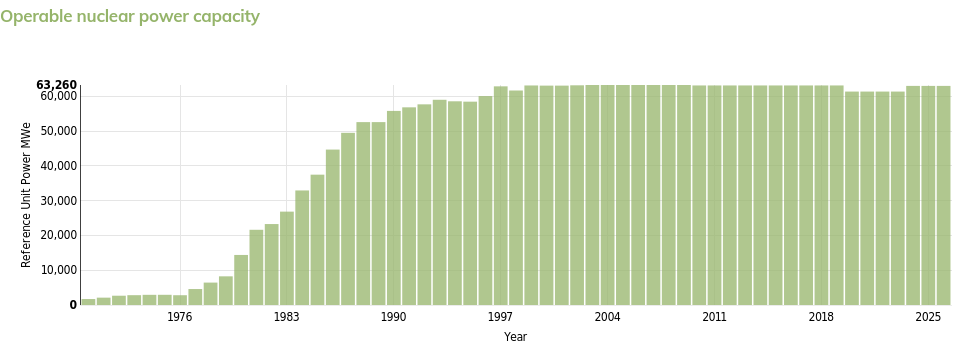
    image.png

    Since 1997 France has added another 225MW to it's nuclear capacity even though demand has increased a tad more.

    That's nearly 8MW a year (~0.01%) and there won't be any more additions until 2038 at the earliest, closures are more likely.


  • Registered Users, Registered Users 2 Posts: 628 ✭✭✭Aontachtoir


    It’s a shame that Europe (France in particular) took the foot off the nuclear pedal. If they had continued adding nuclear capacity at the same rate as the 70s and 80s, how much carbon would we have kept out of the atmosphere? And how close to a decarbonised grid would we be?


  • Advertisement
  • Moderators, Recreation & Hobbies Moderators, Science, Health & Environment Moderators, Technology & Internet Moderators Posts: 98,124 Mod ✭✭✭✭Capt'n Midnight


    Europe didn't. ( The US has only completed two reactors where construction started after the 1970's. )

    Replacing an old coal plant to CCGT would save 75% of the emissions of the old plant.

    In theory nuclear could reduce a coal plant's emissions by 100%. But you'd have to wait 15 years longer for nuclear to arrive. And it would then take 60 years to catch up on the those 15 years of zero emissions savings.i

    And that's before you consider gas has a faster response and so could be ramped down when renewables were on line and that nuclear is reliant on fossil fuel for peaking and peak winter demands.

    During the Russian gas embargo France was importing gas from Germany to produce electricity because the electrical interconnectors were maxed out because half their reactors were offline.


  • Registered Users, Registered Users 2 Posts: 16,594 ✭✭✭✭charlie14


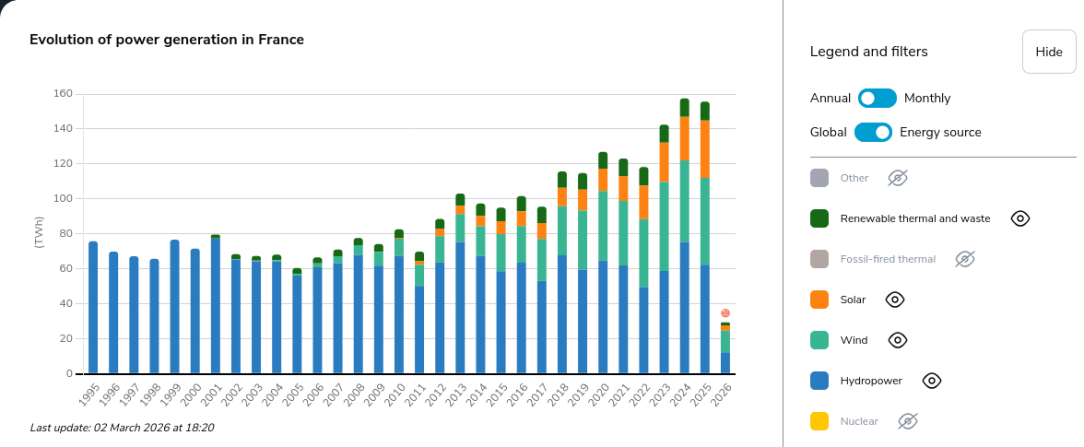
    France are putting their foot back on the nuclear pedal building more plants and it`s not difficult to see why. In 2024 due to nuclear their net export of electricity was a new record at 89 TWh. This year they set a new record of 92.3 TWh for which they received €5.4 Billion.


  • Registered Users, Registered Users 2 Posts: 21,872 ✭✭✭✭cnocbui


    France's grid was effectively net zero in 2023, producing more zero CO2 lecy than the total consumed that year.

    Last I looked they had enough reactors to satisfy their entire demand, if all were operating.


  • Moderators, Recreation & Hobbies Moderators, Science, Health & Environment Moderators, Technology & Internet Moderators Posts: 98,124 Mod ✭✭✭✭Capt'n Midnight


    image.png

    New record ? 89TWh is less than renewables have been producing for a long time.

    [edit adding link] https://analysesetdonnees.rte-france.com/en/generation/global

    Post edited by Capt'n Midnight on


  • Moderators, Recreation & Hobbies Moderators, Science, Health & Environment Moderators, Technology & Internet Moderators Posts: 98,124 Mod ✭✭✭✭Capt'n Midnight


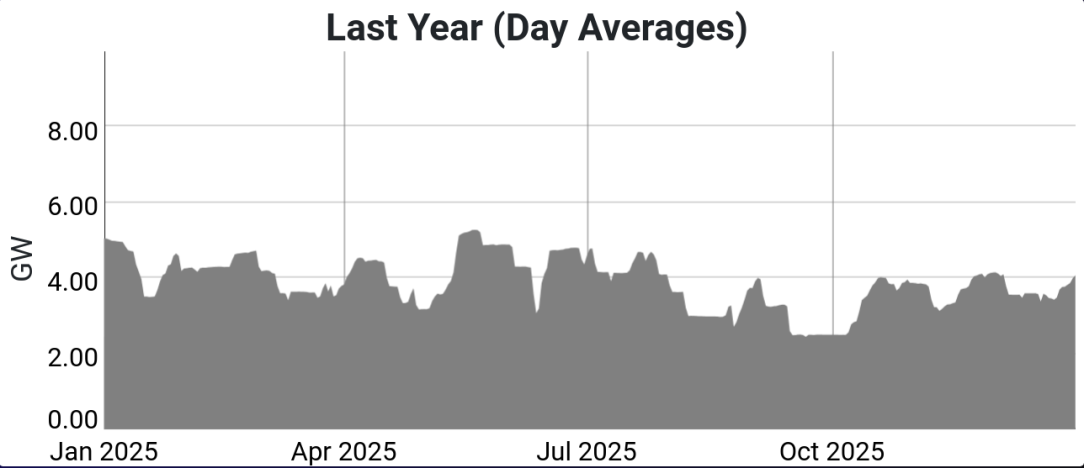
    "if all were operating" They weren't in 2022. Nuclear is not dependable and absolutely requires backup and peaking, at this stage it's hard to argue that it's anything other than fossil fuel through the front door.

    For Japan it's 2011 was when they last had all their reactors operating. Most of those plants could have been restarted, if they'd been the political will and they were up to code.

    image.png

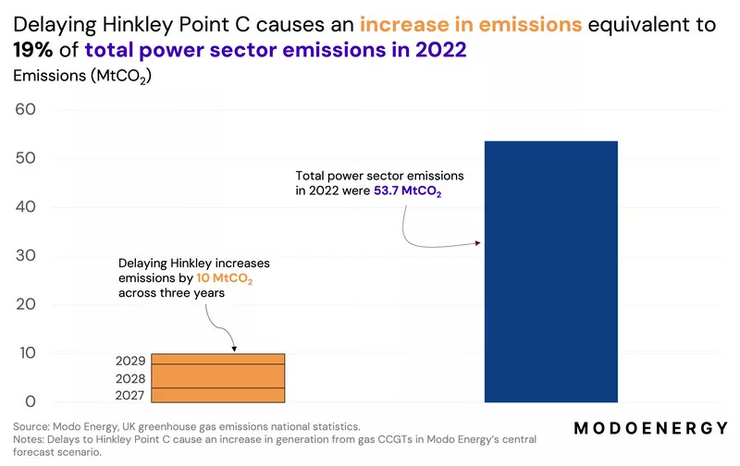
    This is the UK

    And to no one's surprise Hinkley-C has been delayed another year and will cost another £1.4bn

    image.png

    Because 60% of the missing power will have to be provided by gas, Hinkley-C being late is increasing the UK's emissions.


  • Registered Users, Registered Users 2 Posts: 16,594 ✭✭✭✭charlie14


    You keep looking in the mirror telling yourself that France, which generates 70% of its electricity from nuclear and who year-on-year are the largest net exporter of electricity in Europe because of renewables, and one day you might actually convince yourself it`s true.


  • Registered Users, Registered Users 2 Posts: 21,872 ✭✭✭✭cnocbui


    Have you ever considered not lying about nuclear? It is unquestionably the most reliable power source, by a wide margin. 96.4% capacity factor for the S Korean nuclear industry.

    https://www.energy.gov/ne/articles/nuclear-power-most-reliable-energy-source-and-its-not-even-close

    You love the 2022 nuclear maintainance crisis in France and portray it as a testament to unreliability, when it's the opposite. The reactors were all around 30+ years old, meaning they had been reliably producing electricity for 30 years, before needing some work.

    It's like you doing a song and dance claiming Hondas are very unreliable because mine failed an NCT and they wanted new front shocks fitted and I took it to a garage. Look how unreliable Hondas are you bleat, ignoring the fact it was the first time the car had been to a garage in 17 years!

    Renewables are utterly unreliable straight out of the box. Solar with it's risible 11% capcity factor and wind just 30%. You want utterly and atrociously unreliable, floating offshore wind is the undisputed champion. Off Scotland, one FOWF had all the turbines complete wrecks after just 10 years, with all the turbines having to be towed back to Norway for complete rebuilds. In the other Scotish FOWF, one of the small handful of turbines didn't last two years before needing to be towed to Antwerp for a complete rebuild. These FOWFs cost more than nuclear reactors even before the turbines failed, so goodness knows what they ended up costing.

    The problem here is that a large proportion of Ireland's OSW potential, like the west coast, is as extreme as where FOSW has been located, so it's going to be a bloodbath when that realisation sinks in and someone does hard maths on the costs when the were probably thinking UK OSW costs would translate. I suspect this is what happened with the one off Carna in Connemara which had the plug pulled with the developer losing their multimillion bond.

    French nuclear is the reliable backbone of almost the entire European grid, which is why Ireland wants the Celtic interconnector so bad. Typical Irish behaviour, let someone else do the hard stuff, like foreign militaries propping up Ireland's beloved neutrality and comfortable self delusion. Once it's running, Ireland will be paying through the nose and financing France's next reactor, and still won't have energy sovereignty.


  • Registered Users, Registered Users 2 Posts: 9,127 ✭✭✭Markcheese


    I haven't gone looking for sources , but i think by the late 80s frances new nuclear power stations had gotten ridiculously arduous and expensive to build - what was in essence the same design that they were knocking out in the late70s 80s , ( a modified Westinghouse design??)

    The newer epr (? ) , that the French worked on with siemens, was supposed to fix the increasing complexity and bespoke nature of their older plants, as well as being more efficient, flexible and safer , thats olkilouto in Finland, flamaville 3 ,and the 2 reactors in Hinckley

    So far not so great

    But theres 2 operational in france , quicker build , maybe on budget ..

    And edf are working on epr 2 -

    Slava ukraini 🇺🇦


  • Moderators, Recreation & Hobbies Moderators, Science, Health & Environment Moderators, Technology & Internet Moderators Posts: 98,124 Mod ✭✭✭✭Capt'n Midnight


    There's one EPR in France , one in Finland. There's also two in China (one was offline for a year) so they've had plenty of chances to get it right.

    And yes French nuclear reactors are incremental growth on the previous generation and yes they go back to Westinghouse so they shouldn't keep having these difficulties Every. Single. Time. This also means the 2022 corrosion debacle was a repeat of similar issues in the US.

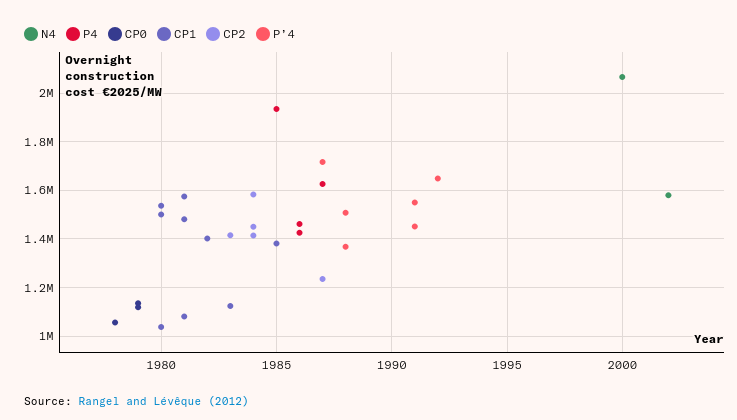
    image.png

    Cost increases per MW. The growth in size was supposed to yield economies of scale.

    Interesting that they didn't keep trying their own design once De Gaulle was gone.

    Any projected savings from EPR2 will be eaten up by cost increases and delays. There will be teething problems because computer simulations don't catch everything , like shoddy workmanship and poor maintenance and unpredictable stuff.


  • Advertisement
  • Moderators, Recreation & Hobbies Moderators, Science, Health & Environment Moderators, Technology & Internet Moderators Posts: 98,124 Mod ✭✭✭✭Capt'n Midnight


    Please, please stop repeating lies.

    Nuclear can look good if you pick one year in the middle of the ~18 month fuelling cycle, over longer periods the cracks show. It's like rating aircraft during cruise and ignoring the take off and landing.

    The actual figures for Korea over the last four years (from the International Atomic Energy Agency) were

    2022 81.7%

    2023 80.2%

    2024 79.6%

    2025 80.4%

    ie. FIVE times more lost capacity than your claim. And that's averaged over a year.

    And that doesn't include construction abandonments or delays or early retirements.

    https://pris.iaea.org/PRIS/WorldStatistics/ThreeYrsUnitCapabilityFactor.aspx

    If half of all Peugeots failed the NCT in one year I wouldn't recommend you buy one.

    If all Mazda's failed ten years in a row and only a small fraction of them passed after 15 years, again I would not recommend.

    If they stopped making Chryslers nearly 50 years ago I would not recommend you buy a new one from a different company with the same name. (it would be like buying an overpriced BMW on the reputation of Rolls Royce)

    If Hyundai had a scandal where they were caught cheating on the NCT I would not recommend you buy one.

    If Lada or BYD made it clear that they might stop selling spares on a the drop of a hat then again I would not recommend you buy.

    And that covers most of the worlds reactors. With nuclear the more you dig the worse it gets.

    Yes the Canadians have good technology, however it would take too long to arrive to make a difference so it's not even worth reading the brochure.


Advertisement
Advertisement