Advertisement
Help Keep Boards Alive. Support us by going ad free today. See here: https://subscriptions.boards.ie/.
https://www.boards.ie/group/1878-subscribers-forum

Private Group for paid up members of Boards.ie. Join the club.
Hi all, please see this major site announcement: https://www.boards.ie/discussion/2058427594/boards-ie-2026

Nuclear - future for Ireland?

1828385878899

Comments

  • Moderators, Recreation & Hobbies Moderators, Science, Health & Environment Moderators, Technology & Internet Moderators Posts: 98,163 Mod ✭✭✭✭Capt'n Midnight


    What role does nuclear have with the problems of transport and heating ? IMHO it's a solution looking for a problem that won't be there by the time it takes to arrive.

    Yes until 2050 we can burn a decreasing amount of fossil fuel. That's a long time in renewable tech and prices. eg: Any energy to fuel would mean oodles of storage for our existing thermal plant.

    As for any gas ? The 2030 target for biogmethane is 5.7TWh which could produce 2-3 TWh of electricity. Total metered electricity here last year was 31.9TWh so it's about a month's worth of storage. And much of that will come from farm waste so it's not going to break the bank.

    Nuclear is not a zero-carbon alternative.

    Even if you look at the minimum direct inputs for steel and concrete you will still generate more carbon emissions from a nuclear plant than it could save compared to going keeping rolling out renewables during 17+ years it would take to go from tender to commercial operation. It's worse than that because the mining and separation of isotopes are a larger source of emissions.

    And it's all front loaded because about 70% of the carbon emissions are during construction and initial fuelling.


  • Registered Users, Registered Users 2, Paid Member Posts: 3,300 ✭✭✭KrisW1001


    It allows burning of gas, just not fossil gas. Zero CO2 generation does not mean "no thermal generation".

    Domestically-sourced biomass and biomethane are net zero co2 and dispatchable. The title slide you posted mentions hydrogen, which can be created from surplus variable energy then burnt/oxidised when needed to produce electricity.

    The other part of the solution is interconnectors to send surplus Irish wind to the continent, and take back surplus French wind (or sometimes nuclear) when we're short.

    "Nobody's done this before" is the stupidest reason to not do something. In the absence of right-sized nuclear technology or local hydro resources, this is our best option for energy security. Other countries aren't doing this because their circumstances are not ours. The alternative is to be beholden to gas markets, and that really is no future to wish on the country.

    If we could buy a few 400 MW nuclear reactors of the shelf and have them up and running in five years, then we could consider nuclear too, but currently for nuclear the only option is 10+ years for a single 1400 MW reactor, which is too big a single point of failure in a grid of less than 10 GW.


  • Moderators, Computer Games Moderators, Recreation & Hobbies Moderators Posts: 11,315 Mod ✭✭✭✭CatInABox


    Yeah, I'd agree that the 100% renewable is a bit unrealistic, and I fully expect that to change. I'd also argue that 100% nuclear isn't going to happen in any state, not even France, so using a measure like LFSCOE-90 is far more likely.

    My question then would be: If a nation with Irelands power mix was just starting out on the path to reduce emission, and chose to use LFSCOE-90, which showed that renewables where cheaper than nuclear, which path would you recommend that they choose?

    The paper also makes assumptions that are proving to be wrong in reality. He cites a paper that says a reduction in storage costs of 75% isn't likely to happen anytime soon, but since 2019, when that paper was written, costs have already fallen 50%. In China, it's fallen even more, with a 30% drop since last year. Not finding fault with his premise, as I think it's a good paper with an interesting idea, but just highlighting that the costs associated with renewables have always been overestimated.


  • Registered Users, Registered Users 2 Posts: 1,599 ✭✭✭gjim


    I've gone through that paper, and it's interesting.

    I tried. After a page or two, I started wondering why it was so lacking in references, especially with regard to claims that I know are false (that major investment in coal generation is still a thing).

    It could due to the age of the paper age as you point out. Or it could be due to the fact that it was written by a student in a Houston Texas think-tank largely run by ex-fossil fuel executives which relies on the same industry for much of its funding. Nor has the paper been published or peer-reviewed.

    Not all “papers” are created equal. But in the modern age of google, you can find “papers” to support any sort of position you want.


  • Registered Users, Registered Users 2 Posts: 1,599 ✭✭✭gjim


    But that is exactly the situation Ireland is aiming for - all energy, including transport and heating, is supposed to be coming from zero CO2 sources by 2050.

    Nope. The aim is NET ZERO - not to eliminate all fossil fuels. You understand the difference? Because it's a pretty fundamental one.

    Most plans include a role for fossil fuels in a net zero situation, but it will be niche/contingency instead of doing the heavy lifting in terms of primary energy.

    It's never clear with your arguments whether they are founded on ignorance of the fundamentals or are disingenuous straw-man set-ups.


  • Advertisement
  • Moderators, Computer Games Moderators, Recreation & Hobbies Moderators Posts: 11,315 Mod ✭✭✭✭CatInABox


    I didn't really want to go into it, and just take it at face value, but yes, there's definitely more than a whiff of "Why doesn't Scarlett Johansson want to marry me, oh, it's because she's not using the metrics that I came up with which shows I'm the perfect choice for her….."


  • Moderators, Recreation & Hobbies Moderators, Science, Health & Environment Moderators, Technology & Internet Moderators Posts: 98,163 Mod ✭✭✭✭Capt'n Midnight


    Out of 10 generating units in the UK today https://web.archive.org/web/20250928213758/https%3A//www.edfenergy.com/energy/power-station/daily-statuses

    4 are online.

    2 are on statutory outage

    1 is refuelling

    2 outages extended due to boiler feed pump failure and turbine rotor work

    1 Automatically tripped following interruption of electrical supplies. BUT expected return date is Oct 14th (!) because you can't stop / start nuclear.


  • Registered Users, Registered Users 2 Posts: 69 ✭✭burgerKev


    p3l1n6w.jpeg

    Nu-Cu-Lar, it's pronounced Nu-Cu-Lar


  • Registered Users, Registered Users 2 Posts: 1,674 ✭✭✭Busman Paddy Lasty


    Is the poop deck really what I think it is?


  • Registered Users, Registered Users 2 Posts: 9,127 ✭✭✭Markcheese


    A short on SMR types and their makers ..

    https://youtube.com/shorts/D8YdpThQAeE?si=sTsA_uaNbjytDqgw

    Slava ukraini 🇺🇦


  • Advertisement
  • Registered Users, Registered Users 2 Posts: 9,127 ✭✭✭Markcheese


    It looks like SMRs are starting to gain traction , a lot yet to be seen ,

    But to be produced at scale ,they're still decades away ..

    Slava ukraini 🇺🇦


  • Moderators, Recreation & Hobbies Moderators, Science, Health & Environment Moderators, Technology & Internet Moderators Posts: 98,163 Mod ✭✭✭✭Capt'n Midnight


    Trench 94 is full of the things https://usstunny.com/chop/

    Newer picture https://virtualglobetrotting.com/map/disposal-site-for-nuclear-submarine-reactors/view/google/

    Production of safe, reliable rectors isn't the issue.

    The trick is to make them economic in a world where Solar has seen prices fall a staggering 99.9% since 1975 and prices are still falling.

    Nuclear power has to be less than half the cost of overnight storage. Otherwise there's no need for it half the year which effectively doubles it's cost.

    image.png

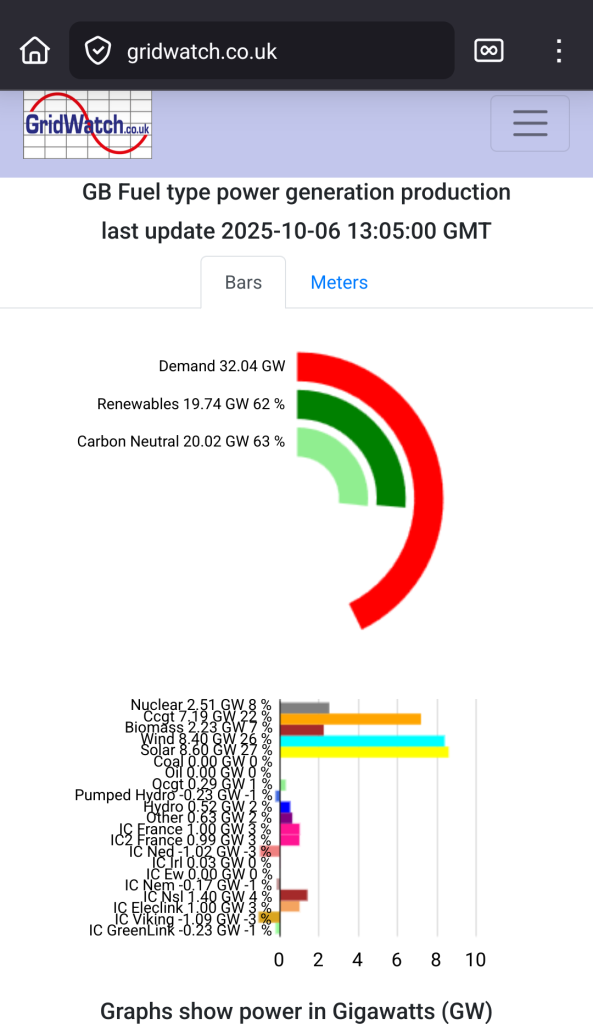
    On Monday at lunch time Solar was the biggest generator on the UK grid. (35% from Synchronous hydro/nuke/gas/other)

    From https://gridwatch.co.uk/

    https://www.msn.com/en-us/money/companies/rolls-royce-losses-widen-at-ftse-100-giant-s-smr-division/ar-AA1NWk8f the good news for Rolls Royce is that co-investor CEZ plans to build the first small modular reactor at the existing Temelin nuclear plant in the first half of the 2030s. So that's 10 more years, downhill, with the wind behind you. And then they've to debug it.

    The not so good news is that they are loosing about a hundred million a year and will continue to do so for the rest of the decade, even with government grants of over a hundred and fifty million over the last two years.


  • Registered Users, Registered Users 2 Posts: 16,603 ✭✭✭✭charlie14


    We are not going to achieve net zero by 2050, or anytime else, by burning non-renewable fossil fuels. The 2030 target was a reduction of greenhouse gases by 51%. The EPA in May this year have us achieving less than half that figure, 23%, by 2030. Net zero by 2050 under our current plan is pie in the sky.

    The question here has always been how are we going to achieve it in a country when, for solar our peak demand is at a time in Winter when our capital city averages 17.5 hours of darkness, or when wind generation drops off the scale for long extended periods, at a cost that will not bankrupt the state economy.

    Other than hopium and vague predictions of costs falling for alternative sources and storage - predictions we had previously for wind generation priced falling that proved very much wide of the mark - I have yet to see actual figures for.

    What we presently have is a 37GW offshore wind energy/hydrogen production plan that will not alone generate our projected demand for 2050, but with the 50/50 split in generation and production will double the strike price for for the consumer even before all the other add-ons of hydrogen production are taken into consideration. A strike price that would be over 50% more expensive than Hinkley Point that some here were once holding up as an example of why we should not even consider nuclear.

    Presently nuclear is very much on par with the cost of wind generation. Especially when you consider the capital costs involved for both and their capacity factors. We are also very much into all the eggs in a wind basket that is not going to give us the capacity factor from Atlantic offshore that was heralded up until quite recently anytime soon, if ever.

    I have no problem with a non-nuclear solution that will see us achieving net zero using nothing but renewable sources that will provide the generation as and when we need it. But that does not include Drax like generation or importing nuclear when the wind goes to sleep for a number of reasons. What I have a problem with is vague hopiums and uncosted proposals that if implemented would leave us with the most expensive electricity on the planet and a resulting economy in ruins.


  • Moderators, Recreation & Hobbies Moderators, Science, Health & Environment Moderators, Technology & Internet Moderators Posts: 98,163 Mod ✭✭✭✭Capt'n Midnight


    Quick question. If a nuclear plant has a transformer outage how do you replace 75% of it's output within 5 seconds without using open cycle gas turbines that are already running at reduced output so they can be ramped up ?

    Nuclear prices are based on running continuously. We are already getting 40% of our electricity from renewables mostly wind, so we've already more than half of the 75% constraint on non-synch generation. That effectively halves the times there's demand for thermal generators.

    And that 75% will increase to 95% and solar will dominate in daylight hours so in 17 years time there won't be much demand for an inflexible generator that needs 75% of it's output to be backed up by spinning reserve 24/7/365.

    It doesn't have to be actually spinning as long as it can make up the ~1 GW difference in 5 seconds or less. Using 1-2% of the rated output of pumped storage to spin those turbines in air doesn't apply as it still takes about twice that time for the water to get there and besides that it's one of the places the remaining 25% of the output restoration will come from seconds later.

    Nuclear has no role in peaking or backup. It's never going to be near a city so might not play a role in providing local stability or voltage control either.


  • Registered Users, Registered Users 2 Posts: 9,127 ✭✭✭Markcheese


    When you say never going to be near a city how far from a city could a nuclear power station be - in an Irish context - we're not that big an island , and in grid terms there's a finite number of locations it could go ,

    Geographically near Athlone area would be logical , with the Shannon for cooling , but closer to Dublin from a power usage perspective ,

    I presume the same batteries and fly wheels that would be needed for wind and solar for the next 20 to 30 years while waiting for nuclear would provide the spinning reserve,

    Slava ukraini 🇺🇦


  • Registered Users, Registered Users 2 Posts: 16,603 ✭✭✭✭charlie14


    Quick answer.

    Why in heaven`s name do you believe I should humour your efforts to distract from you continually refusing to give costings for whatever it is you are proposing to see us achieve net zero by 2050 ?

    The price consumers pay for nuclear is not based on running continuously. It is based on the same as renewables, the strike price. It`s actually more the case consumers paying for wind running continuously as they would be paying for all that it generates whether we wanted it or needed it.

    There is no plan for solar for 2050. There is only a 8GW plan until 2030. With our peak demand being during Winter and with a solar capacity factor of ~5% for that period it would generate 400MW, 6.64% of our current peak demand. If we had that 8GW of solar installed in the morning it would not cover even half of the 14% we imported last year.

    There is a present proposed plan here for 2050 though that is 37GW of wind/hydrogen that you keep refusing to give costings for that will not even meet our projected 2050 demand and will, even if all present proposals are operational by 2030 see just a 23% reduction in emissions compared to the 51% required. Even lower than 23% when you factor in the 14% of our electricity we imported last year. Something that is not going to continue indefinitely being as it is imported from the U.K. who themselves are net importers. Meanwhile we have the third highest electricity charges in the E.U. That the two countries that are more expensive are Germany and Denmark, two countries that are big into the wind basket as well should tell anybody that cares to look just what wind energy has achieved. Or rather not achieved for us on reducing emissions or electricity charges. But at least Denmark realised that the handy dig-out from Norway was no longer an option and lifted their moratorium on nuclear by a large majority parliamentary vote as has Belgium this year also.

    So, yet again, how do you propose and at what cost we get to 2050 using just renewables to achieve net zero. Or even to 2030 without having to pay massive fines every year from 2030 on-wards by throwing good money after bad on an annual basis ?


  • Moderators, Recreation & Hobbies Moderators, Science, Health & Environment Moderators, Technology & Internet Moderators Posts: 98,163 Mod ✭✭✭✭Capt'n Midnight


    In general I'd argue that if you can provide zero carbon backup for nuclear then you didn't need nuclear (cf biomethane). And if your backup isn't zero carbon then nuclear isn't either.

    Flywheels don't provide backup. Currently there must be a minimum of 23,000MWs of inertia on the island. That's only 6.2MWh , but it's practically instant response.

    The 75% limit on non-synch could mean that you'd need 400MW of actual spinning reserve to support 1.2GW of batteries and together they could replace a 1.6GW reactor. Burning 400MW of gas 24/7 would represent something of the order of 10% of our emissions. So even if reserved all of our emission allowances for nuclear we could only use nuclear until 2040. ( You can adjust for 80% SNSP , but the gas is open cycle so worse emissions , and you'd still need dispatchable peaking plant )

    If you were using nuclear as the provider of the 25% of synch generation then you can't replace that with batteries. It's crazy to think that if you had a grid with 1.6GW nuclear and 4.8GW of wind that you'd need 1.6GW of synchronous backup.

    On the other hand if the grid can handle 95% renewables then the remaining 5% would be covered by hydro , waste , CHP , biomethane and biomass leaving no demand for nuclear for extended periods which is something nuclear doesn't handle well.

    Batteries only last 2-3 hours , and that's only if they are fully charged. So you'd have to have several GWh of battery storage in reserve at all times and only for nuclear because 400W would well cover the loss of any other generators on the grid. And there's no guarantee that nuclear could be restored in a few hours so you'd still need 1.6GW of dispatchable generators for the duration.

    https://www.sem-o.com/publications/general-publications on the Single Energy Market lists the grid constraints, for week 42 they include local constraints for Voltage Control and Flow Control in Dublin Area.


  • Registered Users, Registered Users 2 Posts: 16,603 ✭✭✭✭charlie14


    A grid with 95% renewables with the remaining 5% covered by hydro, waste, CHP. Are you nuts?

    By renewables I presume that 95% is from wind and solar. From your promoting solar again presuming you see it playing a major part of that 95%. Did you miss what happened in Spain recently when their grid collapsed. Not only are wind and solar intermittent, solar is AC electricity which requires inverters to convert it to DC. Something that is now looking highly likely for the Spain grid collapse.

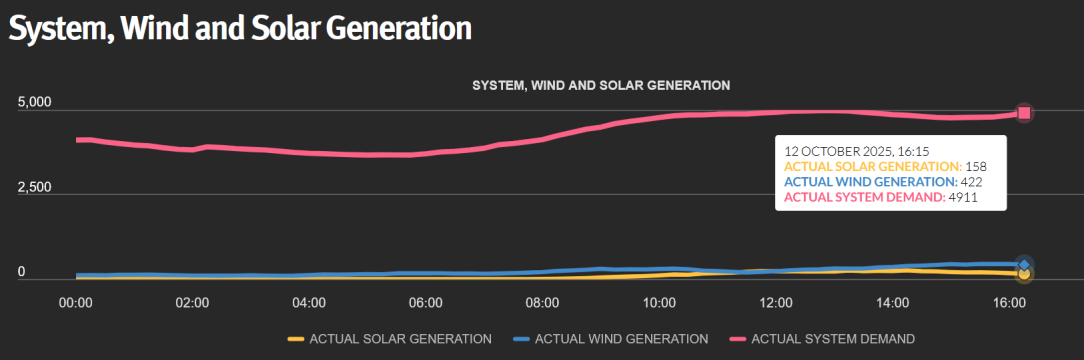
    Not that we would have to worry much about that on days like today.

    Today`s grid Demand, plus Wind and Solar Generation

    image.png

    How much solar and wind capacity would be needed to get your 95% of demand for today never mind on a dark Winters day when our demand will be over 14GW, and at what cost ?

    Post edited by charlie14 on


  • Moderators, Recreation & Hobbies Moderators, Science, Health & Environment Moderators, Technology & Internet Moderators Posts: 98,163 Mod ✭✭✭✭Capt'n Midnight


    The minimum cost of nuclear , is the cost of providing low carbon power for a minimum of 17 years plus the doubling of the costs of Generation III Plants every decade.

    The cost of renewables is the same. Except you don't have to pay for nuclear too.

    Or the huge level of spinning reserve which I'll remind you would require something like our entire emissions budget for 2040 and beyond.


  • Registered Users, Registered Users 2 Posts: 16,603 ✭✭✭✭charlie14


    Any chance you will one of these days actually address the points made rather posting unrelated un-costed ramblings ?


  • Advertisement
  • Moderators, Recreation & Hobbies Moderators, Science, Health & Environment Moderators, Technology & Internet Moderators Posts: 98,163 Mod ✭✭✭✭Capt'n Midnight


    A grid that can handle 95% renewables has no need of a fixed output power source that requires constant spinning reserve.

    In addition to the sources mentioned by 2030 we should have enough biomethane to produce 3TWh of electricity and we'll still be able to use 20% of emissions and there's the interconnectors and storage. And by then we will also have more renewables on line and less curtailment.

    The cost is moot because we'd have to keep rolling out renewables until nuclear is up and running. And sort out the spinning reserve problem.


  • Moderators, Recreation & Hobbies Moderators, Science, Health & Environment Moderators, Technology & Internet Moderators Posts: 98,163 Mod ✭✭✭✭Capt'n Midnight


    The point is that nuclear missed the boat.

    It's no longer technically possible to put a nuclear plant on the Irish grid without increasing both emissions and costs.

    In Europe and the US Generation III costs have doubled ever decade.

    So until you increase your nuclear costs by a factor of 3.25 to represent 17 years you are ignoring the last 40 years of real world nuclear power costs. You are also ignoring the high abandonment rate of nuclear plants after construction starts. Unless and until you factor those in you aren't comparing like with like.


  • Registered Users, Registered Users 2 Posts: 16,603 ✭✭✭✭charlie14


    Ah ffs, where are you going to get 95% renewables to fulfill the estimated 14GW demand for 2050 when wind and solar like today were supplying less than 12% combined for a demand of 4.9GW that would not turns us into a third world economy ?

    You have at least given up on the insanity of battery storage and pumped storage. So that leaves the current hydrogen plan, which even before all the add-on costs, would leave us with a strike price 50% more than that of Hinkley, the most expensive nuclear you could find which was your bogeyman as to why nuclear generated electricity was financially unviable.

    The only thing coming through those inter connectors when wind and solar are doing nothing is not going to be renewables. It`s going to be nuclear.


  • Registered Users, Registered Users 2 Posts: 16,603 ✭✭✭✭charlie14


    The cost of wind generation has gone up by 60% - 70% in less than 2 years and when contracts were increased to compensate, companies still pulled out of contracts because they were financially unviable. Denmark could not get even a single bid for their largest ever offshore offering.

    Recently built nuclear plants and recent contracts for new builds make a bit of a farce for your top of your head nuclear costs. More-so when you can not even give as much as a single figure for any of what you propose.

    Pouring more money into renewables is now on a par with Hemingway`s The Sun Also Rises where one character asked "How did you go bankrupt?" to which the answer was "Two ways. Gradually, then suddenly"


  • Moderators, Recreation & Hobbies Moderators, Science, Health & Environment Moderators, Technology & Internet Moderators Posts: 98,163 Mod ✭✭✭✭Capt'n Midnight


    Hinkley stands out, but not by much. Hinkley-C is eye-wateringly expensive. But so was Flamanville and Olkiluoto 3, as are the costings and timings for European new plants too. Costs in the US when you include the failed ones are in the same ballpark.

    The real costs are the financing and repayments. Trump is causing economic chaos. Who knows what interest rates will be like ?

    There's 7GW connected to the grid right now and almost all of that was connected or refurbished in the last 25 years.

    Again a reminder that France exports a lot less power than is produced by renewables. And for the foreseeable future will be disconnecting more nuclear plants from the grid than they will be connecting.

    Since your fixated by the battery strawman , let me remind you that we could easily store months to years worth of energy to gas in disused gas fields using off the shelf technology.

    Or piggy back off the steel industry who will develop the technology to produce green iron, then you can use powdered iron as a way of storing hydrogen, technically it's less risky than SMR's.

    Nuclear doesn't provide any solutions.


  • Registered Users, Registered Users 2 Posts: 9,127 ✭✭✭Markcheese


    Commercial SMR s are still pie in the sky - as is a realistic large scale hydrogen storage storage system -

    There's tech coming that might .. might … might

    What we've got at the moment is onshore wind solar and natural Gas , and what we've got for the foreseeable is onshore wind ,solar and natural gas .

    We seem to be moving to open cycle gas ,it seems cheaper+quicker to build,but less efficient, as well as quicker to spool up , batteries seem great for peaking and grid stabilization , so probably more on the way ..

    Anything new tech is likely 10 years plus off commercial development , and then it's likely 5 to 10 more years for planning and approval..

    And we're already short on electricity .. solar is wonderful except in winter - so it depends on the current system to back it up , wind is amazing when the wind blows - but when it doesn't you're relying on the same thermal ,

    Gas is flexible and relatively clean, but not that cheap if you need it for base load ..

    It's gonna be a mix

    Slava ukraini 🇺🇦


  • Registered Users, Registered Users 2 Posts: 16,603 ✭✭✭✭charlie14


    The eye-watering stand out from Hinkley C - the most expensive electricity you could find - is that under the proposed offshore 37GW wind/hydrogen plan we would have a strike price of double that of Hinkley C for a system that would have less than half the capacity factor and would require 3 further stages of capital investment during the lifespan of Hinkley C.

    Trump may cause chaos and an increase in interest rates, but interest rates are not what caused the 60% - 70% increase in costs for offshore wind. Not that there is anything I agree with Trump on, but when you see current offshore with a lifespan of 25 years costing €15 Bn. to deliver I GW ……

    That 7 GW we have connected to the grid is currently supplying less than 0.6 GW. I would do the mathematics for you on what the installed capacity required to get your 95% of demand from wind and solar would be if it wasn`t so obvious just how ridiculous your 95% idea is.

    Stop worrying yourself over French nuclear. They are doing just fine exporting nuclear power to all those countries that have much greater installed renewables than France when wind and solar go for those prolonged little naps. Over €22 Bn profit from the last two years and most likely the same level of profit for this year. Especially now that they do not have to subsidise French renewable providers with up to 30% of their nuclear generation at €42 per MWh with the price now being €70 per MWh.

    It doesn`t matter where you store gas. Storing it in disused gas fields is not going to get you less emissions when you burn it. As we are missing that 2030 target is going to cost ~€28 Bn in fines and a further ~€8 Bn a year ever year after 2030 well beyond 2050 following the current path we are on.

    Seriously, your proposals for producing hydrogen for storage are so financially crazy there is no need to add to that by throwing in green iron production to store it.


  • Moderators, Recreation & Hobbies Moderators, Science, Health & Environment Moderators, Technology & Internet Moderators Posts: 98,163 Mod ✭✭✭✭Capt'n Midnight


    How do you provide low carbon power without renewables for the next twenty years while waiting for nuclear ?

    With renewables even if you could solve the legal and PR issues in the next three years and then issue a tender for a nuclear plant then your figures show fines of €28Bn in 2030 and then another €120Bn while waiting for the quickest possible build in Western Europe in the last 40 years. And unless you solve spinning reserve those fines will continue.

    And what is your Plan-B if there are hiccups like delays or massive cost increases ? What if it gets cancelled , like half the nuclear constructions in the USA over most of the last 40 years ? Where do you get the zero carbon power then ?

    Why do you keep misunderstanding that while we can use diminishing amounts of natural gas until 2050 it will essentially be replaced by zero carbon things like biomethane and other types of Energy to Fuel over that time. The efficiency is rubbish but the capital costs are tiny and the storage capacities ginormous.

    Technically if you had nuclear reactors on the grid then in periods of negative pricing due to oversupply they would be glad of fuel to energy systems that didn't charge them too much.


  • Registered Users, Registered Users 2 Posts: 16,603 ✭✭✭✭charlie14


    "Zero carbon things" is not an energy plan. More a sequel to the Netflix series "Stranger Things" That you are now hitching up to the bio-methane wagon is an exercise in desperation rather than reality.

    We currently produce 0.001% of our gas needs from bio-methane. The plan for 2030 is raising that to 0.075%. Hamsters on running wheels level of generation. If you know anything about farming then you know that even reaching that 0.075% is highly unlikely. Reps visiting farmers when farmers see how some have been stung by willow planting and cutting cattle numbers as the great green hopes are being ran out of farmyards faster than they entered on price offered for grass that do not come close to what they can sell hay or silage for with contracts to be signed before the growing season starts guartanteeing the volume they would supply and the quality of the grass with penalties being applied.

    If you somehow believe that farmers are going to sign up to providing grass for electricity generation then you really need to have a re-think because it is just more green pie in the sky thinking. It would require 250,000 acres of grassland to generate 1GW of electricity.

    Nuclear is not the reason we will be paying €28 Bn. in fines in 2030 and at least €8 Bn a year for every year after that until the end of time. The reason is the lack of nuclear and a failed generation policy on renewables that has not only left us with being along with Germany and Denmark - two others in the wind basketcase - having the most expensive electricity in Europe, but also the reason we are facing those fines.

    Throwing more good money after bad at an astronomical level on renewables, you will not even give a figure for, is not going to change that. All it will do is bankrupt the state and turn our economy into that of a third world.


  • Advertisement
  • Registered Users, Registered Users 2, Paid Member Posts: 1,513 ✭✭✭riddlinrussell


    @charlie14 as always, I just want to know how we avoid the fines while we wait for the reactor to be approved an built. I assume both of those things will, in fact, take until beyond 2030 at this stage?

    Boards is in danger of closing very soon, if it's yer thing, go here (use your boards.ie email!)

    👇️ 👇️


Advertisement
Advertisement