Advertisement
Help Keep Boards Alive. Support us by going ad free today. See here: https://subscriptions.boards.ie/.
https://www.boards.ie/group/1878-subscribers-forum

Private Group for paid up members of Boards.ie. Join the club.
Hi all, please see this major site announcement: https://www.boards.ie/discussion/2058427594/boards-ie-2026

Northern Ireland 2125?

Options
17677798182188

Comments

  • Registered Users, Registered Users 2 Posts: 81,350 ✭✭✭✭FrancieBrady


    The speakers of a dialect died out the ‘language’ did not.

    Dialects of the English language died out including some here in Ireland but nobody would be stupid enough or desperate enough to claim the English language was dead.

    As someone said ‘grow a pair blanch, you are simply wrong’.


  • Registered Users, Registered Users 2 Posts: 1,996 ✭✭✭csirl


    I honestly dont think the Irish language or street signs in Belfast will be a big factor in a unification vote. People will decide based on more important topics.


  • Registered Users, Registered Users 2 Posts: 4,223 ✭✭✭Fionn1952


    Are you trying to argue that there was a period of time when nobody in NI spoke any Irish at all, Blanch? I'd love the link to that.

    That a specific dialect died out isn't even remotely close to the language being dead.

    Do you reckon English is a dead language based on reading Chaucer or Shakespeare? It's a ridiculous statement.


  • Registered Users, Registered Users 2 Posts: 6,839 ✭✭✭Francis McM


    This thread is about N. Ireland. The language died there. As someone else said,

    "Nobody has contradicted the fact that the last native speaker died out in the 1980s. Now, there has been a great job at revival done, much better than Ulster Scots, but they were both dead languages up there."

    The vast majority of people in Ireland do not speak it either. There is little or no demand for an Irish language version of boards.ie for example. That despite the fact it is drummed in to us at school and the government spends hundreds of millions on it.


  • Registered Users, Registered Users 2 Posts: 81,350 ✭✭✭✭FrancieBrady


    The 'language is dead' is a taunt.Nothing more.

    And it's a poor one at that, reeking of a self loathing that is in many ways sad.


  • Advertisement
  • Registered Users, Registered Users 2 Posts: 6,839 ✭✭✭Francis McM


    No, putting up signs giving equal prominence to Irish, while at the same time bragging that every word of Irish is a bullet for Irish freedom, is taunting. Especially when the community the taunt is directed at suffered probably more than its fair share of bullets, given Republicans killed 60% of people killed during the troubles.

    In linguistics, a dead language is (usually) defined as a language that some people still use, even if there are no native speakers left. . Latin is probably the most widely known dead language. No one speaks it as their everyday language anymore.

    If it is true that the last native speaker died out in N.I. the 1980s, then the language in N.I. was dead then , or as good as.


  • Registered Users, Registered Users 2 Posts: 33,195 ✭✭✭✭blanch152


    The language was dead in Northern Ireland, that is a FACT, one I have referenced with external links.

    You don't like that FACT because it stops the taunts at Ulster Scots, another revived language, though less successfully.


  • Registered Users, Registered Users 2 Posts: 81,350 ✭✭✭✭FrancieBrady


    The language was dead in Northern Ireland, that is a FACT, 

    It was not. A dialect died out.


  • Registered Users, Registered Users 2 Posts: 33,195 ✭✭✭✭blanch152


    Even if what you say is true, that means at best that Irish is a language imported into Northern Ireland.


  • Registered Users, Registered Users 2 Posts: 81,350 ✭✭✭✭FrancieBrady


    No, it wasn't.

    Irish dialects have always intermixed and been used all over the island.


  • Advertisement
  • Registered Users, Registered Users 2 Posts: 81,350 ✭✭✭✭FrancieBrady


    Some advice as you seem to want to keep digging on 'the language was dead' to underscore belligerent Unionism yet again.

    If you think the language 'died out' with a woman in 1980, research what Conradh na Galeilge and gaelgeoir's in Belfast and Derry and across the north were doing in the 70's and through the 80's.

    You are either under researched or under a spell of misinformation and downright bigotry.


  • Registered Users, Registered Users 2 Posts: 6,839 ✭✭✭Francis McM


    A handful of people possibly doing it as a hobby in the 70s or 80s does not mean the language was in good health in the 70s or 80s. It was never illegial to speak a cupla focail. 99.9% of people though could'nt be bothered in everyday conversation. Even here in the Republic in 2025 it is extremely rare to hear anyone speaking in Irish in the streets, shops, businesses.


  • Registered Users, Registered Users 2 Posts: 81,350 ✭✭✭✭FrancieBrady


    does not mean the language was in good health

    We are getting somewhere…no longer 'dead'.

    That Irish needed promotion and help is a given. This we know and this is why it required measures such as Official status.


  • Registered Users, Registered Users 2 Posts: 33,195 ✭✭✭✭blanch152


    The Irish spoken in Northern Ireland is not native to Northern Ireland, it has been imported and revived. The Irish language, native to Northern Ireland, is dead.

    The language is in the same situation as Ulster Scots (albeit more successfully revived), which is what is causing you a problem as it prevents derogatory comments about Ulster Scots.


  • Registered Users, Registered Users 2 Posts: 81,350 ✭✭✭✭FrancieBrady


    The 'language' has dialects, one of those died out and the language remained.

    I use Ulster-Scots all the time as a part of the English language spoken here in Ulster.
    No issue seeing it preserved and encouraged.


  • Registered Users, Registered Users 2 Posts: 6,839 ✭✭✭Francis McM


    Why not have a third line of signage on the train station in Ulster Scots so? Why discriminate in favour of the Irish language if you want a second line added?

    If you go to Sydney airport, should there not be aboriginee on it too in equal size letters? And native American in equal size letters beside the sign for John F. Kennedy International airport?


  • Registered Users, Registered Users 2 Posts: 81,350 ✭✭✭✭FrancieBrady


    You'll have to ask the Ulster-Scots lobby.
    They all met and discussed this with Translink.
    Ulster-Scots does not have the same status as Irish in NI law BTW


  • Registered Users, Registered Users 2 Posts: 33,195 ✭✭✭✭blanch152


    It wasn't just one dialect that died out, all of the dialects native to Northern Ireland died out, Irish as a native language died up there, that is a FACT. The Irish spoken there is imported, that is also true.

    To be clear, I am not disrespecting any speaker of Irish up there, not at all.

    However, once again, you denigrate Ulster-Scots, it is not a "part of the English language", it is a dialect of Scots, the Northern Ireland Department of Culture, Arts and Leisure considers Ulster Scots to be "the local variety of the Scots language."

    What is up for debate is whether like Irish, the dialects of Scots native to Northern Ireland ever died out. I believe they did, but have not, unlike Irish, been able to find conclusive evidence that is so.


  • Registered Users, Registered Users 2 Posts: 81,350 ✭✭✭✭FrancieBrady


    Do you withdraw the claim that 'the language was dead' or not? Because it wasn't no matter how much you spin.


    And I didn't say it was 'a part of the English language'.

    I said:

    I use Ulster-Scots all the time as a part of the English language spoken here in Ulster.

    If you knew what you were talking about you would know it is interchangable with Scots Gaelic, Irish and English.


  • Registered Users, Registered Users 2 Posts: 33,195 ✭✭✭✭blanch152


    The Irish language, as spoken natively in Northern Ireland, is dead. There are no two ways about that. The Irish spoken in Northern Ireland is imported dialects from elsewhere on the island. Happy to clarify it in that detail for you. The black and white world allows for gotchas and withdrawals, the real world of nuance allows for clarification.

    As for Ulster Scots, please tell the Department of Culture that it is part of English rather than "the local variety of the Scots language". Otherwise, go tell the Scots that they really speak English.


  • Advertisement
  • Registered Users, Registered Users 2 Posts: 81,350 ✭✭✭✭FrancieBrady


    The Irish language, as spoken natively in Northern Ireland, is dead.

    Nuance insists that is clarified, Ulster Irish otherwise known as Donegal Irish was spoken and never died out in the couties of west Ulster. Eastern Ulster Irish that was spoken as far down as Meath died out.

    Ulster-Scots is a part of my English vocabulary as are words from the Irish language.


  • Registered Users, Registered Users 2 Posts: 33,195 ✭✭✭✭blanch152


    That doesn't contradict a single part of my post. Take your argument up with the relevant sources for this Wikipedia article.

    https://en.wikipedia.org/wiki/Irish_language_in_Northern_Ireland

    "The last speakers of varieties of Irish native to what is now Northern Ireland died in the 20th century. Irish as spoken in Counties Down[16]  and Fermanagh were the first to die out, but native speakers of varieties spoken in the Glens of Antrim [17]  and the Sperrin Mountains of County Tyrone [18]  and County Londonderry survived into the 1950s and 1970s respectively, whilst the Armagh dialect survived until the 1930s or '40s.[19] Varieties of Irish indigenous to the territory of Northern Ireland finally became extinct when the last native speaker of Rathlin Irish died in 1985. [20] Séamus Bhriain Mac Amhlaigh, who died in 1983, was reportedly the last native-speaker of Antrim Irish.[21]"

    After that, take your argument that Ulster Scots is really English to the Northern Ireland Department of Culture.


  • Registered Users, Registered Users 2 Posts: 81,350 ✭✭✭✭FrancieBrady


    I don't have an argument with anyone but yourself.

    Again:

    I use Ulster-Scots all the time as a part of the English language spoken here in Ulster.

    doesn't contradict or argue with the Northern Ireland Department of Culture one bit. I'll rewrite it to show how much your comprehension skills are lacking.

    I use Ulster-Scots, which is the local variety of the Scots language in NI, all the time as a part of the English language spoken here in Ulster.

    Confirmed here by no less than the Ulster Scots Agency themselves:

    It is spoken every day by many people in parts of Ulster, and Ulster-Scots vocabulary has been adopted in spoken English in the region.

    Ulster-Scots Language | Discover Ulster-Scots


  • Registered Users, Registered Users 2 Posts: 6,839 ✭✭✭Francis McM


    You link says:

    "The Ulster-Scots language was established in Ulster in the early 1600s…."

    Yes, some of the vocabulary has been adopted in spoken English in the region, as it say, but so has a cupla focail been adopted in spoken English by some people too.

    In my opinion, having Irish language in large letters on the train station, in equal size and font to English, is only confusing for people who are not fluent in either language. There is a very good reasonwhen you go to Sydney airport, you do not see aboriginee on it too in equal size letters. Or native American in equal size letters beside the sign for John F. Kennedy International airport.

    It is more than just the SF slight majority taunting the unionists in N.I. : I would say the same thing (about stupid ugly confusing unecessary words / language on signs ) if someone proposed the same size / font lettering in Irish as in English at Dublin airport for example.


  • Registered Users, Registered Users 2 Posts: 81,350 ✭✭✭✭FrancieBrady


    is only confusing for people who are not fluent in either language.

    Do you have any data on this?


  • Registered Users, Registered Users 2 Posts: 6,839 ✭✭✭Francis McM


    Common sense. Ask any graphic designer if you are unsure. Whenere there are 2 languages on a sign, there is a reason why one is usually smaller / different font.

    It means you can read the signs more easily at a glance.

    Of course the republicans in N.I. want them the same size / font, for obvious reasons.


  • Registered Users, Registered Users 2 Posts: 81,350 ✭✭✭✭FrancieBrady


    Graphic designers have no issues using same size fonts where the hierarchy of the info is the same.

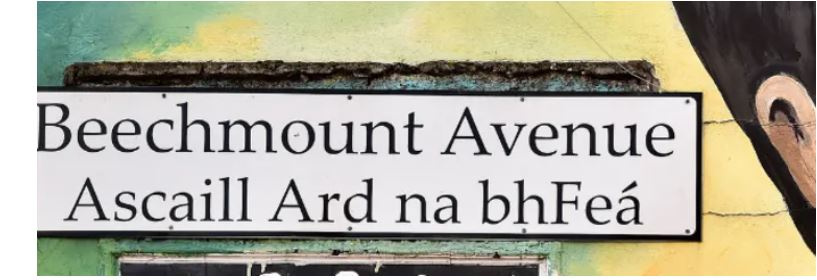
    Besides that, I decided to check your claim and it isn't the same size font, in fact, there is quite a difference if you look at the 'e's:

    st sign.JPG


  • Registered Users, Registered Users 2 Posts: 33,195 ✭✭✭✭blanch152


    Grand, we are in agreement then that Ulster-Scots is a dialect of Scots native to Northern Ireland, you are not disputing that.

    Your confusing statement actually means that you use words of Ulster-Scots in everyday English, like people use a word like "Slainte" in everyday English in Ireland.

    Grand so.


  • Registered Users, Registered Users 2 Posts: 81,350 ✭✭✭✭FrancieBrady


  • Advertisement
  • Registered Users, Registered Users 2 Posts: 4,223 ✭✭✭Fionn1952


    There is not a clear consensus on whether Scots itself fits the bill of a sister language to English or whether it is just a dialect itself, Blanch.

    Curious that Ulster Scots, a dialect descended from a language or dialect from Scotland fits your criteria for native.....but Ulster Gaeilge, descended primarily from Donegal Gaeilge doesn't.


Advertisement
Advertisement