Advertisement
Help Keep Boards Alive. Support us by going ad free today. See here: https://subscriptions.boards.ie/.
https://www.boards.ie/group/1878-subscribers-forum

Private Group for paid up members of Boards.ie. Join the club.
Hi all, please see this major site announcement: https://www.boards.ie/discussion/2058427594/boards-ie-2026

Eir - now offering 2Gb fibre broadband and new WiFi 7 device

1679111225

Comments

  • Registered Users, Registered Users 2, Paid Member Posts: 16,493 ✭✭✭✭The Cush


    Passive fibre optic splitter, aka distribution point (DP).

    Fibre drop point to the premises

    Post edited by The Cush on


  • Site Banned Posts: 1,745 ✭✭✭Raichų


    so I would be correct they are basically the FTTH equivalent of a fttc cabinet?


  • Registered Users, Registered Users 2, Paid Member Posts: 16,493 ✭✭✭✭The Cush


    No, in the FTTC cabinet the incoming fibre optical signal is converted to an electrical signal for distribution via the old copper lines to the various premises. Kinda like what happens in the FTTH ONT mounted inside your house where the incoming optical signal is converted to an electrical signal fed to your router.


  • Site Banned Posts: 1,745 ✭✭✭Raichų


    I suppose what I mean is in terms of getting it to your house it’s just obviously a fibre cable rather than copper


  • Registered Users, Registered Users 2, Paid Member Posts: 16,493 ✭✭✭✭The Cush


    In that case yes.

    In the case of an FTTC cabinet it has up to 92 copper connections iirc or more with the top extension but with a DP on a pole there will be less connections, maybe 4, 8, 12 etc. depending on the number of premises assigned to it at the planning stage


  • Advertisement
  • Registered Users, Registered Users 2 Posts: 788 ✭✭✭PixelCrafter


    FTTC basically just moves the DSL aspect of a telephone exchange closer to the house. You were just running fibre from a node in the exchange building to remote units in those cabinets which kept the lines shorter and allowed higher speed, but it's still a DSL signal over a plain old telephone line, which has severe limitations.

    The FTTH network is basically just rebuilt entirely - has nothing to do with copper phone lines - other than it's pushed down the same ducts and polls, it's an entirely new network.


  • Moderators, Science, Health & Environment Moderators Posts: 18,335 Mod ✭✭✭✭Gonzo


    A very insightful post by BK as to why those of us in the older rural Gpon areas of OpenEir's FTTH network cannot get upgraded to speeds beyond 1000mb. As the OLT's in the exchange are not upgradable beyond replacing completely with the newer tech. I'm sure an investment is needed to replace the gear in the exchange but compared to the original investment of building the entire Gpon Network 2016 to 2020, this upgrade has to be a much smaller investment.

    What worries me the most is looking back on Eircom's/Eirs track record of leaving things be for years and years and a complete lack of investment especially in rural areas. On the other side of things Eir currently are very different to the Eircom of old, who are now basically a french company who have made huge strides in bringing much of Ireland on a fibre optic network. We are probably ahead of the UK by this point.

    I hope they upgrade us in the rural areas within the next 3 years because in about 3 years time multigig speeds will be common place all over Ireland while speeds up to 1gig were cutting edge back in 2016, won't be so cutting edge in 2028. By 2028 OpenEir will probably be already looking at speeds beyond 10gig, perhaps we will have to wait for our upgrade when OpenEir decide it's time to upgrade the entire network to 25gig capable speeds.


  • Registered Users, Registered Users 2 Posts: 10,630 ✭✭✭✭CoBo55


    Personally I think 1gig is as much as any normal household will ever need a long time into the future, it's a bit like TVs, HD is as much as anyone wants, 4K and beyond doesn't really interest the majority of households especially with people using streaming services to watch stuff. ADSL to fttc was a welcome jump that everyone took as soon as it became available quickly followed by ftth 500/1000 anything after that is overkill.


  • Registered Users, Registered Users 2 Posts: 21,872 ✭✭✭✭cnocbui


    They are connection boxes. I'd imagine a cable with multiple fibres is run from the exchange along poles and the box serves as a watertight enclosure where the individual fibres to homes are each connected to one of the fibres in the main cable.

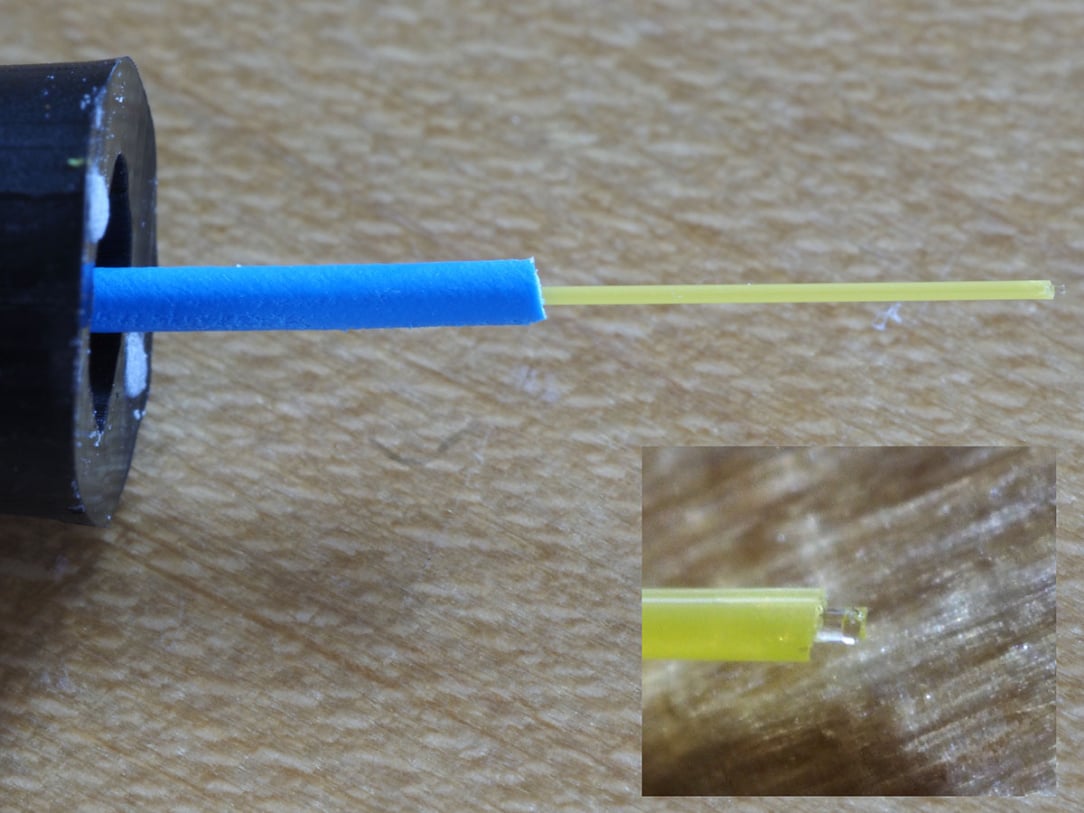
    Fibre cable.jpg

    This is the cable run to my house in 2018 for the rural scheme. The actual fibre is shown in the inset and it's a tiny fraction of the whole cable. I trimmed off a lot of kevlar fibre reinforcement that packs out the gap between the blue and the black. Those two blueish dots on the black polyethylene sheath are likely UHDPE, Dyneema reinforcing strands that are even stronger than kevlar and have very little stretch.

    No metal whatsoever so next to no possibility of conducting lightning.


  • Moderators, Society & Culture Moderators Posts: 3,750 Mod ✭✭✭✭The Real B-man


    Completely agree its a synchronous connection that would make alot of difference to people even 1000/500.

    Very little streaming or gaming services that will actually download at 1gig limited by servers and users hardware.


  • Advertisement
  • Site Banned Posts: 1,745 ✭✭✭Raichų


    I do love when people speak for themselves as though it’s a collective thought…


    maybe you don’t have hardware or use for 2gb+, maybe you don’t watch video in 4/8K and are happy with 1080p but me? Not a fcuking chance.


  • Registered Users, Registered Users 2 Posts: 2,717 ✭✭✭johnbarrett35


    Hi, I'm wondering if any of you might help? I moved to Eir 7 Wi-Fi 2G, but I am only getting about 920mbs I have contacted Eir, and they said I was using the incorrect CAT Cable, I purchased a CAT 8 Ethernet cable, but that has made no difference. I moved it from the 10G port and back but no difference. Has anyone got any suggestions?


  • Registered Users, Registered Users 2 Posts: 10,630 ✭✭✭✭CoBo55


    I said the majority of people have no need for these future speeds that are being mentioned here, 5, 10 gig etc. Try reading my post properly before cursing at me, thanks.


  • Registered Users, Registered Users 2 Posts: 10,630 ✭✭✭✭CoBo55


    The device you're testing on has a 1gig card, proving my earlier point. You need to test on something that has at least a 2gig card or a WiFi 7 device.


  • Registered Users, Registered Users 2 Posts: 2,717 ✭✭✭johnbarrett35


  • Registered Users, Registered Users 2 Posts: 6,150 ✭✭✭JDxtra


    Eir know that nobody is going to really use connections this fast. 1Gb/2Gb/5Gb will have the same network utilisation. It’s really a marketing gimmick.

    Vast majority of people will be streaming video content. 4K streams top out at 30Mbps at the moment. Even if that doubled in the coming years, there’s still an awful lot of headroom on a 1Gb connection even with multiple concurrent streams.

    My home is busier than most (>55 devices on network) and there was zero real world difference in bumping the connection to 2Gb. It just made sense because of the locked in 2 year price and the bump in upload speeds.


  • Registered Users, Registered Users 2 Posts: 51 ✭✭Thanatus


    Thanks for linking the documentation regarding the 5gig package.

    It really does seem like the download bandwidth is becoming less important in the top packages offered by ISP's due to how very few home users will ever saturate the connection through their own use before it hits a throughput limit due to ISP overallocation of the shared fiber occurs.

    Personally it's the upload speed the higher packages provide that has me using it, but if they are moving from 10% asynchronous to 5% asynchronous then the cost difference would have to be minimal for me to conisder it (it's infuriating that ISP's in Ireland won't offer symmetrical broadband to home users in order to keep charging inflated rates to those who want or require greater upload bandwidth).

    Would be very interested in seeing the wholesale pricing from OpenEir when the doc's get public. The UK even if not nearly as complete in terms of fibre infrastructure coverage are still far ahead of Ireland in Quality of life as they had independent ISP's set up their own fibre infrastructure who then provided symmetrical broadband from the start forcing the big ISP's to offer the same.


  • Registered Users, Registered Users 2, Paid Member Posts: 16,493 ✭✭✭✭The Cush


    NGA Bitstream Plus Standalone 5000Mbps 01/06/2025 €39.72

    Same wholesale pricing as the 2 Gbps profile


  • Registered Users, Registered Users 2 Posts: 680 ✭✭✭DrPsychia


    What upload speed does the 2gb package give? I lived in switzerland for a brief period, ISP's offer symmetrical speeds. The house I rented had 1gb/1gb, it was a dream to use.


  • Site Banned Posts: 1,745 ✭✭✭Raichų


  • Advertisement
  • Registered Users, Registered Users 2, Paid Member Posts: 10,717 ✭✭✭✭guil


    Eir are replacing my W7 router because the extender still doesn't work. If that doesn't work they will replace the extender


  • Registered Users, Registered Users 2 Posts: 10,520 ✭✭✭✭Hurrache


    So on the enhanced WiFi 7 mode, I imagine with that turned on you'd have to toggle security back to WPA2 or something?

    When I turned it on but allowed it to change the security protocol a lot of things didn't automatically connect to my WiFi and I thought it might have been due to a misspelling in my SSID when switching routers.


  • Registered Users, Registered Users 2 Posts: 10,461 ✭✭✭✭Dont be at yourself


    Yes, enabling enhanced mode means that devices won't automatically reconnect, even if SSID is the same. Different security protocols so you need to re-add them to the network.


  • Registered Users, Registered Users 2 Posts: 8,697 ✭✭✭batistuta9


    can you use IPoE with eir?


  • Registered Users, Registered Users 2 Posts: 1,753 ✭✭✭KildareP


    Yes but no static IP and no IPv6 on third-party devices.


  • Registered Users, Registered Users 2 Posts: 1,446 ✭✭✭NotShero


  • Registered Users, Registered Users 2 Posts: 1,753 ✭✭✭KildareP


    With IPoE (WAN left in DHCP mode)? It works with PPPoE alright.


  • Registered Users, Registered Users 2 Posts: 1,446 ✭✭✭NotShero


    Yep WAN in DHCP, no PPPoE. It was very straightforward


  • Registered Users, Registered Users 2, Paid Member Posts: 3,527 ✭✭✭Glaceon


    Anything running on the 6 GHz band requires WPA3. As a result, any Wi-Fi network which makes use of it must at least use WPA2/3 transition mode on its 2.4 and 5 GHz radios. This still isn’t compatible with some devices, some HP printers are problematic for example. If you need pure WPA2, you’ll need to disable the 6 GHz band.


  • Advertisement
  • Registered Users, Registered Users 2 Posts: 10,520 ✭✭✭✭Hurrache


    But if I leave 2.4 and 5 at WPA2 I shouldn't have issues with running in enhanced mode should I?

    I can run all 3 bands simultaneously at the moment without whatever the enhanced mode does, but for those capable of 6 they get better speeds with that mode on.

    I think when I originally switched it on it may have changed all bands but I haven't had the house to myself to retry it again.

    Edit: So I tried the enhanced mode while everyone was gone and it's pretty unstable I think, this time no SSIDs were broadcast apart from a 2.4 guest one so knocked if off again. It sets WPA3 for all bands and manually setting 2.5 and 5 back to WPA2 still doesn't seem to function correctly.

    What I did find helpful though was to disable band steering, it seemed to be pushing my 6Ghz capable devices back down to 5, so I turned it off and allowed the devices themselves to manage it and started to get the higher speeds then.

    Post edited by Hurrache on


Advertisement
Advertisement